The Hollywood Sign

The Famous Hollywood Sign on Mount Lee

Originally, the sign was spelled “Hollywoodland,” named after a housing development that was being advertised around 1923. The developers lauded it as a “superb environment without excessive cost on the Hollywood side of the hills.” In 1932, a wannabe actress named Peg Entwistle committed suicide by jumping off the top of the “H.” This was commemorated in a 1972 song by Dory Previn which she called “Mary C. Brown and the Hollywood Sign.” Here is a video of it:

Eventually the sign started looking ratty and falling apart. By the 1940s, it was an eyesore. It was around then that the “land” in “Hollywoodland” was removed and the city took responsibility for it.

There was a major campaign in 1978 to bring the sign up to date, as it had become part of the myth of Hollywood. The campaign was led by none other than Hugh Hefner of Playboy fame. Other donors included Gene Autry, Alice Cooper, Andy Williams, and Warner Brothers Records.

It’s interesting that the sign, which has come to be a major tourist draw, was originally an advertisement. Curiously, you can’t walk up to the sign: There is no convenient trail up Mount Lee, and local residents have done their best to make it difficult to see the sign from up close.

Green at the Heart

Atop Mount Hollywood with Clear Views in Three Directions

Cleveland, Ohio, used to be called “The Forest City” because of its semicircular diadem of parks. It was one of the few good things about the city of my birth. It is interesting that from Cleveland, I moved to Los Angeles, which not only has parks but giant mountain ranges within the county limits. In fact, at least one peak—Mount Baldy, a.k.a. Mount San Antonio—is almost two miles above sea level.

There is one rather large park right near the heart of Los Angeles: Griffith Park, with over 4,000 acres. Mount Hollywood  overlooks downtown L.A., the San Fernando Valley, and southward to Palos Verdes and Long Beach. With over 10 million visitors a year, it’s not exactly uncrowded. Within its boundaries lie the Los Angeles Zoo, the Autry Museum of the American West, and the Travel Town Museum, to name just a few. There is also an equestrian center, a golf course, a famous observatory, a merry-go-round, and numerous picnic areas.

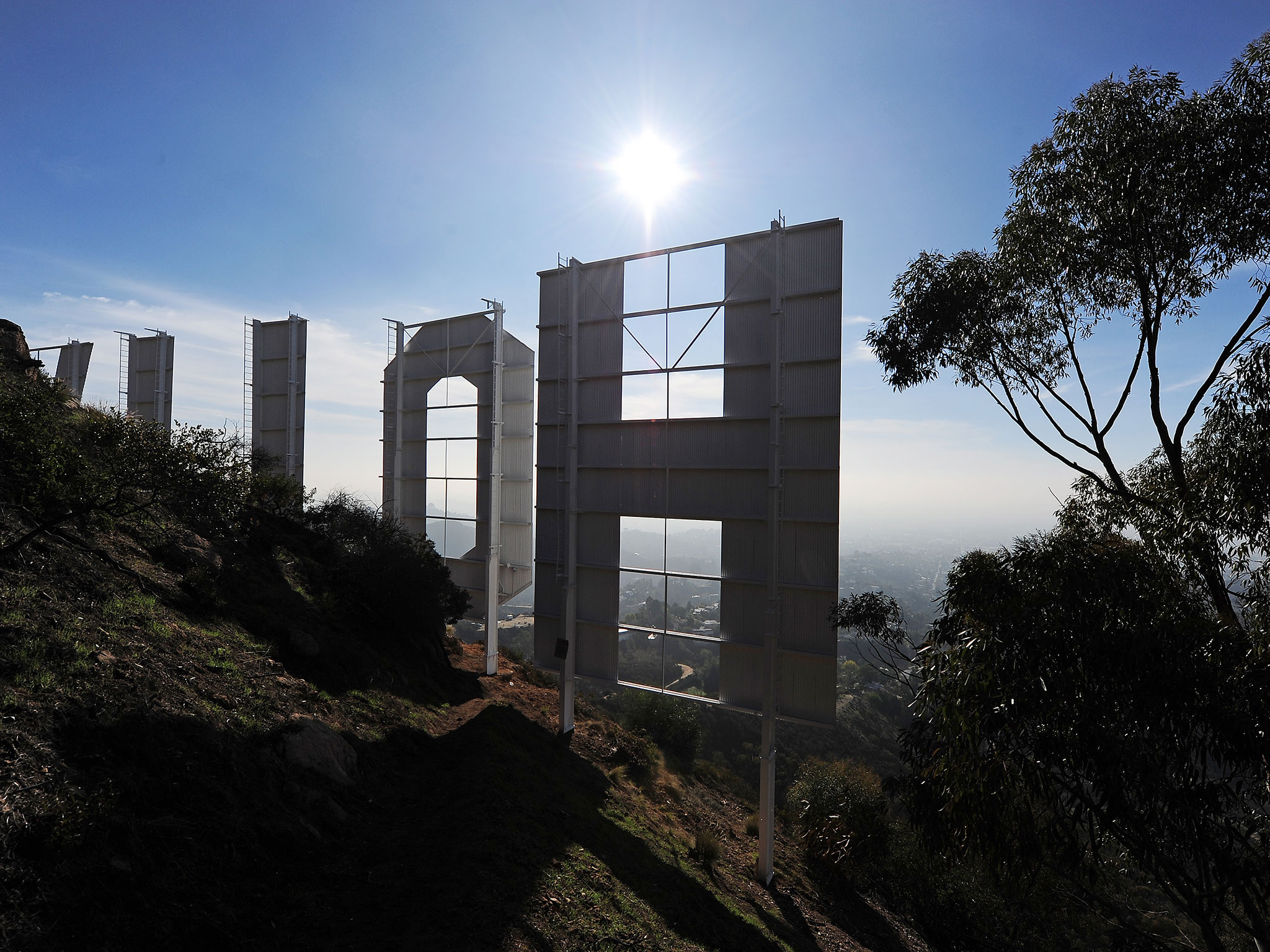
The Hollywood Sign from the Back

Over its history, many famous films were shot in the park, beginning with D. W. Griffiths’ The Birth of a Nation in 1915. My favorite, however, was Nicholas Ray’s Rebel Without a Cause (1955) with James Dean, Natalie Wood, and Sal Mineo. The scene at the observatory is one of the most classic in the whole history of the American cinema. The nearby Bronson Caves were used in Don Siegel’s The Invasion of the Body Snatchers (1956). It was there than Dana Wynter drifted off to sleep and was irrevocably lost to the human race.

Then, too, there is the famous Hollywood sign. It was originally erected as a real estate promotion for a development called Hollywoodland. The “-land” was eventually dropped. See if you can find Dory Previn’s album Mary C. Brown and the Hollywood Sign.

Peg Entwistle and the Hollywood Sign

Scene of Many Hollywood Legends

Scene of Many Hollywood Legends

It stands near the top of Mount Lee in the Hollywood Hills. Originally, the sign read “Hollywoodland”—erected using telephone poles and tin to advertise the housing development below. Eventually, the sign was shortened to “Hollywood” and came to signify something altogether different.

I first heard about the story from Dory Previn, who wrote a song called “Mary C. Brown and the Hollywood Sign” way back in the 1970s. You can hear her singing it in this YouTube video.  It is about a movie starlet who grew disenchanted with the dream factory ending her life by jumping off the letter “H” of the Hollywood sign and dying on the slope below of multiple fractures of the pelvis. She died on September 18, 1932.

It really happened, but not to Mary C. Brown. I guess Millicent Lilian “Peg” Entwistle doesn’t scan as well in a song lyric. Peg was a cute blonde Welsh actress with blue eyes. While acting on the stage in New York, she married Robert Keith in 1927. For a short time, she was the stepmother of the man who grew up to be actor Brian Keith.

By coincidence, Brian Keith also committed suicide.

Starlet Peg Entwistle

Starlet Peg Entwistle

During her time in Hollywood, Peg acted in only one film that was ever released: Thirteen Women (1932). I would like to be able to say that it was a success, but it wasn’t, even though it starred Myrna Loy and Irene Dunne.