Third Time’s a Charm

Martine at Kapiolani Park in September 2022

As I mentioned in my post yesterday, Martine and I are headed back to Honolulu for another visit. Looking back at last year’s pictures, I noticed that Martine looked genuinely happy in most of them. Returning to L.A., Martine has had a difficult year—especially when she broke her wrist in two places after a fall at home. And recovery has been painfully slow, especially since the cast which she war was too tight and affected her ability to bend her fingers once it was removed.

Although I would probably be happier traipsing off to Latin America, Martine’s happiness matters to me; and I can certainly enjoy myself in Hawaii provided I stay away from most mainland tourists of the luau-frequenting variety.

We will be staying at the same hotel we stayed in last year, the Malia. Last year, it was a hotel in the Outrigger chain; now, it is the Waikiki Malia, apparently no longer part of a chain. It is not exactly on the beach, but that is no matter to us as we are not beach types. We prefer the corner of Kuhio and Lewers because of its convenient access to public transportation.

The big success story of last year’s trip was our discovery of the Honolulu bus system, the best we have seen in any American city. As senior citizens, we picked up a Senior Citizens discount Holo card, which enables us to unlimited rides for the entire month of September for $20.00 US for each of us. Compare that with high car rental fees and hotel parking rates of up to $50-60 US per night.

Amazingly, the Honolulu buses go not only all around the city, but along the Southeast (Hanauma Bay, Hawaii Kai), the Windward Coast (Kailuka, Kaneohe, La’e), the North Shore (Waimea, the Banzai Pipeline), and Central O’ahu (the Dole Pinapple Plantation). Where we would need a car would be the Leeward Coast (Ko Olina) and certain trailheads on mountain trails. If you’re thinking of going to Hawaii on a budget, I firmly recommend the public transportation and a non-luxury-priced hotel, preferably on Kuhio Avenue.

We booked our trip through the Southern California Auto Club, which I also recommend.
Back to O’ahu

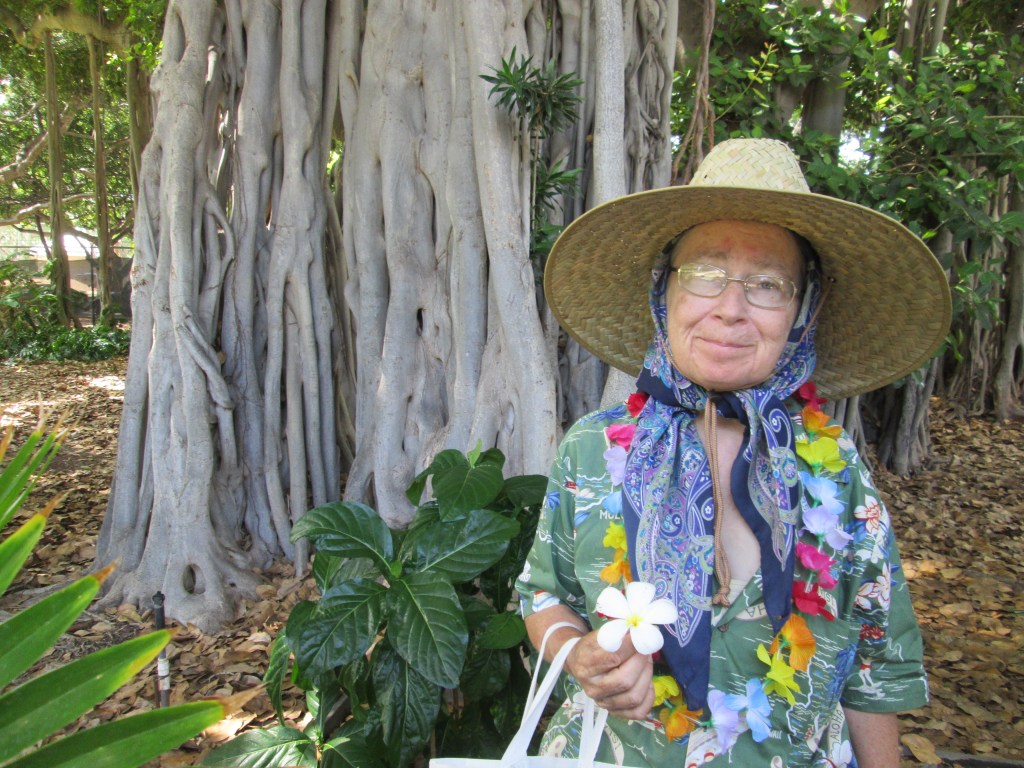
Martine by a Banyan Tree in Kapi’olani Regional Park

This fall, Martine and I are returning to Honolulu. If I had my druthers, I would prefer tracking down obscure Maya ruins in Yucatán, but if I did, I would have to do it alone. And I am getting to an age where that is becoming a bit on the dangerous side for me. Also, as I enjoy traveling with Martine to places that she likes, it adds an extra level of enjoyment for me.

Last year, we concentrated our efforts visiting the Iolani Palace, the Bishop Museum, the Zoo, the Aquarium, and the Foster Botanical Garden. This time, we could visit Queen Emma’s Summer Palace, the Lyons Botanical Garden, the military museum at Fort DeRussy (Martine worked for years as a civilian Army employee), and any number of other places—possibly including another visit to the ethnological riches of the Bishop Museum.

Tomorrow morning, Martine and I will drive down to the Auto Club in Culver City and pick a flight and hotel. I wouldn’t mind staying at the Malia again, even though it is no longer owned by Outrigger Hotels. The area of Waikiki around Kuhio Avenue and Lewers Street may be a few blocks from the beach; but as we are not beach people, we don’t mind. It is right by the bus stop at that intersection which will take us anywhere we want to go.

We still have our HOLO senior ride discount cards for the Honolulu bus system. We just have to add a few dollars of stored value to our cards. That way we can avoid the expense of renting a car and paying big bucks to garage it at our hotel.

Fish Story

Giant Grouper

With this lovely picture, I come to the end of my Hawaii posts. The same day that Martine and I had our disappointing visit to the zoo (The Problem with Zoos), we walked over to the Waikiki Aquarium, which is competently run by the University of Hawaii. The overall experience was better in every way.

It was another hot and humid day, so we sat down in front of a large tank in which the Giant Grouper swam up to the glass and looked at us balefully. There was a docent sitting near us answering questions. Now, I remember eating (and liking) grouper in Florida, but I had no idea they were so big. Apparently the ones in Florida are not quite the size of our friend here, but they are still pretty ginormous.

I like the Aquarium of the Pacific in Long Beach, but the place is always full of toddlers in strollers being pushed by zombie parents who aim at our ankles rather than our brains. It’s obviously a lot better endowed than the Waikiki Aquarium, but size doesn’t always count. Similarly, I much prefer the Santa Barbara Zoo to the enormous Los Angeles Zoo (again, those damned strollers).

The Problem with Zoos

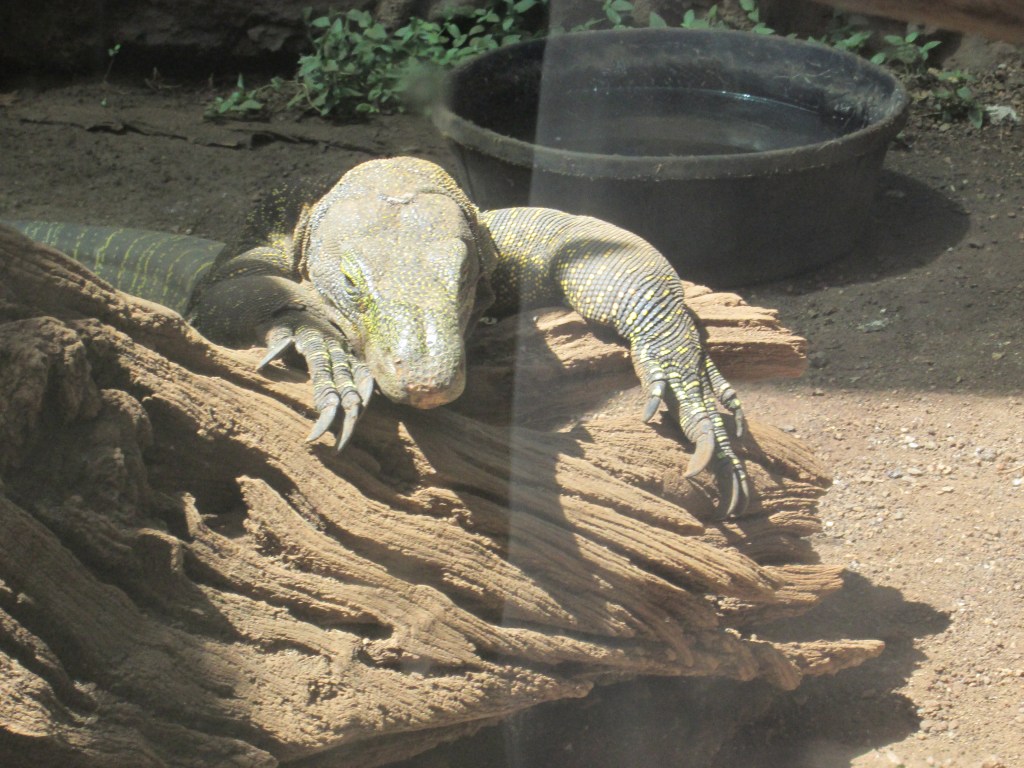
A Komodo Dragon (Varanus komodoensis)

Martine and I have this problem with zoos, namely: empty cages. It seems that one never knows whether a particular bird or animal is in residence or just hiding behind a rock or tree. The only zoos where this is not so much an issue are the San Diego and Santa Barbara Zoos and The Living Desert in the Coachella Valley.

The Honolulu Zoo is noted for its “exhibit absenteeism”: It seems that some 40% of the cages were unoccupied and without any notices that the animal is sick. I realize that in approximately half the cases, the cage occupant is lying doggo. If I were in a cage, I probably wouldn’t want to be stared at by a bunch of tourists or school children.

On the plus side, I did like the Komodo Dragon—my first. I also liked all the banyan trees, which kind of take my breath away. Below is Martine twirling a plumeria blossom in front of one of the zoo’s stately banyans:

It probably didn’t help that the temperature and humidity were in the 90s (Fahrenheit, that is).

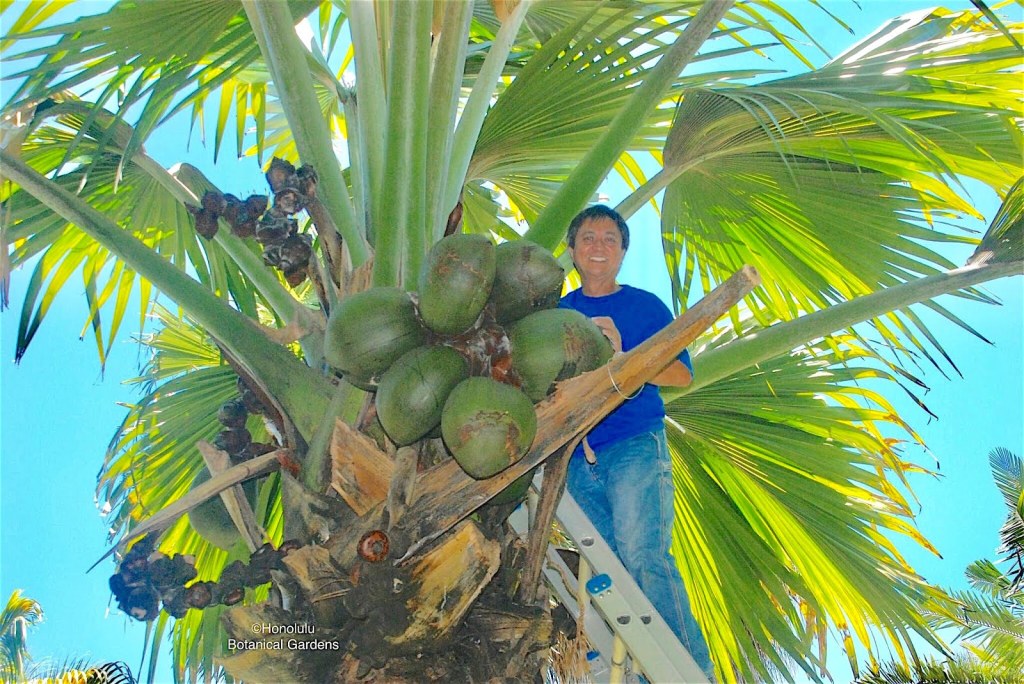
50-Pound Coconuts

Look Out Below!

On our last full day in Hawaii, Martine and I visited the Foster Botanical Garden, just north of Chinatown in Honolulu. It was hot and humid day, but fortunately there were a lot of shady benches. One of the highlights of the garden was the double coconut tree (genus Lodoicea), a native of the Seychelles. Its coconuts can be as heavy as 99 pounds each (45 kilograms).

Needless to say, Martine and I did not risk going under the tree and violently shaking its branches.

Curiously, while the coconuts are edible, they are of no commercial interest.

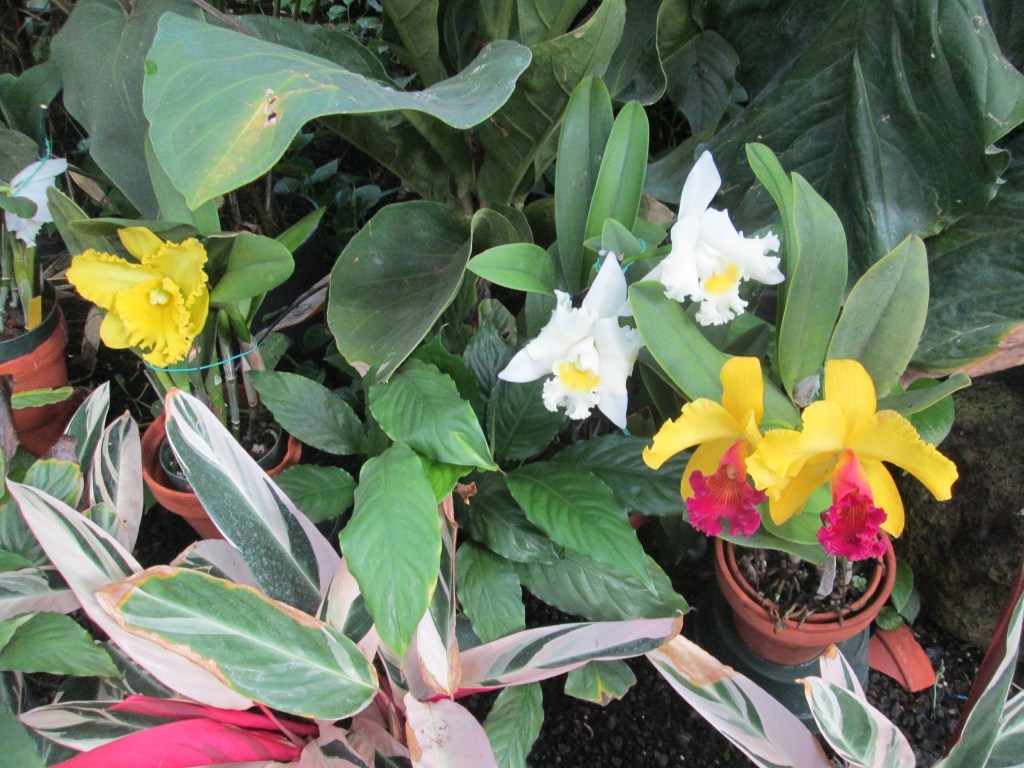
My favorite part of the gardens was the greenhouse with its collection of orchids. It was so warm and humid that the greenhouse door was left open.

Orchids at Foster Botanical Garden

Martine and I liked the garden so much that we resolved to visit several of the other botanical gardens in the Honolulu area or on whatever islands we visit.

The Bishop Museum

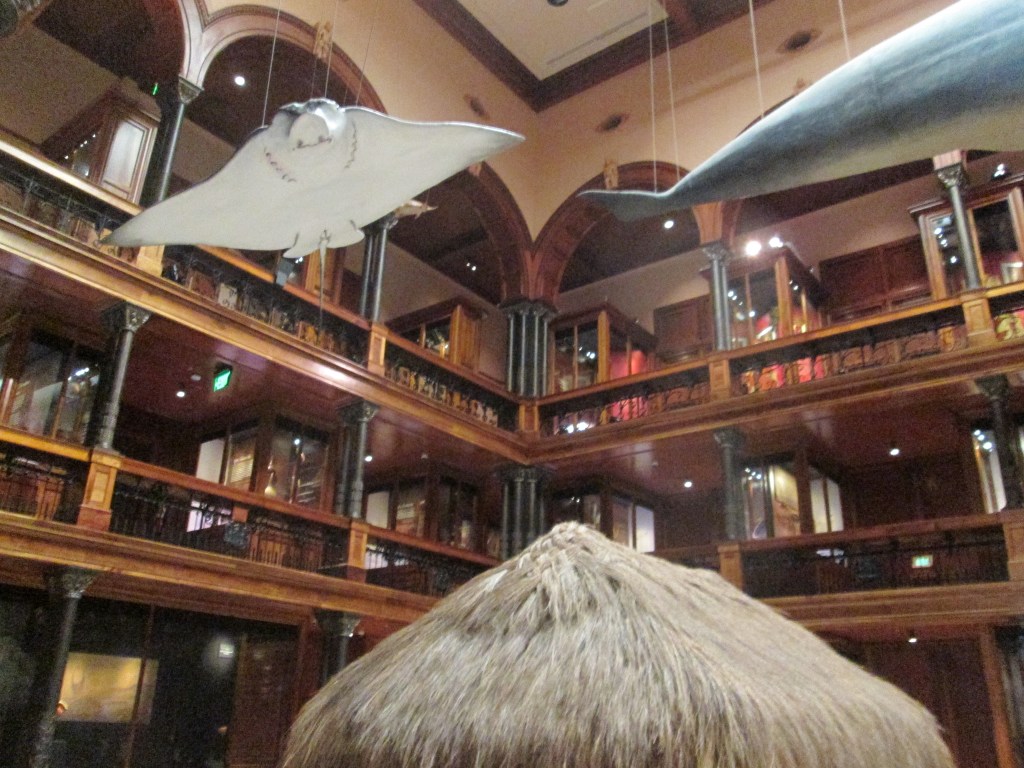
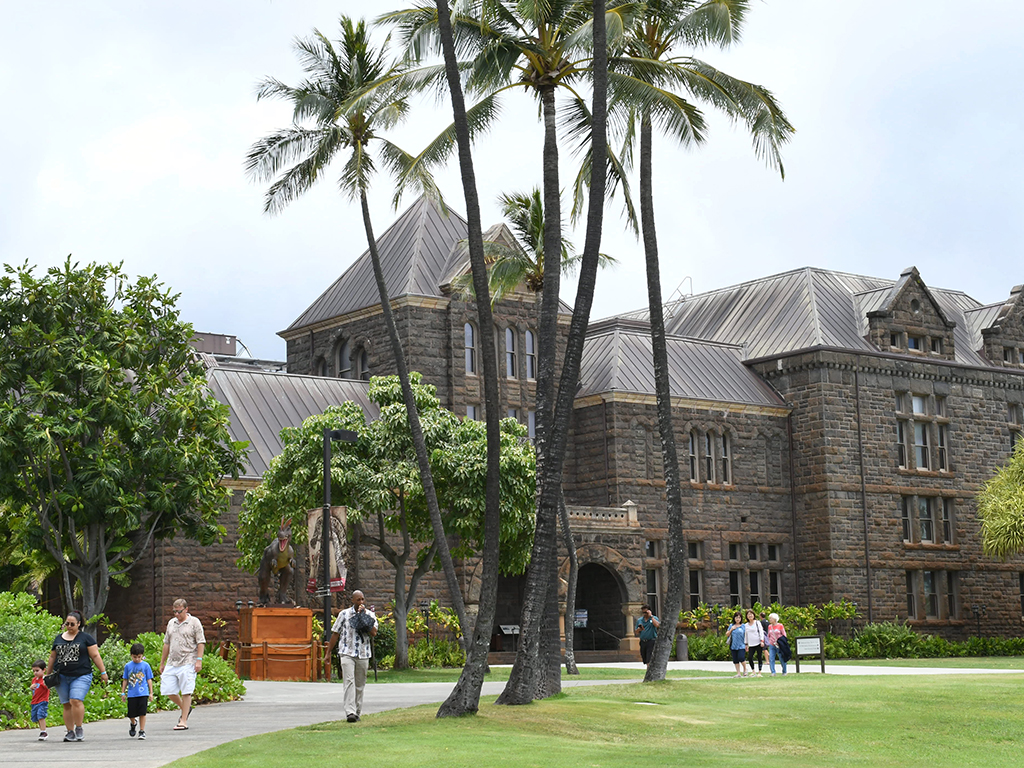
The Bernice Pauahi Bishop Museum in Kalihi

I do not believe that most people traveling to Hawaii care very much for its history and culture. All they really care about is fun on the beach and copious amounts of booze (and coffee: I have seen lines of almost 100 tourists at Waikiki’s International Marketplace waiting for their morning brew from Kona).

Consequently, mention the Bishop Museum to most tourists, and all you’ll get in response is a look of noncomprehension. While we were there, we saw no tourist buses and no tour groups. In fact, there wasn’t even a free handout brochure with a map of the extensive facilities. In fact, I suspect that the Museum is experiencing hard times.

That is a pity because the Bishop Museum is the place to be if you want to understand Hawaii, the land and its people. To that, I would add all of Polynesia. Particularly imposing is the three story Hawaii Hall (illustrated above) with its outstanding exhibits.

One of the reasons for most tourists not knowing about the Bishop Museum is its 19th century Victorian campus, which make it look (shudder) outdated. And yet, its exhibits are anything but!

I think that if tourists should ever encounter a rainy day on the island, they make a beeline for the Bishop. They will very rapidly get a better idea of where they have landed on that long flight from the mainland. Even on a hot and humid day, such as on the Wednesday we were there, it is a worthy destination.

Martine and the Giant Bunny

Martine and Friend at the Hawaii State Art Museum

There it was, occupying its own gallery and lying on its side. A giant inflated pink and white bunny. We were at the Hawaii State Art Museum, right across the street from the Iolani Palace. Actually, we had come to eat at the museum’s much heralded cafe, Artizen by MW. Unaccountably, it was closed that day.

The museum itself is interesting. The budget for the State of Hawaii sets aside a percentage to be used for promoting the arts. One result is the Hawaii State Art Museum, which doesn’t charge admission. Included in its galleries were works of art protesting state projects such as the construction of the H3 limited access highway from west Honolulu to the windward side of O’ahu. I can just imagine the stink that public sponsorship of protest art would cause in California.

In any case, the giant bunny was friendly, and Martine looked happy to have her picture taken with him.

Taking the Bus

Route #2 Took Us to Most of Our Destinations

As I planned for our trip to Hawaii, I had a bad feeling about the cost of renting and parking a car during our trip. I know that Americans as a rule tend to avoid public transportation like the plague, but Martine and I do not subscribe to that feeling. I figured that it would cost us well over $100 a day to rent a car, especially with liability and collision insurance. Added to that, most hotels charged between $25 and $50 a day to park the car overnight. Then add more bucks for gas and daytime parking. In no time at all, the cost would exceed $1,000.

Martine and I adopted a solution that cost a grand total of $30 for our transportation on O’ahu for the entire vacation!

How was that possible? First of all, both of us are seniors. Secondly, to use a Hawaiian pidgin term, we decided to be akamai (smart) about saving money. On our first day in Honolulu, we took the #2 bus from Waikiki to the Kalihi Transit Center at the end of the line and got two senior HOLO cards. They were ready in a few minutes, and I forked over the $30 in cash. And that was that!

We would simply tap our HOLO card on a special reader as we boarded the the bus and take our seats. The buses were comfortable and air-conditioned. At the Transit center, we had picked up all the schedules we needed, and the rest was pure gravy.

Are you on the mainland now and doing research for a trip? Go to TheBus.Org for schedules and route maps as well as more information on the different kinds of HOLO cards.

Forbidden

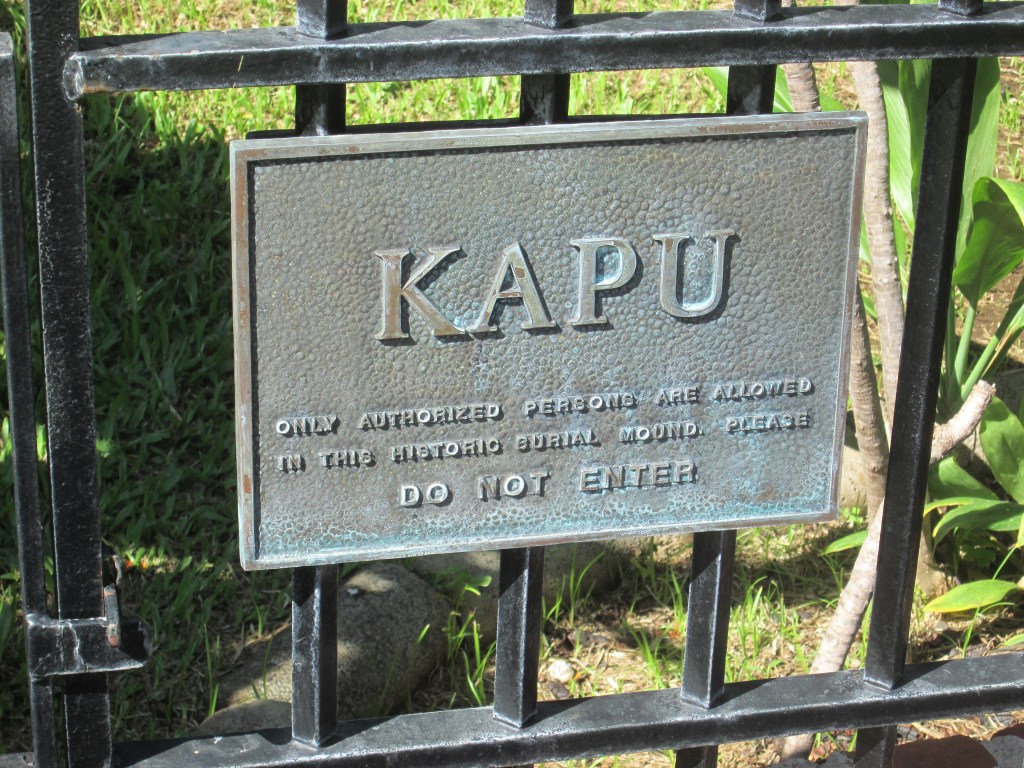
Sign on the Grounds of Iolani Palace

In the southeast corner of the grounds at Iolani Palace is a low mound that bears the Hawaiian language warning “Kapu.” Because the Hawaiian language doesn’t have the sounds of the consonants “t” and “b,” it would not make any sense if the sign red “Tabu.” Yet that is what it means.

Similarly, foods made from the pounded taro root are everywhere. Yet in Hawaiian, the word is written “kalo.” (There is no “r” in the language.)

The forbidden mound contains the remains of many old Hawaiian chieftains, or ali’i. Before the Iolani Palace was built in the late 19th century, there was an earlier, less European-looking palace that housed the great of O’ahu and the outlying islands. The earlier kings of the Kamehameha dynasty were buried there before a mausoleum was built to house their remains a mile or so to the west.

After the bones of the kings were removed, the Hawaiians had trouble identifying the other remains; so they fenced in the mound and made access to it Tabu.

The Vacant Throne

The Throne Room at Iolani Palace, with King Kalakaua’s Ceremonial Uniform

On our first full day in Honolulu, Martine and I visited the Iolani Palace, which was the seat of the Hawaiian monarchy that was dethroned in 1893 by a cabal of crooked American businessmen, diplomats, and naval officers. Even after they succeeded, it was only the sinking of the Maine in Havana harbor in 1898 that led to Hawaii becoming a U.S. territory.

The story of the annexation of Hawaii is told in Stephen Dando-Collins’s Taking Hawaii: How Thirteen Honolulu Businessmen Overthrew the Queen of Hawaii in 1893, With a Bluff. The “founding fathers” of the annexation make Donald Trump look like a Boy Scout, what with their lies, braggadocio, and even cowardice. When the moment came to move, several of the members of the so-called Committee of Public Safety conveniently came down sick.

The Hawaiians of today revere their monarchy, especially Queen Lili’uokalani, who was an able ruler who failed only because she could not appease a cabal of American and European businessmen who did not even feel that Hawaiian natives should have the right to vote.

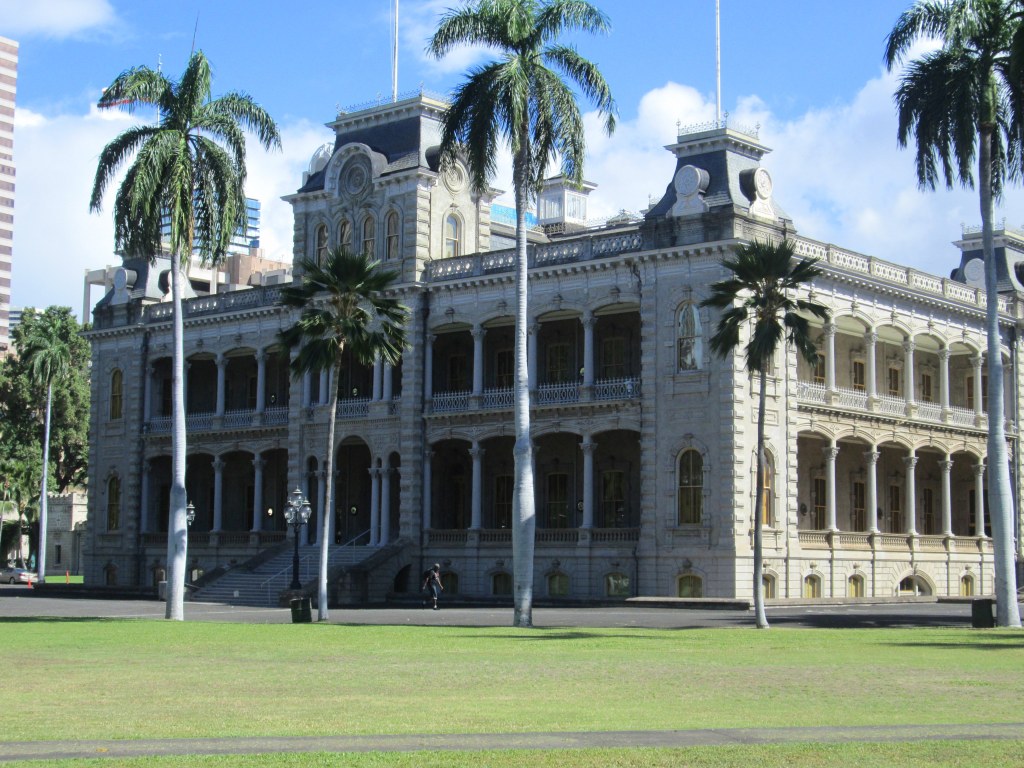
The Iolani Palace

The Palace was built by the penultimate ruler of the monarchy, King Kalakaua, in 1882. It is tastefully designed, with verandas on all sides permitting the cool ocean breezes to circulate through the building. Nowadays, all the windows are closed so that the paintings on the wall don’t fade prematurely.