“Sometimes They Sing”

The following short short story is from a collection of Antonio Tabucchi’s short stories entitled Message from the Shadows. The author, an Italian who lives in Portugal, is known for his diverse points of view, In this story, we see humanity from the perspective of a whale.

Postscript: A Whale’s View of Man

Always so feverish, and with those long limbs waving about. Not rounded at all, so they don’t have the majesty of complete, rounded shapes sufficient unto themselves, but little moving heads where all their strange life seems to be concentrated. They arrive sliding across the sea, but not swimming, as if they were birds almost, and they bring death with frailty and graceful ferocity. They’re silent for long periods, but then shout at each other with unexpected fury, a tangle of sounds that hardly vary and don’t have the perfection of our basic cries: the call, the love cry, the death lament. And how pitiful their lovemaking must be: and bristly, brusque almost, immediate, without a soft covering of fat, made easy by their threadlike shape, which excludes the heroic difficulties of union and the magnificent and tender efforts to achieve it.

They don’t like water, they’re afraid of it, and it’s hard to understand why they bother with it. Like us, they travel in herds, but they don’t bring their females, one imagines they must be elsewhere, but always invisible.

Sometimes they sing, but only for themselves, and their song isn’t a call to others, but a sort of longing lament. They soon get tired and when evening falls they lie down on the little islands that take them about and perhaps fall asleep or watch the moon. They slide silently by and you realize they are sad.
Bad Brujo

Speaking of Cajamarca …

Although he did as much as possible to hide all information about his origins, Carlos Castaneda, whose books about the sorcery of a Yaqui Indian named Don Juan Matus were best sellers in the 1960s and 1970s, was actually born in Cajamarca, Peru. If I ever went there, I sincerely doubt there will be monuments or museums dedicated to him. Nonetheless, Northern Peru, about which I have been writing posts for the last week, is known for its brujos, or sorcerers.

I am currently re-reading in order of publication the books written by Castaneda. Even though it is generally known that there probably never was a Don Juan Matus, Carlos was in fact a spiritual leader whose work clicked with the American public of that time. And his work is in fact very interesting to me.

Do I care whether Castaneda was telling the literal truth? Not at all. But he was intent on describing a way of power that, in the end, caught him up in its web. I am also reading Amy Wallace’s Sorcerer’s Apprentice: My Life with Carlos Castaneda.

To be sure, Carlos would not have liked this tell-all biography, in which he is surrounded by a cadre of adoring females whom he dominates. But then, in it Carlos tells the tale of his encounter with Alan Watts, another more or less legitimate spiritual leader, who attempted to seduce him—even as Carlos seduced Amy Wallace and probably others.

One can point the way toward the path to be followed, even as one, being human, cannot follow it perfectly. In one of his works, he writes, “If [the warrior’s] spirit is distorted he should simply fix it-purge it, make it perfect-because there is no other task in our entire lives which is more worthwhile…To seek the perfection of the warrior’s spirit is the only task worthy of our temporariness, our manhood.”

Yes, but there is this problem about being human.

The Alliance

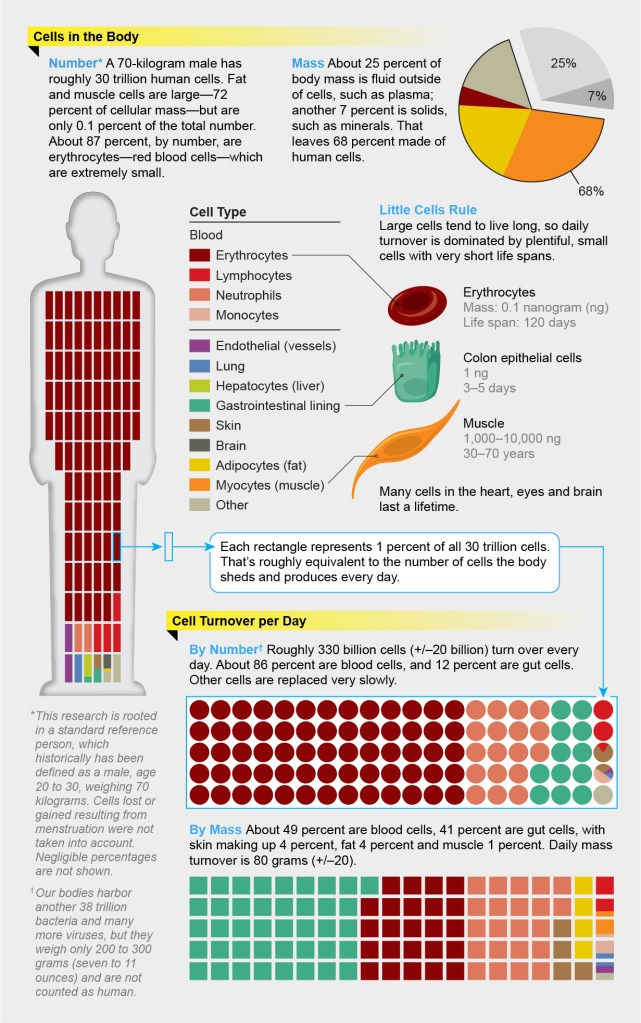
What makes you YOU? Is it a single thing? or an alliance of upwards of 30 trillion things working together? According to an article in the April 2021 issue of Scientific American:

The human body replaces its own cells regularly. Scientists at the Weizmann Institute of Science in Rehovot, Israel, have finally pinned down the speed and extent of this “turnover.” About a third of our body mass is fluid outside of our cells, such as plasma, plus solids, such as the calcium scaffolding of bones. The remaining two thirds is made up of roughly 30 trillion human cells. About 72 percent of those, by mass, are fat and muscle, which last an average of 12 to 50 years, respectively. But we have far more, tiny cells in our blood, which live only three to 120 days, and lining our gut, which typically live less than a week. Those two groups therefore make up the giant majority of the turnover. About 330 billion cells are replaced daily, equivalent to about 1 percent of all our cells. In 80 to 100 days, 30 trillion will have replenished—the equivalent of a new you.

In a strange way, every human being, every animal, every plant is an alliance of micro particles. In my lifetime, I have given birth to and sloughed off untold trillions of tiny pieces of me. Yet I still see myself as a unified being with certain likes and dislikes, certain patterns of thought.

When it comes time for me to die, it’s like Better.Com firing 900 employees on a Zoom call. Except some 30 trillion parts of me would be abruptly cashiered—without benefit of unemployment compensation. I would like to think that my mental processes would continue somehow, but that’s getting into highly disputed territory.

So far my alliance has held together pretty well. The whole coronavirus situation has been like an invasive plant or insect species. Undoubtedly, I have ingested perhaps thousands, perhaps even millions of Covid-19 viruses, but never enough to disturb the majority population of the alliance, which, by the way, itself includes billions of non-threatening viruses of various sorts.

When you look at yourself as an agglomeration of tiny living things, it makes you feel humble. And it makes you laugh at a lot of the things that make people worry.

I feel good about myself because, as of now anyway, my 30 trillion parts are a kind of parliamentary democracy in which all the components still work together, peacefully for the most part.

The Missing Link, Going Forward

Man May Prevail, But With What “Modifications”?

Man May Prevail, But With What “Modifications”?

I am always amused about talk of a “missing link” between what was recognizably ape and what is recognizably human. But once we have Homo sapiens down, what about changes to our species that may be as significant—if not more significant—to those which we have traditionally associated with the concept of a missing link?

Today, I had lunch at a local Thai restaurant. In the next booth sat a woman who was part of a larger party that had not yet all met up. No sooner did she get seated than she had a long painful conversation with another member of the party which was supposedly looking for the restaurant but had trouble finding it. At no point did she get the name of the restaurant correct (she kept calling it simply “Thai Café”) and never thought to supply the exact street address. All her instructions were with regard to the identities of nearby retail establishments. If her friend was several blocks away, he would have no more luck finding the “Thai Café” than the stores in its immediate vicinity.

The thought suddenly hit me that the smart phone has introduced new ways of thinking. No longer is any sort of advance preparation required for anything. One can simply make a phone call and use relational markers to home a friend in to the desired location employing fuzzy logic of a sort.

Man has developed increasingly sophisticated tools for tens of thousands of years, but for the first time we are approaching the point where we are using tools to change ourselves and our very thought processes. It is possible, for example, that the smart phone may be as significant for the human race as Gutenberg’s invention of moveable type. If we ever improve robots to the point that we can communicate with them, that may be even more significant. In both cases, man is delegating his own brain powers to a device that parses, stores, and possibly communicates commands.

What do you suppose the effect of that will be on the human brain? Perhaps it will begin to atrophy. Once one has a truly smart phone, one does not have to think for oneself any more.

I’m not sure I would like that development, or should I say retrogression?