When Hungarians Picnic

My Father and My Uncle at a Picnic

My Father and My Uncle at a Picnic

Set your Wayback Machine to about seventy-five years ago. At one of Cleveland’s many parks, you would see those two irrepressible Slovak twins—Elek (Alex) and Emil Paris—and their girls having a Hungarian-style picnic. The entrée of choice is likely to be szalonnás kenjer, or sliced rye bread with chopped onions, paprika, and smoked bacon drippings. On the left is Elek, my father, with either a girlfriend or his first wife, who was said to be overweight. Next to her are my Aunt Annabelle (née Herbaj) and Uncle Emil. It was a scene to be repeated well into my teen years, except the girlfriend/first wife was replaced by my mother.

Speaking of Hungarian picnics, allow me to quote Carl Sandburg to you. His short poem is called “Happiness”:

I asked the professors who teach the meaning of life
      to tell me what is happiness.
And I went to famous executives who boss the work of
      thousands of men.
They all shook their heads and gave me a smile as though
      I was trying to fool with them
And then one Sunday afternoon I wandered out along
      the Desplaines river
And I saw a crowd of Hungarians under the trees with
      their women and children and a keg of beer and an
      accordion.

I’m not altogether sure about the accordion. The Paris brothers were too busy eating to sing. On the other hand, when I went to Slovakia with my parents in 1977 (it was then part of Czechoslovakia), we sang all the old songs with my pretty cousins Gabriela, Margit, and Marinka (the last two being themselves twins).

A brief note about nationality: Like the Kurds, the Slovaks were a cohesive people for hundreds of years before ever having a country of their own, until Vaclav Havel, last President of Czechoslovakia, granted them their independence in 1993. When my father and uncle were born in 1911, Slovakia was a part of the Austro-Hungarian Empire that was administered by the Hungarians. In the end, my father spoke better Hungarian than Slovak; though I found out as early as 1977, Hungarian was spoken only by the old people.


Beigli

Hungarian Ground Walnut and Poppy Seed Rolls (Beigli)

Hungarian Ground Walnut and Poppy Seed Rolls (Beigli)

Today was a combined Spring Festival and Mother’s Day Celebration at the San Fernando Grace Hungarian Reformed Church in Reseda.Martine and I always show up the first Sunday in May to help relieve the parishioners of their excellent home cooked food. Available was gulyás leves (better known as Hungarian Goulash, actually a beef and vegetable soup), Hungarian kolbasz sausage with red cabbage, barbecued pork (laci pecsenye), and langos (a fried bread concoction that Hungarians go gaga over). But the starring attraction were the many varieties of pastries, especially a type of custardy cheesecake not quite as sweet as the deli variety, and, of course, beigli.

When I was a kid in Cleveland, it was the beigli with ground walnut that I most particularly remembered. My Mom made it at least once a week, together with the ground poppy seed variety which I did not like nearly as much Although Martine made major inroads on the pastry table, including several varieties to take home, for the first time I passed up sampling any. I know what it tastes like. I love it. But I have Type 2 Diabetes and am fighting a difficult battle.

Still, we had a good time, watching a recitation, singing, and dancing presentation on the subject of Mother’s Day. Then, the local dancing master, Tibor, showed couples how to dance the csardás, the most famous of the Magyar folk dances.

Finally, there was a literary event in which the author of a book on the 1956 Hungarian Revolution had two reciters read passages about how he fled Budapest to Yugoslavia and finally settled in the United States. I didn’t understand very much, as my Hungarian is quite rudimentary, and both the book and the recitation were mostly above my head. Still, it’s good for me to reacquaint myself with my native tongue, however much I stumble my way through it.

A Hungarian Christmas

A Hungarian Christmas Tree

A Hungarian Christmas Tree

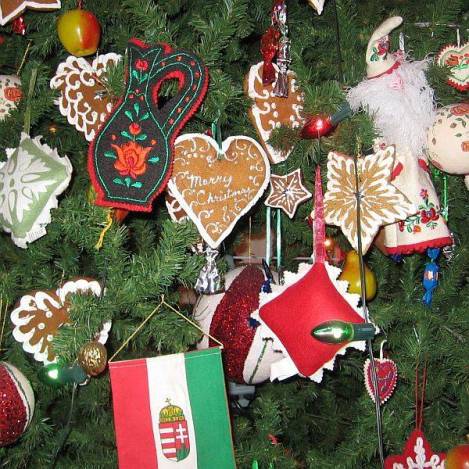
There are fewer things that can elicit such an outpouring of sentiment in me as the sound of the Hungarian language. My own knowledge of my native language is unidiomatic and ungrammatical, with a child’s vocabulary, but nonetheless, there is that rhythm and intonation that makes me think I am home. When I hear the Magyar National Anthem, or Hymnusz, I stand at attention in a way that I do not when I hear that sad old English barroom song that is the National Anthem of the United States. (And I mean no disrespect to my adopted country when I say this.) See what the Magyar Nemzeti Himnusz sounds like when done right:

It’s the same way with Christmas carols. I like many of the English carols—except for that pahruppahpummpumm monstrosity—but the Hungarian carols all sound sweeter to my ears. Try this one on for size from the group Labdarosza (“Ball Rose”?):

I have no idea what those instruments are, but I have heard them in my dreams. Here is one more, whose translated name means “Oh, Fortunate Night!”:

Although the language that is most familiar to me in English, I find that it is a language which I admire but cannot love. I sometimes feel like an exiled person. But then, I think that, to a certain extent, that is true of all of us. We have been rudely banished from childhood and made to grow up in a world which is not altogether responsive to our needs. What we have to do in our lives is to take advantage of that disconnect and use it as a source of our creativity.

Note that behind everything I say is a disconsolate Magyar six thousand miles and a generation away from what sustained him.


Rocking with the Hungarians

Members of the Kárpátok Hungarian Folk Enesemble

Members of the Kárpátok Hungarian Folk Ensemble

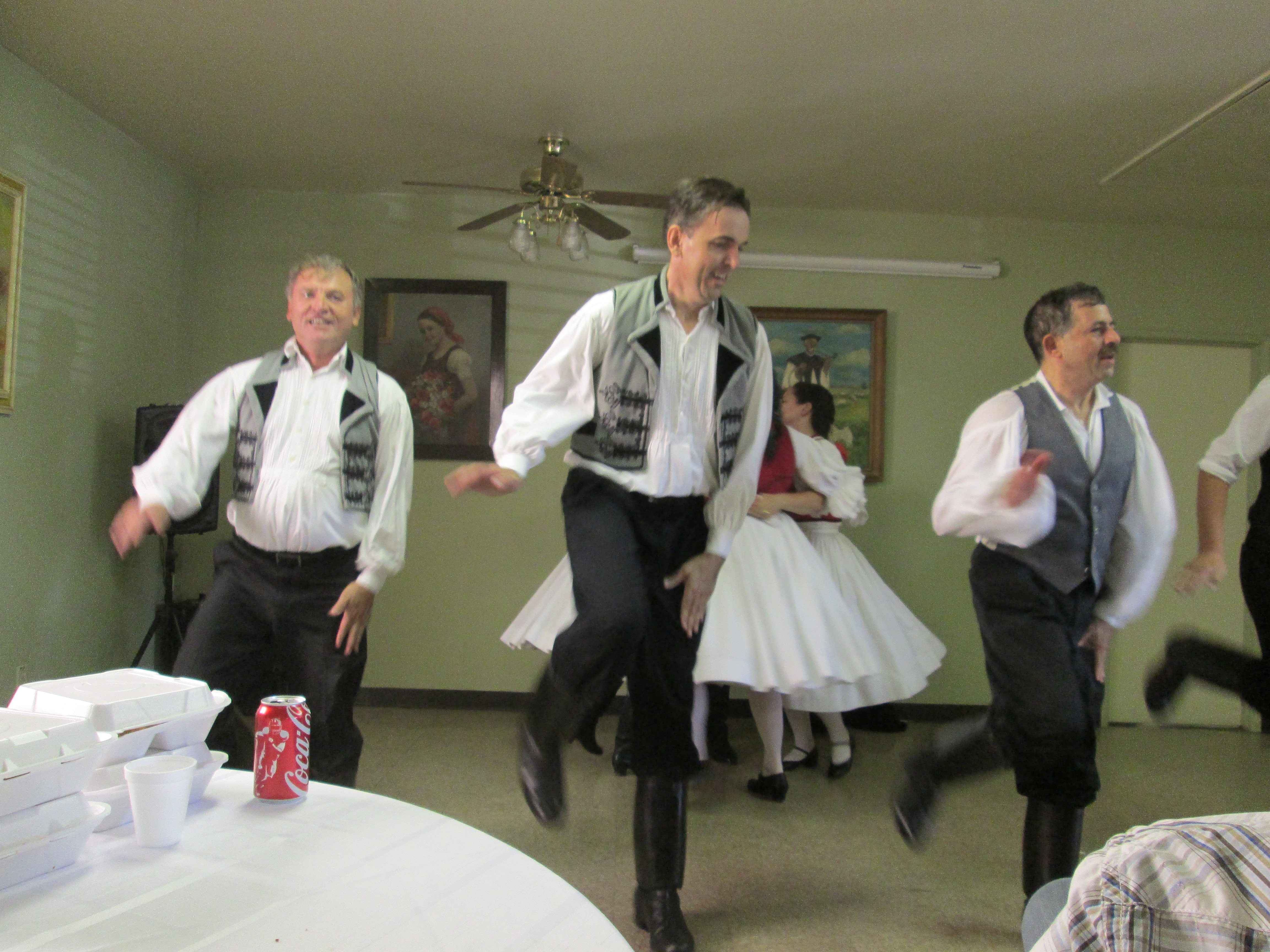
Last Sunday, Martine and I went to the First Hungarian Reformed Church of Los Angeles in Hawthorne for their annual harvest festival. It was a good opportunity to catch up with L.A.’s Hungarians, who are all spread across the landscape of Southern California. And it was a great opportunity to have some home-cooked Magyar dishes (kolbasz and hurka) and enjoy the energetic dancing of the Kárpátok Hungarian Folk Ensemble (pictured above).

I am always pleasantly surprised to find out how musically talented my people are. (And me with a tin ear!) In addition to the dancing, there are always several musicians playing musical instruments from the accordion to the violin. The small church hall fairly rocked with all the musical acts.

Although I do not belong to the Hungarian Reformed church, my mother did. My Mom and Dad had an agreement between themselves that any sons in the family would be brought up as Catholics, and any daughters as Protestants. Well, it turned out there were only my brother Dan and me. We were both were baptized Catholic and attended Catholic elementary and secondary schools. For some reason, the Hungarian Catholics in L.A. don’t seem to have any festivals—at least, none of which I am aware. As a result, Martine and I usually hang out with the Protestants.

Martine may have been born in France, but she loves Hungarian food and music. And she loves Hungarian pastries. So these few local church events are high points in our year.

A Hungarian Interlude

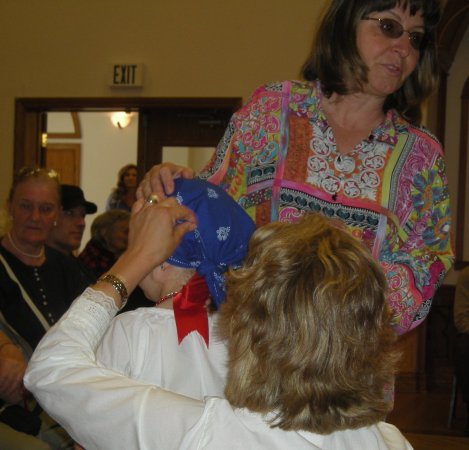
Stage Mother Putting the Finishing Touches on Her Daughter

Stage Mother Putting the Finishing Touches on Her Daughter’s Costume

Today was the annual Majális-Tavaszi (May Day-Spring) Fesztival at the Grace Hungarian Reformed Church in Reseda. Martine and I headed there early so as to have one of their authentic Magyar lunches. I had Gulyás Leves (Goulash Soup), while Martine ate Stuffed Cabbage Rolls. The main event for Martine was the arrival of the pastries, which resulted in a large and ravenous line.

Even longer was the line for langós, which is Hungarian fry bread (very much like Navajo Indian Fry Bread), on which people put grated cheese, sour cream, and minced garlic. For some reason I have never been able to determine, this is considered one of the most desirable Hungarian foods.

The church puts on a children’s program of folk dancing, singing, and a recitation in the hall.  Afterwards, the parish’s superb a capella choir sings in the church proper.

While it won’t help my diabetes any, it’s always good on occasion to reconnect with my roots. It is fun for Martine as well, as she is one French girl who prefers Hungarian food to the food of her native land.


Howdy Doody and Harvey Rice

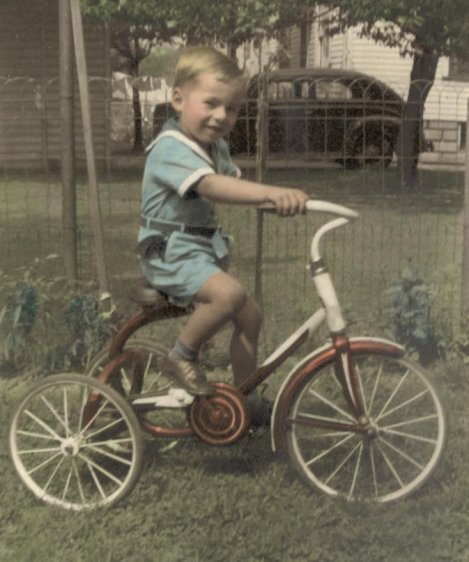
Me on a Tricycle Ca. 1950

Me on a Tricycle Circa 1950

That’s me on a tricycle, sometime around 1950. We were living at 2814 East 120th Street off Buckeye Road in Cleveland. The whole place was filthy with Hungarians. There were so many, in fact, that I did not know the English language existed until two things happened: First, we got a television set late in 1949, and I started watching the Howdy Doody show at 5 pm every day, just after Kate Smith closed her show by singing “When the Moon Comes Over the Mountain.” (It took me a while to understand what Howdy and Buffalo Bob Smith were saying.)

Secondly, I started kindergarten at Harvey Rice School on East 116th Street in January of 1950. My parents thought that, living as we did in a Hungarian neighborhood, the public school teachers would speak Hungarian. Nothing doing! Mrs. Idell sent me home with a note pinned to my shirt that asked, “What language is this child speaking?” As if she didn’t know!

That last factor decided my Mom that we had to leave our little Hungarian womb on the East Side and move to the suburbs. Gone forever would be the Reverend Csutoros and the First Hungarian Reformed Church; the Regent and Moreland movie theaters; Kardos’s Butcher Shop with its delicious Hungarian sausages; the College Inn, where my Dad would take me for French Fries; and the Boulevard Lanes where my Dad bowled and I kept score.

It was a cohesive little world, but my parents ate the apple from the Tree of Knowledge when they decided to raise me as a Hungarian. You know what? I’m grateful that they did. I made my adjustment to English (and I’m still making it), but my heart belongs to the Magyar Puszta.

.

On Hungarian Time

Hungarian Cowboy, or Csikos, on the Hortobagy

This weekend was spent attending two Hungarian events: A Los Angeles Hungarian Meetup Group get-together at Mishi’s Strudel Shop in San Pedro and the Fall Bazaar of the First Hungarian Reformed Church in Hawthorne.

It was interesting to spend a weekend on Hungarian time. At the strudel shop, Martine and I were there on time (at 2 pm), but no one else was. At the church, the bazaar was to begin at 1 pm. We got there fifteen minutes early, and found the place was full because everything started much earlier than the posted time, perhaps by as much as an hour. (And it ended an hour and a quarter early, too.)

I am usually fanatical about being not only on time, but a little early, for everything. It was strange to be outdone in this regard by my fellow Magyars.

Fortunately, it didn’t matter. We just took our seats and enjoyed ourselves immensely through the dinner and musical program. There were two opera singers—Sándor László and Huba Marcsi—singing old Hungarian folk songs to be piano accompaniment. This was followed by a singalong led by Dr. Tai Chen of other old folk songs based on music passed out to everyone. (My Hungarian, being sub par, made it difficult for me to participate.)

There was also a number of rousing folk dances by the Kárpátok Hungarian Dance Ensemble, whose flawless execution of a series of stunning and complicated maneuvers is always a crowd pleaser. I see tthem at least twice a year and find their work to be exhilarating.

It was such a good weekend that I feel like manhandling a bunch of horses like the csikos in the above photo, which comes from Flickriver.