The Traveling Cripple

In 2001, I Traveled with a Cane—In Considerable Pain

In 2001, I Traveled with a Cane—In Considerable Pain

When I went to Iceland in 2001 (and yes, this will be the last you will hear about my 2001 trip), I was in considerable pain from a severe case of osteoarthritis in my left femoral head. I had hobbled around with that arthritis ever since 1967, the year after I had my brain surgery. Once my pituitary gland was removed and I started taking hormones, I began to grow again. Unfortunately, my left hip joint did not take too kindly to the changes taking place to my body.

By the year 1997 or 1998, I was using a cane. People would constantly ask me why I was standing up when there was a nearby chair. I would answer them by saying because the pain of getting up was far worse than the mere inconvenience of standing. (I can still stand still for long periods of time without discomfort)

Things got worse when I landed in Iceland in August 2001. Of course, pain or no pain, it didn’t stop me from being active. The only effect was, on the two days of touring with my guide Illugi, I had to avoid climbing a particular hill and taking a trail around lava formations near Dettifoss. Otherwise, I was still pretty game.

Pain is one of those things which I can tolerate in fairly high doses. Not that I want to, but it is usually better than the alternative. Now that Martine is in pain from fibromyalgia (or something that looks and behaves very much like fibromyalgia), I tried to explain this to her; but she wasn’t buying it. Every person has his or her own acceptable threshold of pain, and mine just happens to be higher. Is it because I have been in fairly acute physical pain ever since my childhood—first from a pituitary tumor pressing on my optic nerve, and then from osteoarthritis? Only in the last ten years or so have I been as free of pain as I was when I was ten.

The photo above shows Lake Mÿvatn from my window at the Ferðaþjónustan Bjarg. (Don’t try to pronounce this without a Icelander present … or I should say don’t try to pronounce this with an Icelander present.) Notice the tents between the guesthouse and the lake’s edge.

Many campers don’t like the Bjarg and regard the management as unfriendly. I gained points when registering for one of the two rooms in the guesthouse by asking, “Wasn’t the name of Grettir Asmundarsson’s family home in West Iceland called Bjarg?” Not only was the owner shocked that an American knew this, but I quickly found that he was a big time fan of Grettir’s Saga and named his son Illugi (my guide) after Grettir’s youngest brother.

I loved the Bjarg Guesthouse. It had only two bedrooms, but a big kitchen, where I sat eating harðfiskur with fresh Icelandic butter spread on it. There was also a nice living room which I had to myself when I stayed there.
 

Iceland 2001: Rainbows and Waterfalls

Rainbow in the North of Iceland

Rainbow in the North of Iceland

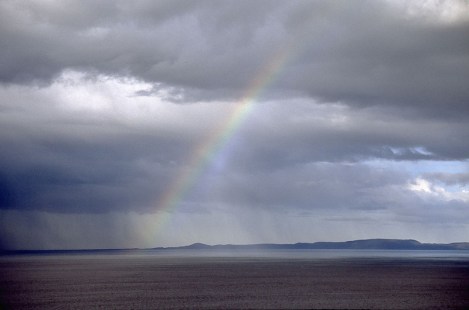
We were in the north of Iceland, somewhere between Ásbyrgi and Húsavík. By we, I mean our guide Illugi from Lake Mÿvatn, a group of European twenty-somethings, and me, hobbling around with a cane due to severe osteoarthritis. It was a gorgeous day: Bright sunlight interspersed with rain-bearing clouds. A perfect day for rainbows. It was one of those days when one is likely to behold almost more beauty than a human being can stand.

Iceland does that to me. That’s one of the reasons I am bringing up these photographs from twelve years ago. The image of a place that is at once wild and beautiful keeps coming back to me. On a long bus ride along the famous Ring Road, one sees endless waterfalls cascading down from mountains and glaciers; and the changeableness of the weather makes rainbows frequent and spectacular. Sitting here in Westwood during the endless repetition of foggy mornings and hazy sunshine in the afternoon that is typical of L.A. spring weather, I yearn for the crystalline wide open spaces.

Soon. Soon.

The Falls at Dettifoss

The Falls at Dettifoss

Earlier on the same day that I shot the rainbow above, we visited Europe’s most powerful falls at Dettifoss along the Jökulsá á Fjöllum River, one of Iceland’s largest and longest.


Iceland 2001: The Huldufólk

Those Strange Basalt Formations Could Be a Troll ... or the Home of an Elf

Those Strange Basalt Formations Could Be a Troll … or the Home of an Elf

Many Icelanders, particularly those who grew up before the island became cool, believe in the hidden folk. As a matter of fact, despite all that ice, it was once a very hot place—so hot that the residents bake rye bread by burying it in a hole only a couple of feet deep. Many places, like the original Geysir (yes, that’s how it is spelled) are so hot that a single misstep could plunge you into boiling mud.

There are numerous stories about the island’s hidden folk, or huldufólk, namely trolls, ogres, elves, mermen, and others. If you think I’m being tongue-in-cheek while writing this, allow me to refer you to a story that recently hit the news in Reykjavík.

An interest group called Hraunavinir (‘Lava Friends’) is planning to sue over the making of a new road to Álftanes from Engidalur in Garðabær, across the lava field Gálgahraun, and to a roundabout opposite Bessastaðir, the presidential residence.

Seer and piano instructor Erla Stefánsdóttir maintains that the elf boulder Ófeigskirkja will be destroyed in the process and fears that wrath of dwarves in the hidden world will cause accidents on the road, Fréttablaðið reports.

Now this is not the type of story one would encounter in the New York Times. What I found particularly interesting was that there were some serious follow-up stories, including one just a few days ago in which one resident suggested the whole problem could be eliminated by a couple of strategically-placed roundabouts.

In Reykjavík, there is even an Elfschool, which has been open for over twenty years. It is run by Magnus Skarpheðinsson, who is an expert on Iceland’s huldufólk.

When I look at that basaltic plug in the photo above, at Dimmuborgir on the shores of Lake Mývatn in Northeast Iceland, I think that it may well be a petrified troll who hung around after sunset, or the residence of elves, who venture forth from their stony fastness to confound the ways of men.

Serendipity: A “Miraculous” History

Vikings: The Stereotype

Vikings: The Stereotype

Right under the dedication of his book Feud in the Icelandic Saga, Jesse L. Byock includes this incredible quote from an almost forgotten book written a century ago:

The whole of Icelandic history is miraculous. A number of barbarian gentlemen leave Norway because the government there is becoming civilized and interfering: they settle in Iceland because they want to keep what they can of the unreformed past, the old freedom. It looks like anarchy. But immediately they begin to frame a Social Contract and to make laws in the most intelligent manner: a colonial agent is sent back to the Mother Country to study law and present a report. They might have sunk into mere hard work and ignorance, contending with the difficulties of their new country; they might well have become boors without a history, without a ballad. In fact the Icelandic settlers took with them the intellect of Norway; they wrote the history of the kings and the adventures of the gods. The settlement of Iceland looks like a furious plunge of angry and intemperate chiefs, away from order into a grim and reckless lank of Cockayne. The truth is that those rebels and their commonwealth were more self-possessed, more clearly conscious of their own aims, more critical of their own achievements, than any polity on earth since the fall of Athens. Iceland, though the country is large, has always been like a city-state in many of its ways; the small population, though widely scattered, was not broken up, and the four quarters of Iceland took as much interest in one another’s gossip as the quarters of Florence. In the Sagas, where nothing is of much importance except individual men, and where all the chief men are known to one another, a journey from Borg to Eyjafirth is no more than going past a few houses. The distant corners of the island are near one another. There is no sense of those impersonal forces, those nameless multitudes, that make history a different thing from biography in other lands. All history in Iceland shaped itself as biography or as drama, and there was no large crowd at the back of the stage.

Whew! Years ago, I had read the book from which this long quote is excerpted: W. P. Ker’s The Dark Ages (1904). I have not been able to locate my copy, but was delighted to find that the book is available free of charge in a number of formats, including Kindle.

We should by no means denigrate books like Ker’s just because they were written decades ago. Sometimes those old historians and critics had a lot more on the ball than our contemporaries.


Trunt, Trunt, and the Trolls in the Fells

Troll

Troll

There were once two men who went up into the mountains to gather edible moss. One night they were sharing a tent, and one was asleep and the other awake. The one who was awake saw the one who was asleep go creeping out; he got up and followed him, but however hard he ran he could not catch up with him. The sleeping man was headed straight up the mountain towards the glaciers, and the other saw where a huge giantess was sitting up there on the spur of the glacier. What she was doing was this: she would stretch out her arms with her hands crossed and then draw them in again to her breast, and in this way she was magically drawing the man towards her. The man ran straight into her arms, and then she ran off with him.

A year later, some people from this man’s district were gathering moss at the same place; he came there to meet them, and he was so short-spoken and surely that one could hardly get a word out of him. They asked him who he believed in, and he said he believed in God. The following year he came to the moss-gatherers again, and by then he looked so like a troll that he struck terror into them. However, he was again asked who he believed in, but he made no reply. This time he stayed a shorter time with them than before. The third year, he came again; by then he had turned into an absolute troll, and a very ugly-looking one too. Yet someone plucked up courage to ask him who he believed in, but he said he believed in “Trunt, Trunt, and the trolls in the fells”—and then he disappeared. After this he was never seen again, but for some years afterwards men did not dare go looking for moss in that place.—Jacqueline Simpson, Icelandic Folktales and Legends

Iceland 2001: Returning to Heimaey

Heimaey Wrapped in an Embrace by the Volcano Eldfell

Heimaey Wrapped in an Embrace by the Volcano Eldfell

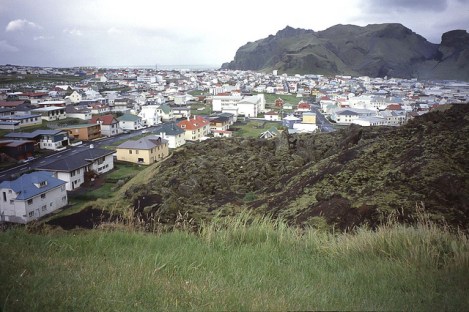
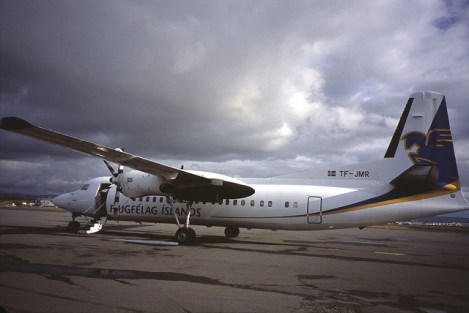
It was difficult getting to Heimaey back in 2001. I had two choices: Either I could take a gut-wrenching 3½-hour ferry ride across the stormy North Atlantic from Þorláshöfn (famous for seasickness) or I could fly there. Now there is a cheaper choice: I could take the ferry from Landeyjahöfn, which is only a 30-minute ferry ride. Back then, I took a ruinously expensive day trip by flying Flugfélag Íslands from Reykavík. Below is a picture of the prop plane I took on that occasion.

The Prop Plane to Heimaey

The Prop Plane to Heimaey

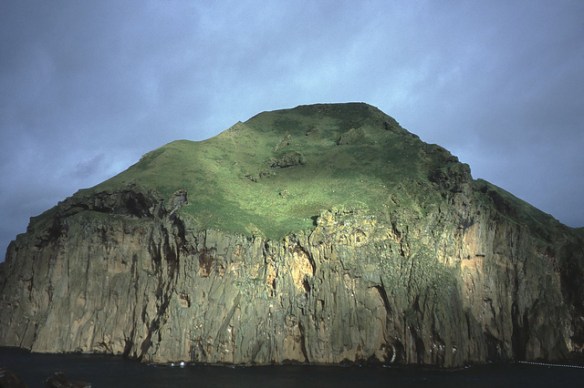
The main reason I’m going to Heimaey is the same reason I decided to go in August 2001, namely to see puffins. I was just a tad late, as I could see the white spots of puffins leaving the bird cliffs for their flight to the British Isles. Here is a picture of the puffins vacating their nests for the flight over the North Atlantic:

PuffinCliffs

The Little White Spots Are Puffins

This time I did my research and timed my visit right. There should be something like two-three million of the little birds feeding their young when I get there.

I will be staying at the Hotel Vestmannaeyjar for two nights, so I should have plenty of time to see the bird life on the island, as well as the volcano show and little natural history museum. There also used to be a fish cannery museum, but I no longer see it mentioned in the lists of sights to visit. Nonetheless, I plan to have plenty of fish, as Heimaey is the busiest fishing port in Iceland. That’s why the Icelanders were so frantic about saving the harbor in 1973 when the volcano Eldfell erupted.

Iceland 2001: Watch a Whale, Eat a Whale

The Port of Husavík in Northern Iceland

The Port of Husavík in Northern Iceland

There is a controversy still going on in Iceland between fisherman who catch whales for domestic consumption and those who run whale-watching cruises for foreign tourists who are dead set against hunting whales.

Although, in general, I am against hunting whales, I think that a small island that has depended on whale meat for over a thousand years deserves a break. Many of the old Icelandic sagas, such as Grettir’s Saga, feature family feuds that began when one family group cut up a beached whale for itself while another claimed the rights to it.

The whales that Icelanders hunt are Northern or Common Minke Whales (Balaenoptera acutorostrata), which are small and relatively common—by no means the endangered species that American, Russian, and Japanese vessels in the Pacific hunted to the point of no return.

During my 2001 to Iceland, I took a whale-watching cruise out of Husavík, along Iceland’s north coast. We only saw a couple of Minke Whales (I guess it was a bad day), but we had a good time. And the galley prepared delicious hot chocolate and sweet rolls for all the passengers.

There is also a decent-sized whaling museum in Husavík that I visited and enjoyed twelve years ago.

If you want me to translate the sign in the above picture, I believe it goes, “If you can read this, you’re too darn close.”

Iceland 2001: Surviving the Fierce Winds

In a Land of Fierce Winds, Corrugated Steel Siding is Required

In a Land of Fierce Winds, Corrugated Steel Siding is Required

How windy is it in Iceland? For one thing, there are no tall trees on the island. The joke among the natives is the answer to the riddle, “What do you do if you’re lost in an Icelandic forest?” The answer: “Stand up!”

More of the land used to be forested, but centuries of sheep herding and gathering wood for charcoal and building had depleted the original forests. In the medieval sagas, most of which were written in the thirteenth century, much is made of who has the legal rights to claim driftwood that has washed up on the beach. (Cf. The Saga of Havard of Isafjord.)

One of the things I found most curious when I landed in Reykjavík were all the houses with painted corrugated steel siding. The above house is in Heimaey on the Westman Islands, but the general principle holds: Protect it with steel or the wind will blow your house in, if not away. The same goes for the roofs: A shingle roof would not last a month.

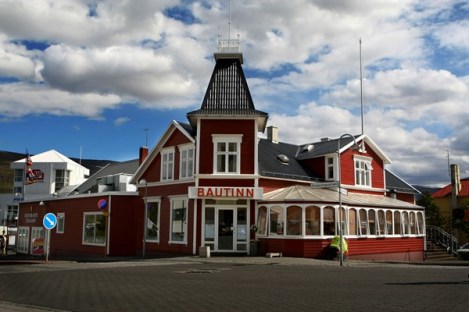
The painted corrugated siding does add quite a bit of color to a land which would otherwise tend toward the grey and gloomy. The following is a photo of the Bautinn, my favorite restaurant in Akureyri:

The Colorful Bautinn Restaurant in Akureyri

The Colorful Bautinn Restaurant in Akureyri

Whole neighborhoods in Reykjavík and other cities feature buildings whose siding has been painted in bright colors.


The Bus and Train Freak

At the Bus Station in Trelew, Argentina

At the Bus Station in Trelew, Argentina

Here in the United States, our intercity ground transportation is the pits. Even Mexico has us beat, with buses they manufacture themselves. Of course, neither the U.S. nor Mexico are any good at railroads, with a few minor exceptions.

One thing about me that you may not know is that I am a transportation freak. I think about public transportation a lot. Two weeks ago, I suddenly woke up in the middle of the night remembering the bus company that took me in 2001 from Reykjavík to Akureyri via the Kjölur route across the desolate plateau that forms the center of the island. The bus I took was labelled Seydisfisbilar Akureyrar. (There may be a few diacritical marks missing: The line doesn’t show up on a present day Google search.).

The funny thing is that I could figure out bus and train schedules almost irrespective of what European language they’re written in. Asking questions and understanding the answers is an entirely different issue.

In Argentina, Martine and I rode long-distance buses between Puerto Madryn, Trelew, and Gaiman—mostly on the 28 de Julio line. They were so far and away better than anything Greyhound has in the field that I blush with shame. Even the verbal interface with the ticket agents in the above cities was relatively easy, until I found out that, on some routes, seating is assigned rather than being asiento libre (“sit where you please”).

When I am in Iceland, if I run into Straeto employees that either do not or will not speak English, I may run into a spot of trouble. But since 95% of Icelanders under the age of 70 speak English, that is pretty much a baroque fear.

As for Icelandic train schedules, there are none, primarily because no one ever built a passenger railroad to serve a sparsely populated island in the Arctic.


Iceland 2001: Jökulsárlón

The Glacial River Lagoon of Vatnajökull

The Glacial River Lagoon of Vatnajökull

About a week ago, I found my old Kodachrome slides of my 2001 trip to Iceland. I had them converted by Bel Air Camera in Westwood to JPEG format and copied onto a CD-ROM. Over the next couple of weeks, I will be interspersing my best Iceland 2001 pictures with my regular posts.

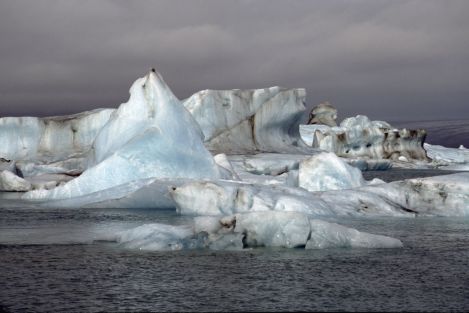
The above glacial lagoon is near the Southeast Corner of Iceland, between Höfn and Skaftafell. Iceland is called Iceland because that corner is occupied by Europe’s biggest and most deadly glacier, Vatnajökull. And that glacier is the first part of the island that comes into view when sailing aboard a Viking craft from Europe.

Beneath a heavy layer of glacial ice at Vatnajökull lies the volcano Grimsvötn.

Think of what happens when an active volcano that is covered by a glacier suddenly erupts. You have a phenomenon, unknown in the Continental United States, referred to by Icelanders as a Jökulhlaup, a sudden flood that forms from seemingly nowhere and rushes to the sea, destroying everything in its path. It is because of this phenomenon that Iceland did not have a permanent road connecting the Southeast of Iceland to the Southwest. The picture below shows the wreckage of a steel bridge not far from the lagoon above from the 1996 eruption of Grimsvötn:

Bridge Destroyed by 1996 Eruption of Grimsvötn

Ruins of Bridge Destroyed by 1996 Eruption of Grimsvötn

The lagoon of Jökulsárlón is one of the most popular tourist attractions in the area. The calved pieces of the glacier are all shades of blue and white. It is possible to take an amphibious boat ride among the floating chunks of ice, which I plan to do next month. The bus from Reykjavík to Höfn (and back) stops there for about thirty minutes to let all the shutterbugs have a go at it.