Demoted!

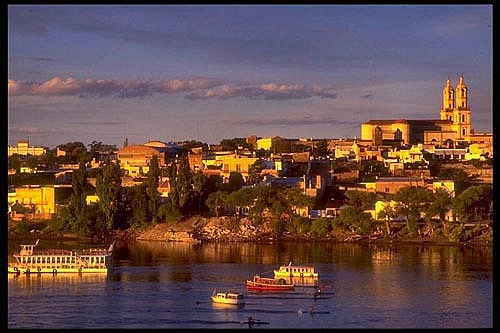
Carmen de Patagones Seen from Viedma

Carmen de Patagones Seen from Viedma

The two cities sit on opposite banks of the Rio Negro. Carmen de Patagones, on the north bank, is the southernmost city of the State of Buenos Aires; Viedma, occupying he south bank, is the capital of the State of Rio Negro, which extends west as far as the Andes and the Chilean border.

It seems that the current edition of the Lonely Planet Guide to Argentina no longer has chapters for the twin cities on the Rio Negro. I guess they’re not Disneyfied enough to draw all the tour groups. For travelers driving from Buenos Aires to Patagonia, it is at best a stopping place for the night before big chunk of attractions around Puerto Madryn and Trelew.

Viedma also happens to be the terminus of the Tren Patagonico, about which I wrote yesterday. From there, it goes clear across the State of Rio Negro to the Patagonian Lake District around San Carlos de Bariloche. Today, I finally got an e-mail response from the Tren Patagonico people telling me they’ll be ready to take my reservation for November in a week or so.

If my reservation is confirmed, I’ll spend a couple of nights in either Viedma or Carmen de Patagones and wander around both towns seeing the local museums.

In 2001, I remember being the only visitor in a two-hour period to the old fish canning museum in Heimaey in Iceland’s Vestmanneyjar Islands. I loved every minute. The curator gave me a personal tour and explained how Heimaey was the main fishing port in Iceland, a country whose GDP is based on their fish catch. Even though the museum is no more (I looked for it in 2013 but couldn’t find it), I have special memories of my visit. And that is much better than being jostled by huge crowds of tourists who distractedly push their way past all the exhibits on their way to the next destination.

So Viedma and Carmen de Patagones have been demoted! So much more for me to see!

Surprise: They’re Not All Blondes

Some Surprising Results from Gene Studies

Some Surprising Results from Gene Studies

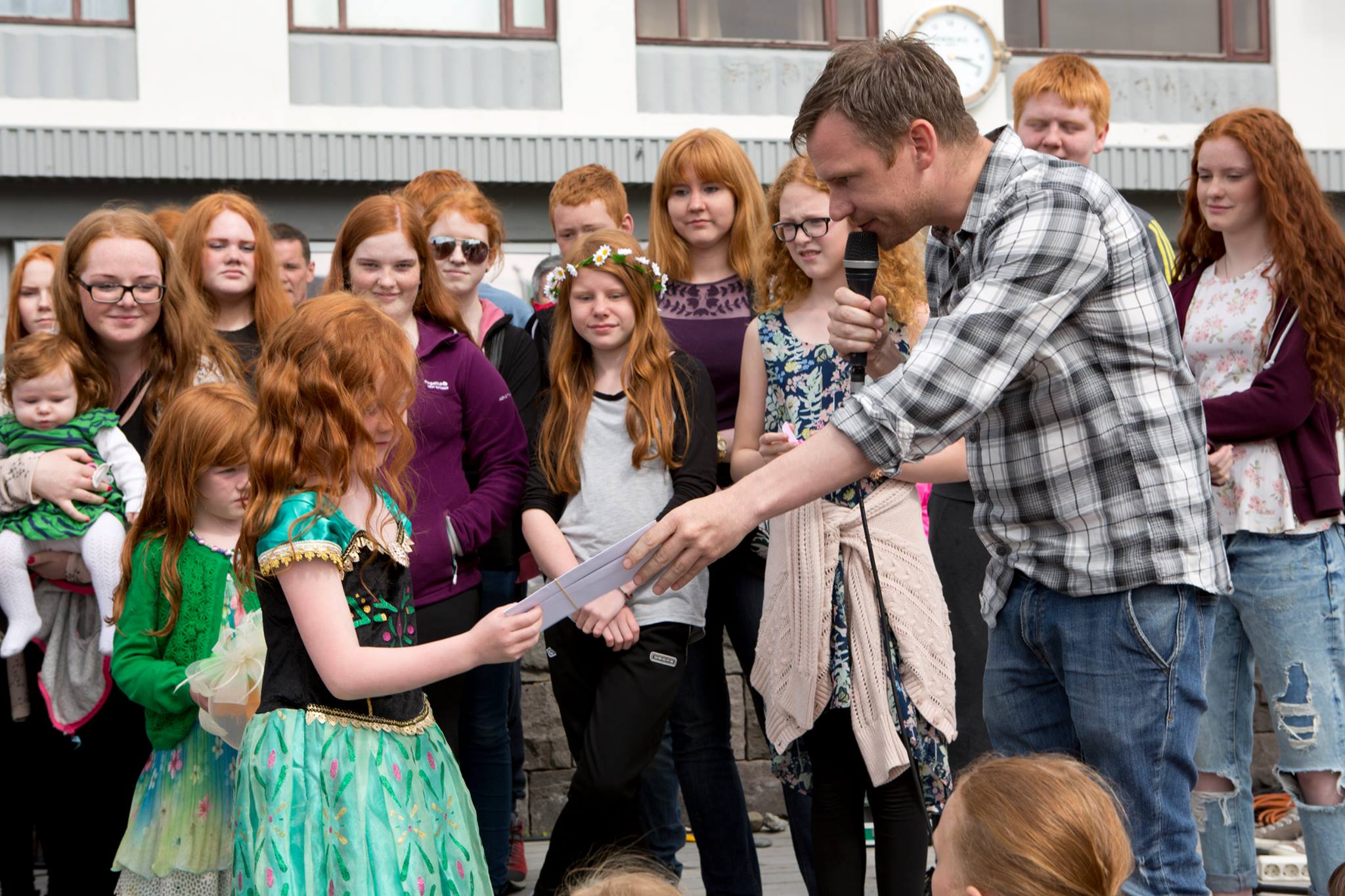
All the people in the above photograph are Icelanders. What you are looking at are some of the contestants in the Irish Days festival in Akranes, a small city just north of Reykjavík. Now why would Iceland be having an Irish Days festival?

Apparently Iceland was first settled by Irish hermit monks for about a century before Ingólfur Arnarson became the first Scandinavian settler in A.D. 874. These papar (“Papists”), as they were called, did not stick around once they were surrounded by hyper-aggressive heathens. And, being celibate, they probably did not add their genes to the population of Iceland; but the Vikings did raid Ireland for slaves, and that’s where things suddenly become interesting.

Genetic studies taken of the Icelandic population show that 20% of the males and 63% of the females have Irish ancestry. I find that statistic to be interesting, but I have some trouble wrapping my head around it. Even if the Vikings preferred Irish redheads to the Scandinavian blondes, the Irish women would give birth to as many if not more males than females (the ratio is 21:20 in the U.S.). Perhaps the male Irish slaves had a harder life and were not permitted to mate, while the women were encouraged to bear children, whether within or outside of wedlock. If so, it’s just another instance of the hard life that the Irish have suffered through the ages.

Prizewinner at Akranes

Prizewinner at Akranes

By the way, the winner of the Akranes competition was one Laufey Heiða from the Westfjords. Runner-up was Vígdis Birna, who is shown above receiving her prize.

One thing I can say with certainty is that Icelandic women tend to be beautiful, whether they are blondes or redheads.


A Christmas Card from Iceland

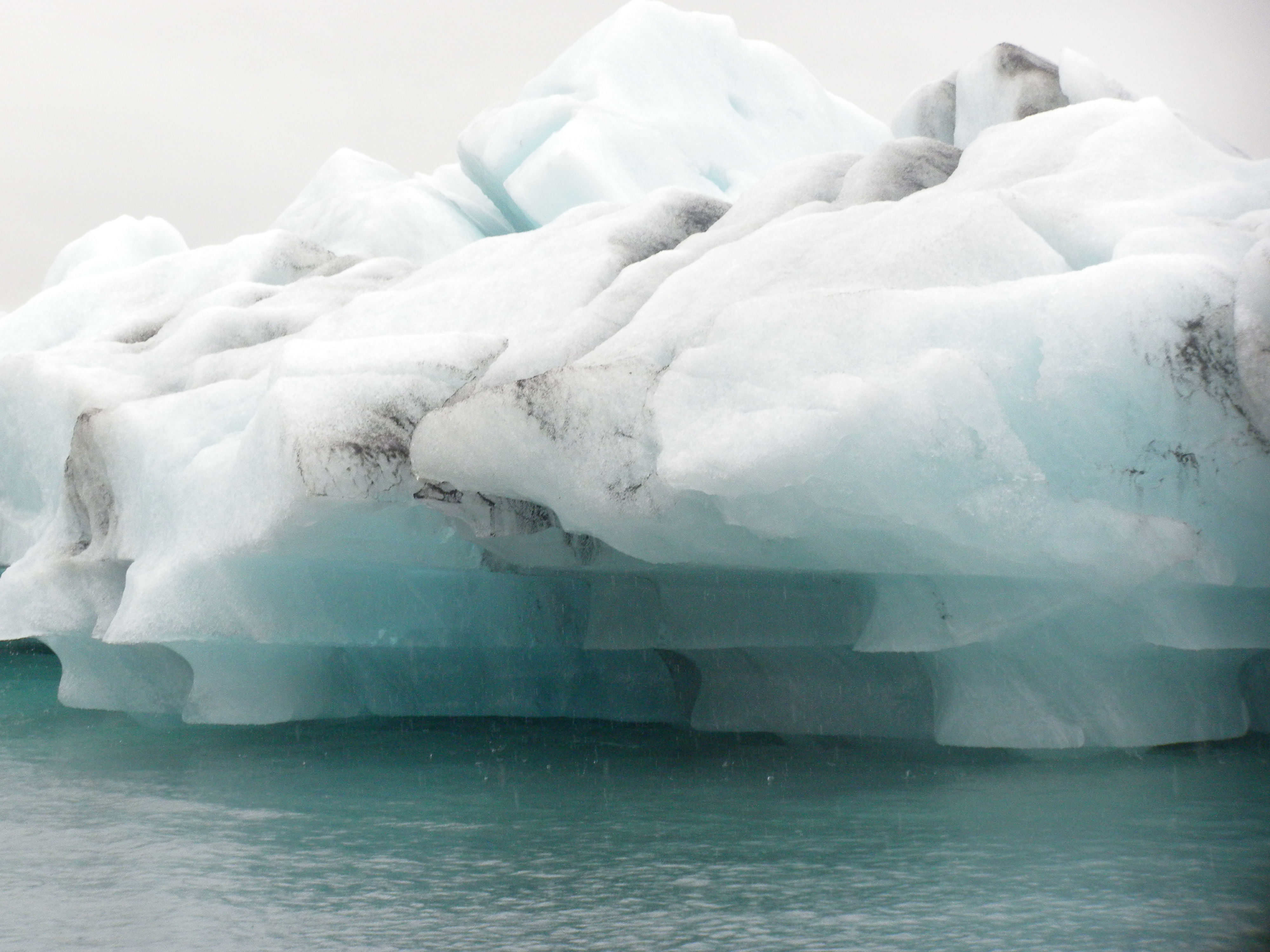
The Jökullsárlón Glacial Lagoon

The Jökullsárlón Glacial Lagoon

Ever since I first went to Iceland in 2001, I’ve loved The Iceland Review. This year, their talented photographer/editor Páll Stefansson and their ace writer Benedikt Johannesson came up with a holiday slide show accompanied by original music. I thought I would like to share it with you.

As we say in Hungary, Boldog Karácsony!

I Have This Thing About Volcanoes

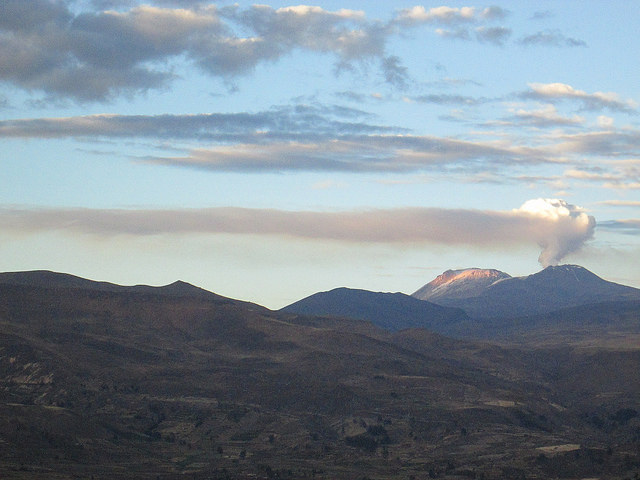
The Volcano Sabancaya in Eruption, seen from Colca Canyon

The Peruvian Volcano Sabancaya in Eruption, seen from Colca Canyon

I can tell you the day and time when it first started. It was at 6:00:41 am PST on February 9, 1971, when the earth started shaking. I held on to my mattress for dear life, even as it was sliding onto the bedroom floor from the massive jolts. The noise was deafening with all those structures shaking, and all the kitchen cabinets being emptied onto the floor. I had just lived through the Sylmar Quake in which 58 people lost their lives.

It was then that I realized we as a species were not exactly in control. Man inhabited a thin crust which was criss-crossed by earthquake faults and floating atop oceans of magma waiting to break out at points along the globe and cover our puny undertakings with layers of lava and ash. And there I was, right on the famed Ring of Fire, in a state with hundreds of faults and not a few volcanoes.

Since then, I have been to Iceland to see Hekla and Eyjafjallajökull, which at various points in history—the latter in 2010—caused havoc worldwide. And now, even as I write, it is Bárðarbunga which continues spewing lava after several weeks.

In September, I saw two volcanoes in Peru’s State of Arequipa spewing ash: Sabancaya and Ubinas. Both are highly active and may continue erupting for some time.

Our lives on this earth are incredibly fragile. I am most impressed by earthquakes and volcanoes, but there are other terrestrial and atmospheric events that can cut our short lives even shorter. That’s not even to mention microscopic bacteria and viruses, slips and falls, tree branches crashing down on our heads, automobile accidents, or any number of causes. Life is magnificent even when it is at its most destructive. Enjoy it while you can!


Mucho Magma

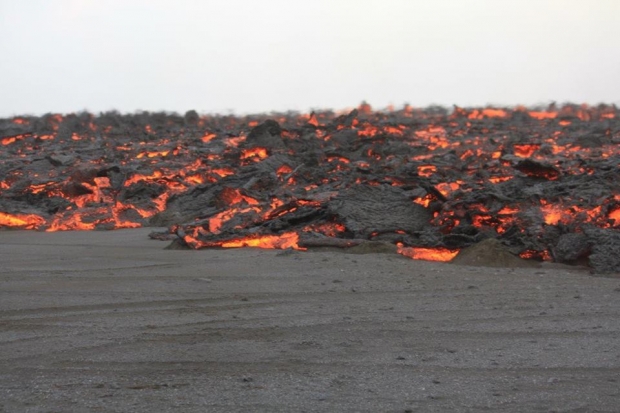
Magma from Holuhraun

Magma from Holuhraun

It’s actually a coincidence that my last two vacations were spent in countries where there are many active volcanoes. Iceland, where I spent part of Summer 2013, is now experiencing a huge eruption that is five to six times bigger than 2010’s eruptiojn at Eyjafjallajökull, which put a stop to much of Europe’s air traffic because it reduced air visibility over a wide area. It is also four times greater than Grimsvötn in the following year, which also was a major spewer of ash.

The difference with Holuhraun is that, although it has blanketed Iceland with dangerous levels of sulfur dioxide, it is known more for the massive amounts of magma produced. To date, one cubic kilometer of lava has been produced. According to The Iceland Review:

In terms of volume of lava, the Holuhraun eruption is now the biggest in Iceland since the 1783 Laki eruption (aka Skaftáreldar). The lava which surfaced during that disastrous eruption is 14 times the volume of the Holuhraun eruption.

“It now covers an area the size of Reykjavík and in some places it is 10-20 meters thick,” geophysicist Magnús Tumi Guðmundsson, who is on the Civil Protection Department’s Scientific Advisory Board, said of the new lava in Holuhraun.

This year I spent three weeks in Peru, where I saw the Volcano Sabancaya in eruption. What’s next for me? Krakatoa?

It’s Not Over Until the Bearded Lady Sings

In Eurovision, the Wurst Always Wins

In Eurovision, the Wurst Always Wins

I have always been amused by the annual Eurovision song contest, if only because it means so much to all the nations participating.This year, the winner was a bearded drag queen from Austria who goes by the name of Conchita Wurst (real name: Tom Neuwirth). I heard a bit of his/her number, “Rise Like a Phoenix,” on YouTube. I have to admit that Conchita was in good voice and deserved some credit for not turning the number into a freak show.

Every year, I root for Iceland to win. For a tiny little island nation (under 400,000 population), they have tons of raw musical talent. This year, the representative was a group called Pollapönk, which looks something like a cross between the Mighty Morphin Power Rangers and the Teletubbies. Their musical number was called “No Prejudice,” which you can see here at YouTube. This year Pollapönk placed a lowly fifteenth out of twenty-six. According to the Iceland Review website, their favorable votes came mostly from San Marino (8), France (7), and Italy (6).

I doubt anything lik Eurovision would ever make it big in the United States. Although Europe has the musical talent, Eurovision is far too political (big surprise!) and far too oriented toward a lumpenproletariat audience. It differs from such performers as Barry Manilow and Tom Jones mainly in the politically liberal orientation of the musical numbers presented.


Tarnmoor’s ABCs: Iceland

Land of Fire, Ice—and Sagas

Land of Fire, Ice—and Sagas

I was so very impressed by Czeslaw Milosz’s book Milosz’s ABC’s. There, in the form of a brief and alphabetically-ordered personal encyclopedia, was the story of the life of a Nobel Prize winning poet, of the people, places, and things that meant the most to him. Because his origins were so far away (Lithuania and Poland) and so long ago (1920s and 1930s), there were relatively few entries that resonated personally with me. Except it was sad to see so many fascinating people who, unknown today, died during the war under unknown circumstances.

This blog entry is my own humble attempt to imitate a writer whom I have read on and off for thirty years without having sated my curiosity. Consequently, over the next few months, you will see a number of postings under the heading “Tarnmoor’s ABCs” that will attempt to do for my life what Milosz accomplished for his. I don’t guarantee that I will use up all 26 letters of the alphabet, but I’ll do my best. Today, we’re at the letter “I”:

I have been to Iceland twice, first in 2001 and then in 2013, both times by myself. (The first time, Martine didn’t want to go; the second time, she couldn’t.) During the two trips, I traveled around almost the entire circumference of the island, and through the interior on the Kjölur route, where we traveled on a long dirt road and forded several rivers between Geysir and Akureyri. Would I go again? Yes, in a heartbeat, but I’d like to go with someone so that we could rent a car and see some of the lush countryside off the main routes.

What led me to Iceland was, not surprisingly for a bookworm like me, was reading the Icelandic sagas. In the 13th century AD, there was no better literature being written anywhere in Europe. Other than a handful of Arthurian legends and a few devotional books, there just was no competition to the “Big Five” Sagas of Icelanders, namely: Njals Saga, Grettir’s Saga, Egils Saga, the Laxdaela Saga, and the Eyrbyggja Saga. I have read all five at least twice; the Njals Saga, the greatest of them all, at least three or four times. The last time I went, I visited two museums dedicated to individual sagas, in Hvõlsvollur (Njals Saga) and in Borgarnes (Egils Saga).

Both times, I did all my traveling by bus. Occasionally I took tours when I had to. Otherwise, I used the public Stræto and Sterna buses. It isn’t terribly difficult, as all bus drivers and just about everyone else under the age of 70 in Iceland speaks English. This is a function not only of education, but of the prevalence of English and American television programming.

At least once a day, I would have delicious fish dinners. At the majority of restaurants where I dined, I was no farther than a couple hundred feet from the fishing boats that had just brought in their catch. Until I went to Iceland, I had no idea of what fresh fish really tasted like. Now I do. I would just order the fish special of the day, even if I never heard of that fish species before. It was always scrumptious, whether it was arctic char, salt water catfish, and most especially my favorite—cod. In Southern California, I am allergic to shrimp and lobster. In the cold waters off Iceland, I had no allergy problems.

Until global warming becomes more prevalent, the tourist season in Iceland is a necessarily short one, lasting only from June to August. Already, at the end of August, many tourist facilities are converted back to school facilities and visiting hours are slashed. People start thinking about the darkness of winter. Toward the end of June, the sun never entirely sets. It is up when you go to bed, and up when you awake. I thought I would not be able to sleep under those conditions: If I tire myself out, which I frequently did, there was no problem.

I would love to fly back to Reykjavík with a Kindle loaded with Icelandic sagas.



I Run Into Charles Keating

S & L Fraud Meister Charles Keating (1923-2014)

S & L Fraud Meister Charles Keating (1923-2014)

When Charles Keating died in Phoenix last week, I thought of my meeting with him in Iceland (of all places) in August 2001. I was staying at the Foss Hotel Skaftafell in Svinafell (see photograph below), about two kilometers south of what was then the Skaftafell National Park, and is now merely part of the giant Vatnajökull National Park that occupies most of the country’s southwestern quadrant. Since I was traveling alone and without camping gear, it was the only place I could stay in walking distance of the park without roughing it.

I was sitting in the hotel dining room, close to a large center table where there was a large, noisy group who were swilling large amounts of imported wine. (What other kind is there in Iceland?) The oldest member of the group excused himself for a rest room visit, while his friends talked about him behind his back. It was then I learned the man was the infamous Charles Keating, whose leadership of the American Continental Corporation and the Lincoln Savings & Loan Association led him afoul of the law, more so because he had tried to suborn five legislators (the so-called “Keating Five”) into letting him off scot free. It didn’t work, as in December 1991, he was convicted on seventeen counts of fraud, racketeering, and conspiracy and given the maximum sentence of ten years by Judge Lance Ito. At the time, Ito is said to have remarked, “More people have suffered from the point of a fountain pen than from a gun.”

When Keating returned to the table, he noticed my sour looks (I don’t much cotton to strangers, especially when they’re drunk ratbags) and invited me over to his table. I politely refused and finished up my meal to return to my room and read Viking sagas about even more thoroughgoing ratbags.

The Foss Hotel Skaftafell

The Foss Hotel Skaftafell

The next morning, as I was hiking to the national park headquarters, I saw the Keating party leave in a small chartered tour bus and sighed with relief. I knew two people who had invested in his S&L and nothing good to say for or to the man. It was rather pitiful that he found it necessary to travel with a bunch of yes-men who had nothing particularly good to say about him while he was out of earshot.

So it goes.


Disaster Days?

What Fresh Hell Is This?

What Fresh Hell Is This?

Hólmavík in the Strandir region of Iceland’s West Fjords is a strange place. Its main claim to fame is the presence of the Icelandic Museum of Sorcery and Witchcraft. Now it seems there is a second reason to feel apprehensive about a visit to Hólmavík, especially this time of year when many of the roads are closed.

The reason? In a word, Hörmungardagar, or “Disaster Days.” According to Páll Stefánsson of The Iceland Review:

On Friday’s program, among other activities, is a course in self-pity, a complaint service and an ugly dance performance.

On Saturday, head to the library to find bad books and later listen to the worst Eurovision songs [this could the most dreadful event of all] and the worst poem competition, where very bad coffee will be served. In the local church, sad (and bad) songs will be performed.

On Sunday, an anger management game will be held and a program about what has happened in the region.

The festival is directed by Ester Ösp Valdimarsdóttir, the so-called [huh?] spare time manager of the Strandir region.

I would like to have stayed in Hólmavík for a day or two, but I just couldn’t book a room; so I didn’t want to risk getting stuck there. I did change buses there, however. Toward the end of my trip, I had an all-day bus ride from Isafjorður to Borgarnes, during which I changed buses in Hólmavík in the local supermarket parking lot. The long bus ride from Isafjorður was uncomfortable because the bus was full of backpackers and all their gear, so there was barely room for my feet. Fortunately, the second leg of the trip on on a large and comfy Stræto bus.

I’m sure that if you can find your way to Hólmavík this weekend—fat chance, that!—you’ll find that, after all, you don’t have all that much about which to complain.

By the way, if you’d like to see a sampling of truly dreadful Eurovision songs, click here. And please don’t hold me responsible! You will find that there are musical acts that are far worse than anything even Lawrence Welk could have imagined.

Thirteen Trolls for Christmas

The Icelandic Yule Lads Make Up for Santa Claus

The Icelandic Yule Lads Make Up for Santa Claus

Icelanders celebrate Christmas with the thirteen Yule Lads, or Jólasveinarnir. You might say it’s the 13 Days of Christmas, except these begin on December 12. As they come, day by day, they reward good children by placing gifts into their shoes which have been left on window sills. And if the children are bad, there are always rotten potatoes.

Here is a description of the Yule Lads:

  1. Stekkjarstaur, or “Sheep-Cote Clod.” Harasses sheep, but is impaired by his stiff peg-legs. Arrives December 12, leaves December 25.
  2. Giljagaur, or “Gully Gawk.” Hides in gullies while waiting for an opportunity to sneak into the cowshed and steal milk. Arrives December 13, leaves December 26.
  3. Stúfur, or “Stubby.” Abnormally short. Steals pans to eat the crust left on them. Arrives December 14, leaves December 27.
  4. Þvörusleikir, or “Spoon-Licker.” Steals long-handled wooden spoons (þvörur) to lick. Is extremely thin due to malnutrition. Arrives December 15, leaves December 28.
  5. Pottaskefill, or “Pot-Scraper.” Steals leftovers from pots. Arrives December 16, leaves December 29.
  6. Askasleikir, or “Bowl-Licker.” Hides under beds waiting for someone to put down their askur, or bowl, which he thereupon steals. Arrives December 17, leaves December 30.
  7. Hurðaskellir, or “Door-Slammer.” Likes to slam doors in the middle of the night. Arrives December 18, leaves December 31.
  8. Skyrgámur, or “Skyr-Gobbler.” Likes to steal skyr, the yummy Icelandic equivalent of yogurt. Arrives December 19, leaves January 1.
  9. Bjúgnakrœkir, or “Sausage-Swiper.” Prefers to hide out in the rafters and snatch sausages that were being smoked. Arrives December 20, leaves January 2.
  10. Gluggagœgir, or “Window-Peeper.” A voyeur Yule Lad who would look through windows for things to steal. Arrives December 21, leaves January 3.
  11. Gáttaþefur, or “Doorway-Sniffer.” This one has an unusually large nose and an acute sense of smell which he uses to locate laufabrauð. Arrives December 22, leaves January 4.
  12. Ketkrókur, or “Meat-Hook.” As you can probably guess, he uses a hook to steal meat. Arrives December 23, leaves January 5.
  13. Kertasníkir, or “Candle-Stealer.” Follows children around in order to steal their candles (and eat them), Arrives December 24, leaves January 6.

The above illustration differs slightly from the above list, which is taken from Wikipedia, You get the general idea, though. Instead of a quick slide down the chimney with presents to leave under the tree, and leaving as soon as the milk and cookies have been imbibed, these snarky little trolls will take up more than three weeks of your time in all stealing your food, rogering your wife, making your dog pregnant, and causing various other types of mischief.

Just between you and me, I’ll take Santa.