Nothing Is Infinite, Except Stupidity

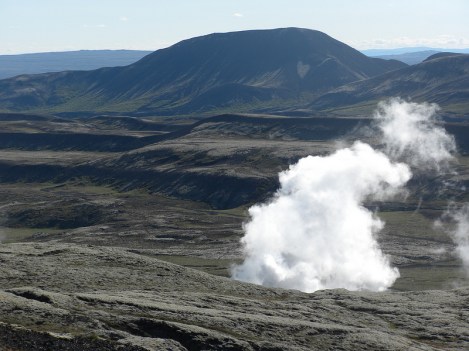
Fumarole Near Thingvellir

Fumarole Near Thingvellir

Some time ago, I heard that Iceland was looking for some way to store electricity for transshipment to other countries that were shortchanged of the fuels required to run their turbines. It appeared that, with all their volcanoes, the little island nation was sitting on an infinite source of energy. After all, one just had to punch a hole in the ground, and steam would come pouring out.

But the actual situation is more complicated than that. For one thing, there is a relatively new kind of pollution that occurs when you harness the seemingly infinite energies of molten lava under the earth. For one thing, you get Hydrogen Sulphide pollution, which is already so bad in Reykjavík that it adversely affects sound recording equipment. The geothermal power plant at Hellisheiði is some 30 km east of the capital—contrary to the prevailing westerly wind. Yet H2S precipitates on copper and silver lead to a shortening of the equipment’s life. This could put a serious crimp in Iceland’s attempt to become a rock and roll superpower.

Then there is the matter of polluted effluent lagoons for the steam that has cooled. These pool are loaded with minerals, the concentration of which has not yet been sufficiently studied. The tourist area south of Hellisheiði, Hveragerði, is complaining that pollutants are leaching into their soil and water supply.

The Geothermal Power Plant at Hellisheiði

The Geothermal Power Plant at Hellisheiði

When Iceland lurched into its own economic recession in 2008, the solution was to build even more geothermal plants, which could generate power to run gigantic aluminum smelters—one of the most energy-intensive industrial processes known to man. The plan was to put up a cluster of power plants just to power the giant smelter at Helguvík, just south of the capital on the way to the airport. But then it was found that Hellisheiði produced insufficient power to run the smelter, and that the additional power plants envisioned by the government were running into strong opposition from the ecology-minded citizens.

Not only that, but the Hellisheiði plant was in danger of being tapped out.


Fading from View

At Vatnajökull

At Vatnajökull

I have been back in Southern California for three weeks, and only now am I no longer dreaming about Iceland. It is time to get on with the rest of my life. From time to time, I will return with a post about Iceland, but it is no longer occupying the front and center position of my life. (Of course, I would dearly love to return and spend some more time in the Northeast of the island.)

In the above photo, I am standing at the tongue of Heinabergsjökull, one of the extensions of the gigantic Vatnajökull icecap, the third largest in the world after Antarctica and Greenland.

At the same time that Iceland is starting to fade from view, so is Vatnajökull itself. Over the last eighty years, the glacier has pulled back from the edge of the sea for several miles and shows signs of a further retreat. In the 1930s, if I were standing in the same position, there would be perhaps a hundred meters of ice below me (or above me).

What I hope will never fade from view are my memories: Iceland occupies a special place in my heart—along with Patagonia, the American Southwest, Yucatán, and the islands off the coast of Scotland. Visiting those places has, to a large extent, made me the person I am today. I went from being a little kid whose family was too poor to take him anywhere to a grown-up who has developed an insatiable itch for travel.

Who knows what the next few years will bring? My gaze is still skipping around the globe, looking for places that might interest me. And I hope that Martine can accompany me, because her presence and her sense of wonder make everything better.


Iceland Is for the Young

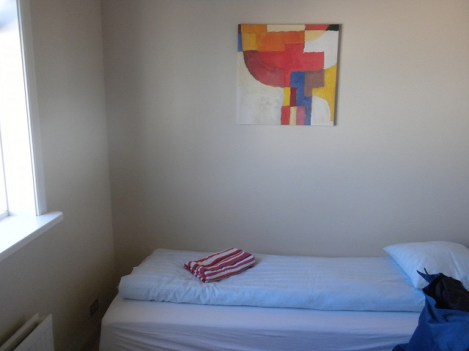
The Gamla Youth Hostel in Ísafjörður

The Gamla Youth Hostel in Ísafjörður

For some reason, I usually wind up staying at a youth hostel at least once on each vacation. In Iceland, it was because I delayed too long waiting for Martine’s health to improve before making my reservations. The impression I had was that not too many people traveled up north to the remote Westfjords. It turned out that I was wrong. Although I got two nights at the business-class Hotel Ísafjörður, my last two nights in the Westfjords were to be spent in a dorm room at the Gamla Guesthouse.

Now this brings up an interesting contradiction. Although I prefer to stay in a room myself with a made-up bed (a shared bathroom presents no particular difficulties for me), I always fear that my goods would be stolen by my fellow roommates. And, not only do I avoid talking to other tourists staying at the same hotel or guesthouse, I tend to make more friends with the young who stay in the hostels.

My roommates were a German couple and a French student named Jamie, all three of whom I grew to like—to the extent that I didn’t mind sharing information with them. (With American tourists dressed in their usual country-club resort togs, I usually answered all questions in Hungarian with a confused look on my face.)

The Westfjords were full of European backpackers looking for the weather to break so that they could catch a launch to the even more remote Hornstrandir area across the fjord. A hike there usually involved several days and could be ruined by the typically bad weather of the Westfjords.

So why did I like these young people so much? For one thing I admired their courage. I would never venture to carry a tend, sleeping bag, and several days of food on my bag with the threat of uncertain weather looming. For another, for the most part my fellow tourists at the Gamla Youth Hostel (shown above) were a congenial set of people. What I shared in common with them is that I had booked my trip myself and did a lot of preparation reading about the history and the culture. I even knew a fair bit about the Hornstrandir Peninsula, though I had to admit I was too old for its rigors.

In Iceland, there are two classes of accommodation, which can be roughly described as made-up bed accommodations and sleeping-bag accommodations. For the latter, a bed is provided—but without a pillow or cover. (I paid extra, because I knew what it was like to sleep in a stinky sleeping bag from past experience.) So I had what was, in essence, a made-up bed in a sleeping bag accommodation youth hostel. I got a few snarky looks from the management, but I succeeded in pointing out to them that Booking.Com, through which I made the reservation, said nothing about sleeping bags. And I was willing to pay the extra 1,700 kronurs for breakfast at the neighboring guesthouse under the same management, which was pretty good. (I especially liked the lumpfish caviar.)

Needless to say, I felt accepted even though I was by far the oldest person staying at the hostel.

1,017

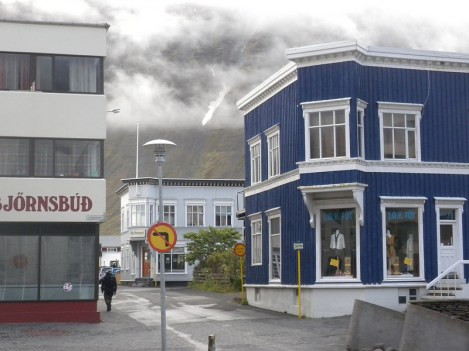
Downtown Ísafjörður in the Westfjords

Downtown Ísafjörður in the Westfjords

It took a while, but now I have all 1,017 photographs I took in Iceland (minus a few obvious nixies) available on Yahoo! Flickr. You can see them by clicking here.

Eventually, I will take the hundred or so best pictures, create title pictures and maps, and add a soundtrack. Then I’ll try to get some cloud space and store it there. At that point, I will let you know how to access it..

Every once in a while, you will see a dark vertical line at the right edge of the picture. That started happening when I accidentally dropped my camera on Austurstræti in Reykjavík. Now when I take a picture, the camera makes a funny noise and some, but not all, of the pictures have the dark line. Otherwise, they seem to be all right.


From Point A to Point B—Without Crowflies

Beautiful But Deadly

The Westfjords of Iceland have only some 7,000 residents. Although many formerly cinder-only roads are now paved, there are several very good reasons why visiting motorists outrageously underestimate the driving time between two points. For instance, let’s take the land route between Reykjavík and Isafjördur. As the crow flies, the distance only amounts to 222 kilometers; but, alas, there are no crowflies in Iceland.

If you insist on paved roads all the way, it takes between 6-7 hours to take the Ring Road and branch off north of Bogarnes to Route 61 via Holmavík. That part’s fairly straightforward, but then you have follow the fjords as they zig and zag along Isafjördurup for some three hours. That’s about 30 km (18 miles) of the air distance per hour. Check out this circuitous route:

Check Out the Road South East of Isafjördur

Check Out the Road South East of Isafjördur to Holmavík

For over three hours from Isafjördur south, one must follow the contours of the fjords and of the giant basaltic hogbacks that stretch out like fingers and define them. Only at one point is there a bridge that cuts the distance—slightly.

A slightly faster option is to drive to Stykkisholmur and take the Baldur car ferry to Brianslækur, driving the 90% cinder Route 60 due north to Isafjördur. (The only benefit on this route is that one gets to see the falls at Dynjandi, which is one of the most lovely in all of Iceland.) It takes an hour less, but driving this road will take its toll on you in other ways. At the end is a spectacular tunnel between Þingeyri and Isafjördur. (Without that tunnel, I don’t know whether it is even possible to visit the southern part of the Westfjords without air transport.)

I suspect that many tourists just fly to the Westfjords and rent a car there.

Many long-distance buses in the Westfjords only run three days a week. The Sterna bus between Isafjördur and Holmavík on a Sunday was so full of backpackers and their impedimenta that there was barely room to get in or out.

But was it worth it? Yes, indeed. And I’d to it again!

Running Around in the Land of the Midnight Sun

My Guesthouse in Reykjavik at 11 pm

My Guesthouse in Reykjavik at 11 pm

My first day in Iceland began with my arrival at Keflavík Airport around 6:30 am Greenwich Mean Time (GMT). (I should add that it is not Daylight Savings Time, which is not needed when it’s light 24 hours a day.) In Los Angeles time, it was only 11:30 pm on the previous day. I knew that my sleep pattern would be massively disrupted if I tried to hit the sack at that point.

What I did was to go all over the place so I wouldn’t sleep until around 11 pm GMT. To that end, here is a partial listing of what I did on the first day:

  1. The first stop was the excellent information center of The Icelandic Travel Market at Bankastræti 2, where I picked up a 3-day Reykjavík Welcome Card and some local bus schedules.
  2. In 2001, I never got a chance to visit the original saga manuscripts; so I took care of that right away by stopping in at The Culture House.
  3. Then I walked over to the city’s famous hot dog stand: Bæjarins Beztu and got eina pylsur með öllu (what they call a hot dog with everything). Very tasty!
  4. Then it was off to the old port to book a Sea Adventures puffin tour by boat to the Isle of Lundey (“Puffin Island”) in Faxafloi Bay.
  5. I had some time to kill, so it was off to the Settlement Museum, also known as Reykjavík 871±2, where I saw the ruins of one of the original farmhouses from the 9th century A.D.
  6. I hung around the Old Harbor waiting for the puffin tour, which I loved.
  7. Next: Get a great fish dinner, using my Reykjavík Welcome card 10% discount at The Fish Company, where I dined on arctic char and other Icelandic fish delicacies. It was what my British friends would call “splashing out,” but it was worth every penny!
  8. That put me in the mood for GoEcco’s Haunted Walk of Reykjavik at 8:00 pm local time.

By the time the Haunted Walk ended around 10:30 pm, I was feeling a bit haunted myself; so I trudged back to the Guesthouse Odínn, ready to hit the sack.

The Sack

The Sack

I expected to have trouble dealing with the sun being up 24 hours on the longest day of the year, so I had purchased a sleep mask. All that did was make my head sweat, so I decided I would just deal with it. I laid it aside, never to pick it back up, and sank into a deep, dreamless sleep. I woke briefly around 3:00 am and saw the sun still up. Having warn myself out with all my running around, I had no trouble sinking back into sleep.


The Word for World Is Hraun

Hraun Is the Icelandic Word for Volcanic Waste

Hraun Is the Icelandic Word for “Volcanic Waste”

Few countries lay out such an uninviting welcome mat as Iceland. The International Airport at Keflavik (KEF) is on the barren Reykjanes Peninsula, most of which is described as Hraun, or volcanic waste. The photo above shows the Þáinsskjaldarhraun around Vogar, which is succeeded by the Kapelluhraun as you approach the gigantic aluminum smelter just south of Hafnarfjörður. It doesn’t look very inviting, does it?

As a form of visual punctuation, from the road one can see volcanic steam rising from the ground south around Krysuvik.

And yet just about everyone I meet repeats the old chestnut that Iceland is Green and Greenland is, well, ice. Not exactly. Large stretches of Iceland—approximately 10%—are ice, in the form of glaciers. Another 50-60% are volcanic wastelands, especially in the interior of the country. Look at a map of the island, and you will notice that there are no towns in the interior—nada, zero, zip. Just about everyone lives either on the coast or in one of the scattered fertile valleys near the coast in which the lava has been around long enough to form topsoil. (Where it hasn’t, the enterprising Icelanders have planted lupines,which help the process along.)

Below is a field of lupines at the edge of a volcanic ridge:

Lupines

Lupines

As you get closer to Reykjavik (the airport is 30 km southwest), you begin to see grasses and trees; and you get to feel somewhat better about your vacation choice.

I remember my first encounter with the hraun landscapes in 2001, which made me ask myself, “What are you letting yourself in for, Jim? This looks like the Mojave Desert on ice.”


Does It Pay To Take a Chance?

KFC in Keflavik

KFC in Keflavik

During my recent visit to Iceland, I saw a number of American fast food chains represented, including KFC (see above photograph), Subway, Quizno’s, and several others—but, curiously, no hamburger chains. McDonald’s was there, but is gone now. I guess they couldn’t make a go of it.

As I would avoid most of these chains at home, I didn’t care to patronize them on my vacation either. Mostly, I looked for fish dishes, which were always fresh and delicious. Once I had a hamburger on the main drag in Isafjördur at Hamraborg and found it by no means inferior to  American burgers. In fact, I thought the béchamel sauce was a nice touch.

Not all of Hamraborg’s offerings looked quite so appetizing:

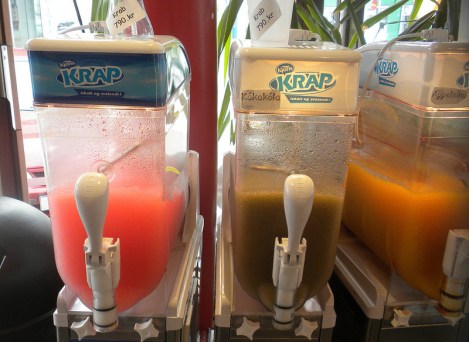
A Local Specialty I Decided Not to Try

A Local Specialty I Decided Not to Try

It looked as if it were loaded with sugar anyhow.

As in California, the type of restaurants I preferred were one-of-a-kind. At Háholt in Mossfellsbær, for example, I had a long wait; so I passed by the KFC and Subway and found a delightful little place near the local Bonus Supermarket:

I Was Probably the First American To Eat Here

I Was Probably the First American To Eat Here

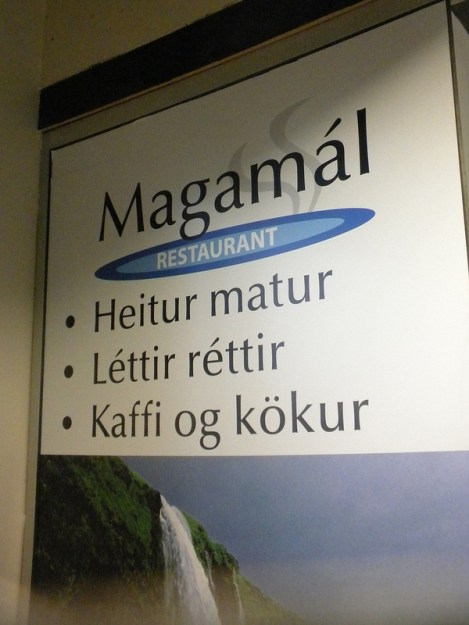
Now the sign doesn’t really tell you very much, does it? (I know the last line refers to coffee and cakes, however.) But I talked to the owner as he moved some tables and chairs outside and I decided to eat there. I had some great soup and a delicious piece of codfish with fresh vegetables. The owner was a bit of a health nut, and that fit in perfectly with my dietary restrictions. That was probably my best lunch in Iceland. I told the owner I was delighted not to have to eat at Subway or KFC, which were the only other choices within walking range.

Sometimes it pays to take a chance.


Puffin Safari

Never Did I Think It Would Be So Difficult

Never Did I Think It Would Be So Difficult

On one hand, I saw literally thousand of puffins. On the other hand, I had no idea they were such agile little buggers. They hang out along the tops of cliffs, where they create burrows in the topsoil to serve as nests. If you try to approach them, there is a good chance the soil will collapse into one of their burrows, sending you catapulting over the edge.

Icelanders eat puffins. They catch them by dangling on a rope from the top of the cliff and catching the puffins with a net that looks something like a lacrosse stick. But I was not interested in eating any puffins—although I had the chance—because, well, I started to admire these clownfaced little birds.

The above photo, and the cropped and heavily manipulated photo below is taken from the above picture, just so that you can get a close-up view of a real live wild puffin (Fratercula arctica).

Close-Up from the Top Photo

Close-Up from the Top Photo

All in all, I saw puffins on Lundey Island in Faxaflói Bay, on the Westman Islands (by the thousands), and on Vigur Island on Isafjarðardjúp fjord. The above photo was taken on Vigur, where the wind and rain kept the puffins from venturing into its teeth. The pictures were taken with the maximum telephoto setting on my Nikon CoolPix s630. I had to work fast, because the puffins would dart around quickly, and it took several seconds between pictures for my camera to reset.

It’s not like Argentina, where Martine and I paid a visit to several hundred thousand Magellanic penguins, who just stood by quizzically wondering whether we were good to eat, or what. That enabled me to get lots of close-ups, because they weren’t exactly flying off.

Because Martine was not with me on this trip, I wanted to at least get some good puffin pictures to show her. We had looked for puffins in Scotland in 1998, but we were too early. I looked for them in Heimaey in 2001, but I was too late.

I guess the puffins, in the end, were easier to photograph than moose. They weren’t quite so shy, they were around in great abundance—but you had to act fast.

Politics As It Should Be

Outgoing Icelandic Prime Minister Johanna Sigurdardottir

Outgoing Icelandic Prime Minister Johanna Sigurdardottir

There is a delightful little video on YouTube about the recent change of government in Iceland. Although I didn’t understand a word of it, I loved the spirit of the whole thing. Instead of doing the kind of mean-spirited things that characterize American politics, the Icelanders had a little fun with it. In particular, do not miss the bomb-detecting robot in the Prime Minister’s Office Building! (That’s the two-story 18th century building shown in the video, also worn as a hat at the beginning.)

By the way, outgoing PM Johanna Sigurdardottir was probably the first lesbian head of state who was in a same-sex marriage.