Recovering from Illness

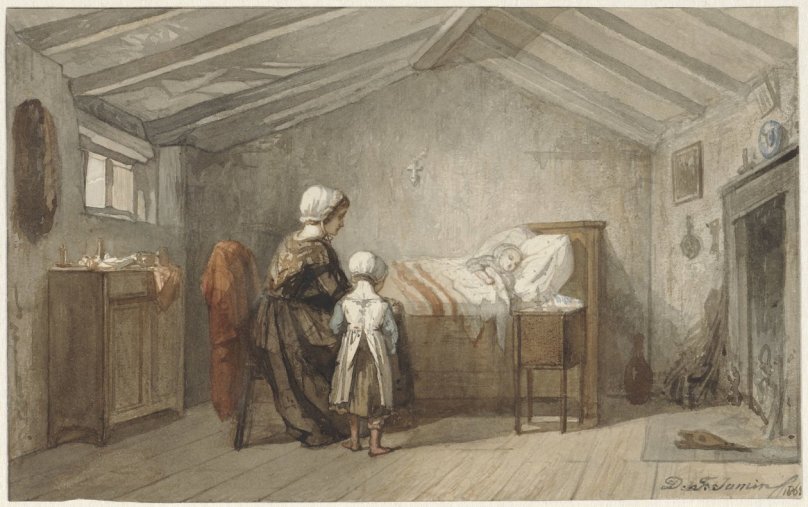
Mother and Daughter by the Sickbed of a Child by Diederik Franciscus Jamin

The above sketch from Amsterdam’s Rijks Museum pretty much describes how I spent most of this week. Something I ate on Tuesday violently disagreed with me, so in addition to the usual messy food poisoning symptoms, I was totally prostrated. Picture Martine at my side feeding me endless glasses of water to avoid dehydration along with hydrocortisone to make up for my body’s inability to produce adrenaline. Without the hydrocortisone, I was likely to die.

To avoid concentrating on the messy details, I would like to present a poem by Robert Louis Stevenson I remember from when I was a boy of ten sleeping in my parents’ bed while I was sick and they were at work. Half the time, my great-grandmother was around to feed me. It presents a very vivid picture of illness seen from the point of view of a child.

The Land of Counterpane

When I was sick and lay a-bed,
I had two pillows at my head,
And all my toys beside me lay,
To keep me happy all the day.

And sometimes for an hour or so
I watched my leaden soldiers go,
With different uniforms and drills,
Among the bed-clothes, through the hills;

And sometimes sent my ships in fleets
All up and down among the sheets;
Or brought my trees and houses out,
And planted cities all about.

I was the giant great and still
That sits upon the pillow-hill,
And sees before him, dale and plain,
The pleasant land of counterpane.

Sick Again

Twice in the last eight days, I have come down with a combined attack of nausea and diarrhea complicated by a lack of adrenaline to fight them. Both times, I wound up lying on my back in bed while my intestines attempted to turn my body into a Niagara of something browner and more disgusting than Lake Ontario.

I felt almost too weak to make the occasional dash to the bathroom, and for a while, I had the chills.

There was no fever, however, and there was a very clear solution. I took 60 mg of Hydrocortisone and waited several hours for it all to go away. By 4 PM, I was up and about and even able to eat some crackers and plums.

The good thing about my lack of a pituitary gland in these situations is that the solution is increased Hydrocortisone or Prednisone. The illness departs in a few hours and leaves no trace behind.

Except, one of these days I will be alone and too sick to take the steroids, and I will slowly, peacefully, glide out of this life. It’s not a bad death as deaths go, but it is just as final as any other.

Sorry I had to leave you with this image, but it is an aspect of my life that I cannot ignore. Thanks to Martine’s kind nursing, I’m still kicking.

Back to the Books

Enjoyable Books: Just the Thing I Need!

After a month of illness, I have finally returned to my first love: reading. I started with a reread of Lawrence Durrell’s Balthazar (the second volume of The Alexandria Quartet) and then picked up John Le Carré’s Agent Running in the Field.

On Thursday, I plan to resume my weekly visits to the Central Library in downtown Los Angeles. The combination of a guided Mindfulness Meditation session with access to the vast circulating holdings of the library is my indication that things are returning to normal. Plus, I have seven overdue books to return.

This January has been my worst month in many a year. Add to that the fact that it was Los Angeles’s worst month in thirty-one years. What happened in 1994 that was so bad? The Northridge Earthquake on January 17 of that year.

Return to Life

Two Weeks of Acid Reflux!

If I have not been posting much lately, it is because I have been ill. The month started with an Addisonian Crisis (lack of adrenaline). No sooner did I get discharged from UCLA Ronald Reagan Hospital than Los Angeles damned near burned down. Then I started feeling week with a severe pain around my sternum. That turned out to be acid reflux.

As a result, I lost nineteen pounds because it was just to painful to eat. Even when I put myself on the BRAT diet (Bananas, Rice, Applesauce, Toast), any food make my stomach hurt for hours.

Finally, my doctor put be on a drug that relieved the pain. Now I have to be able to build up my strength after lying on the couch for weeks.

Hopefully, I’ve seen the worst and am on the mend. Wish me luck!

Puzzlement

The Human Body Is an Endless Mystery

Yesterday I didn’t post because I had one of my periodic, mystery illnesses. The symptoms were weakness, diarrhea, and vomiting. This time, I did not go into the emergency ward because I knew that I would get better in a few hours, especially after taking four 10mg hydrocortisone pills.

As I no longer have a pituitary gland, that is meant to supply me with the adrenocorticotropic hormone (ACTH) my body no longer produced on its own. Apparently, when I get one of those episodes—with or without diarrhea and vomiting—it usually takes six to eight hours to return to normal.

Was it food poisoning that caused my illness? Was it low blood pressure (which was lower than usual when I measured it in the evening)? Was it high blood sugar (which was in fact running high when I measured it in the late afternoon)?

The thought suddenly came to me that we are so used to living in a digital world with its clearly demarcated boundaries that we tend to forget that we are primarily an analogue entity. My doctor thinks that what causes these incidents is an interaction involving the hormonal, circulatory, and digestive systems. Whatever the condition(s) that cause me to go out of whack, the treatment is the same: Hydrocortisone or Prednisone. Or 100mg Solu-Cortef injected into my bloodstream.

I will probably never find out what causes these bodily crises. I would be willing to bet that it may not even be determinable from an autopsy.

The health of the body is a mystery. I just have to be careful about eating, sleeping, pushing my body beyond its limits, and everything else. At the same time, I have to maintain a certain sense of humor about what is an endless conundrum.

On To O’ahu

Tomorrow Martine and I are headed off to Honolulu for a week in the sun. The last few days, both of us have had a low-level flu. I am getting better, but Martine has a real problem with insomnia. Some years ago, she got too used to taking prescription sleeping pills and is dismayed to find that they don’t work as well as they used to. The best thing would have been not to get hooked on them in the first place, but that boat has sailed.

We’ll be staying at the same hotel we stayed at last year. It may not be on he beach, but we would prefer not to hang out at the beach. We prefer the hotels on Kuhio Avenue, one or two blocks makau (inland) from the beachfront properties on Kalakaua Avenue.

Tonight I don’t expect to get much sleep. And because of the time zone difference, tomorrow will be a 27-hour day. I expect both of us will get a good night’s sleep tomorrow.

Look for this blog to resume on Wednesday or Thursday of next week. Until then, aloha!

Kahuna Lapa’au

In preparation for an upcoming trip to Hawaii in a couple of weeks, I am reading the work of a distinguished novelist and microbiologist: O. A. Bushnell’s The Gifts of Civilization: Germs and Genocide in Hawaii. Never before have I read a book about what happens to public health when a 19th century Western power takes over a primitive aboriginal society.

Bushnell claims that the native Kahuna Lapa’au healers were not inferior to American physicians of the period. When you consider that 19th century medicine was into bloodletting, blistering, and the ingestion of mineral poisons. it is not surprising that aboriginal healers were in now wise inferior.

Unfortunately, they were dealing with a whole new range of illnesses introduced by the white man, diseases such as measles, smallpox, malaria, leprosy, and the various venereal diseases. This led to widespread confusion among native healers as to which treatment to use, at a time when neither American nor native Hawaiian medical practice was effective.

In this book and in his novels—The Return of Lono, Ka’a’awa, Molokai, The Stone of Kannon, and The Water of Kane—Bushnell created an impressive body of work on the interface of the two cultures.

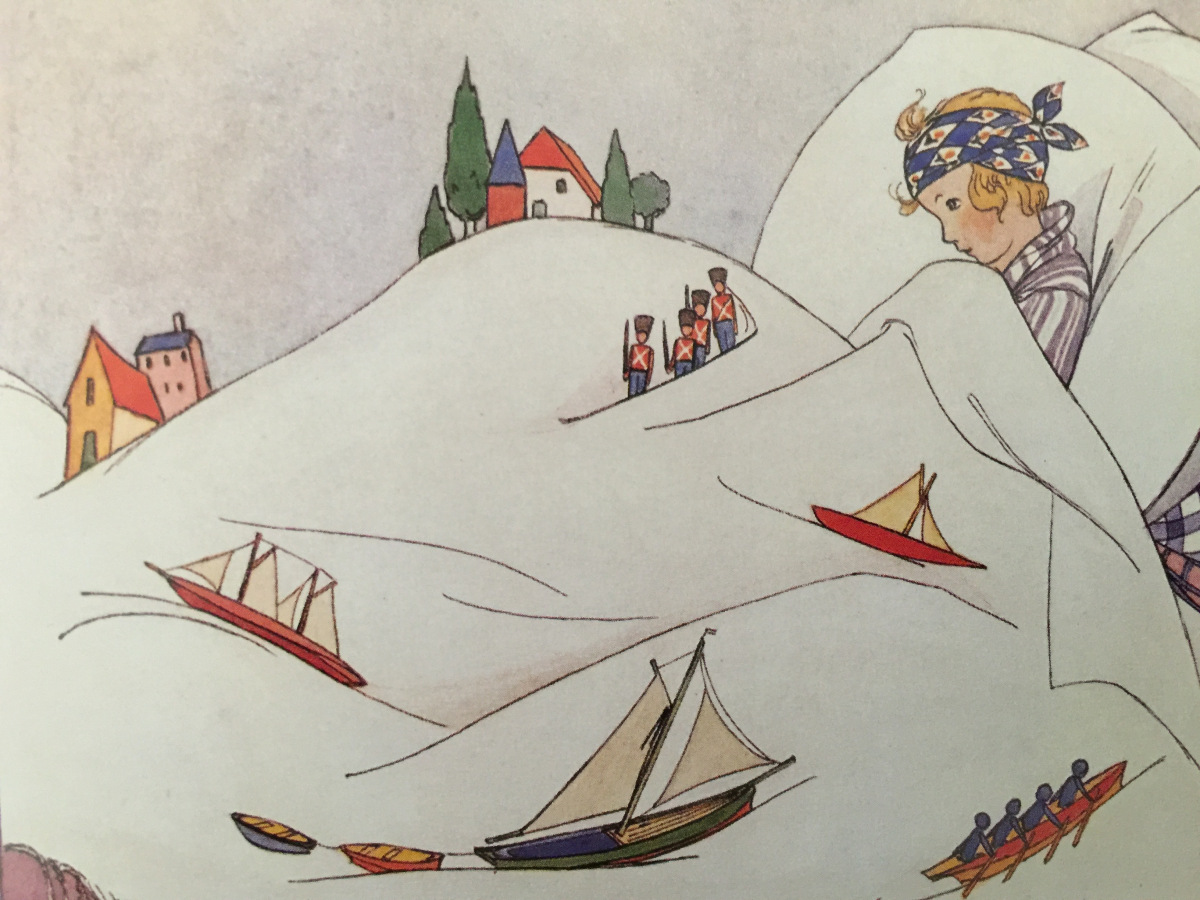
“The Land of Counterpane”

I Remember This Illustration from My Childhood

The first poem I remember was “The Land of Counterpane” from Robert Louis Stevenson’ A Child’s Garden of Verses. I was in grade school and sick with some childhood disease. While Mom and Dad were off at work, and I was being cared for by my great-grandmother Lidia Toth, I was allowed to lie in their bed. Mom had gotten be a library book with this poem in it—and with the above illustration. I don’t know which impressed me more, the words of the poem or the illustration. In any case, the memory has stuck with me through the years. Here’s the words of the poem:

When I was sick and lay a-bed,
I had two pillows at my head,
And all my toys beside me lay,
To keep me happy all the day.

And sometimes for an hour or so
I watched my leaden soldiers go,
With different uniforms and drills,
Among the bed-clothes, through the hills;

And sometimes sent my ships in fleets
All up and down among the sheets;
Or brought my trees and houses out,
And planted cities all about.

I was the giant great and still
That sits upon the pillow-hill,
And sees before him, dale and plain,
The pleasant land of counterpane.

Now, many years later, I am rediscovering RLS, especially his last years in the South Pacific. I wonder if, somehow, my memory over the great gulf of years, has anything to do with my wanting to go back to Stevenson and reacquaint myself with his work. In any case, that’s what I’m doing … and I am enjoying every moment of it.


The End of Tusitala

RLS (Seated Center, Rear) and His Household in Samoa

His nickname in Samoa was Tusitala, “The Teller of Tales.” He had gone to Oceania for his health. It is not known what the exact nature of his illness was, but it seemed to be hereditary. His mother died of an apparent stroke at the age of 38. When he died on on December 3, 1894, Robert Louis Stevenson was only 44.

I have just finished reading the letters that RLS wrote to his friend and sometime editor Sidney Colvin between November 1890 and October 1894. They have been published as The Vailima Letters, named after the author’s estate in Samoa. In them, he writes about his frequent illnesses, his involvement in island politics, and his intense efforts to make money by writing novels and stories. In those last four years, he wrote:

  • Catriona (1893), aka David Balfour, a sequel to Kidnapped
  • Island Night’s Entertainments (1893), aka South Sea Tales
  • The Ebb-Tide (1894), co-author Lloyd Osbourne
  • Weir of Hermiston (1896), left unfinished at the author’s death
  • St. Ives: Being the Adventures of a French Prisoner in England (1897)

At times, Stevenson’s letters rise to the level of poetry. In March 1891, he writes:

I said I was tired; it is a mild phrase; my back aches like toothache; when I shut my eyes to sleep, I know I shall see before them—a phenomenon to which both Fanny and I are quite accustomed—endless vivid deeps of grass and weed, each plant particular and distinct, so that I shall lie inert in body, and transact for hours the mental part of my day business, choosing the noxious from the useful. And in my dreams I shall be hauling on recalcitrants, and suffering stings from nettles, stabs from citron thorns, fiery bites from ants, sickening resistances of mud and slime, evasions of slimy roots, dead weight of heat, sudden puffs of air, sudden starts from bird-calls in the contiguous forest—some mimicking my name, some laughter, some the signal of a whistle, and living over again at large the business of my day.

In May1892, this description of clouds appears in the letters:

As I rode down last night about six, I saw a sight I must try to tell you of.  In front of me, right over the top of the forest into which I was descending was a vast cloud.  The front of it accurately represented the somewhat rugged, long-nosed, and beetle-browed profile of a man, crowned by a huge Kalmuck cap; the flesh part was of a heavenly pink, the cap, the moustache, the eyebrows were of a bluish gray; to see this with its childish exactitude of design and colour, and hugeness of scale—it covered at least 25°—held me spellbound.  As I continued to gaze, the expression began to change; he had the exact air of closing one eye, dropping his jaw, and drawing down his nose; had the thing not been so imposing, I could have smiled; and then almost in a moment, a shoulder of leaden-coloured bank drove in front and blotted it.  My attention spread to the rest of the cloud, and it was a thing to worship.  It rose from the horizon, and its top was within thirty degrees of the zenith; the lower parts were like a glacier in shadow, varying from dark indigo to a clouded white in exquisite gradations.  The sky behind, so far as I could see, was all of a blue already enriched and darkened by the night, for the hill had what lingered of the sunset.  But the top of my Titanic cloud flamed in broad sunlight, with the most excellent softness and brightness of fire and jewels, enlightening all the world.  It must have been far higher than Mount Everest, and its glory, as I gazed up at it out of the night, was beyond wonder.  Close by rode the little crescent moon; and right over its western horn, a great planet of about equal lustre with itself.  The dark woods below were shrill with that noisy business of the birds’ evening worship.  When I returned, after eight, the moon was near down; she seemed little brighter than before, but now that the cloud no longer played its part of a nocturnal sun, we could see that sight, so rare with us at home that it was counted a portent, so customary in the tropics, of the dark sphere with its little gilt band upon the belly.  The planet had been setting faster, and was now below the crescent.  They were still of an equal brightness.

I could not resist trying to reproduce this in words, as a specimen of these incredibly beautiful and imposing meteors of the tropic sky that make so much of my pleasure here; though a ship’s deck is the place to enjoy them.  O what awful scenery, from a ship’s deck, in the tropics!  People talk about the Alps, but the clouds of the trade wind are alone for sublimity.

I could easily come up with another half dozen passages that impressed me. And I am all the more impressed becau8se today is my father’s birthday. Were he still alive, he would be 108 years old. But, alas, he died at the age of 74—which, to be precise, is my present age—a fact which makes me ever more conscious of my own mortality.

Draining … Drained

I Felt Hurled Back into Childhood

When I was a child, I suffered intensely from allergies. My nose was frequently blocked, so that I had to breathe through my mouth, making me feel as if I had ingested a bucket of fine sand. My mother would boil up a big pot of water and add salt to it. She had me cover my head with a towel and bend forward to inhale the salty steam. Not that it did me any good.

For decades now, I have not had the experience of having my nasal air passages totally blocked … until this last week. I got a cold which in itself was not that bad, but as soon as I climbed into bed, my nasal passages shut down a la my youth. My doctor recommended something akin to my mother’s remedy: Shoot distilled water up my nose that contains powdered salt with sodium bicarbonate. This actually works, and I am finally able to sleep in bed again.

My cold was not that bad, but the long recovery is a pain. It seems as if I fill endless handkerchiefs with mucus that has the gluey texture of rubber cement. At the same time my cold began, my eyes started to water and itch again. I have spent the better part of a week draining in various ways—and that has tired me out big time. I attribute this illness to a cold snap that has hit Southern California right after I returned from Guatemala. It seems that the temperature has not climbed up to 70º Fahrenheit (21º Celsius) since the start of the month.

Eventually the temperature will rise and I will have drained out the last cubic centimeter of mucus as well as whatever is discharging from my eyes. Until that time I will just have to be patient.