
Zero Tolerance Policy

The Twin Towers Correctional Facility in Downtown Los Angeles

Martine likes to spend a day in downtown L.A. once a week. While there, she spends some time around the Twin Towers Correctional Facility operated by the Los Angeles County Sheriff’s Department. It holds more than 2,000 inmates. Crumpled up outside the jail are interesting sheets of paper which give a lurid picture of life in stir.

Today, Martine handed me an information sheet entitled “Prison Rape Elimination Act (PREA) Comprehensive Inmate Education.” It and other informative pieces of paper are tossed away by released inmates. At the top of the sheet is the usual administrative huffing and puffing by the Sheriff’s Department (which refers to itself as the LASD):

LASD maintains a ZERO TOLERANCE POLICY for sexual harassment or sexual abuse of all inmates in its custody.

This means you have the right to be free from sexual harassment and sexual abuse by anyone, including staff, volunteers, contractors, medical and mental health staff, and other inmates, while in LASD’s custody.

You have the right to report if you have been sexually abused/sexually harassed, or if you know of someone else who has been or is being sexually abused/sexually harassed. No one deserves to be sexually abused/sexually harassed.

You have the right to report if you have a suspicion or know of threats that you or someone else will be sexually abused/sexually harassed.

Of course, if you have a ZERO TOLERANCE POLICY, it pretty much means that it is probably widespread across the institution. It is typical that the prison administrators will wish the problem away by burying it in reams of paperwork, of which this Inmate Education sheet is an example. It gives detailed information on whom to contact and how. Also included are the following tips on how to protect yourself from being victimized:

  • Stay away from gambling or trading goods with other inmates.
  • Do not use drugs or alcohol [about which there is another ZERO TOLERANCE POLICY]. Being intoxicated puts you at higher risk for sexual abuse.
  • Do not accept gifts or offers of protection from other inmates.
  • Keep this information sheet with you for future reference.
  • There are PREA posters in each housing unit that provide this information.
  • You will also see a video about PREA in your housing unit that is played on a regular basis.
  • PREA is also discussed during town hall meetings with staff.

Nowhere is the point made that if you stay out of prison, you are more likely not to be raped, abused, or harassed.
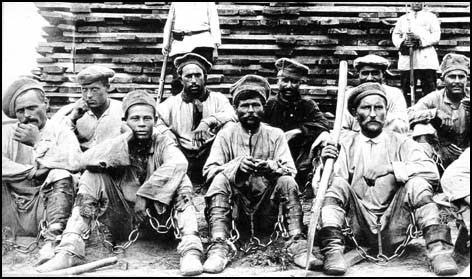
Time Off in Siberia

Tsarist Prisoners in Siberia

I have a particular love for Russian prison literature. For the third time, I am reading Fyodor Dostoyevsky’s The House of the Dead. By no means is it anywhere near the greatest of Dostoyevsky’s novels, but the subject has always fascinated me.

After the October Revolution, and especially during Josef Stalin’s reign, the literature of the GULAGs became a standard literary genre. I love Alexander Solzhenitsyn’s massive The GULAG Archipelago as well as One Day in the Life of Ivan Denisovich and The First Circle. Also well worth reading is Varlam Shalamov’s grim Kolyma Tales.

It is a common misconception that Dostoyevsky’s book is not a novel but just a thinly fictionalized account of his own four years in Omsk. At the time he wrote it, he was trying to reestablish his literary reputation after four years in prison and subsequent time with the Siberian Army Corps of the Seventh Line Battalion in Semipalatinsk. He was worried that if he wrote a book that was less than uplifting, he would once again be regarded as a political prisoner and suffer excessive censorship.

While it is anything but pollyanna-ish, The House of the Dead provided a rare look at the Tsar’s prison colonies on the other side of the Ural Mountains.

An Impassioned Plea for Freedom

Gulag Prisoners in Siberia

Gulag Prisoners in Siberia

Fyodor M. Dostoyevsky could hardly believe his eyes. He had spent four years in a Siberian prison camp and six years in the Russian military in Siberia. His first published works after returning to St. Petersburg were comedies: Uncle’s Dream and The Village of Stepanchikovo. Now he wrote two short pieces for publication about his experience in the camp. The first was approved by the Tsarist censors; the second, rejected—because it was thought that Dostoyevsky was saying that life in the Gulags was actually quite appealing.

That could not be allowed to stand. Dostoyevsky immediately penned a supplement to that piece, which included the following:

What is bread? They [the convicts] eat bread to live, but they have no life! The genuine, the real, the most important is lacking, and the convict knows he will never have it; or he will have it, if you like, but when? … It’s as if the promise is made only as a joke.

Try an experiment and build a palace. Fit it out with marble, pictures, gold, birds of paradise, hanging gardens, all sorts of things…. And step inside. Well, it may be that you would never wish to leave. Perhaps, in actual fact, you would never leave. Everything is there! “Let well enough alone!” But suddenly—a trifle! Your castle is surrounded by walls, and you are told: “Everything is yours! Enjoy yourself! Only, don’t take a step outside!” And believe me, in that instant you will wish to quit your paradise and step over the wall. Even more! All this luxury, all this plenitude, will only sharpen your suffering. You will even feel insulted as a result of all this luxury…. Yes, only one thing is missing: a bit of liberty! a bit of liberty and a bit of freedom!

This impassioned plea is perhaps the germ of Dostoyevsky’s great works which were to follow: Notes from the Underground, Crime and Punishment, The Idiot, The Possessed, and The Brothers Karamazov.