Halfway through my re-reading of The Lord of the Rings trilogy, I have come to realize that orcs really do exist. They are capable of only one feeling: Rage. And they meekly do the bidding of the Dark Lord, who is squirming in frustration at Mordor-a-Lago as further indictments attempt to break his power forever. They are distributed across the land, but most particularly in what has been referred to as the Red States.
Am I perhaps being too simple-minded? Perhaps. But the peace of Middle-Earth is in danger of being shattered forever. The land in which I was raised is being threatened by dark hordes who, while waving the same flag to which I pay allegiance, are quite satisfied to stomp on and destroy everything it stands for.
Somehow, over the last few decades, we have been nurturing a generation of thugs who have declared unending enmity with the elves and other libtards whom they feel have been sneering at them.
Oh, where is that ring of power now that I want to throw it into a white-hot dumpster fire?
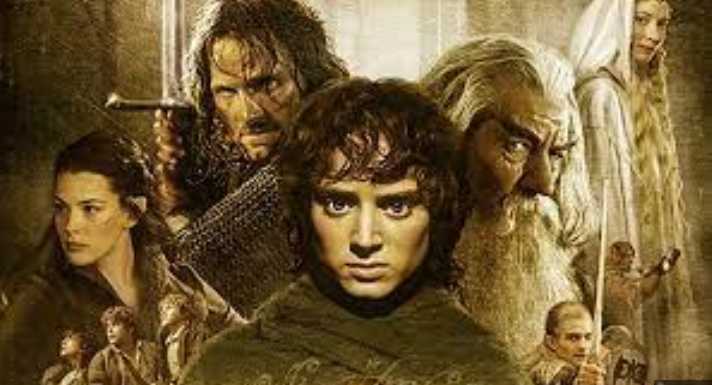
The Main Characters from Sir Peter Jackson’s Film Version
I have decided that I will have a J. R. R. Tolkien summer during which I will re-read the Lord of the Rings trilogy and undertake to read The Silmarillion for the first time. And I will see all three films in Sir Peter Jackson’s masterful film version. (I own all three films on DVD). I have already had the same book/film experience last year with The Hobbit.
Less than half an hour ago, I completed my re-reading of The Fellowship of the Ring, probably my favorite novel of the three, because all nine major characters are interacting with one another during much of the length of the story.
It seems that Tolkien’s trilogy never grows old. I cannot but think that it is one of the great literary accomplishments of the Twentieth Century. It is fantasy, but with an eye cocked at the growth of fascism in Europe during the 1930s and its harvest as the Second World War. I wonder if someone even half so good as Tolkien will chronicle our own uneasy times.
It was inevitable that I would re-read The Lord of the Rings for the third—or is it the fourth?—time. Too much of my memory of the volumes in the trilogy have been replaced by my memory of the masterful Sir Peter Jackson films. And a good thing, too! I was beginning to forget the Old Forest, Tom Bombadil, and the Barrow Wights, which were not represented in the film version of The Fellowship of the Ring (Volume I of The Lord of the Rings).
I first heard about J. R. R. Tolkien’s fantasy masterpiece from an exhibit at Dartmouth College’s Baker Library. A number of professors were asked to exhibit the books which most influenced them, and there, under glass, were first editions of the three volumes. I was enthralled before I ever read a word of it.
Only when I came to Los Angeles in the late 1960s did I find the trilogy being published in paperback. Naturally, I bought all three volumes and read them. I even read a very funny Harvard Lampoon parody called Bored of the Rings. (Do I still have it in my massive library?)
Now I am reading it in the glorious Folio Society hardbound edition, complete with glorious woodcuts and an Anglo-Saxon motif cover. Amazingly, I find myself being drawn into the story yet again, as if I were encountering it for the first time.
What a master story-teller Tolkien was! I must remember to also read The Silmarillion when I have finished re-reading the trilogy.
A good number of dwarves will fill the screen in the upcoming movie, The Hobbit: An Unexpected Journey, but they’re just a few of the hundreds of characters J.R.R. Tolkien created for Middle-Earth.
As I am re-reading J.R.R. Tolkien’s The Hobbit for the second time, I thought I might reprint the words from one of the songs in the book—probably the most evocative of them all.
Far over the misty mountains cold
To dungeons deep and caverns old
We must away ere break of day
To seek the pale enchanted gold.

The dwarves of yore made mighty spells,
While hammers fell like ringing bells
In places deep, where dark things sleep,
In hollow halls beneath the fells.

For ancient king and elvish lord
There many a gleaming golden hoard
They shaped and wrought, and light they caught
To hide in gems on hilt of sword.

On silver necklaces they strung
The flowering stars, on crowns they hung
The dragon-fire, in twisted wire
They meshed the light of moon and sun.

Far over the misty mountains cold
To dungeons deep and caverns old
We must away, ere break of day,
To claim our long-forgotten gold.

Goblets they carved there for themselves
And harps of gold; where no man delves
There lay they long, and many a song
Was sung unheard by men or elves.

The pines were roaring on the height,
The winds were moaning in the night.
The fire was red, it flaming spread;
The trees like torches blazed with light.

The bells were ringing in the dale
And men looked up with faces pale;
Then dragon’s ire more fierce than fire
Laid low their towers and houses frail.

The mountain smoked beneath the moon;
The dwarves, they heard the tramp of doom.
They fled their hall, to dying fall
Beneath his feet, beneath the moon.

Far over the misty mountains grim
To dungeons deep and caverns dim
We must away, ere break of day,
To win our harps and gold from him!
I have been spending some time in Middle Earth the last few days, watching Sir Peter Jackson’s Hobbit trilogy. It made me think of much I don’t like about my fellow Americans, particularly white males. With their scruffy look, tattoos, and exaggerated machismo, I see many of them as little better than Tolkien’s orcs. Take this quote from The Lord of the Rings:
Much of the same sort of degraded and filthy talk can still be heard among the orc-minded; dreary and repetitive with hatred and contempt, too long removed from good to retain even verbal vigour, save in the ears of those to whom only the squalid sounds strong. [Italics mine]
Look at our movie heroes. How many of them remind you of the figure above? Sly Stallone, Vin Diesel, Bruce Willis, Dwayne Johnson, Russell Crowe—all could be cast as Middle Earth villains. The tent-dwelling homeless population of Los Angeles all look like orcs. It’s a look they tend to strive for: The “No one messes with me” look. I mean, who would want to? Even the police are not eager to make contact with males who look mean and diseased at the same time. Would you even want to share a police cruiser with one of them?
As for myself, I’m not into aggressive squalor. I’d prefer to throw in my lot with the elves, hobbits, wizards, dwarves, and men of Middle Earth.
England has produced a rich crop of fantasy writers who have latched onto the brilliantly coruscating speech of the Middle Ages and the Elizabethan Era. Their styles are at times midway between poetic and overblown. There is a framing story in which a narrator is escorted by a strange bird to the planet Mercury (?!), where there is a war between the Demons and the Witches. BTW, our narrator is dropped in the second chapter and is not heard from again.
Who are the good guys? Well, E. R. Eddison, the author of The Worm Ourobouros (1922) is content to follow both sides. Unlike Tolkien, there is no clear cut good or evil. In fact, good and evil seem to be intermixed. Here is a sample of the language:
Juss, Goldry, and Spitfire, and ye other Demons, I come before you as the Ambassador of Gorice XI., most glorious King of Witchland, Lord and great Duke of Buteny and Estremerine, Commander of Shulan, Thramnë, Mingos, and Permio, and High Warden of the Esamocian Marches, Great Duke of Trace, King Paramount of Beshtria and Nevria and Prince of Ar, Great Lord over the country of Ojedia, Maltraeny, and of Baltary and Toribia, and Lord of many other countries, most glorious and most great, whose power and glory is over all the world and whose name shall endure for all generations. And first I bid you be bound by that reverence for my sacred office of envoy from the King, which is accorded by all people and potentates, save such as be utterly barbarous, to ambassadors and envoys.
I am still in the beginning chapters of The Worm Ourobouros, so I have not made up my mind about the book—yet. Will I be enthralled by the poetic language, or slightly nauseated by the endless archaisms? Time will tell. On the plus side, my copy of the book has introductions by Orville Prescott and James Stephens (who wrote the truly poetic The Crock of Gold). His work is also admired by the likes of James Branch Cabell, J. R. R. Tolkien, Robert Silverberg, and C. S. Lewis.
There is to be a wrestling match to the death between Gorice XI of Witchland and Lord Goldry Bluszko of Demonland in lieu of an outright war (at least for the time being):
My hippogriff travelleth as well in time as in space. Days and weeks have been left behind by us, in what seemeth to thee but the twinkling of an eye, and thou standest in the Foliot Isles, a land happy under the mild regiment of a peaceful prince, on the day appointed by King Gorice to wrastle with Lord Goldry Bluszco. Terrible must be the wrastling betwixt two such champions, and dark the issue thereof. And my heart is afraid for Goldry Bluszco, big and strong though he be and unconquered in war; for there hath not arisen in all the ages such a wrastler as this Gorice, and strong he is, and hard and unwearying, and skilled in every art of attack and defence, and subtle withal, and cruel and fell like a serpent.
I have had this book on my shelves since the late 1960s, when I bought it from the famed sci-fi/fantasy bookstore called A Change of Hobbit while it was still located in Westwood. The bookstore is no more, but it left behind fond memories by many sci-fi writers, including Harlan Ellison, who once wrote an original story while sitting in the display window of the store with a typewriter.




 Tarnmoor
You must be logged in to post a comment.