
The Game of the Goose

The Map of Paris Around Which the Plot of Jacques Rivette’s Le Pont du Nord (1981) Revolves

Sometimes one sees a great film, but it doesn’t seem so at first. Sometimes it has to rattle around in your head for a while before you realize that what you have just seen is a seminal work of art. Such is the case with the films of Jacques Rivette I have seen, particularly Le Pont du Nord (“North Bridge”).

In that film, we have two main characters, played by the mother/daughter team of Bulle and Pascale Ogier. Bulle (Marie Lafée) has just been released from prison and is too wracked with claustrophobia to enter a building or a car without freaking out. Pascale (called by the boy’s name of Baptiste) runs across Bulle three times, making her conclude that they are destined to be together. Pascale is the ultimate paranoiac, mutilating the eyes of models and actors shown on large posters.

Bulle hooks up with her old boyfriend Julien, who seems to be on some strange quest. Pascale pulls a switch on his portfolio, allowing her and Bulle to see its contents, which consists mostly of newspaper clippings and a map of Paris (above) which acts as a kind of game board. Bulle and Pascal decide to follow it, noticing that it seems to be a version of the European Game of the Goose, similar to the English Snakes and Ladders and the American Chutes and Ladders.

Bulle and Julien meet with death at the square containing the Pont du Nord, but Pascale ends up getting a martial arts lesson from “Max,” one of the mysterious characters who is also playing the game.
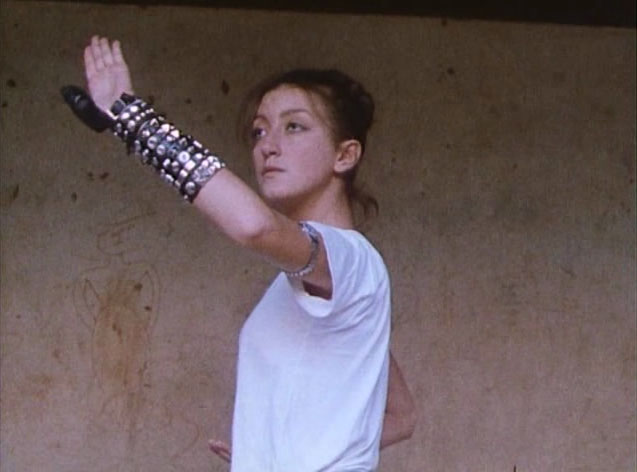
Pascale Ogier as Baptiste

I was strongly impressed by Pascale Ogier as the paranoid gamine. Three years later, she was to die at the age of twenty-five of a heart attack aggravated by her use of recreational drugs. She is one of those actresses whose eyes are expressive and who use their glances to attract the viewer’s attention (and, admit it, admiration). I was appalled to find, when checking out her career, that her life was cut so short.

Jacques Rivette is one of the lesser-known directors of the French New Wave. I have seen in all three of his films, set at the beginning—Paris Belongs to Us (1961)—the middle—the film we are discussing—and the end—La Belle Noiseuse (1991)—of his career. All of his films left me hungering for more.
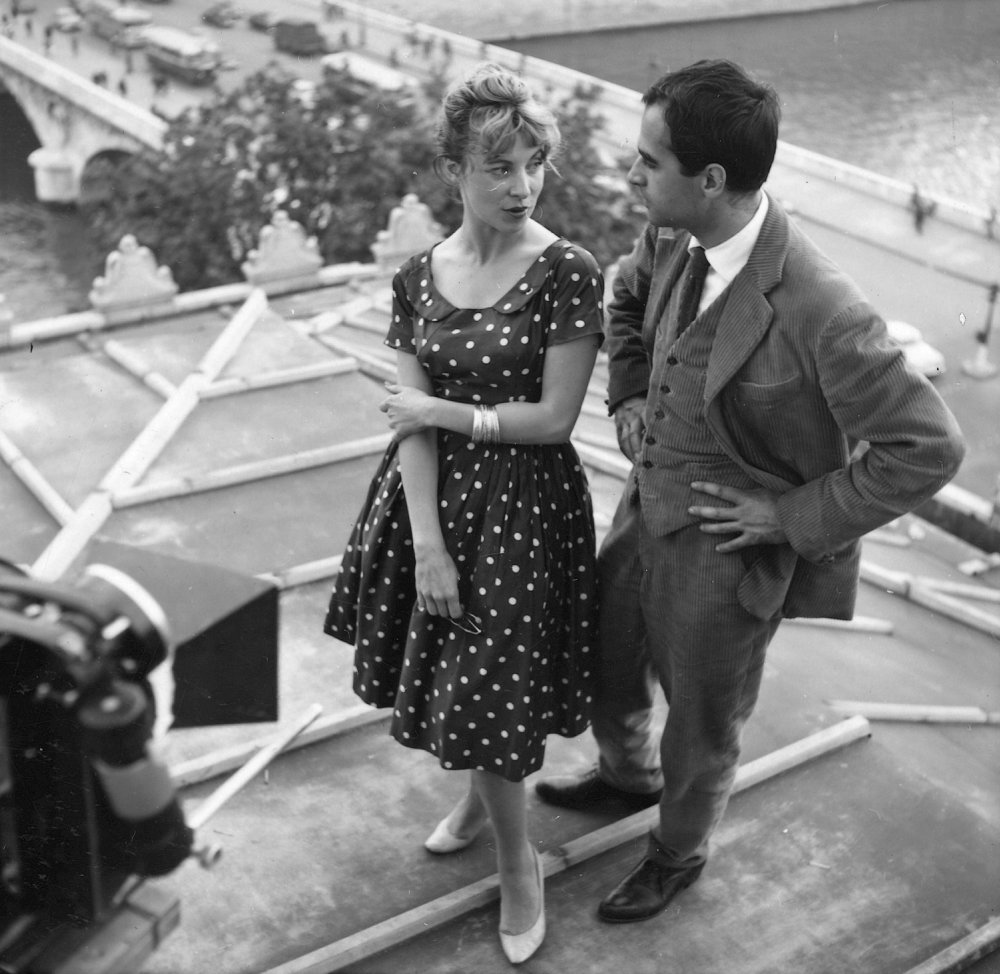
 

Favorite Films: Paris Belongs to Us (1961)

Production Shot from Jacques Rivette’s Film with Françoise Prevost and Giani Esposito

They called it “The New Wave” as if half a century more would not pass and make a mockery of the term. It’s like those terms such as modernism and post-modernism. What’s next? Postpostmodernism? YetAgainModernism? It was definitely a new movement, breaking away from the stagy studio and going off into the streets of Paris. There were a whole slew of great directors, such as Jean-Luc Godard, François Truffaut, Claude Chabrol, Alain Resnais, Eric Rohmer, Agnes Varda, Louis Malle, and let us not forget Jacques Rivette.

Rivette spent three years in making Paris Belongs to Us (Paris nous appartient). I saw it several times in the 1960s and early 1970s, and I loved the film anew with each viewing. Then the film dropped out of sight. Today, I watched the Criterion Collection version and once again fell for it. Except, now I think I understand the film whereas before I was merely dumbly enthralled by it.

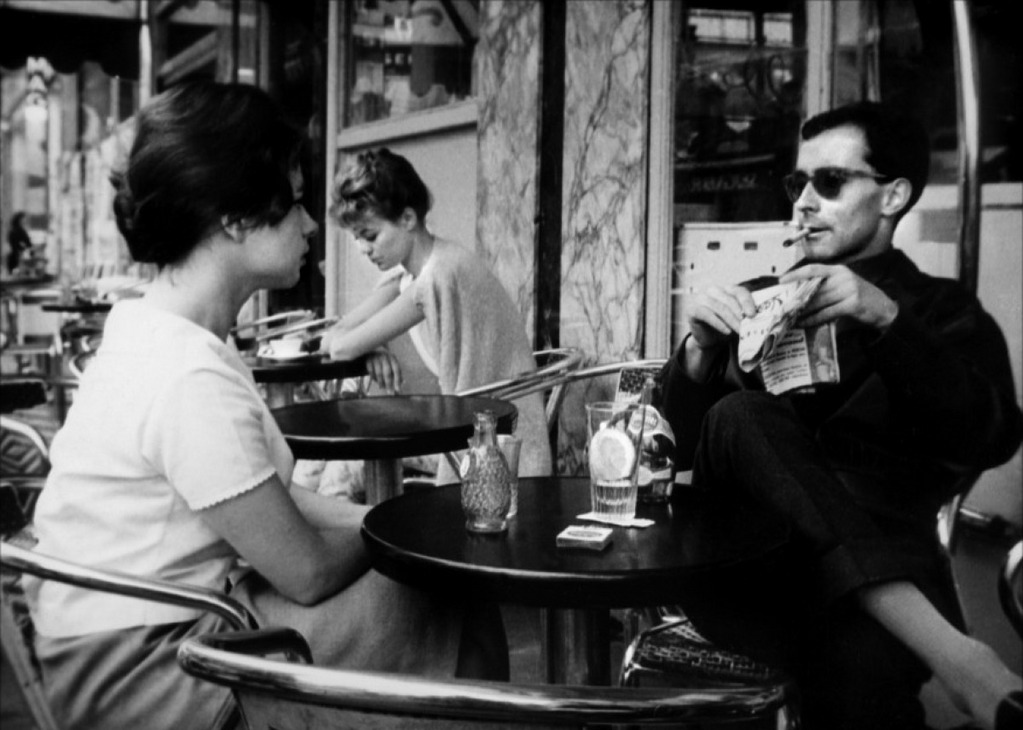
This is the ultimate conspiracy film. Betty Schneider (Anne) goes to a cocktail party where the suicide of a talented musician named Juan is discussed. The people we meet at this party will continue to play a part in the film. Anne next attends a rehearsal of a production of Shakespeare’s Pericles, Prince of Tyre directed by Giani Esposito (Gérard). She is offered the part of Marina, the daughter of Pericles; and Gérard begins to fall for her. Gérard’s girlfriend is the Sphinxlike Terry, who seems to ward off everyone. Anne goes in search of a tape that Juan had recorded for Pericles, and runs into several people who knew Juan. One of them is played by director Jean-Luc Godard (below).

Betty Schneider and Jean-Luc Godard at a Café

Other people begin to die mysteriously, including Gérard and even Anne’s brother Pierre. There is talk of a worldwide Fascist conspiracy, a theory fomented especially by Daniel Crohem as Philip Kaufman, an American fleeing the McCarthy hearings in the United States. How did Gérard die? Was it suicide, or was he murdered. It appears that Pierre was gunned down by Terry. Why? There are no clear-cut answers. There is only the persistent Betty, making the rounds of people who might know of Juan’s tape in the labyrinth that is Paris.

In the opening credits sequence of Paris Belongs to Us, there is a quote from the poet Charles Péguy: “Paris belongs to no one.” Now, as I write about this film, I want to see it again.