Battlefield Director

Tsutomo Yamazaki (Left) in Kurosawa’s High and Low (1963)

This is an unusual thing to say, but if I were to look at all the great film directors with a point of view of selecting the one that would make the best general on the battlefield, my choice would be Japan’s Akira Kurosawa (1910-1998).

Yesterday evening I did not post here because I was watching Kurosawa’s great noir film High and Low for the third time. The tale follows Toshiro Mifune as a shoe manufacturer whose son is kidnapped and held for ransom. Except it turns out that it is actually his live-in chauffeur’s son who is taken. In paying the ransom anyhow, Mifune impoverishes himself, losing his business, his house, and even his furniture.

Why do I feel that Kurosawa would make an able general? In no other film (except one, that I shall mention later) is there so much intelligently conveyed detail that enables a viewer to follow the police investigation in all its aspects during its 143 minute length without feeling lost. And the film gallops along like a 73 minuter Poverty Row quickie.

During its course, Kurosawa takes us into such a realistic picture of heroine addiction that, even today, would be too much for Hollywood to handle.

The only other film that so capably marshals s vast amount of detail is the same director’s Seven Samurai (1954). This is actually a film about a 16th century military campaign in which seven masterless samurai help farmers fight back an invasion of forty mounted bandits who are after their crops. Throughout the film’s 207 minute length, we are aware of what is happening in every part of the battlefield as the samurai and farmers battle the bandits. As with High and Low, the film zips along at a fast pace despite a vast amount of detail without losing its audience.

Compare these with the average current Hollywood production in which 120 minutes seems like a lifetime and the audience is slogging through a swamp shortly after the opening credits.

The Flying Monster from Mount Aso

British Release Poster for Rodan (1956)

Don’t be misled by the above film poster: The “Cert X” refers to the British rating at the time as unsuitable for children. When I saw Rodan in 1957, I was scared out of my pants, particularly by all the claustrophobic monster scenes in the coal mine. And now, sixty-eight years later, I saw it again the other night. Both as a twelve-year-old child and as an old codger, I enjoyed the film immensely. It really did have a cast of thousands, and it showed models of several Japanese cities being demolished by the two Rodan monsters.

Mount Aso on the island of Kyushu—the birthplace of Rodan—is Japan’s most active volcano, and among the largest in the world. It has erupted as recently as 2021.

The Crater of Mount Aso, Where Rodan Was Born

Unlike Godzilla, Rodan did not use many of the big Toho Film Studio stars, and certainly none that I recognized. And it did not feature any annoying child stars who made goo-goo eyes at the monsters.

It is always interesting to re-see movies that impressed one as a child. It’s a way of taking a measure of oneself after decades of growth. I do the same thing with books. Sometimes, as a child, I am impressed for all the wrong reasons. For instance, as a college student, my favorite book was Gilbert Highet’s The Art of Teaching. I desperately wanted to become a college professor. Now, after Gen X, Gen Z, and Gen Whatever, I have no desire to light a fire under kids whose sacred scripture is Tik Tok.

Two Women Alone in the Wild

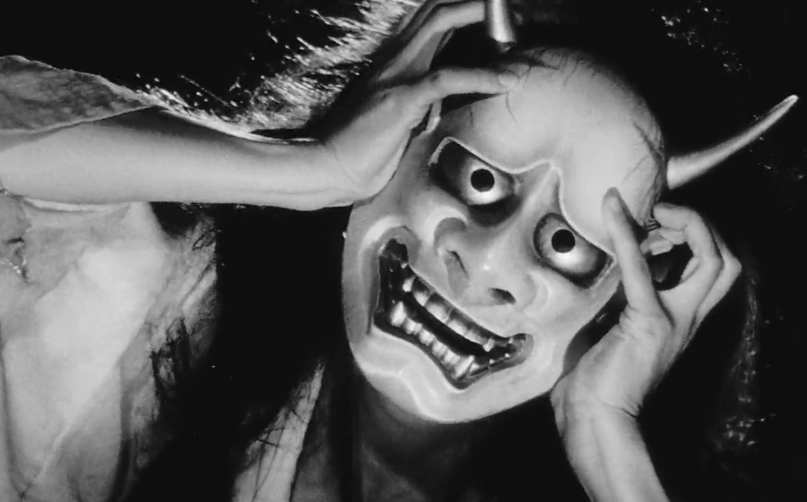
Woman Wearing Demon Mask in Onibaba

Both films begin with the same situation. In Medieval Japan, there is civil war. Men are pressed into one of the competing armies, leaving behind a mother and wife in a hut. The situation is dangerous, what with deserters and roving bands of masterless samurai. And the same actress appears in both films, Nobuku Otawa, who also happened to be the director’s wife.

The two films are Onibaba (1964) and Kuroneko (1968), both by the same director—Kaneto Shindo— and both produced by the Toho Studio. In the former film, the hut is located in a sea of tall reeds; in Kuroneko, in a bamboo forest.

In the 1960s, I believe that the best films produced anywhere in the world were made by a handful of Japanese film studios: Toho, Daiei, Schochiku, Nikkatsu, and Tohei. Although Hollywood pioneered wide-screen films, it was the Japanese who mastered the medium, whether in black and white or in color.

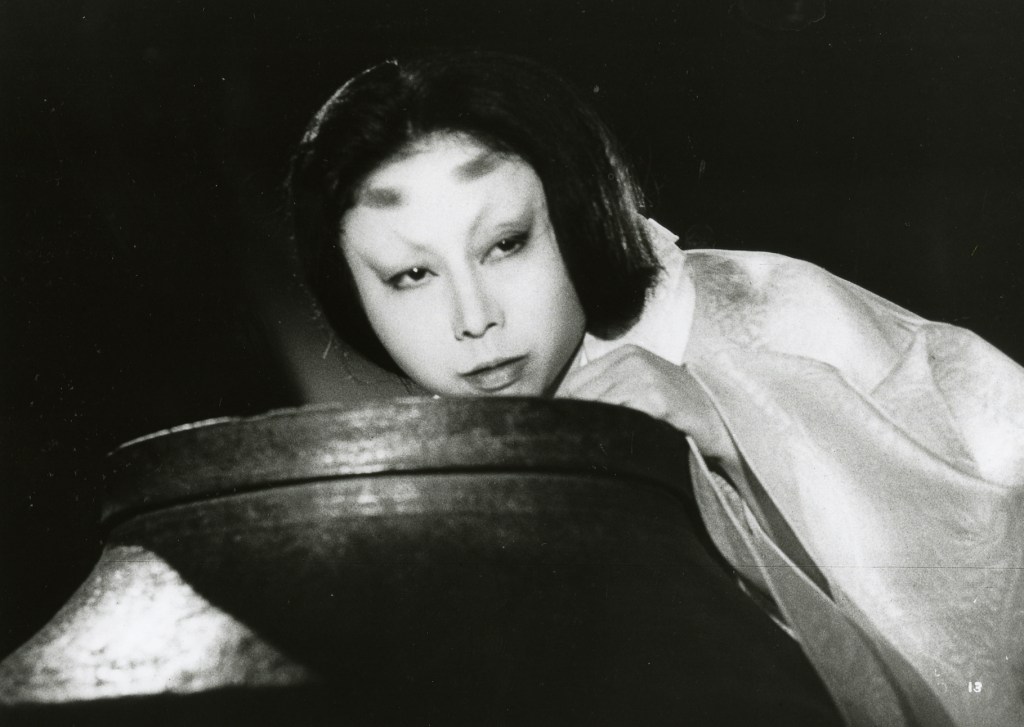
Nobuku Otawa in Shindo’s Kuroneko

Last night I stayed up late watching Onibaba and Kuroneko on the Turner Classic Movies (TCM) channel.

Onibaba is the better of the two films. The tall grass becomes a character in the film, much like the sand dunes in Hiroshi Teshigahara’s Woman in the Dunes (1964). When the daughter runs through the tall grass to tryst with her lover, the viewer feels that anything can happen. And it does: A demon appears in her path blocking the way.

Both films are available from the Criterion Collection.

Kigumi

The Art and Tradition of Japanese Carpentry

Today, I met my brother at the Japan House in Hollywood. He drove in from Palm Desert, where he is a builder whose specialty over the years has been working with wood. On display at the Japan House through January 22, 2025 is an exhibit entitled “Masters of Carpentry: Melding Forest, Skill and Spirit.” It was an awesome display of the beauty and intricate detail that is the art of Japanese carpentry.

According to the handout describing the exhibit:

The exhibit is structured around 5 pillars of daiku [Japanese woodworking masters] culture: a reverence for nature and the Japanese forest, the master carpenters’ refined tools, the practice of dōmiya daiku—the temple and shrine carpenters, kigumi— the strength and beauty of Japanese joinery, and the work of the sukiya daiku—the skillful carpenters employing natural materials to detail and finish teahouses.

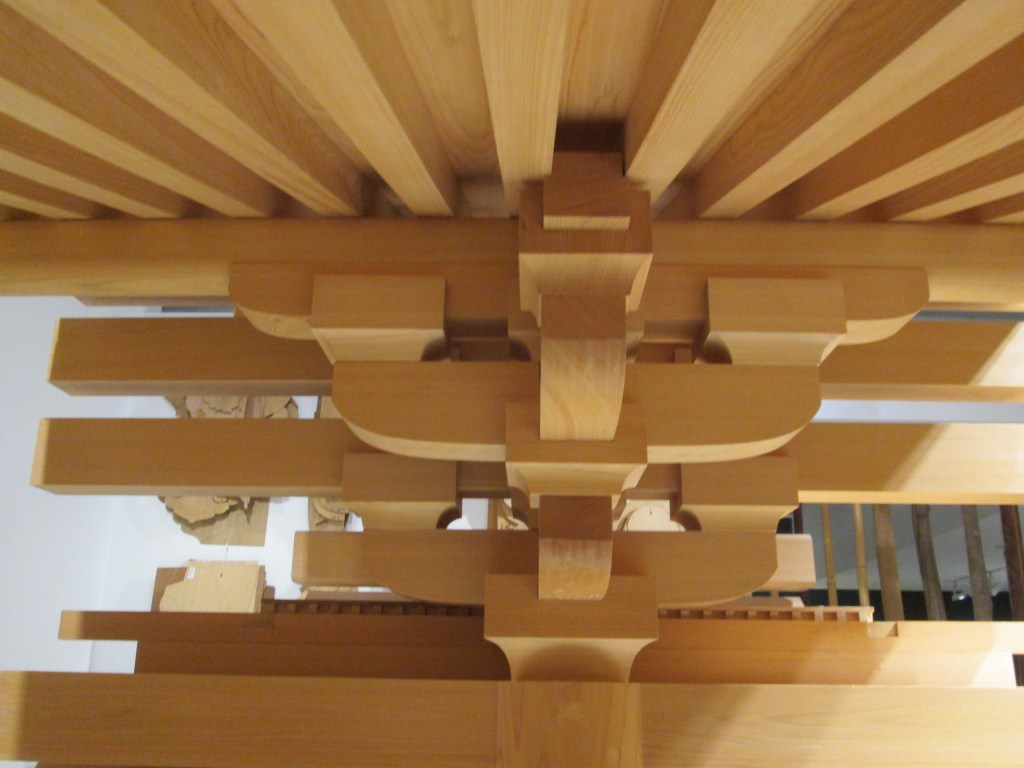
What impressed me the most were the exhibits of the intricate joinery linking the boards, posts, and beams using careful measurement and relying as little as possible on nails and other iron and steel fasteners. The result is aesthetically pleasing and built to last. And because it is carefully selected from a large variety of native woods, it even smells beautiful.

According to the exhibit, the islands that constitute Japan are 67% forested. Even such exotic woods as persimmon fruit trees are used because of the striated grain of the wood.

Intricate and Ultimately Pleasing

Although, unlike my brother, I have no skill in woodworking, I quickly became aware that this was high art and a labor of love. This is an exhibit with broad appeal to anyone with an artistic frame of mind. The two hours we spent at the Japan House Masters of Carpentry Exhibit was well worth it.

Japan House Los Angeles
Gallery Level 2
6801 Hollywood Blvd
Los Angeles, CA 90028

https://www.japanhousela.com/

Ars Est Celare Artem

Japanese Film Director Yasujiro Ozu (1903-1963)

It was Horace in his “Ars Poetica” who wrote ars est celare artem, meaning that true art conceals the means by which it is achieved.

The film medium has an unusually rich variety of tools that can be used in movies, including zooms in and out, pans, wipes, tracking and dolly shots, tilts, and crane shots. And these do not include the complex technically-assisted tools such as are involved in computer generated imagery (CGI).

In Vertigo (1958), Alfred Hitchcock created a stunning visual effect by combining zooming out with tracking in. Some directors like Sergei Eisenstein, Max Ophuls, Jean-Luc Godard, and Andrey Tarkovsky have used the language of film in new and exciting ways.

Just as there are writers like Ernest Hemingway who employ a simple style. There are others, such as James Joyce, Marcel Proust, and Georges Perec who used all the bells and whistles of literature to achieve their aims.

If there is an equivalent to the Hemingway style in film, I would have to say it is in the films of Yasujiro Ozu. In the dozen or so films I have seen, I remember only one camera movement, a slight pan in his Tokyo Story (1953), in which we follow an elderly couple as they walk alongside a wall at a seaside resort. With Ozu, there is, for the most part, only a succession of simple shots, most frequently at the level of a Japanese person seated on a tatami mat.

Intercut with these shots are others that are almost like stills. In the sound pictures, the music wells up, and the audience is meant to absorb what has just happened. This is referred to in Japanese as mono no aware. literally: the pathos of things. There is, for instance, this recurring shot in Floating Weeds (1959):

As one American writer put it in The Other Journal:

When I reflect on Japanese cinema, I find that one of the things that continually draws me back to it is a sort of gentle melancholy and pensive longing. Granted, this isn’t true of all Japanese films — I don’t know if you’d find it much in violent yakuza films or over-the-top kaiju films — but the ones that have stuck with me over the years are typified by this emotion and seem to contain it in large amounts.

There’s a Japanese phrase that sums up this feeling I’m describing: “mono no aware.” Roughly translated into English, it means “the sadness of things”. It’s not sadness in the sense of depression or angst, but rather, it refers to an awareness of the fragility of existence, of the transient and bittersweet nature of life, which, I’ve found, can make for incredibly beautiful and poignant cinema.

That feeling is present in all the Ozu films I have seen, which is why I regard him as one of the greatest of all film artists and perhaps the preeminent artist in the Japanese cinema.

Floating Weeds

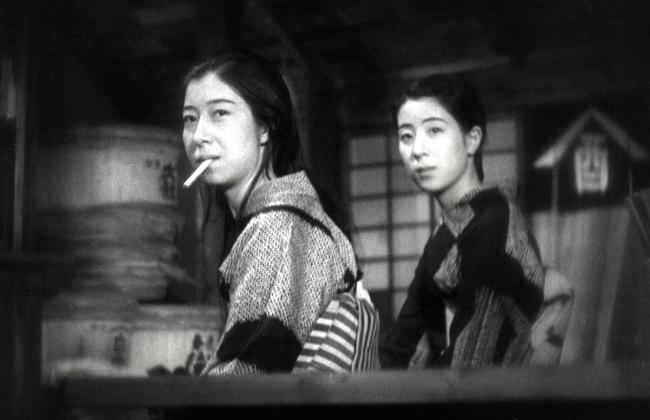
Rieko Yagumo and Yoshiko Tsubouchi in Story of Floating Weeds (1934)

Over the last two days, I have had the good fortune to see two great films by Japanese director Yasujiro Ozu, one the remake of the other. Although the technology to make sound films existed in Japan, Ozu deliberately made only silent films until 1936.

His A Story of Floating Weeds (1934) is about a traveling Kabuki player troupe that visits a small town. On a previous visit to that same town, the head of the troupe, played by Takashi Sakamoto, had an affair with a local woman who ran a small restaurant/bar and had a son by her. In the intervening years, he sent money for his education and begged the mother to say that he was the boy’s uncle instead of his “deceased” father.

Sakamoto loves spending time with his son, and that arouses the envy of Rieko Yagumo, his mistress on the road. She bribes her fellow actress Yoshiko Tsubouchi to seduce the boy, but they fall in love with each other. Furious, Sakamoto dissolves the acting troupe.

Like all of his films, A Story of Floating Weeds shows a group of people at odds with one another coming together in the end with an enhanced respect and gentleness.

It is no surprise that Ozu remade the film in 1959 as Floating Weeds. It is the same basic story, but with sound and color.

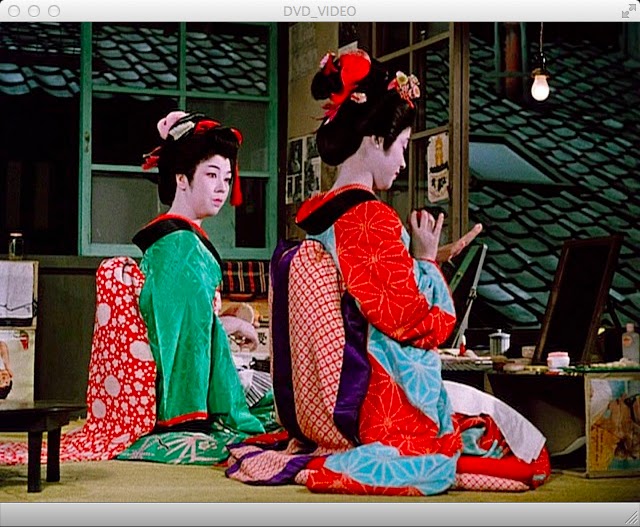
The Same Two Roles a Quarter Century Later

I actually prefer the original silent 1934 version. It was a better story and had better actors (even though the 1959 version had Machiko Kyo in the role of the mistress in the troupe). It was so good, in fact, that I plan to buy the recent Criterion release of both versions on DVD.

Yasujiro Ozu was one of the five or ten greatest film directors who ever lived. Over the years, I have seen over a dozen of his films, and there was not a clinker in the bunch. Even John Ford, Jean Renoir, and Carl Dreyer made some stinkers. But not Ozu. The world lost a magnificent artist when he died in Tokyo in 1963. I plan on discussing his film style in a later post this week.

Tsukioka Yoshitoshi

Tsukioka Yoshitoshi’s “The Story of Otomi and Yosaburo” (1885)

His working life spanned a period of cataclysmic change in Japanese culture. Japanese print maker Tsukioka Yoshitoshi (1839-1892) started out in the Edo Period before Commodore Perry opened his island nation to the Western world, and died during the Meiji Restoration, which saw Japan being increasingly influenced by American and European ways. Yoshitoshi himself was a traditionalist in a rapidly changing world.

The woodblock art form in which he worked was referred to as ukiyo-e, commonly translated as “pictures of the floating world.” According to John Fiorillo:

Yoshitoshi was arguably the finest ukiyo-e print designer of the late nineteenth century. His figures were vividly realized and invested with a realism that relied, not insignificantly, on superb drawing ability. As he broke away from stagnating convention, Yoshitoshi’s seemingly unfettered imagination found expression in many subjects: history, folklore, legend, warrior tales, women, daily life, and old and new customs. He was uniquely gifted as a visual artist and a connoisseur of stories about Japanese and Chinese history and legend. By bridging the transition from the feudal society of the Edo period to the enlightenment restoration of the Meiji period, he succeeded in revitalizing ukiyo-e in unexpected ways.

“A Young Woman from the Kansei Period Playing with Her Cat” (1888)

This print is from a series entitled Thirty-two types of Beauty in Daily Life (Fūzoku sanjūnisō).

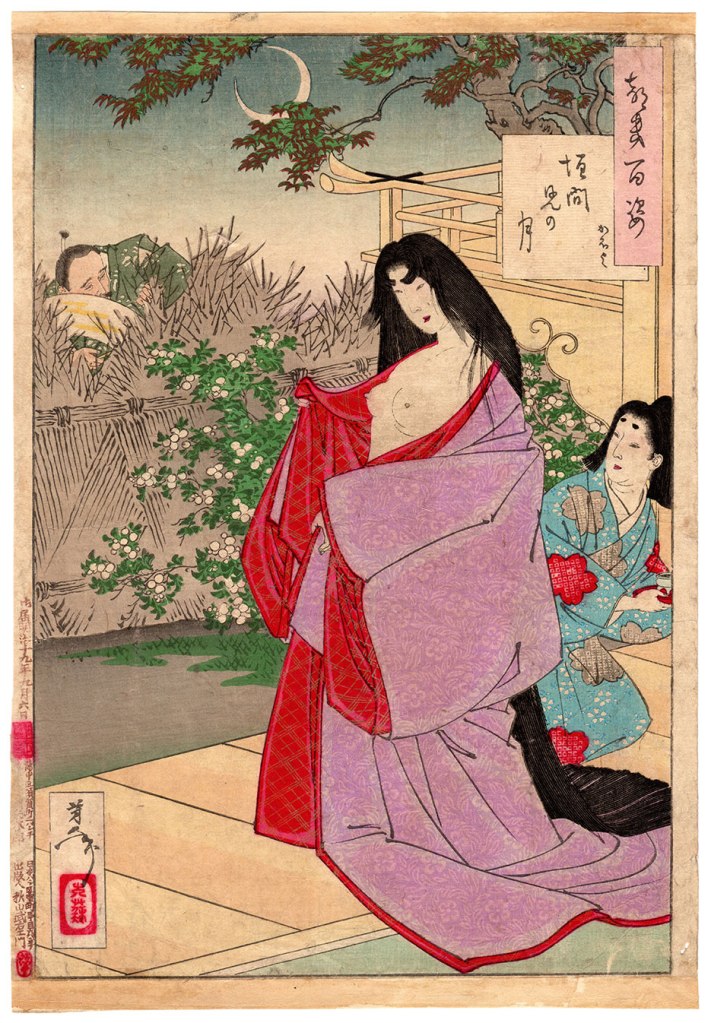
“A Glimpse of the Moon” (1886)

This image is from a famous old tale. According to Scholten Japanese Art:

This composition presents a combination of stories and references. The tale originates from chapter 21 of the 14th-century historical epic Chronicle of Great Peace (Taiheiki). Lord Ko Moronao (d. 1351), a chief retainer of the Shogun Ashikaga Takauji (1305-1358), hears of a great beauty who happens to be the wife of another shogunal official, En’ya Takasada. Moronao arranges to see her after a bath and, even though she was without the feminine trappings of splendid robes and make-up, finds her irresistible. In an effort to take her for himself, he accuses En’ya of treason. But in a twist of fate, En’ya tries to flee and Moronao has the official and his family, including his wife, killed.

I decided to take a look at Yoshitoshi because he is not well known in the West, except to art specialists. His use of line and color in pursuit of traditional Japanese subjects during a period of transition makes him a great master in my book.

Samurai Swordplay

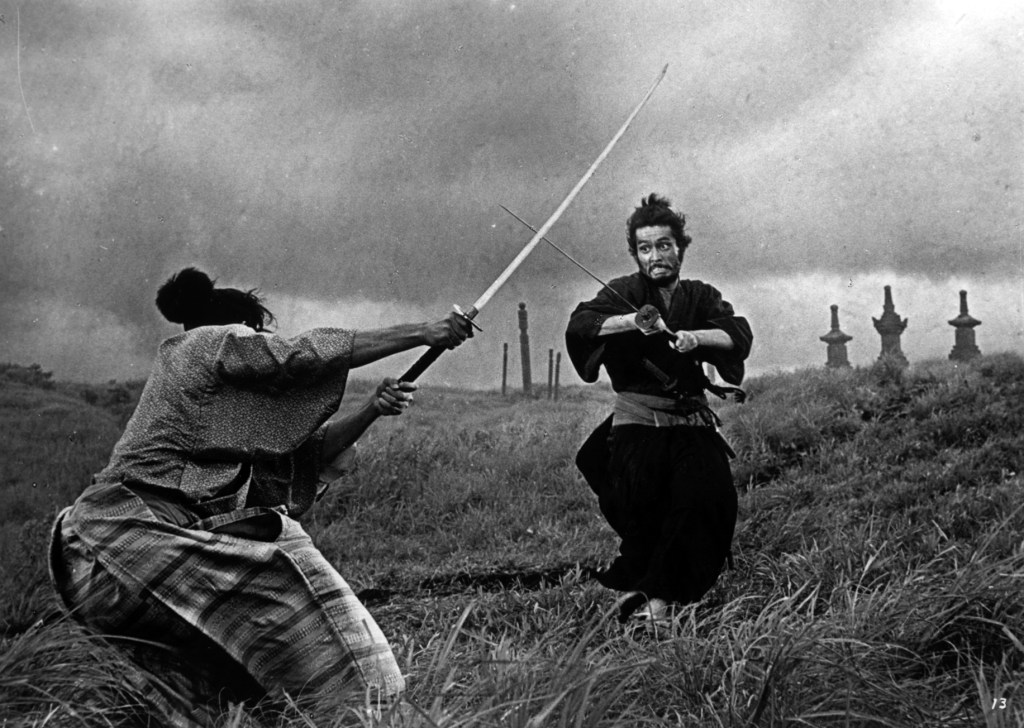
A few days ago, I promised to list my favorite Japanese samurai films. Here I present the annotated list in alphabetical order by eight directors, with my favorite samurai film for each director:

  • Hideo Gosha: Goyokin (1969) See also his early Three Outlaw Samurai (1964) and Sword of the Beast (1965).
  • Kazuo Ikehiro: Trail of Traps (1967). My favorite of the Kyoshiro Nemuri films starring Raizo Ichikawa.
  • Hiroshi Inagaki: Samurai Trilogy, comprising Musashi Miyamoto (1954), The Duel at Ichijoji Temple (1955), and Duel on Ganryu Island (1956).
  • Masaki Kobayashi: Harakiri (1962) starring the great Tatsuya Nakadai.
  • Akira Kurosawa: The Seven Samurai (1954), just one of over a dozen great chambara epics usually starring Toshiro Mifune.
  • Kenji Misumi: Lone Wolf and Cub: Sword of Vengeance (1972). Weird and entertaining.
  • Kihachi Okamoto: Sword of Doom (1965), another great Nakadai role.
  • Kimiyoshi Yasuda: Zatoichi’s Fire Festival (1970), one of a score of films starring Shintaro Katsu as a blind samurai warrior. Very funny.

After the 1970s, the studio system that supported the great Japanese films of the postwar period collapsed because the studios made more money selling their studio space in a real estate bubble than they ever did making movies. There’s a lesson to be learned there.

Ronin

It is without a doubt one of the most incredible shots in the history of the cinema. And yet it was the work of a director, Hideo Gosha, on his first motion picture, Three Outlaw Samurai (1964). Picture to yourself a peasant who with two of his friends kidnapped the daughter of a corrupt local magistrate as part of a protest against his cruel administration. Instead of keeping his promises, this magistrate sends thugs to kill him. As he lies bleeding with his back slashed by a sword, we cut to a closeup up the peasant, dying, looking with wide-eyed wonder at a lone wildflower growing in front of his face.

In the 1950s and 1960s, the Japanese cinema was at its height, one of the most fascinating in the world. The best of their films were in a genre known as jidaigeki, historical pictures set mostly during the Tokugawa Shogunate between 1603 and 1868. Starring most prominently were samurai, particularly masterless or outlaw samurai called ronin. Other films in the genre portrayed gangsters (yakuza), merchants, even peasants.

I had seen Three Outlaw Samurai at least twice before, but this time the film’s pessimism struck home. Aiding the peasants in their protest are three ronin who, one by one, come together. They are unable, however, to help the peasants win. After the three who kidnapped the magistrate’s daughter are killed, the other peasants in the surrounding villages are afraid to present their protest to a wondering clan chief who is due to visit in a few days. It is because of this visit that the magistrate hires waves of goons to attack not only the protestors, but previous goons who are asking for too much money.

The bloodshed is considerable. The three ronin kill at least a hundred of the magistrate’s men, who in turn kill large numbers of peasants. At the end, the three ronin decide to travel together in a direction selected by chance.

Ever since I first fell in love with movies as a student at Dartmouth, I have loved the fast action of chambara (“sword fight”) films. But, like the best Westerns, these “Easterns” can attain the status of high art. In a future post, I will list my favorite samurai films.

Grace Under Pressure

Opening Ceremony of the 2020 Tokyo Olympiad—in 2021!

Japan was put in an untenable position by the International Olympic Committee (IOC). At a time when Covid-19 was surging through the island nation, the IOC said the Olympic Games had to go on nonetheless. Of course, we won’t know for a week or two whether Japan will pay the price by putting on the games during an epidemic.

I must say, however, that Japan reacted with competence and grace and managed to put on a memorable event. Even if the stands were mostly empty, these games were an utter delight, even if NBC’s televising was at times ham-fisted and soap-opera-ish.

My favorite events were the team competitions, such as men’s and women’s basketball, women’s indoor and beach volleyball, women’s water polo, and some of track and field events. I didn’t much care for golf, canoeing/kayaking, swimming and diving. Never before have I spent so much time glued to the television set watching sporting events. It was worth it, and I feel bereft now that the Games are over.