
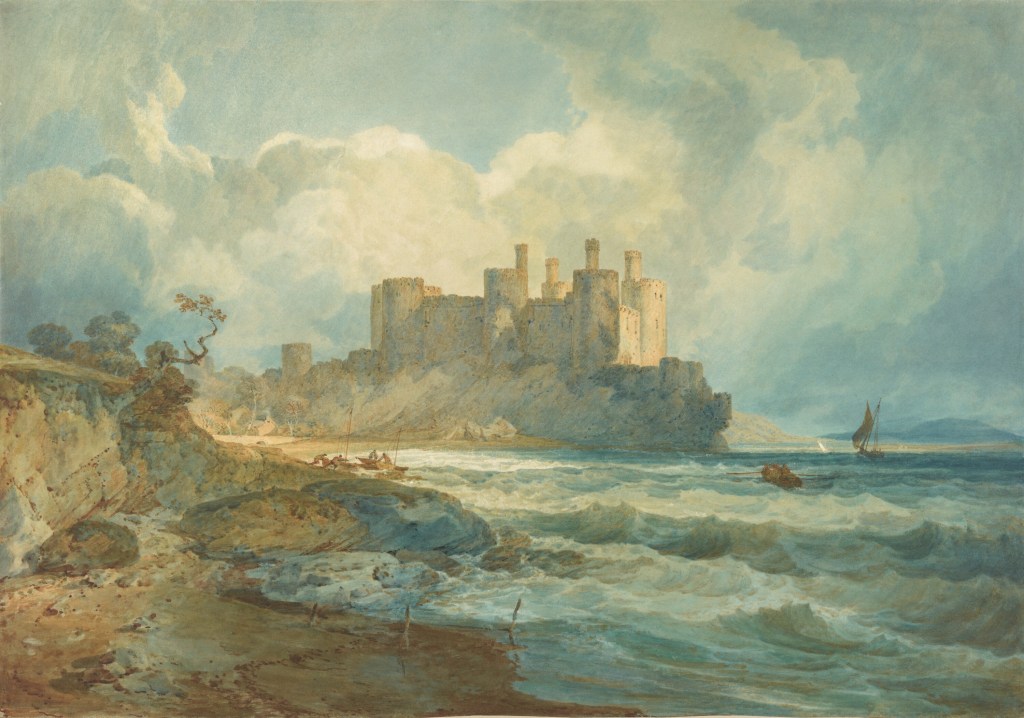
J M W Turner’s Castle in Wales

“Conway Castle, North Wales” as Painted by Joseph Mallord William Turner (1798)

Back in 1976, I visited Britain after making some money selling a script idea. One of the places I stayed was Betws-y-Coed, from which I could visit several beauty spots in North Wales. One of them was Conwy [sic] Castle. I was elated to see at the Getty Center J M W Turner’s rendition of Conway Castle, which is what the English called it.

The Getty website describes the painting:

On a dramatic, rocky area of the northern coast of Wales looms the late medieval Conway Castle. It towers over a stormy bay while fisherman struggle to pull their boats ashore. Caught in this uproaring of the sea, the tiny figures of fishermen in their boat convey a sense of humans’ barely significant place in the order of the universe.

The Welsh landscape exerted a strong hold on Joseph Mallord William Turner, and he made several sketching trips there in the 1790s. In this early Romantic painting, Turner represented the dramatic effects of natural light, allowing sunshine breaking through the clouds to illuminate the castle and the coast beyond.

The castle was built by Edward I—the evil king in Mel Gibson’s Braveheart played by Patrick McGoohan—between 1283 and 1287. It was one of a number of fortifications he built in his effort to subdue the Welsh. Here’s what it looks like today:

Conwy Castle Today
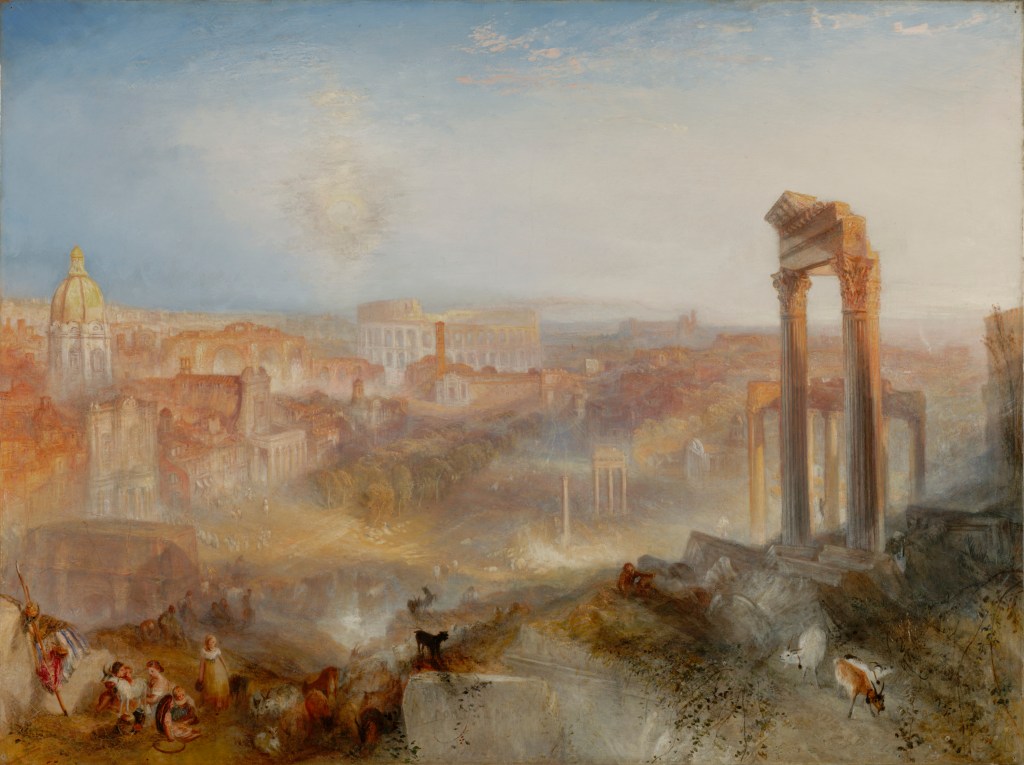
Rome in God’s Eye

The title of the illustrated painting is “Modern Rome—Campo Vaccino.” It was painted in 1839 by Joseph Mallord William Turner (1775-1851). It is the third of five paintings that moved me during my last visit to the Getty Center in Los Angeles.

There is something about the quality of light in J.M.W. Turner’s work. The painting is described as follows by the Getty’s database:

Ten years after his final journey to Rome, Turner envisioned the Eternal City through a veil of memory. Baroque churches and ancient monuments in and around the Roman Forum seem to dissolve in iridescent light shed by a moon rising at left and a sun setting behind the Capitoline Hill at right. Amidst these splendors, the city’s inhabitants carry on with their daily activities. The picture’s nacreous palette and shimmering light effects exemplify Turner at his most accomplished.

When first exhibited at the Royal Academy in 1839 with its pendant, Ancient Rome; Agrippina Landing with the Ashes of Germanicus, the painting was accompanied by a modified quotation from Lord Byron’s masterpiece, Childe Harold’s Pilgrimage (1818): “The moon is up, and yet it is not night, / The sun as yet divides the day with her.” Like the poem, Turner’s painting evokes the enduring sublimity of Rome, which had been for artists throughout history less a place in the real world than one in the imagination.

Note the characters and livestock in the foreground of the painting. In the background, ancient and contemporary Rome are intermingled as the light at the end of day washes out all the details. It looks almost as if Rome is in flames.

Campo Vaccino literally means cow pasture or cattle field in Italian. For years, the location had been a cattle market. According to the Princeton Art Museum, “Essentially in ruins since the fifth century A.D., by the seventeenth century the still-to-be excavated Roman Forum was popularly known as the Campo Vaccino, or cow field, alluding to its dual role as pasture and cattle market; it was also a popular sketching spot for artists.”