Orozco at Dartmouth

Panel of Orozco’s Epic of American Civilization

One of the things I most loved about my years at Dartmouth College was studying in the Baker Library’s Reserve Room, as it was then called. The Mexican artist José Clemente Orozco (1883-1949). Between 1932 and 1934, he painted a series of murals entitled “The Epic of American Civilization” in the college’s Baker Library.

There is a detailed discussion of Orozco’s mural put out by Dartmouth’s Hood Museum describing all the panels.
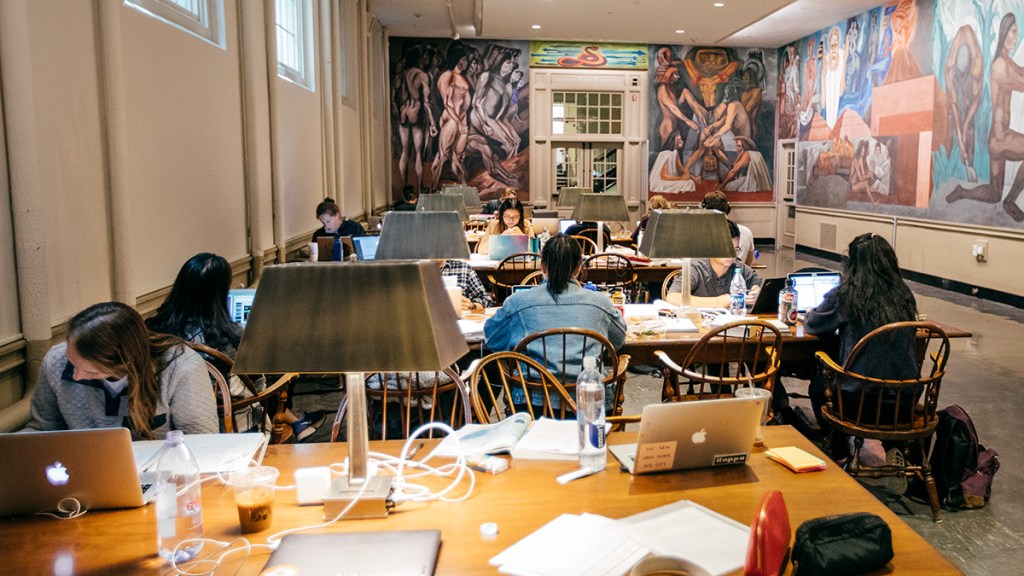
The Reserve Room

Sometimes I think it is those murals which first got me interested in going to Mexico. Nine years after I graduated, I finally made it to Yucatán and visited the ruins at Uxmal, Chichén Itzá, Mayapan, and Kabah during a two-week trip in November 1975.

Until I saw Orozco’s work, Mexico and the Pre-Columbian civilizations of the Americas just weren’t on my radar. Afterwards, they became a major preoccupation.

Quetzalcoatl in a Panel of the Orozco Murals

Little did I know in my college years that my interest in the murals would eventually lead me not only to Mexico, but also Argentina, Guatemala, Honduras, Uruguay, Chile, Peru, and Ecuador.
My Libraries

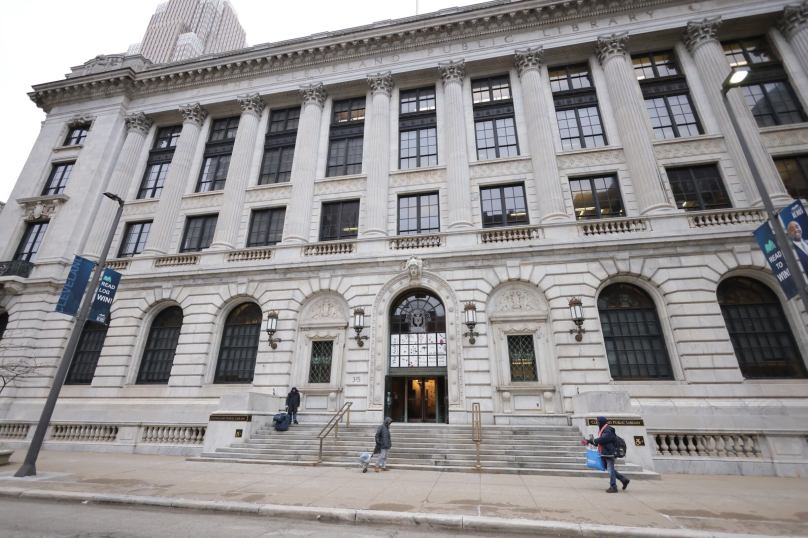
The Main Branch of the Cleveland Public Library Downtown

Books and libraries have always played an important part in my life.

When I was a toddler, my mother took me to the branch of the Cleveland Public Library on East 109th Street (now Martin Luther King Drive). Not that I could read, but I could indicate based on the illustrations the books I would be most interested in. She would check them out and read them to me in Hungarian, probably embroidering a bit. The one book I remember from that period was Dr. Seuss’s The King’s Stilts, which I now have in my collection.

In 1951, after my brother Dan was born, we moved to the Lee-Harvard Area on the East Side of Cleveland. For many years, I went to the Lee-Harvard branch which was located on Lee Road, first north of Harvard, and then south of it. The head librarian was a fellow Hungarian, Mr. Matyi, who played the oboe in the Cleveland Philharmonic Orchestra.

During my college years at Dartmouth, I spent many hours at Baker Library, which was modeled after Independence Hall in Philadelphia. What I loved most about it were the frescoes in the reserve room that were painted in the 1930s by José Clemente Orozco.

Jose Clemente Orozco, Murals at Baker Library Reading room, Dartmouth College, Hanover NH; The Machine

Once I moved to Los Angeles, I spent some time at the UCLA University Library, but I liked going to the main branch of the Santa Monica Public Library—which satisfied me until an opportunity opened up with the construction of the E (for Expo) Line of the Metro Rail. Driving and parking downtown was always a major pain. But now I was able to whiz downtown for 35 cents in three quarters of an hour.

I am now hooked on the Central Branch of the Los Angeles Public Library. Not only because of the library’s holdings, but various events sponsored by the library, especially the guided Thursday mindful meditation sessions.

The one library I forgot to mention is my own personal library of some 6,000 volumes, which I am slowly trying to thin by donations.

Greed

José Clemente Orozco Mural at Dartmouth College

So many of our problems as a nation are due to the institutionalization of greed in our culture. Even in our Declaration of Independence, we are declared to have the right to “Life, Liberty and the pursuit of Happiness.” Originally, the text read “Property” instead of “the pursuit of Happiness.”

So here we are, with the 21st century well under way, admiring billionaires like Elon Musk and Jeff Bezos, as well as self-declared billionaires (but not really) like Donald J. Trump. As a people, we still believe the rich are job creators, even when they get rich by sending American jobs overseas, in which case they could be regarded as job destroyers. In the meantime, we are becoming poorer as a nation, even while believing the opposite.

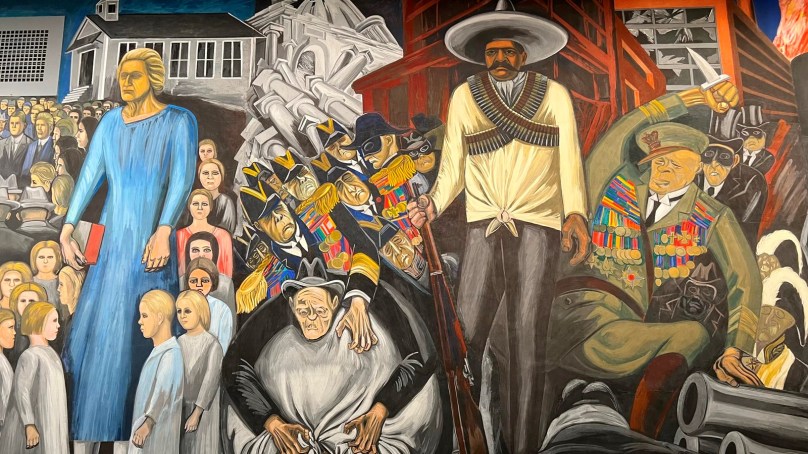
When José Clemente Orozco painted his famous murals at Dartmouth College’s Baker Library, he was commenting on the betrayal of ideals in the wake of the Mexican Revolution, which came hard on the heels of the Porfiriato, the stifling military dictatorship of Don Porfirio Díaz, which ran from 1876 to 1910. He also painted elsewhere on campus, the so-called “Hovey Murals,” which were so controversial that they were painted over for offending wealthy alumni donors.

Small wonder that they weren’t offended by the above panel from the Baker Library murals.

The wealthy are correct to regard the United States as the land of opportunity. This opportunity, however, comes at a cost. We are too ready to enthrone greed as an American virtue while treating the American poor as somehow losers in the game of life.

América Tropical

The Reconstruction of América Tropical in Downtown LA

In the 20th century, Mexico produced three great muralists: José Clemente Orozco, Diego Rivera, and David Alfaro Siqueiros. On other occasions, I have written about the influence on me of the Orozco frescoes at Dartmouth College. Sometimes, I think that my interest in Latin America began in the Reserve Room of Baker Library, where the frescoes were located.

Los Angeles has only a reconstruction of David Alfaro Siqueiros’s América Tropical, which was created in 1932 at its present location on Olvera Street. Unfortunately, Siqueiros’s revolutionary message angered LA business leaders, who had the mural painted over.

Reconstruction of Detail

Today, the fresco is restored—but, alas, only in black and white. Below is what the original looked like:

The Fresco As It Originally Appeared

It took a quarter century for the Getty Conservation Institute to restore the image which was obliterated by layers of white paint. You can read about it here. When the Covid-19 outbreak comes to an end, you can view the restoration in person.

The Muralist

Quetzalcoatl Mural at Dartmouth College’s Baker Library

During the four years I was at Dartmouth College in Hanover, New Hampshire, I spent many hours studying in the reserve room of Baker Library where, between 1932 and 1934, José Clemente Orozco painted a striking series of murals named “The Epic of American Civilization.” One of the images (above) was of the god Quetzalcoatl (or Plumed Serpent) crossing the Gulf of Mexico to Yucatán. It was largely due to Quetzalcoatl’s yellow beard in Aztec iconography that misled Moctezuma to believe that Hernán Cortés was Quetzalcoatl returned to the Aztecs. We all know how that turned out….

Orozco also did other murals at a dining hall at Dartmouth, but they were removed because they were thought to be Communist, and the Patricians in control at Dartmouth were aghast that the Mexican visitor would abuse their hospitality. (A similar thing happened in Los Angelist, where Mexican muralist David Alfaro Siqueiros painted a mural called “América Tropical” that was painted over for similar reasons.)

I love Orozco’s work. At one point, I even journeyed to Guadalajara to see more of his work, such as the image of Miguel Hidalgo below:

Mural by Jose Clemente Orozco featuring Miguel Hidalgo (leader of the Mexican War of Independence), Palacio de Gobierno (Government Palace), in the historic Center of Guadalajara, Jalisco, Mexico

Censorship of a great work of art because one does not believe in the political philosophy espoused by the artist is, to my mind, barbaric. Only in the United States is there a simultaneous attraction/repulsion response to Orozco’s emphatic mural style. Any attempt to paint over his work in Mexico would cause a bloody riot. But then, Mexico does not swing as far to the right as our country does.


Facing South

Skeletoid Academics?

Dartmouth College was the beginning of many things in my life. One of the most influential was the Reserve Room on the ground floor of Dartmouth’s Baker Library. On three sides was a magnificent sequence of frescoes by José Clemente Orozco (1883-1949) which began with the invasion of Mexico by the Conquistadores and ended up with the mess that Mexico was in during the 1930s. One of the most shocking images was the one above of the skeletoid academics giving birth to a baby skeleton.

These frescoes influenced me so much that I would study or even just hang out in the Reserve Room just to imbibe the atmosphere of Orozco’s powerful political murals. It was no accident that the first vacation I took on my own, nine years after my graduation, was a visit to Mayan ruins in Yucatán. Over the next seventeen years, I was to go to Mexico eight times, spending as much as a month on each visit.

José Clemente Orozco

During those visits, my eyes turned further south. I would have loved to go from Yucatán to Belize and on to the Mayan ruins at Tikal in the Petén region of Guatemala. At that time, however, the man in charge was Efraín Ríos Montt, a murderous dog who was responsible for the massacre, rape, and torture of thousands of indigenous people; and the U.S. State Department did not recommend that Americans vacation in Guatemala during his presidency.

Around then, Paul Theroux published The Old Patagonian Express (1979), about taking trains from Boston as far south in the Americas as one could go. I vowed that I would eventually make it to South America, and I did. Since 2006, I visited Argentina (three times!), Uruguay, Chile, Peru, and Ecuador. An despite Mexico’s continuing problem with narcotraficantes, I would not mind going to Yucatán and Chiapas again.


Posada’s Mexico

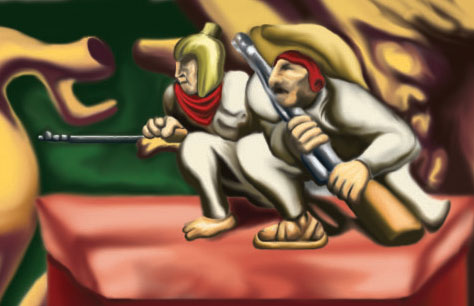
Posada’s Assault of the Zapatistas

Posada’s Attack of the Zapatistas

José Guadalupe Posada was born in Aguascalientes, Mexico, in 1852.During the Mexican Revolution. By the time of the Mexican Revolution, of which the above engraving shows a scene, he was poor despite his immense talent as a folk artist. He died in 1913, but not before having influenced the great muralist José Clemente Orozco. It was Orozco’s frescoes in the Reserve Room of Dartmouth College’s Baker Library that influenced me in my own visual tastes.

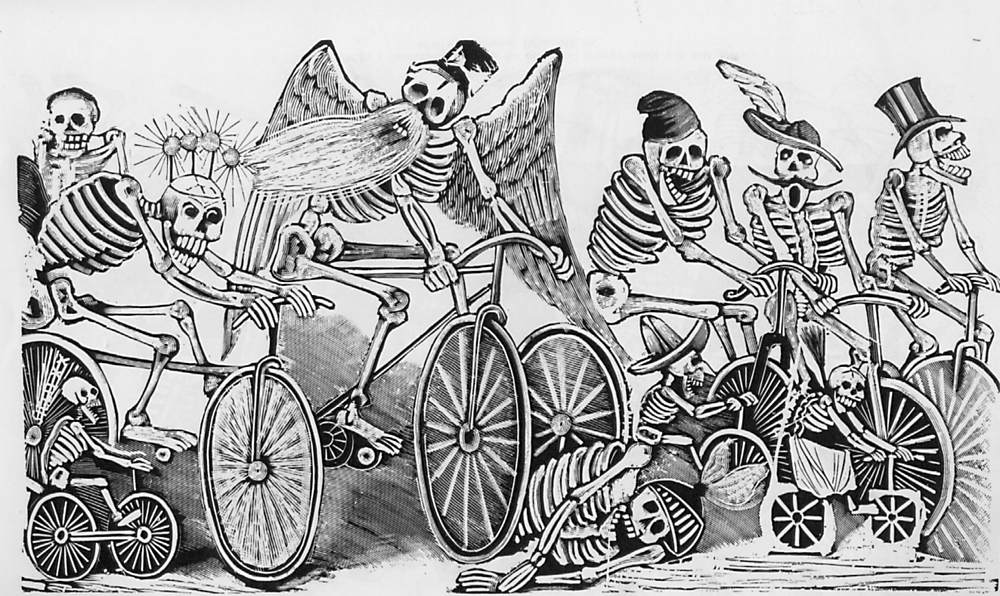
Posada’s Cyclists

Posada’s Cyclists

Posada is probably best known for his calaveras, images of skeletons savagely satirizing life under Mexican dictator Porfirio Diaz. Not surprisingly, most of these cavorting skeletons have become associated with the Mexican Day of the Dead, or All Souls’ Day, on November 2. On this day, families have picnics by the graves of their loved ones who have passed on.

I thought Posada would be a good artist for Halloween as well.