The Elemental Voices

Waves

Waves

The three elemental sounds in nature are the sound of rain, the sound of wind in a primeval wood, and the sound of outer ocean on a beach. I have heard them all, and of the three elemental voices, that of ocean is the most awesome, beautiful, and varied. For it is a mistake to talk of the monotone of ocean or of the monotonous nature of its sound. The sea has many voices. Listen to the surf, really lend it your ears, and you will hear a world of sounds: hollow boomings and heavy roarings, great watery tumblings and tramplings, long hissing seethes, sharp, rifle-shot reports, splashes, whispers, the grinding undertone of stones, and sometimes vocal sounds that might be the half-heard talk of people in the sea.—Henry Beeson, The Outermost House: A Year of Life on the Great Beach of Cape Cod

“Secret Movements of a Puppet Show”

Charles Churchill (1732-1764)

Charles Churchill (1732-1764)

Peace to such triflers; be our happier plan
To pass through life as easy as we can.
Who’s in or out, who moves this grand machine,
Nor stirs my curiosity nor spleen.
Secrets of state no more I wish to know
Than secret movements of a puppet-show:
Let but the puppets move, I’ve my desire,
Unseen the hand which guides the master-wire.—Charles Churchill, “Night: An Epistle to Robert Lloyd”

Can This Be Me?

Budé

Guillaume Budé

In 1503 he married the daughter of an ancient Norman house, and it is said that, on his wedding-day, by an exceptional act of self-denial, he limited his time of study to three hours only. In his studies he was aided in every possible way by the devotion of his wife. Once, when he was busy reading in his library, one of the servants suddenly rushed in to inform him that the house was on fire. The scholar, without lifting up his eyes from his book, simply said to his informant:—allez avertir ma femme; vous savez bien que je ne m’occupe pas des affaires du menage! (Translated as: “Go tell my wife. You know I don’t concern myself with household matters.”) His health was seriously impaired by his prodigious industry, and the surgeons of the day vainly endeavoured to cure him of his constant headaches by applying a red-hot iron to the crown of his head. Happily he was enabled to find a safer remedy by taking long walks and by cultivating his garden.—John Edwin Sandys, A History of Classical Scholarship, Vol. II, Entry on “Guillaume Budé”

A Dead Language

Ancient Rome

Ancient Rome

My own career is a good example of many things, but none more than in my experience of the language and the literature of Ancient Rome. Like millions of my fellows, I was brought up in the 1930s to study Latin. When I was seventeen I switched to English, which nevertheless meant that I continued to study the classics, though less inflexibly than before. When I secured an award in English and went up to Oxford in 1941 I had the advantage of a classical training, for all that it seldom felt like any sort of advantage at the time.

The foregoing is a mere exordium in that I have no intention of going on to say that to have studied Latin is in itself somehow good for you or for your English style. It is not that a knowledge of Latin protects anybody from making mistakes about the meaning of English words, because the meanings of words are not fixed, they change in and after their move from one language to another. It is true that defendo means ‘I defend,’ but a muscle is not a little mouse, which etymologically it is, nor is a pencil what its origins declare it to be, a doubly small penis. Neither is it the case that, as schoolmasters are supposed to have thought or said at one time, one was helped to think by mastering that language, as if it were a course of mental gymnastics. Nevertheless the student of Latin, as of any considerable dead language, must constantly be trying to choose the right word to give the meaning of a Latin expression in English or an English expression in Latin. And if the writing of English generally is in decline, as many would say it is, we may be tempted to say that people no longer try to choose the right word as they once did. They often got it wrong, but they tried. Do they now?

Something like the foregoing sketch might be developed to accompany an analysis of English poetry as written over the last fifty years or so. If this is seen as having become not only less formally organised but less exact in its expression, then the loss of Latin has surely had a hand in the matter somewhere. Again, I do not simply mean that an acquaintance with Propertius or Catullus in the original is beneficial to any sort of poet, though I think I do think so, but just as simply that translation into and out of Latin verse calls for exactness, and that that quality is demanded in the writing of poetry as nowhere else. Exactness, by the way, is to be understood as applying to more than denotation: a word or phrase must be suitable to its context, so that a dialectal or slang term, for instance, is on the whole unlikely to fit well into a passage of high seriousness — except for special effect, as teachers used to add.

The chances are that no particular virtue attaches to Latin as a language, although its role in our culture is unique and uniquely important. Any dead language will do as the kind of trainer I mean, such as Ancient Greek or, were it copious enough and intelligible, Etruscan. But deadness is necessary. A living language is by definition unfixed, in a state of continuous development and change, adapting and often dropping dialecticisms, provincialisms, technical terms, slang of all sorts, foreign expressions and more. It has no choice but to be useless as any sort of example.

The preceding paragraphs are no doubt speculative. What follows is all too manifest. Not just Latin itself has disappeared but in many cases any certain knowledge of what it was. A phrase like mutatis mutandis, apart from being offensively unintelligible to almost every British person, will be taken as a bit of Italian or French or (it’s tempting to add) Choctaw rather than Latin. You come across it on old gravestones and monks used to sing it, or in it. The rest is silence. Latin is not only dead but cancelled.—Kingley Amis, “The Disappearance of Latin,” The King’s English: A Guide to Modern Usage


Learn Your Classics!

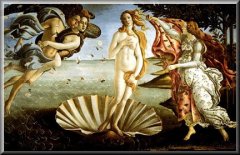
Botticelli’s Venus

Botticelli’s Venus

The English letters are twenty-six in number. There is nothing like beginning at the beginning; and we shall now therefore enumerate them, with the view also of rendering their insertion subsidiary to mythological instruction, in conformity with the plan on which some account of the Heathen Deities and ancient heroes is prefixed or subjoined to a Dictionary. We present the reader with a form of Alphabet composed in humble imitation of that famous one, which, while appreciable by the dullest taste, and level to the meanest capacity, is nevertheless that by which the greatest minds have been agreeably inducted into knowledge.

THE ALPHABET.

A was Apollo, the god of the carol,
B stood for Bacchus, astride on his barrel;
C for good Ceres, the goddess of grist,
D was Diana, that wouldn’t be kiss’d;
E was nymph Echo, that pined to a sound,
F was sweet Flora, with buttercups crown’d;
G was Jove’s pot-boy, young Ganymede hight,
H was fair Hebe, his barmaid so tight;
I, little Io, turn’d into a cow,
J, jealous Juno, that spiteful old sow;
K was Kitty, more lovely than goddess or muse;
L, Laocoon—I would’nt have been in his shoes!
M was blue-eyed Minerva, with stockings to match,
N was Nestor, with grey beard and silvery thatch;
O was lofty Olympus, King Jupiter’s shop,
P, Parnassus, Apollo hung out on its top;
Q stood for Quirites, the Romans, to wit;
R, for rantipole Roscius, that made such a hit;
S, for Sappho, so famous for felo-de-se,
T, for Thales the wise, F.R.S. and M.D.
U was crafty Ulysses, so artful a dodger,
V was hop-a-kick Vulcan, that limping old codger;
Wenus—Venus I mean—with a W begins,
(Vell, if I ham a Cockney, wot need of your grins?)
X was Xantippe, the scratch-cat and shrew,
Y, I don’t know what Y was, whack me if I do!
Z was Zeno the Stoic, Zenobia the clever,
And Zoilus the critic, Victoria for ever!—Percival Leigh (1813-1889), Paul Prendergast, or: The Comic Schoolmaster

A Change of Leeches

Ambrose Bierce

Ambrose Bierce

That I should give my hand, or bend my neck, or uncover my head to any man in mere homage to, or recognition of, his office, great or small, is to me simply inconceivable. These tricks of servility with the softened names are the vestiges of an involuntary allegiance to power extraneous to the performer. They represent in our American life obedience and propitiation in their most primitive and odious forms. The man who speaks of them as manifestations of a proper respect for “the President’s great office” is either a rogue, a dupe or a journalist. They come to us out of a fascinating but terrible past as survivals of servitude. They speak a various language of oppression and the superstition of man-worship; they carry forward the traditions of the sceptre and the lash. Through the plaudits of the people may be heard always the faint, far cry of the beaten slave.

Respect? Respect the good. Respect the wise. Let the President look to it that he belongs to one of these classes. His going about the country in gorgeous state and barbaric splendor as the guest of a thieving corporation, but at our expense—shining and dining and swining—unsouling himself of clotted nonsense in pickled platitudes calculated for the meridian of Coon Hollow, Indiana, but ingeniously adapted to each water tank on the line of his absurd “progress,” does not prove it, and the presumption of his “great office” is against him.

Can you not see, poor misguided “fellow citizens,” how you permit your political taskmasters to forge leg-chains of your follies and load you down with them? Will nothing teach you that all this fuss-and-feathers, all this ceremony, all this official gorgeousness and brass-banding, this “manifestation of a proper respect for the nation’s head” has no decent place in American life and American politics? Will no experience open your stupid eyes to the fact that these shows are but absurd imitations of royalty, to hold you silly while you are plundered by the managers of the performance?—that while you toss your greasy caps in air and sustain them by the ascending current of your senseless hurrahs the programmers are going through your blessed pockets and exploiting your holy dollars? No; you feel secure; power is of the People, and you can effect a change of robbers every four years. Inestimable privilege—to pull off the glutted leech and attach the lean one!—Ambrose Bierce, Antepenultimata (1912)

“Grassed Down and Forgotten”

tess

Cover of Tess of the D’Urbervilles

The past was past; whatever it had been it was no more at hand. Whatever its consequences, time would close over them; they would all in a few years be as if they had never been, and she herself grassed down and forgotten. Meanwhile the trees were just as green as before; the birds sang and the sun shone as clearly now as ever. The familiar surroundings had not darkened because of her grief, nor sickened because of her pain.

She might have seen that what had bowed her head so profoundly—the thought of the world’s concern at her situation—was founded on an illusion. She was not an existence, an experience, a passion, a structure of sensations, to anybody but herself. To all humankind besides Tess was only a passing thought. Even to friends she was no more than a frequently passing thought. If she made herself miserable the livelong night and day it was only this much to them—’Ah, she makes herself unhappy.’ If she tried to be cheerful, to dismiss all care, to take pleasure in the daylight, the flowers, the baby, she could only be this idea to them—’Ah, she bears it very well.’ Moreover, alone in a desert island would she have been wretched at what had happened to her? Not greatly. If she could have been but just created, to discover herself as a spouseless mother, with no experience of life except as the parent of a nameless child, would the position have caused her to despair? No, she would have taken it calmly, and found pleasure therein. Most of the misery had been generated by her conventional aspect, and not by her innate sensations.—Thomas Hardy, Tess of the D’Urbervilles

The Deception

Loneliness

Loneliness

Another wonderful quote from the website Laudator Temporis Acti:

“Fleetwood, you are too much alone. I hear people talk of the raptures of solitude; and with what tenderness of affection they can love a tree, a rivulet, or a mountain. Believe me, they are pretenders; they deceive themselves, or they seek, with their eyes open, to impose upon others. In addition to their trees and their mountains, I will give them the whole brute creation; still it will not do. There is a principle in the heart of man which demands the society of his like. He that has no such society, is in a state but one degree removed from insanity. He pines for an ear into which he might pour the story of his thoughts, for an eye that shall flash upon him with responsive intelligence, for a face the lines of which shall talk to him in dumb but eloquent discourse, for a heart that shall beat in unison with his own. If there is any thing in human form that does not feel these wants, that thing is not to be counted in the file for a man: the form it bears is a deception; and the legend, Man, which you read in its front, is a lie. Talk to me of rivers and mountains! I venerate the grand and beautiful exhibitions and shapes of nature, no man more; I delight in solitude; I could shut myself up in it for successive days. But I know that Christ did not with more alacrity come out of the wilderness after his forty days’ sequestration, than every man, at the end of a course of this sort, will seek for the interchange of sentiments and language. The magnificence of nature, after a time, will produce much the same effect upon him, as if I were to set down a hungry man to a sumptuous service of plate, where all that presented itself on every side was massy silver and burnished gold, but there was no food.”—William Godwin, Fleetwood: or, The New Man of Feeling (1805)