
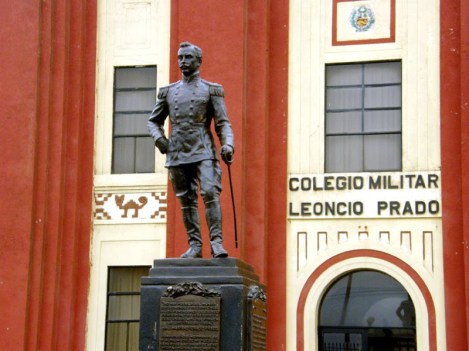
The Colegio Militar Leoncio Prado Near Lima
I have just finished reading the first novel by the Nobel Prize winning Peruvian author Mario Vargas Llosa, The Time of the Hero (1963). The originally published title, The City and the Dogs (La Ciudad y los Perros) is probably more appropriate, given the subject matter. As in the United States, military schools are primarily for children of good families from broken homes in which one of the parents (usually the father) wants to “make a man” out of an unruly son. I read over half the book before realizing that the Colegio Militar Leoncio Prado (CMLP) is a real institution in the La Perla district of Lima. It is named after a colonel who was executed by the Chileans after being captured at the Battle of Huamachuco (1883) during the “War of the Pacific” between Bolivia and Peru against Chile. (It was during that war that Bolivia lost its only access to the Pacific by way of the port of Antofagasta.)
Vargas Llosa’s CMLP is full of brutal young scamps who break all the rules, haze one another almost beyond endurance, and in general make a mockery of all attempts to civilize them. The author spent several years here from the age of fourteen. Instead of going for a commission in the military, he left the Academy and went on to become a writer and journalist in the northern city of Piura. His book seemed so uncomplimentary to the CMLP that, at first, it bought up copies of the book and had them burned, thinking they were a propaganda tool of the Ecuadorians. Now they are proud of the exposure the novel gave them.
The book centers on Alberto Fernández Temple, a teen from a broken family, and his relations to The Circle, a group of determined cadets who defend themselves and their interests from the officers and the other classes. He befriends Ricardo Arana, nicknamed the Slave, who tries to follow the rules but pays the ultimate price. When Arana informs on a fellow cadet in The Circle who steals a copy of a chemistry exam, he is shot in the head during military maneuvers. This sets Alberto off and he goes up against all his classmates, especially the Jaguar, who is their ringleader. This roils not only the students, but the staff, who are less interested in justice than in smoothing over the crisis.
The Time of the Hero is not a book that holds out much hope for its characters, but it is nonetheless an interesting first effort by Vargas Llosa, who is obviously attempting to exorcise some of the baneful effects of his tenure at the Academy.
If you are interested, you can check out the website of the CMLP and particularly this YouTube video of goose-stepping cadets who are singing as they march.
 Tarnmoor
You must be logged in to post a comment.