Eiseley on Spiders

Poet and Naturalist Loren Eiseley (1907-1977)

Yesterday, I posted a quote from Loren Eiseley’s The Unexpected Universe about spiders. He frequently thought about and wrote about seemingly small and insignificant creatures. Here is a poem he wrote about spiders in 1928 that was published in Prairie Schooner:

Spiders

Spiders
are poisonous, hairy, secretive.
Spiders are old—

they watch from dark corners while wills are made.

They weave grey webs for flies, and wait…
tiles drop from the roof,
leaves turn moldy under the black, slanting rain,
people die…
and the spiders inherit everything.

Spiders are antiquarians—
fond of living among ghosts and haunted ruins,
The black jade pillars totter in the halls of Marduk;

stones fall from the archways,
at night grey sand
whines by the lampless windows.

The god lies shattered,
his green-jeweled eyes are gone;
the sockets are hacked and empty as a skull.
Upon his face a squat tarantula is creeping…

a bland yellow noon
smiles at a black tarantula
creeping on the skull of a god!

Spiders are ghouls—
they live secret lives in graveyards,

A red spear of light
pierces the stained vault-window
and makes a warm pool on a black coffin in a niche.

A lean spider droops on a thread from above,
falls into the light, and changes color…
a crimson spider
sprawling on an ebony coffin
mumbles a fly in his toothless mouth.

Spiders…
time is a spider,
the world is a fly
caught in the invisible, stranded web of space.

It sways and turns aimlessly
in the winds blowing up from the void.

Slowly it desiccates… crumbles…
the stars weave over it.

It hangs…
forgotten.

Lessons from a Spider

Orb Weaver Spider in Its Web

Probably the most famous lesson learned from a spider weaving its web is of Robert the Bruce, King of Scotland, who, hidden in a cave, marveled at a spider’s persistence in completing its web. Supposedly, it inspired him to attack the English at Bannockburn in 1314 and win a decisive victory. American naturalist Loren Eiseley learned a very different lesson watching an orb spider weaving its web. The following quote comes from his collection of essays entitled The Unexpected Universe.

For example, I once received an unexpected lesson from a spider.

It happened far away on a rainy morning in the West. I had come up a long gulch looking for fossils, and there, just at eye level, lurked a huge yellow-and-black orb spider, whose web was moored to the tall spears of buffalo grass at the edge of the arroyo. It was her universe, and her senses did not extend beyond the lines and spokes of the great wheel she inhabited. Her extended claws could feel every vibration throughout that delicate structure. She knew the tug of wind, the fall of a raindrop, the flutter of a trapped moth’s wing. Down one spoke of the web ran a stout ribbon of gossamer on which she could hurry out to investigate her prey.

Curious, I took a pencil from my pocket and touched a strand of the web. Immediately there was a response. The web, plucked by its menacing occupant, began to vibrate until it was a blur. Anything that had brushed claw or wing against that amazing snare would be thoroughly entrapped. As the vibrations slowed, I could see the owner fingering her guidelines for signs of struggle. A pencil point was an intrusion into this universe for which no precedent existed. Spider was circumscribed by spider ideas; its universe was spider universe. All outside was irrational, extraneous, at best, raw material for spider. As I proceeded on my way along the gully, like a vast impossible shadow, I realized that in the world of spider I did not exist…..

I began to see that among the many universes in which the world of living creatures existed, some were large, some small, but that all, including man’s, were in some way limited or finite. We were creatures of many different dimensions passing through each other’s lives like ghosts through doors.

The Physicist and the Tortoise

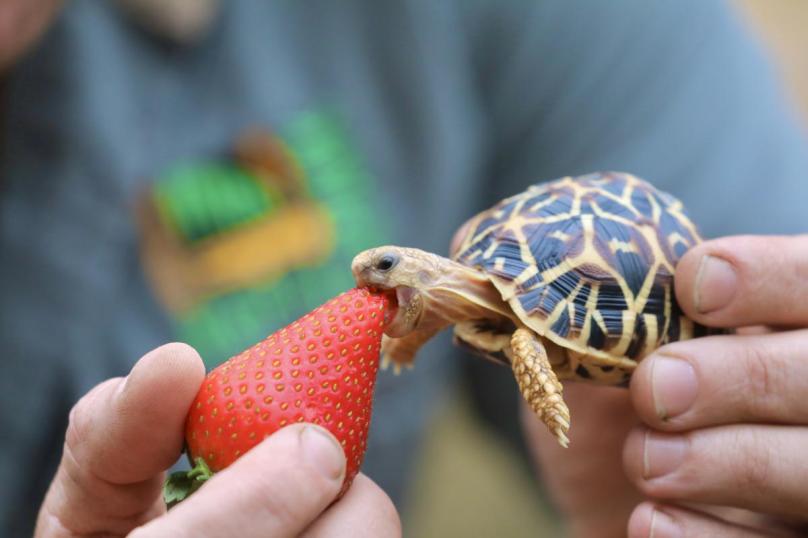
Small Tortoise and Strawberry

This is a story that the naturalist Loren Eiseley (1907-1977) tells in his book The Firmament of Time. I instantly fell in love with it:

There is a story about one of our great atomic physicists—a story for whose authenticity I cannot vouch, and therefore I shall not mention his name. I hope, however, with all my heart that it is true. If it is not, it ought to be, for it illustrates well what I mean by a growing sense of self-awareness, a sense of responsibility about the universe.

This man, one of the chief architects of the atomic bomb, so the story runs, was out wandering in the woods one day with a friend when he came upon a small tortoise. Overcome with pleasurable excitement, he took up the tortoise and started home, thinking to surprise his children with it. After a few steps he paused and surveyed the tortoise doubtfully.

“What’s the matter?” asked his friend.

Without responding, the great scientist slowly retraced his steps as precisely as possible, and gently set the turtle down upon the exact spot from which he had taken him up.

Then he turned solemnly to his friend. “It just struck me,” he said, “that perhaps, for one man, I have tampered enough with the universe.” He turned, and left the turtle to wander on its way.

Seen From Above

Poet and Naturalist Loren Eiseley (1907-1977)

It is a well-known fact that there are probably half a dozen writers that you have been urging your friends to read … with no success. My own personal failure in this regard is with the works of Loren Eiseley. Perhaps as a scientist, he is a little too out of date; but the fact that he is also a poet makes everything I have read by him almost numinous. Here, for example, is a poem called “The Condor”:

The Condor

The great bird moves its feathers on the air
like fingers playing on an instrument,
the instrument of wind; it climbs and scarcely moves
while steady thermals push
its giant wings still higher till it soars
beyond my sight completely, though it peers
through strange red eyes
upon my face below.
Its kind is dying from the earth; its wings
create a foolish envy among men.
Its shadow knew the mammoth and he passed,
floated above the sabertooth, now gone,
saw the first spearmen on the bison’s track,
banked sharply, went its way alone.
Its eyes are larger than its searching brain;
the creature sees like a satellite,
but exists within
an ice-world now dead. This bird cannot
understand rifles, multiply its eggs,
one hidden on a cliff face all it has.
Its shadow is now passing from the earth
just as the mammoth’s shadow at high noon.
Something has gone with each of them, the sky
is out of balance with the tipping poles.
No huge, tusked beast is marching with the ice,
no aerial shadow tracks the passing years.
Only below the haze grows deeper still,
only the buildings edge up through the murk.
Planes fly, and sometimes crash, but no black wing will write
the end of man, as man’s end should be written
by all the condor wings beneath high heaven.

I have seen Andean condors in Peru at Colca Canyon. They were rising and falling in the thermals hundreds of feet at a time.

Serendipity: A Re-Discovery

Loren Eiseley (1907-1977)

Loren Eiseley (1907-1977)

Have you ever laid something precious aside and, years later, suddenly be reminded of it? Then, going back to it, you find it was not only as good as you ever thought it was, but even better.The last book I read by Loren Eiseley was The Man Who Saw Through Time, about Sir Francis Bacon, back in 1990. Then I saw a blog by Fred Runk, whose perceptive comments you may have encountered in this space, quoting and commenting on a poem by Eiseley. It seemed as if a vortex formed around my head, in which I saw the waste of nearly a quarter century without once having encountered one of my favorite writers. I am making up for lost time by reading The Star Thrower, his last book, with essays on nature and science and a few of his early poems.

There is something small and humble about Eiseley as he examines nature and our place in it. Survival of the fittest?

A major portion of the world’s story appears to be that of fumbling little creatures of seemingly no great potential, falling, like the helpless little girl Alice, down a rabbit hole or an unexpected crevice into some new topsy-turvy realm…. The first land-walking fish was, by modern standards, an ungainly and inefficient invertebrate. Figuratively, he was a water failure who had managed to climb ashore on a continent where no vertebrates existed. In a time of crisis he had escaped his enemies…. The wet fish gasping in the harsh air on the shore, the warm-blooded mammal roving unchecked through the torpor of the reptilian night, the lizard-bird launching into a moment of ill-aimed flight, shatter all purely competitive assumptions. hese singular events reveal escapes through the living screen, penetrated, one would have to say in retrospect, by the ‘overspecialized’ and the seemingly ‘inefficient,’ the creatures driven to the wall.

In another essay, he talks about how life on our planet would have failed if it weren’t for the birth of flowers and everything that came in their train. At another time, we see him playing with an unafraid young fox with a pile of bones and selecting one and handing it to him. In yet another essay, we see him watching while an unusual squirrel manages to climb a post that had a wrap-around funnel protecting the food left for birds.

This is not BIG nature. It is all little nature with a lot of very BIG implications. Eiseley is a wonderful essayist and poet, deserving not only of scientific fame, but literary fame as well. It is no accident that the Introduction to The Star Thrower was written by an admirer named W. H. Auden.

In future, I will write more about Eiseley. Having rediscovered him, I cannot let him down.