“That Terrible Dusty Brilliance”

I have been reading a fascinating book of stories by Gavin Lambert about Hollywood as it was in the 1960s. The book is called The Slide Area, after the crumbling cliffs overlooking the ocean from Santa Monica north to Pacific Palisades. It is some of the best writing about Los Angeles as it was then. Lambert, by the way, was also the author of Inside Daisy Clover, which was made into a Robert Mulligan film starring Natalie Wood. Oh, and Lambert also wrote a biography of Natalie.

Following is an excerpt from near the beginning of The Slide Area:

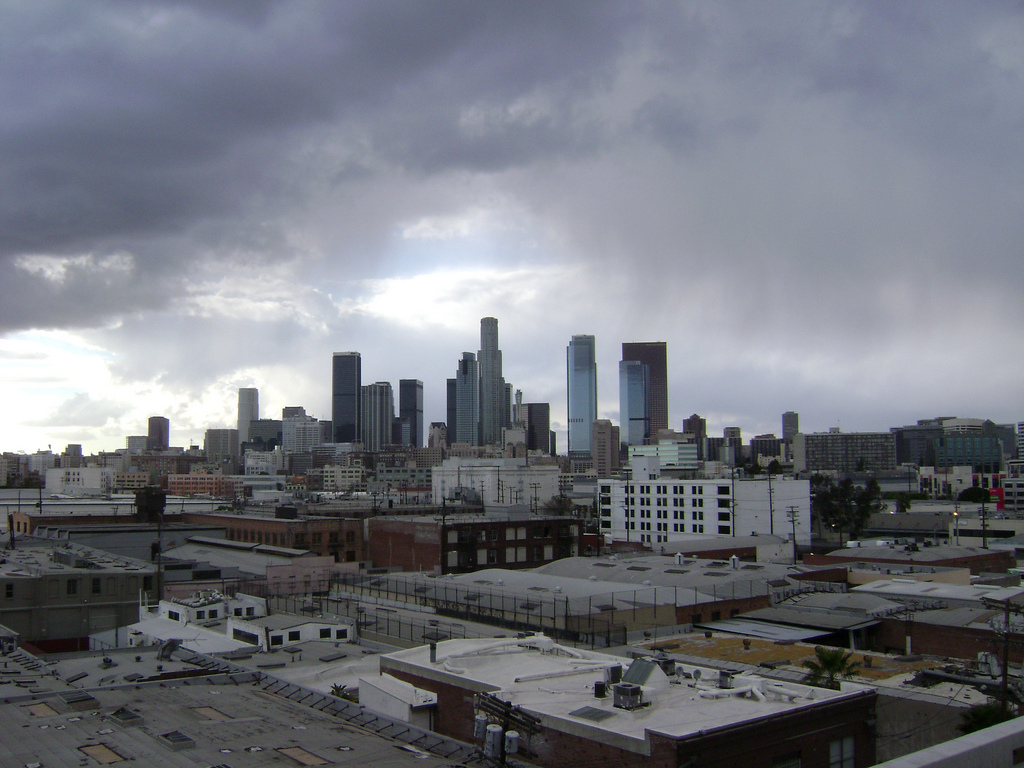
It is only a few miles’ drive to the ocean, but before reaching it I shall be nowhere. Hard to describe the impression of unreality, because it is intangible; almost supernatural; something in the air. (The air … Last night on the weather telecast the commentator, mentioning electric storms near Palm Springs and heavy smog in Los Angeles, described the behaviour of the air as ‘neurotic’. Of course. Like everything else the air must be imported and displaced, like the water driven along huge aqueducts from distant reservoirs, like the palm trees tilting above mortuary signs and laundromats along Sunset Boulevard.) Nothing belongs. Nothing belongs except the desert soil and the gruff eroded-looking mountains to the north. Because the earth is desert, its surface always has that terrible dusty brilliance. Sometimes it looks like the Riviera with a film of neglect over villas and gardens, a veil of fine invisible sand drawn across tropical colours. It is hard to be reminded of any single thing for long. The houses are real because they exist and people use them for eating and sleeping and making love, but they have no style of their own and look as if they had been imported from half a dozen different countries. They are imitation ‘French Provincial’ or ‘new’ Regency or Tudor or Spanish hacienda or Cape Cod, and except for a few crazy mansions seem to have sprung up overnight….

Los Angeles is not a city, but a series of suburban approaches to a city that never materializes.

Jidaigeki

Posters for The Seven Samurai (1954) and Harakiri (1962)

When I first came to Los Angeles in 1967, it didn’t take long for me to fall in love with everything Japanese. That included Japanese films, Japanese food, Japanese literature, and Japanese women. My first long RTD (Rapid Transit District) ride was on the old #83 Wilshire Boulevard route from West L.A. to La Brea Boulevard, where the Toho LaBrea theater was located a couple blocks south. I even remember the film: It was Part One of Hiroshi Inagaki’s Samurai trilogy.

Here I was, a Hungarian kid from Cleveland, finding a kind of home in the Japanese community of L.A. I even moved to Mississippi Avenue in the Sawtelle Japanese district, where there were two Japanese restaurants, the O-Sho and the Futaba Café. They were my first introduction to the cuisine. I was pretty raw at the time: When I had my first cubes of tofu in miso soup, I thought, “I’ll bet these are cut-up shark fins!”

I used to hate seafood. I thought the fish there was picked up from floating debris atop polluted Lake Erie. Now on my own in Southern California, I found myself trying (and loving) sushi after five short years.

What I loved most, however, were Japanese jidaigeki (period films), particularly those set in the samurai era. My friends Alain Silver and Jim Ursini (who collaborated on the first book on samurai films to be published in the U.S.) and I would regularly go to one of the five Japanese movie theaters then existing in Los Angeles:

  • The Toho LaBrea screened films from the Toho Studio
  • The Kokusai and Sho Tokyo theaters played Daiei films—probably my favorite
  • The Kabuki played films from Shochiku
  • The Linda Lea (my least favorite) played films from Tohei

They are all gone now. It’s all part of the growing Americanization of Japanese-Americans.

The Kokusai Theater on Crenshaw South of Adams

In fact, Alain, Jim, an I wrote a column for the UCLA Daily Bruin called “The Exotic Filmgoer.” The articles were all signed Tarnmoor (which, curiously, is the name I go under for this blog). We wrote about the Japanese and other ethnic cinemas that existed back around 1970.

I still love jidaigeki, though they’re not usually to be found around town playing in movie theaters. I have a large collection of DVDs of samurai films, and watch the Japanese films on the Turner Classic Movies (TCM) channel when they are playing.

And I still love Japanese food, though sushi is getting to be priced beyond my means.

The Snowcapped Mountains of L.A.

The San Gabriel Mountains Seen from Altadena

This has been the coldest winter I can remember since I first moved to Southern California in 1966. It has been wet, too—but not quite the wettest. That honor belongs to several winters in the 1970s and early 1980s, and most particularly the winter of 2004-2005.

As I drove to the Original Farmers Market at 3rd and Fairfax, I saw the peaks of the San Gabriel Mountains covered with a heavy mantle of snow. The mercury stood in the low 50s Fahrenheit (or low teens Celsius).

Southern California winters usually consist of periods of cold interspersed with several warm spells, where the temperature can go as high as the 80s and 90s Fahrenheit (or 30s Celsius). For the last few months, however, I have been wearing long-sleeves shirts, a wool vest or sweater, and a windbreaker. In December, my gas bill topped $365.00—a new record!

I feel sorry for tourists who come to L.A. to bask in the sunshine and spend some time tanning at the beach. They will likely encounter icy winds and blowing sand.

RIP P-22

Mountain Lion P-22 in Better Days

He could not express what he felt But when Mountain Lion P-22 was captured and euthanized a couple of days ago, Los Angeles suddenly woke up to the fact that it had lost a hero of sorts. He had survived for years on the fringes of urban civilization, feasting on kitties and obnoxious Yorkies. He had name recognition. In the end, though, it all caught up with him.

According to CNN:

The department said the “compassionate euthanasia” was unanimously recommended by the medical team at San Diego Zoo Safari Park and conducted under general anesthesia.

P-22 was given an “extensive evaluation” which “showed significant trauma to the mountain lion’s head, right eye and internal organs, confirming the suspicion of recent injury, such as a vehicle strike,” said the department. “The trauma to his internal organs would require invasive surgical repair.”

The 12-year-old mountain lion also had “significant pre-existing illnesses, including irreversible kidney disease, chronic weight loss, extensive parasitic skin infection over his entire body and localized arthritis,” according to the release.

He was in poor health overall and “may also have had additional underlying conditions not yet fully characterized by diagnostics,” said the department.

Over the years, we kept hearing about P-22’s exploits, how he was suddenly seen in somebody’s back yard or how he callously chomped on Fluffy. The point is: He survived under difficult circumstances. It’s a pity they felt they had to kill him: They should have put him out to stud.

Beware: Raindrops!

Rain Predicted for Los Angeles! Flee to the Hills!

The dire warnings have been appearing on the news for several days now: Rain is coming to Los Angeles. The city of brown lawns (watering of which is forbidden) is about to entertain a soaker. In a city unused to rain, the water that turns everything green and fills the reservoirs is also a present danger.

For one thing, drivers don’t seem to be able to modify their motoring to accommodate wet roads and flooded street corners. (What, I wonder, would they do in the icy streets of Cleveland?) I always slow down when it rains. It helps that my vehicle is an all-wheel-drive Subaru Forester.

Weather forecasting in a region of mountain ranges, valleys, and dry rivers with concrete banks is a chancy thing. Undoubtedly, some areas will get several inches of rain—mostly in the mountains; but in our neck of the woods, we rarely get as much as the news forecasts. At least in the last several decades, there is been a palpable drying trend. I remember some rainstorms of the 1970s and 1980s that did significant damage and dumped large amounts of precipitation.

I actually like the rain—even when it tends to fall on the weekends. Now that I’m retired, that’s no longer an issue.

Winning Back the Streets

Political Handout for Traci Park

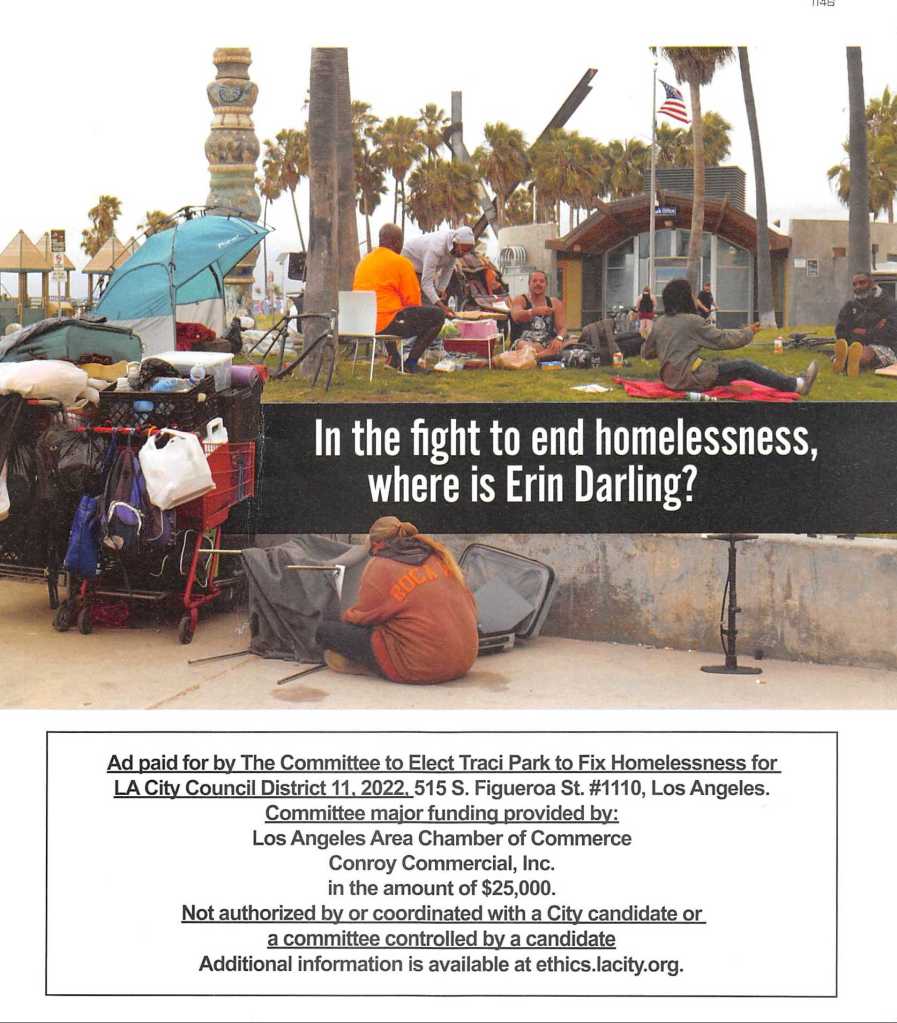
An intense campaign is shaping up for Los Angeles’s City Council District 11 between two defense attorneys: Erin Darling, a Progressive Democrat, and Traci Park, probably a Republican. At stake is the proliferation of homeless encampments in the district.

On Saturday morning, Martine and I had a chance to see a debate between Darling and Park. We were unimpressed by both of the candidates—though we suspect that Park is more willing to enforce existing laws forbidding encampments near schools, churches, and public parks.

In general, there are two prevailing voter viewpoints regarding the homeless: On one hand, there are the Mother Teresas and, on the other, the Darth Vaders. If a homeless person is willing to observe the law and is seriously interested in leaving the street encampments, I am willing to join the Mother Teresas to assist them. For those who are mentally hill and are unwilling to obey rules regarding alcohol and recreational drugs, I prefer the Darth Vader approach: drive them off the streets, by force if necessary.

Political Handout for Erin Darling

Although Erin Darling is endorsed by the Los Angeles Times and several liberal politicians and organizations, I see that Traci Park is endorsed by the Fire Department and local Police Departments. I rather suspect that Darling is one of those Woke Liberals I dislike as much as Trump’s MAGA insurrectionists. At one point in the debate, he spoke glowingly of the skateboarding community. What, aren’t they all still in Middle School? Sheesh!

The older I get, the more I realize that we are rarely presented with candidates and issues which we can enthusiastically support. All Martine and I care about is cleaning the garbage piles off the streets (usually associated with bums living in tents); cutting down on petty thefts of bicycles, medications, food, and drink; and threats of violence from rampaging bums (which have affected both Martine and me).

Fun in the Sun?

Family On Summer Beach Vacation Run Out Of Sea Towards Camera

Ah yes, Paradise on Earth. As a people, we have traditionally viewed summer beach vacations as the closest one could get to Heaven while alive. When I first came out to California in the late 1960s, I thought so, too. While working part-time at System Development Corporation in Santa Monica, I spent many afternoons lying on a towel and reading steamy fiction like Lawrence Durrell’s Alexandria Quartet.

The water was fun to a certain extent, but I was never a board or body surfer, though I went in often enough to be savaged by the occasional rough wave. Also, I tended to burn—especially as I had no one to slather my back with sun tan lotion.

While I live only two miles from the beach at Santa Monica, I don’t spend time there any more, unless I take a walk on the boardwalk connecting Santa Monica to Venice. Part of the reason is that the water is more polluted than ever, especially because we are only 20-30 miles (32-48 km) from the nation’s largest port, where freighters and tankers regularly foul the waters with petrochemical waste.

So when Martine and I go to Hawaii in a couple months, are we planning for any beach time? Not really. Although the waters at Waikiki are less polluted, the sun is stronger; and we both have fair skin. We are more interested in visiting Honolulu as a destination rather than trying to live in a pharmaceutical commercial.

I suppose if we lived east of the Mississippi, we would yearn for sunshine; but, living in Southern California, we have sunshine on most days of the year. In fact, September tends to be one of the hottest months of the year in Los Angeles. So we are likely escaping even hotter (albeit drier) weather at home.

“Nothing Is Easy”

Bengals QB Joe Burrow Grimaces in Pain

I am not known as a big football fan, but nonetheless I decided to watch today’s Superbowl LVI between the Cincinnati Bengals and the Los Angeles Rams. After all, the game was being held in L.A. and featured the home team.

While it was nice that the Rams won, I was very conscious of the physical pain that is an inevitable part of the game. In the Second Quarter, Rams receiver Odell Beckham Jr had a non-contact misstep which injured his left knee and sidelined him for the rest of the game—leading to additional defensive coverage on Cooper Kupp that made things rough on QB Matthew Stafford until the fourth quarter.

What particularly caught my eye was the sacking of Bengals QB Joe Burrow by Rams linebacker Von Miller early in the Fourth Quarter (above). For several seconds, Burrow lay on the field with his face contorted in pain. Fortunately for his team, he was able to recover, though I felt there will be something to pay for that takedown.

There was a lot of meaningless commentary by all the sports pundits, but only once did the truth come out when one of them said, “Nothing is easy.” No truer words were ever spoken in sport.

The Geography of Los Angeles

One thing about Los Angeles is its distinctive geography, much celebrated in literature and film. You can always tell when some New Yorker just deplaned at LAX and started spouting inanities that displayed an ignorance of this geography. That’s what happened when I read Megan Abbott’s neo-noir thriller Die a Little. There were a few names like “Pico Boulevard” (which everyone here just calls Pico), the giant doughnut at Randy’s in Inglewood, even several restaurant names like the Apple Pan and Ciro’s—but they just didn’t hold together. It’s as if she was using a map and a guidebook and just pasting the places together.

Take Woody Allen’s film Annie Hall (1977) with its tone-deaf attacks on L.A.

After all, it’s been more than 35 years since Alvy Singer hilariously dissed the city in “Annie Hall,” saying that people here “don’t throw their garbage away, they make it into television shows” and that “the only cultural advantage is that you can make a right turn on a red light.”

I can only hope he enjoyed the mashed yeast he ordered on the Sunset Strip.

When you read Raymond Chandler or Ross Macdonald, you get a feeling for the crumbling sandstone of the coastal mountains, the transverse mountain ranges running west to east, the vast distances going from one point to another, as well as the odd architectural vibe of the place. When I first came out here in 1966, I was confused by all the stucco and chicken wire architecture, until I experienced my first real earthquake in 1971.

You can always tell when an east coast writer is slumming in Southern California. It doesn’t come across as real.

Down Two Muses

Christmas 2021 was going to see Los Angeles minus two of her muses. We just lost Joan Didion (above) to Parkinson’s disease; and six days ago, we lost Eve Babitz (photo below) to Huntington’s disease. Didion and Babitz were, to my mind, the leading writers about life in Southern California over the last half century or so.

I remember when I was first introduced to Didion by my friend Stephanie Hanna, who recommended back around 1970 that I read her great collection of essays entitled Slouching Toward Bethlehem. Since then, I have read at least eight other volumes of her fiction and nonfiction.

Eve Babitz was a more recent discovery, thanks mainly to the New York Review of Books (NYRB), which brought out most of her work in the last few years. I consider Eve’s Hollywood and Slow Days, Fast Company to be among the best works written about life in Southern California.

Joan Didion died in her 80s, and Eve Babitz at the age of 78. That makes me feel vulnerable, as I am a male who is about to reach his 77th year next month. In many ways, my acceptance of women as a source of outstanding literature about the local scene is due to these two powerful figures.

Now, as I look around me, who is there to take their places? No one that I can recognize at this point. I am just going to have to start looking….