
The Medicine of Bow-Returning

An Excerpt from a Short Story by Mary Austin

Some of the best books about the American West were written by Mary Hunter Austin (1868-1934). In the last year of her life, she published a collection of short stories entitled One-Smoke Stories, in which the following appears:

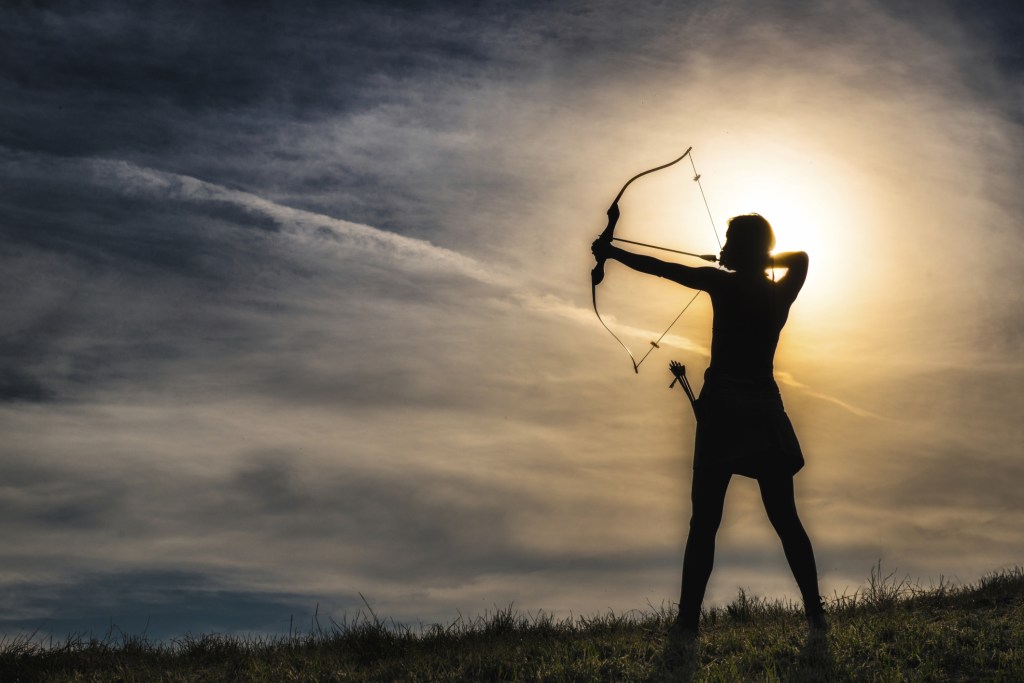
So Taku-Wakin, who was afterward called Bow-Returning, went toward the mountain called Going-to-the-Sun for his fast, and as he went he felt the thoughts of his mother push him. He went far, climbed the high mountains and bathed in the sacred lakes, keeping holy science. On the mountain, when by fasting he was removed from himself, his eyes were opened. He saw all the earth and the sky as One Thing, even as the bow is one thing and the cord of the bow which draws it. Even so he saw the thoughts of men pulling at the corners of the world as the cord pulls at the bow, and the bow bending and returning. In the silence he heard in his heart the One-Who-Walks-in-the-Sky talking.

‘This is true medicine, Taku-Wakin. All things are one, man and the mire, the small grass and the mountain, the deer and the hunter pursuing, the thing that is made and the maker, even as the bow and the cord are one thing. As the bow bends to the cord, so all things bend and return, and are opposed and together. The meaning of the medicine is that man can hurt nothing without also hurting himself.’ Thus said the One-Who-Walks-in-the-Sky to Taku-Wakin….

After long seeking he heard the voice of the Sky-Walker. Then said Bow-Returning: ‘This is my medicine, that everything is One Thing, and in this fashion I have kept it. Meat I have taken for my needs according to the law of food-taking, but I have hurt no man. Neither the flower in the field have I crushed, nor trodden on the ant in my pathway. How is it, then, that my wife is dead, my son given to another, and my medicine is gone from me?’

Then said the One-Who-Walks-in-the-Sky to Bow-Returning, ‘Did I not also make woman?’

Indian Baskets and Coyote Dentures

Panamint Shoshone Indian Baskets

Inyo County’s county seat is the small town of Independence, CA. To me, it will always be associated with the Eastern California Museum and the writings of Mary Hunter Austin (1868-1934). Curiously, the museum and Mary Austin’s house are just across the street from one another. I have always thought that Austins The Land of Little Rain and The Basket Woman are two of the best books written about life in the Eastern Sierras over a century ago. The Austin house is not open to visitors, but you can always cross the street to the museum to buy her books and learn about this incredible writer.

In fact, there is little about the Eastern Sierras that you can’t learn about from the museum. If the Owens Valley and its continuation northward to the Nevada state line is of any interest to you, you owe it to yourself to spend at least half a day at the museum. There you will learn about the miners, the Indians, the Japanese interned at Manzanar, the pioneer men and women, the mountain climbers, the water wars, the geology, the railroads, and the farmers.

One of the most incredible displays is a set of dentures using coyote teeth for a dentally distressed resident by the name of George Washington Hancock. While we visited the museum, we heard two visitors walk in the door and immediately ask about the “coyote teeth.”

The Coyote Dentures and the Story Behind Them

The collection of Paiute and Shoshone Indian basketry is world class. I particularly liked the Panamint Shoshone designs on their baskets. I was disappointed to learn that these baskets were made for early tourists to the area, as the Indians were much too pragmatic to bother about designs for something so utilitarian as a food container. Yet the designs came from somewhere and are visually striking.

In many ways, it is recommended to visit the museum at or near the beginning of your trip along Highway 395. Wherever you are going, whatever you are planning to do, you will find answers here in this museum which is owned and run by Inyo County. There are no admission fees, but I strongly recommend you make a donation so that this outstanding institution can continue to highlight one of the most interesting corners of our country.