
About Those Eyebrows

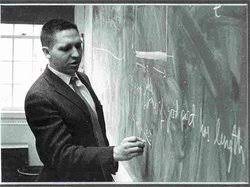
Hazleton “Terry” Mirkil III, Associate Professor of Mathematics at Dartmouth

In the Winter Trimester of my freshman year at Dartmouth College, I took the second of my two math courses, which were required of part of the college’s “distributive requirements.” The term refers to courses in fields that don’t interest you so that you could become a well-rounded person. The course was called something like “Introduction to Probability and Statistics,” though it was mostly the former.

There are only two things I remember about the course. The first is that in any random group of thirteen people, there is an even chance that two of the party share the same birthday. (That was more than I can recall about my previous math course on Calculus.)

The other thing I remember were Professor Hazleton Mirkil’s wild eyebrows. In profile, they stood out like wild antennae reaching up to an inch from his brow. His eyebrows come to mind because I seem to have developed the same antenna-like eyebrows. When I get a haircut, my barber trims them for me, though they always grow back thrusting in all directions.

Thinking about Professor Mirkil’s eyebrows, I decided to see what I could find out about him on the Internet. What I found was not much, inasmuch as he had committed suicide in 1967, the year after I graduated from Dartmouth. According to the West Lebanon Valley News:

Hazelton Mirkil III, 44, associate professor of mathematics at Dartmouth College, was found dead Wednesday afternoon in the woods back of Chase Field. Dr. I. A. Dinerman of Canaan Grafton County medical referee attributed death to suicide by shooting. He said that Prof. Mirkil, was “dead at least a month or two,” was shot through the head and found with a revolver in his hand.

Prof. Mirkil was on leave from Dartmouth for the current academic year and had been at the Veterans Hospital at Northampton, Mass. Having obtained leave from the hospital and not having returned,
he was reported missing March 17.

Very likely, my Math prof received a bad diagnosis from the VA Hospital. The above photo was the only one I could find except for a tiny picture in uniform during WW2. That’s typical for people whose lives have ended well before the advent of the Internet.

I never was much good in math. I received a C+ in both Calculus and Probability. I am certainly not a graduate that the Math Department at Dartmouth would be proud of. (Nor the English Department, as I ended that last sentence with a preposition.)

If you fear that I, too, would blow my brains out because of my unruly eyebrows, don’t worry. I am too funny-looking on a number of counts to worry solely about my eyebrows.
Juggling with Infinity

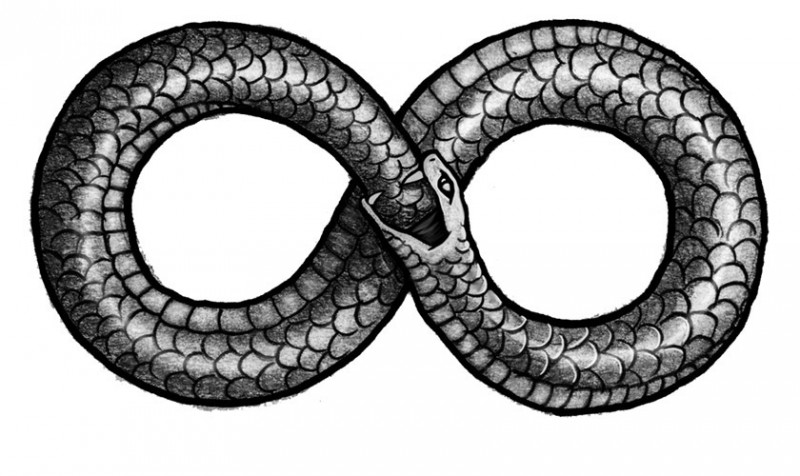
The Worm Ourobouros, One of the Symbols for Infinity

I have just finished reading Amir D. Aczel’s book on the mathematics of infinity, entitled The Mystery of the Aleph: Mathematics, the Kabbalah, and the Search for Infinity (New York: Washington Square Press, 2000). Although I am an ignoramus when it comes to theoretical mathematics, I was able to follow this book pretty much throughout; and I found it utterly fascinating.

The most important contributions to the mathematics of infinity have come from two Europeans, first Georg Cantor of Germany and then Kurt Gödel of Austria. In vainly attempting to prove their theorems regarding infinite sets, both men went mad. Cantor died at Halle’s Nervenklinik in 1918; and Gödel of starvation in Princeton, NJ, of all places, in 1978.

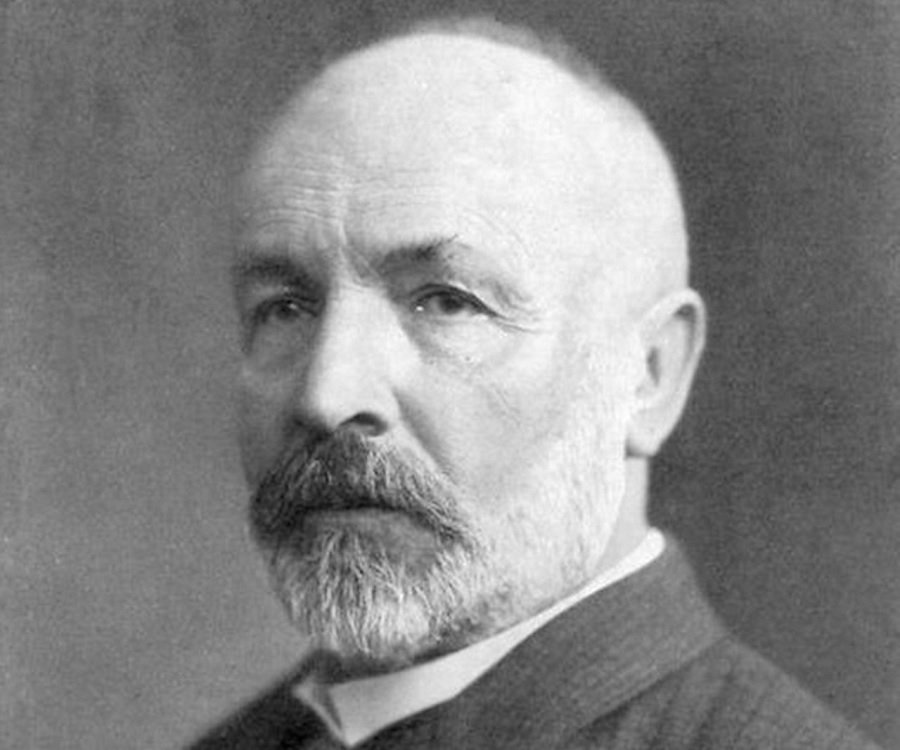
Georg Cantor

What sent Cantor to the clinic multiple times were his difficulties in finding a proof for the so-called Continuum Hypothesis, which, stated all too briefly, is that there is no set whose cardinality is strictly between that of the integers and the real numbers. In other words, it relates to quantifying systems of sets containing infinite values, whether real or integer. Got that? Well, it killed Cantor and also Gödel.

Kurt Gödel

Even though at the end his mind was wasted, and he insisted that people were trying to poison him, Gödel finally understood one very important fact:

Gödel and [Paul] Cohen have brought us to a sobering realization: hard as we may try, there will always be some truths forever beyond our reach. Human beings may never understand the deep nature of infinity. This is perhaps something that Kabbalah practitioners understand on an intuitive level, without requiring a mathematical proof. To them, infinity was God or things that are God’s. One such infinity was the chaluk, God’s infinitely bright robe, at which no human can look.

It all makes sense. To prove something, one has to be able to see through to its essence, which is difficult when infinities are involved.


A Physicist Disproves the Existence of Vampires

Bela Lugosi as Dracula

Bela Lugosi as Dracula

It was bound to happen. According to University of Central Florida physics professor Costas Efthimiou, there is a simple mathematical argument against the existence of vampires. I saw it on Livescience.Com. (If you follow this link, click on slide #5 for the reference.)

According to Efthimiou, there were 536,870,911 human beings on January 1, 1600. Let us assume that the very first vampire came into existence on that day and bit one person a month so that he could sustain himself with his victim’s blood and change his victim into another vampire. By February 1, 1600, there would be two vampires; by March 1, four vampires; by April 1, eight vampires. If vampirism spread at that rate, it would take only two and a half years for the entire population of the earth to be converted into undead bloodsucking beasts. If that happened, there would be no one left to feed on.

Even if you played with the equation a bit and allowed vampires to feed less often, the constant doubling of the vampire population would have consumed the entire non-vampire population rapidly.

In the end, the proof resembles the story of the ancient king and the grains of wheat on the chessboard. If you’re interested in pursuing that tale, here is a charming re-telling of it on a Canadian website.

So when you go to bed tonight, you needn’t festoon all the entryways with wreaths of garlic. Instead, just eat the garlic. It’s good for you!