Influencers on the Road

Have Camera, Will Travel

Since I am planning for a possible trip to Isla Mujeres in Mexico, I have been watching dozens of videos posted on YouTube by mostly young influencers. They have proven to be helpful in one way: I have a pretty good idea what Isla Mujeres looks like.

On the other hand, I have never seen so many mispronunciations and errors of fact. I don’t get the feeling that many of these influencers ever did their research before picking up their camera and buying a plane ticket. Fortunately, there are exceptions, such as this eminently useful post on how to avoid the “shark tank” at the Cancun International Airport, with its ravenous timeshare condo salespersons.

One unfortunate tendency is for most of these influencers to get sloshed on cocktails with every meal and between meals. Many of the travel videos for Isla Mujeres are 50% taken up with drinking sessions. Talk about Ugly Americans!

Also, it becomes very evident that these influencers are selling their recommendations of hotels, destinations, restaurants, and bars—presumably for free or heavily discounted products or services.

I will still consult many of these videos because they do give me some ideas. One simply has to learn to separate the wheat from the chaff.

“A Long and Silent Street”

Mexican Poet and Diplomat Octavio Paz (1914-1998)

Octavio Paz is Mexico’s lone winner of the Nobel Prize in Literature. He is best known for his poetry, but he also wrote a great long essay about Mexico entitled The Labyrinth of Solitude (1950). Below is a haunting poem by him about human isolation:

The Street

Here is a long and silent street.
I walk in blackness and I stumble and fall
and rise, and I walk blind, my feet
trampling the silent stones and the dry leaves.
Someone behind me also tramples, stones, leaves:
if I slow down, he slows;
if I run, he runs
I turn:
nobody.

Everything dark and doorless,
only my steps aware of me,
I turning and turning among these corners
which lead forever to the street
where nobody waits for, nobody follows me,
where I pursue a man who stumbles
and rises and says when he sees me:
nobody.

Plotting a Getaway

Isla Mujeres Seen from the Air

The island is a half hour boat ride from Cancun’s Puerto Juarez. It is approximately 4.3 miles (7 km) long and on an average of 0.4 miles (650 meters) wide. In the above photo, you are viewing the eastern tip of the island, known as Punta Sur. The main town and the best swimming beaches are at the far end.

I am in the process of trying to convince Martine to come with me for a week in Isla Mujeres. It would be a low stress visit with lots of great seafood and, at Playa Norte, a beach that has a sand bottom, no waves, no rip tides, no rocks, no seaweed, and plenty of clear, utterly transparent water of the right temperature.

Martine does not like traveling to Mexico (she’s been to Yucatán once and Cabo San Lucas once). I am hoping I can lure her with pictures of a no-fuss, no-muss destination with great seafood, swimming, and shopping. And virtually no automobiles, except for taxis.

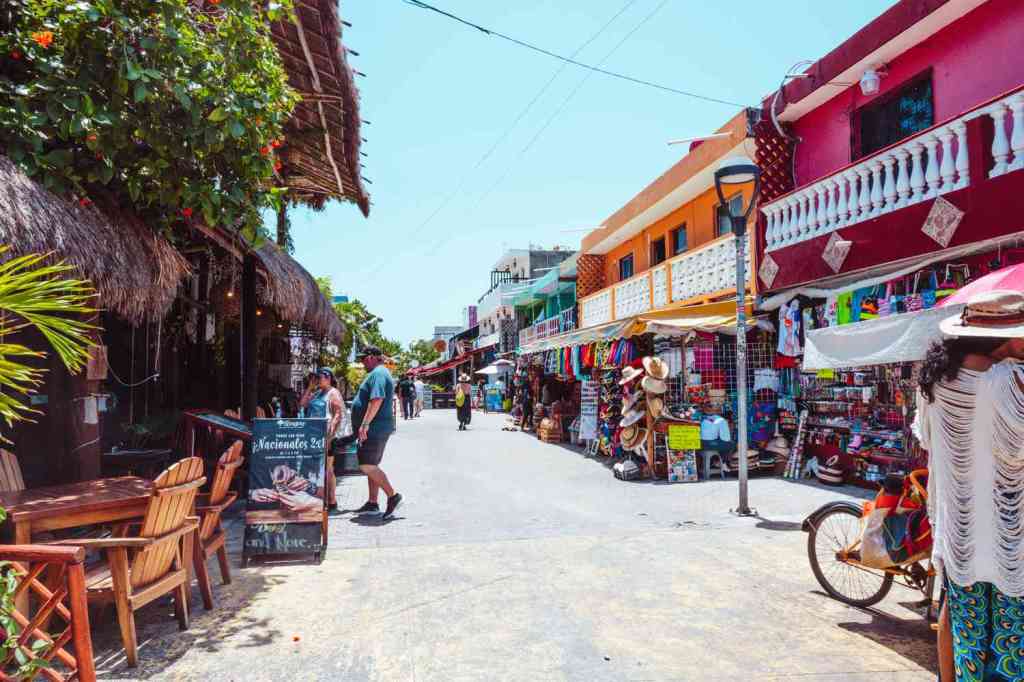
Shopping on Isla Mujeres

Although Isla Mujeres is famous for diving and snorkeling, I have no intention to do either. I have never dived or snorkeled before, and I don’t intend to start at age 80.

I have been watching YouTube videos submitted by Internet Influencers. They have been useful for showing what the place looks like, and how young influencers like to get sloshed when they’re away from home.

Wish me luck with Martine.

Mexican Rules

Benito Juarez Airport in Mexico City

I was reading Oliver Sacks’s Oaxaca Journal—a book I do not recommend you read unless you are a botanist—when I came across this passage which reminded me of past trips to Mexico:

“What gate do we go from?” everyone is asking. “It’s Gate 10,” someone says. “They told me it was Gate 10.”

“It’s Gate 3,” someone else says, “It’s up there on the board, Gate 3.” Yet another person has been told we are leaving from Gate 5. I have an odd feeling that the gate number is still, at this point, indeterminate. One thought is that there are only rumors of gate numbers until, at a critical point, one number wins. Or that the gate is indeterminable in a Heisenbergian sense, only becoming determinate at the final moment (which, if I have the right phrase, “collapses the wave function”). Or that the plane, or its probability, leaves from several gates simultaneously, pursuing all possible paths to Oaxaca..

. . . . . . . . . . . . . . . . . . . . . . . . . . . . . . . . . .

This reminds me of a trip my brother and I took to Mexico in 1979. We flew into Mexico’s Benito Juarez Airport and were to take a connecting flight to the misnamed city of Villahermosa. Not only was the gate uncertain, not only was the time uncertain, but whether the flight would take place at all was uncertain. (You can read more about it here.) This was a interesting lesson in traveling under Mexican rules.

This was no longer the precise Anglo-Saxon world we had just left behind. There was uncertainty everywhere. If you let it bother you, you will mot enjoy your vacation. If, on the other hand, you take it as a “Heisenbergian” event and hang in there to see how it all sorts out, you not only win but you learn an interesting lesson that, in the end, you can take back home with you.

Orozco at Dartmouth

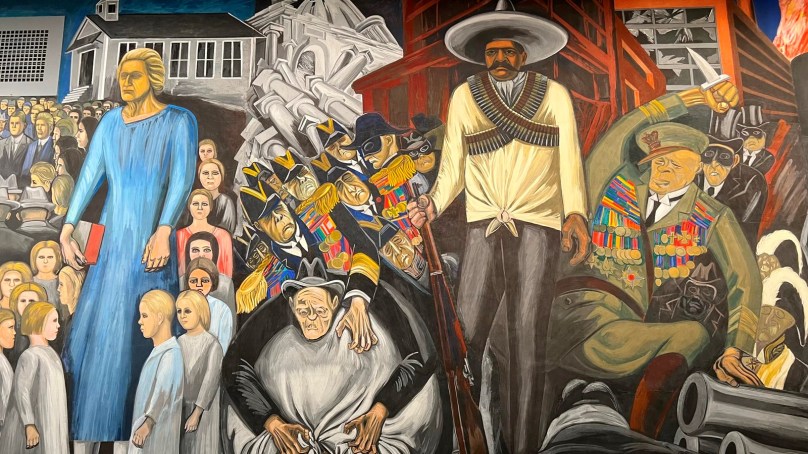
Panel of Orozco’s Epic of American Civilization

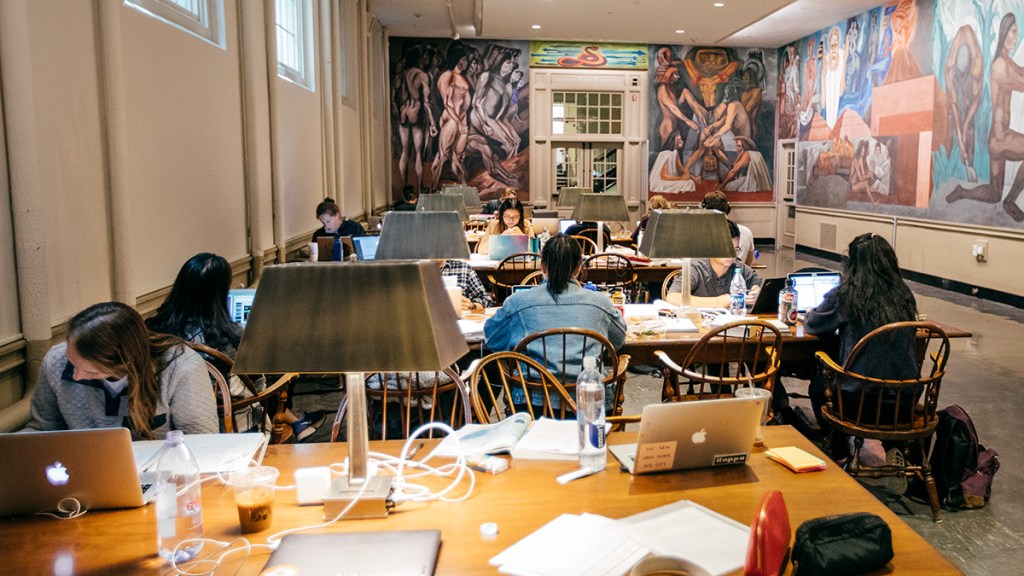
One of the things I most loved about my years at Dartmouth College was studying in the Baker Library’s Reserve Room, as it was then called. The Mexican artist José Clemente Orozco (1883-1949). Between 1932 and 1934, he painted a series of murals entitled “The Epic of American Civilization” in the college’s Baker Library.

There is a detailed discussion of Orozco’s mural put out by Dartmouth’s Hood Museum describing all the panels.

The Reserve Room

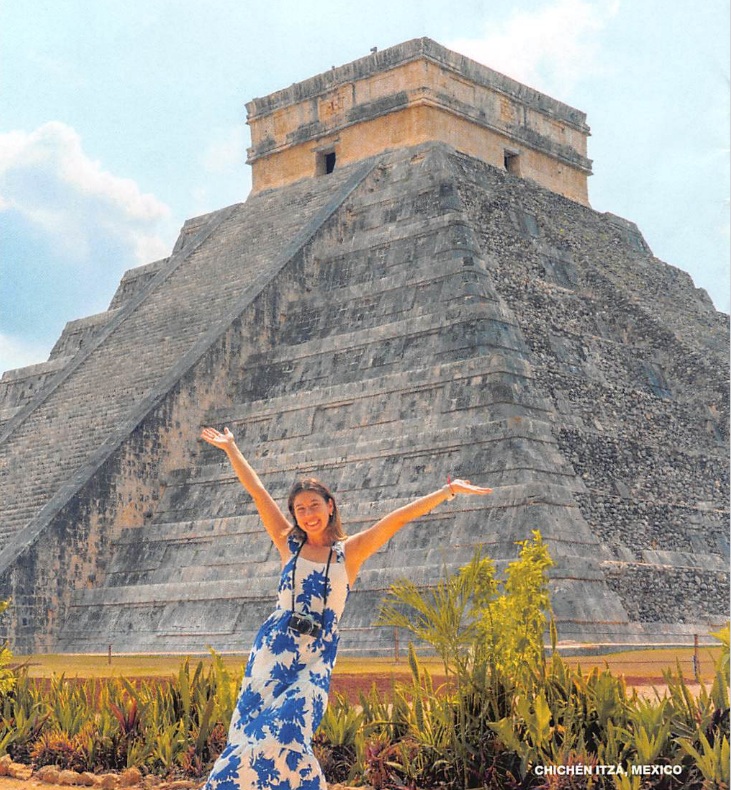
Sometimes I think it is those murals which first got me interested in going to Mexico. Nine years after I graduated, I finally made it to Yucatán and visited the ruins at Uxmal, Chichén Itzá, Mayapan, and Kabah during a two-week trip in November 1975.

Until I saw Orozco’s work, Mexico and the Pre-Columbian civilizations of the Americas just weren’t on my radar. Afterwards, they became a major preoccupation.

Quetzalcoatl in a Panel of the Orozco Murals

Little did I know in my college years that my interest in the murals would eventually lead me not only to Mexico, but also Argentina, Guatemala, Honduras, Uruguay, Chile, Peru, and Ecuador.

Four Englishmen Do Mexico

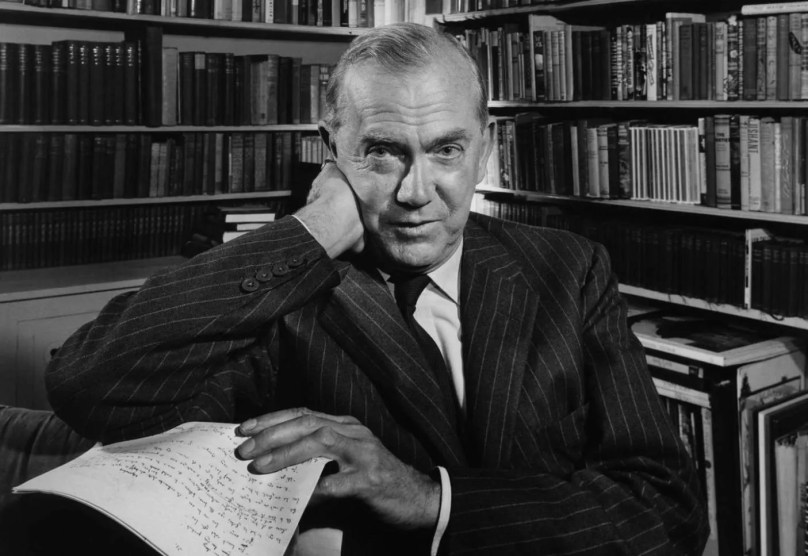
British Writer Graham Greene (1904-1991)

In the 1920s and 1930s, Mexico suddenly came to the attention of the English. There had been a messy revolution, numerous political assassinations, persecution of the Catholic Church, and the nationalization of the country’s petroleum assets. English writers seemed to want to understand Mexico, even if it meant an investment of several weeks to do so.

The results were pretty much a hodge-podge. Probably the most interesting works were by Graham Greene in his novel The Power and the Glory (1940) about the religious persecution in Tabasco and Chiapas and The Lawless Roads (1939), a travel book in which the author admits to loathing Mexico. “No hope anywhere. I have never been in a country where you are more aware all the time of hate,” this after he broke his glasses while on the road.

Also interesting is Aldous Huxley (1894-1963) with his tour of Mexico and Central America published in 1934 called Beyond the Mexique Bay.

D. H. Lawrence was hot and cold on the subject of Mexico. His Mornings in Mexico (1927) shows that he knew how to appreciate Mexico, whereas The Plumed Serpent (1926) is a weird and unconvincing novel.

Worst of the books was Evelyn Waugh’s Robbery Under Law: The Mexican Object-Lesson (1939), in which it is apparent that he is in a permanent snit on the subject of Mexico, and his sources were all obviously fascistic jackals. I read the first half of the book with its endless complaints of Lazaro Cardenas’s nationalization of the petroleum industry (was he possibly a disappointed investor?) and the United States’s hamfisted interventions during the Mexican Revolution. At no point did I feel that Waugh was seeing with his own eyes. (And yet, he was such a brilliant novelist. Go figure!)

The Archbishop’s Garden

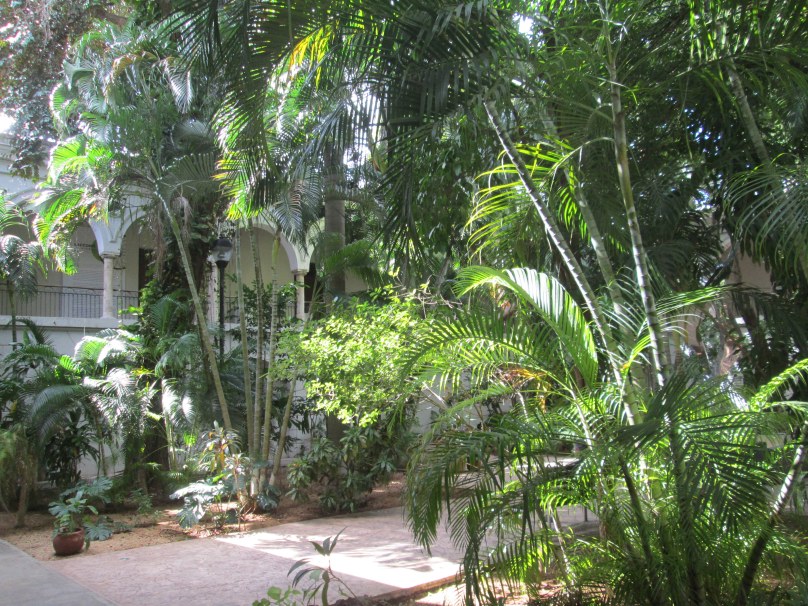
The Archbishop’s Enclosed Garden in Mérida, Yucatán

Do you ever really use your front lawn? There you are, in full view of wandering passersby and the occasional hobo. You feel self-conscious and even slightly stupid—unless you are doing yard work.

Take a look at the above courtyard, which is surrounded on all sides by the Mérida, Yucatán archbishop’s palace. It was a hot, humid day; yet the garden was cool with comfortable benches in the shade. I took advantage of the benches before seeing the rest of the art museum that the archbishop’s palace has been turned into.

I love the Mexican houses that have no setback from the street, instead enclosing a private courtyard that is in actuality the heart of the house. Of course, there are laws that prevent such a thing in the United States. Hence all those front lawns that are thirsty for water and fertilizer and are never used for the pleasure of the family within.

Granted, the archbishop had the means to have something special built for him; but I have seen scores of small gardens in more modest Mexican houses, including many of the small hotels at which I have stayed. In many cases, they are used as bars or simple restaurants.

Sometimes I think that the water shortages in California and other desert states could be alleviated simply by getting rid of those front lawns that attempt to imitate an English country house. California is not England, nor is it the Eastern U.S.

“This Disorganized Room”

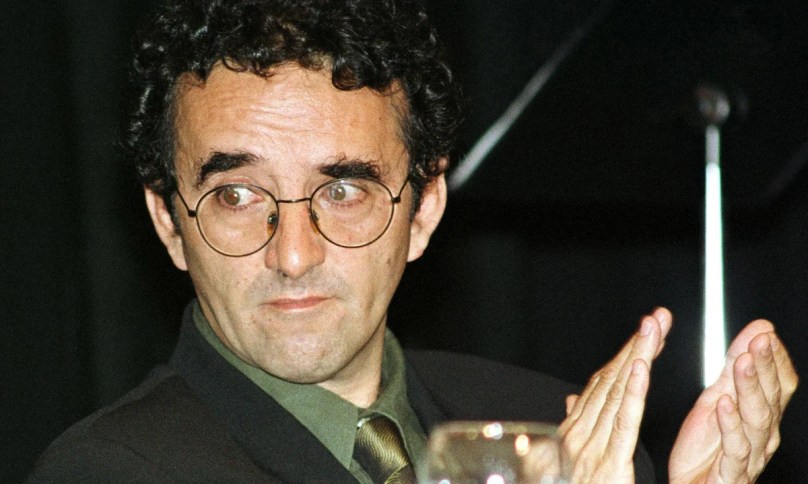
Chilean Writer and Poet Roberto Bolaño (1953-2003)

It’s a pity that Roberto died so young! Only fifty years of age! Over the last ten years he has brought so much enjoyment to me with his novels, stories, and poems. Here is one of his poems of which I am particularly fond:

The Memory of Lisa

The memory of Lisa descends again
through night’s hole.
A rope, a beam of light
and there it is:
the ideal Mexican village.
Amidst the barbarity, Lisa’s smile,
Lisa’s frozen film,
Lisa’s fridge with the door open
sprinkling a little light on
this disorganized room that I,
now pushing forty,
call Mexico, call Mexico City,
call Roberto Bolaño looking for a pay phone
amidst chaos and beauty
to call his one and only true love.

Day of the Dead

November 2 in the Catholic liturgy is All Souls’ Day, or in Mexico, El Dia de Los Muertos, the Day of the Dead. Here is a poem by Alberto Rios, a Hispanic resident of Arizona.

November 2: Día de los muertos

1

It is not simply the Day of the Dead—loud, and parties.
More quietly, it is the day of my dead. The day of your dead.

These days, the neon of it all, the big-teeth, laughing skulls,
The posed calacas and Catrinas and happy dead people doing funny things—

It’s all in good humor, and sometimes I can’t help myself: I laugh out loud, too.
But I miss my father. My grandmother has been gone

Almost so long I can’t grab hold of her voice with my ears anymore,
Not easily. My mother-in-law, she’s still here, still in things packed

In boxes, her laughter on videotape, and in conversations.
Our dog died several years ago and I try to say his name

Whenever I leave the house—You take care of this house now,
I say to him, the way I always have, the way he knows.

I grew up with the trips to the cemetery and pan de muerto,
The prayers and the favorite foods, the carne asada, the beer.

But that was in the small town where my memory still lives.
Today, I’m in the big city, and that small town feels far away.

2

The Day of the Dead—it’s really the days of the dead. All Saints’ Day,
The first of November, also called the día de los angelitos

Everybody thinks it’s Day of the Dead—but it’s not, not exactly.
This first day is for those who have died a saint

And for the small innocents—the criaturas­—the tender creatures
Who have been taken from us all, sometimes without a name.

To die a saint deserves its day, to die a child. The following day,
The second of November, this is for everybody else who has died

And there are so many,
A grandmother, a father, a distant uncle or lost cousin.

It is hard enough to keep track even within one’s own family.
But the day belongs to everyone, so many home altars,

So many parents gone, so many husbands, so many
Aunt Normas, so many Connies and Matildes. Countless friends.

Still, by the end of the day, we all ask ourselves the same thing:
Isn’t this all over yet?

3

All these dead coming after—and so close to—Halloween,
The days all start to blend,

The goblins and princesses of the miniature world
Not so different from the ways in which we imagine

Those who are gone, their memories smaller, their clothes brighter.
We want to feed them only candy, too—so much candy

That our own mouths will get hypnotized by the sweetness,
Our own eyes dazzled by the color, our noses by the smells

The first cool breath of fall makes, a fire always burning
Somewhere out there. We feed our memories

And then, humans that we are, we just want to move quickly away
From it all, happy for the richness of everything

If unsettled by the cut pumpkins and gourds,
The howling decorations. The marigolds—cempasúchiles

If it rains, they stink, these fussy flowers of the dead.
Bread of the dead, day of the dead—it’s hard to keep saying the word.

4

The dead:
They take over the town like beach vacationers, returning tourists getting into everything:

I had my honeymoon here, they say, and are always full of contagious nostalgia.
But it’s all right. They go away, after a while.

They go, and you miss them all over again.
The papel picado, the cut blue and red and green paper decorations,

The empanadas and coconut candy, the boxes of cajeta, saladitos,
Which make your tongue white like a ghost’s—

You miss all of it soon enough,
Pictures of people smiling, news stories, all the fiestas, all this exhaustion.

The coming night, the sweet breads, the bone tiredness of too much—
Loud noise, loud colors, loud food, mariachis, even just talking.

It’s all a lot of noise, but it belongs here. The loud is to help us not think,
To make us confuse the day and our feelings with happiness.

Because, you know, if we do think about our dead,
Wherever they are, we’ll get sad, and begin to look across at each other.

Obscuridad Mexicana

Mexican Novelist Fernanda Melchor

In this case, obscuridad is translated not as obscurity, but darkness. I toyed with the idea of calling this post “Noir Mexicana,” but I didn’t want to mix the two languages. I hope you get the general idea.

Fernanda Melchor is a very dark writer indeed. I have in the last few months read all three of her novels that have been translated into English:

  • This Isn’t Miami (Aqui no es Miami)
  • Hurricane Season (Temporada de huracanes)
  • Paradais

All three novels are about wasted lives in the vicinity of the author’s home state of Veracruz. Although short in length, all three are crammed with violence, superstition, and fear. In the background—or sometimes in the foreground—there are the drug cartels, with scenes such as Milton in Paradais being commanded to shoot and kill a pathetic old taxi driver who is begging for his life.

Reading Melchor is like reading Louis-Ferdinand Céline or the Jim Thompson of The Killer Inside Me. One is reminded that, in Mexico, it is easier to see the skull beneath the skin.