A Nostalgia for Evil Empires?

Ruins at Mayapan in Yucatán

You can see the prejudice even in the naming of the archeological periods of Maya civilization. There is Preclassic, Classic, and Postclassic. The Classic Period ended around AD 800, while the English were struggling with Viking invaders, and while Charlemagne ruled in France. The Classic period was when most of  the big pyramids and temples were built—some 700 years before Cortés and the Spanish decided to muscle in on the action.

When we travel in Yucatán or the jungles of Petén, what we marvel at are the Classic ruins of places like Tikal, Copan, Calakmul, Uxmal, and Chichen Itza. In our simple way of admiring the wrong things. The Classic period was great for the divine kings who wasted their subjects in massive construction projects and endless wars.

After the Classic period, the Maya actually improved their lot: In place of pharaonic dictates to abject slaves and massive tragedies when one of their divine kings bit the dust, the new emphasis was on trade and multiple sources of power. Of course, there were no more huge pyramids, but the Maya could spend more time on agriculture, trade, and a slightly less domineering religion.

When the Grijalvas and Alvarados began attacking the Maya, the Maya resisted. The Aztecs lasted only a couple of years under the onslaught of the Conquistadores, whereas the Maya held out until 1697, some 175 years after the Aztecs fell. Today, there are about a million speakers of Nahuatl, which was the language of the Aztecs. The Maya today number about six million in Mexico, Belize, Guatemala, Honduras, and El Salvador—and they speak some 28 dialects of the Mayan language! While the Aztecs went down in flames, the Maya survived in greater strength despite multiple attempts to curtail their numbers and their power.

 

Pre-Columbian Writing

Detail from the Dresden Codex

At the time the Spanish landed in he New World, there was only one Pre-Columbian culture that had a written alphabet, and that was the Maya. Now I have heard that in earlier centuries, the Zapotecs and Mixtecs of Northern Mexico had a written alphabet, but stopped using it after a certain point. Curiously, the Aztecs and Inca did not have their own alphabet, however advanced they may have been in other respects.

Right now, the only instances we have of writing in Mayan are glyphs at various Maya ruins and four surviving codices that escaped the religious zeal of the Spanish missionaries in destroying what they perceived to be heretical. And since the subject matter related to Maya religion, it was heretical insofar as Christianity was concerned.

The most famous destroyer of Mayan codices was Diego de Landa, the Franciscan Bishop of Yucatán in the 16th century. In a famed book burning conducted in 1562, de Landa had 27 codices burned at Mani. He described the Maya as being disconsolate at the destruction of so much of their culture at one time. Curiously, it was the same de Landa who wrote the Relación de Las Cosas de Yucatán, which preserved an astonishing amount of the culture and language, such that it is still studied by Maya scholars. It is still available in a Dover Publications paperback.

Do you see the dots and dashes in the above detail from the Dresden Codex just above the four seated figures? They are, in order, the numbers 16, 4, 9, 13, zero (yes, the Maya had discovered zero), 5, 12, 2, and 1. As you can probably surmise from this, the dashes represented the number five or a multiple of fives; and a dot, a one or multiple of ones up to four. It was a vigesimal system, meaning to the base 20 rather than base 10 like ours. Very likely, the numbers in the illustration represent a “long count” calendar date fixing a particular event in time. You can read more about Maya mathematics here.

The other interesting thing about the Mayan alphabet is that some symbols were hieroglyphic and stood for an entire word and others phonetic, standing for syllables. This confused scholars for years.

At the time I started visiting the Maya world, only the calendrical symbols had been decoded (mostly thanks to the selfsame good/bad Diego de Landa). In the last forty years, we have discovered that the Maya have a history. We have learned names of rulers and translated descriptions of events commemorated by Maya rulers.


O Brave New World!

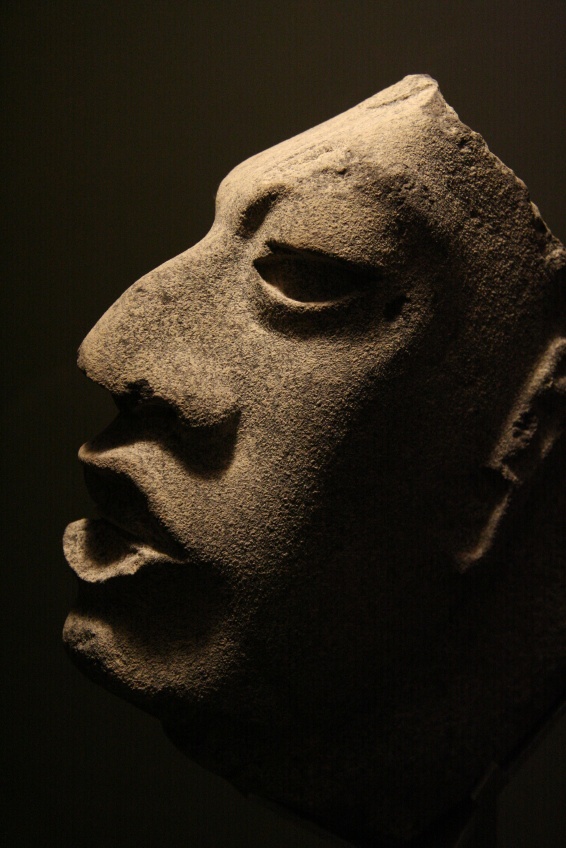
Maya Nose on Pre-Columbian Figure

The world opened up for me when I was thirty years old. It was the first time I even thought of breaking loose from my mother and father and exploring the world. For my first trip, I chose Yucatán in November 1975. And it was magical. First there was that cab ride to the Hotel Mérida past snack bars that were open to the street. It was my first experience of the tropics (other than Florida), and in the dark I saw men and women drinking beer and sodas. I was able to peer into houses and saw families watching television.

Once I checked in to my hotel, I stood at my sixth-floor window looking down onto Calle 60 and looking at passers-by walking on the sidewalk below. Suddenly one stopped and looked straight up at me. How did he know to do that? I stayed up until the wee hours of the morning, staring at an optician’s office across the way called Optica Rejón.

I was entranced by the zócalo and the 16th-century structures surrounding it. I had my boots polished every day. There was endless people-watching, all those Maya with their distinctive noses.

How many goodly creatures are there here!
How beauteous mankind is! O brave new world,
That has such people in ’t!


Around mid-afternoon, I hung out at the main entrance of the University (also on Calle 60, just a couple blocks from my hotel). So many beautiful young women that looked so different from the ones back home! Young Maya women are astonishingly good looking.

Can you wonder that, feeling the way I did about travel, that it would become a major feature of my life. Even though, in the next two years, I would travel to Europe, there was something about Latin American that lured me—and still does.

Why I’m Stuck on the Maya

Maya Girls

My first real trip outside the borders of the United States was to Yucatán in November 1975. I was so entranced with what I saw that I kept coming back to Maya Mexico for years, until 1992. During that time, I also wanted to go to Guatemala, but a civil war between the Maya and the Ladinos (Mestizos) was raging until 1996; and Guatemala was on the State Department’s “Level 4: Do Not Travel” list until just recently. Even now, the State Department as the whole country classified under a blanket “Level 3: Reconsider travel to Guatemala due to crime” warning.

Why is it that I am so fascinated by the Maya that I would risk flouting President Trumpf’s State Department?

For one thing, the Maya are incredible survivors. The Aztecs were ground down by Cortez within two years. In Peru, it took forty years before resistance was smashed by Pizarro and his successors. And the Maya? That took a full 180 years before the last Maya kingdom (at Tayasal in Guatemala) was leveled.

Today, there are 1.5 million speakers of Nahuatl, the language of the Aztecs. There are some 6 million speakers of the 26-odd Mayan languages and dialects. Of course, the Incan Quechua language has even more speakers: some 8.5 to 11 million speakers in several South American countries.

In recent years, there have been several disturbances in the Maya area:

  • In Mexico, there was a Maya war against the Ladinos in Yucatán that lasted from 1847 to 1901 and a Zapatista revolt in Chiapas that flared briefly in 1994.
  • In Guatemala, there was a violent civil war against the Ladinos from 1960 to 1996. It is estimated that tens of thousands of Maya were massacred by the army.
  • In El Salvador, there was a civil war from 1979 to 1981. (Only some of the indigenous peoples involved in that one were Maya.)

The Maya are still there, occupying large parts of Mexico (Yucatán, Chiapas, Tabasco, Campeche, and Quintana Roo); Belize; Guatemala; and parts of Honduras and El Salvador. It is no small achievement for them to have survived so much persecution for upwards of 500 years.

That is what interests me.


Portrait of a Sucker

Scene in the Crafts Market, Otavalo, Ecuador

There is nothing quite like the crafts market of a Latin American city like Chichicastenano, Guatemala; Otavalo, Ecuador; or Cusco, Peru. One wonders down narrow ways awash with color and aglitter with native ingenuity. There are times when I felt bad for not buying far more handicrafts than I could reasonably be expected to carry—especially the textiles. What I do buy is usually small enough to fit into the single bag with which I travel.

I remember the first time I felt this way. I was in San Cristóbal de las Casas in Chiapas, Mexico. It was December 1979, and I was fascinated by the Highland Maya textiles. It was then that a little Chamula girl, no older than eight or nine, sold me a little doll in native costume that she had made herself (or so she said). As she was describing it in her Highland Mayan dialect of which I knew not a single word, and stroking it as if it were something rare and magical, my heart melted and I bought the doll. I still have it on one of my bookshelves, resting against the Latin American literature section.

At some point, I’ll take a picture of it so that you can all see what I sucker I am. I suppose it is better than being heartless.

The Joys of Pre-Columbian Art

Moche Portrait Vessels at Lima’s Museo Larco

Not everyone is an aficionado of primitive art—particularly the Pre-Columbian art of the Americas. Children are not taught in schools about the early civilizations of the Americas. On the contrary, I suspect most kids think that, since the ancient civilizations fell so quickly to the conquistadores,  they didn’t have anything to offer to us.

Even one of my literary heroes, Aldous Huxley, came a cropper in his 1934 travel classic, Beyond the Mexique Bay: “Frankly, try how I may, I cannot very much like primitive people. They make me feel uncomfortable. ‘La bêtise n’est pas mon fort.’”

I strongly suspect that among Europeans of some eighty years ago, that was a common opinion. After all, the Olmecs, Maya, Aztecs, Moche, and Inca do not in any way resemble the ancient Greeks and Romans—except that the Inca, like the Romans, were also great road-builders. They didn’t have much of a literature that has survived the Spanish conquest, except perhaps for the Maya Popol Vuh of the 16th century. As for philosophy, drama, novels, poetry… you can pretty much forget about it.

There was a period of tens of thousands of years during which the peoples of the Americas were isolated from any possible contact with European civilization. In consequence, they developed along different lines. Again and again in his book on Guatemala and Mexico, Huxley shows himself to be unwilling to consider that the Maya are very different. Not inferior, just different.

The Moche figures in the above photograph are all highly individualized. They remind me of the terra-cotta Chinese warriors discovered in Xian: Each of the 8,000 soldiers was different from all the others.

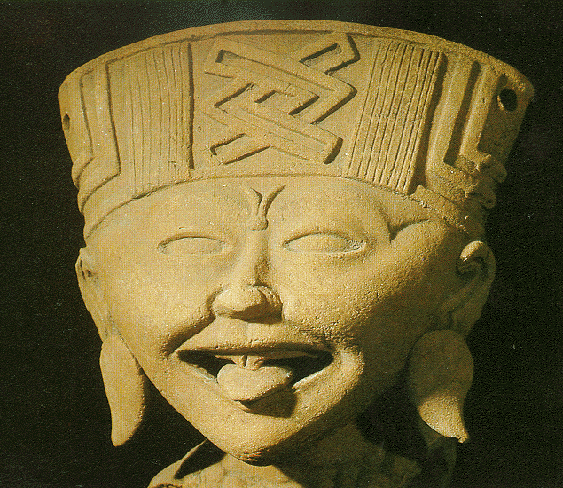
Totonac Figure from Mexico

Take the Totonac figure from the State of Veracruz in Mexico. This is a typical subject for Totonac art. Do we know what it means? The sloping forehead (does it show a deliberately deformed skull such as many Maya subjects?), the humorous expression: It is as if the distant past were laughing at us. And, in a way, it is. Many Pre-Columbian figures of animals from Mexico are downright hilarious. I don’t remember that type of humor from Greece or Rome, and certainly nothing similar from the Christian era.

Look at the Diego Rivera mural below, depicting a scene from El Tajin, the ancient ceremonial center of the Totonacs:

Scene from Diego Rivera Mural of El Tajin, Ancient Totonac Center

Let’s face it. We don’t quite understand what is going on here. We probably never will. I myself have been to El Tajin and saw Totonac youths rotating around elevated poles as voladores. Was there any convincing explanation of what was going on here? No, of course not. What intrigues me about this period is that the subjects are incredibly fascinating, but it is all a great mystery. Like life in general.


Xu’tan

The Term Means, Literally, “The End of the World”

The contradiction goes all the way back to 1562, when Spanish Bishop Diego de Landa ordered some 5,000 Maya cult images and a number of codices in Mayan to be burned in the city of Mani in Yucatán (see illustration below).  Yet, four years later, this same Diego de Landa preserved an incredible amount of Maya culture in his book Relación de las Cosas de Yucatán, without which it is doubtful we would have learned to read the Mayan language. So what is the verdict on de Landa? Only history will tell.

In his book Mornings in Mexico, D. H. Lawrence wrote:

The Indian way of consciousness is different from and fatal to our own way of consciousness. Our way of consciousness is different from and fatal to the Indian. The two ways, the two streams are never to be united. They are not even to be reconciled. There is no bridge, no canal of connection…. The sooner we realize, and accept this, the better, and leave off trying, with fulsome sentimentalism, to render the Indian in our own terms.

Yet we cannot seem to ever “leave off trying.” I certainly can’t. In my reading and in my travels I revisit this primitive world. I have been numerous times to the Hopi and Navajo Reservations, and visited many of the Pueblos of New Mexico, from Acoma to Zuñi. I have eaten their food, purchased their crafts, even given rides to their hitchhikers.

Diego de Landa Burning Maya Codices

I have just finished reading Victor Perera and Robert D. Bruce’s The Last Lords of Palenque: The Lacandon Mayas of the Mexican Rain Forest, which tells of the doom in store for the Lacandon Maya of Chiapas. The doom begins with visits from foreigners, continues with ecological disaster (building roads, cutting down or burning forests), and ends with the end of a culture which has survived for hundreds, perhaps thousands of years.

The old spiritual leader of the Lacandons, the now deceased Chan K’in, predicted this xu’tan, or end of the world:

“The world is going to die,” he said, with the bright obsessive gaze that overtakes the younger Lacandones when they speak of the world’s end. “It is too old already. The flesh is also old. It is exhausted. The world will burn up soon. The sun will stop, not move in the sky, and it will burn everything down. It will burn everything until the world is naked. It will burn for three weeks. Then it will rain. It will rain for three weeks without stopping, until everything is flooded. Then, above, in the upper heaven of the minor gods all will be dark, and they will cut off the heads of the people and Ts’ibatnah [the god of the graphic arts] will paint the houses with the blood of the good people. Their blood is bright red and smells very good, like nthe tuberose. But the celestial jaguars will eat the people with dark blood, which will be spilled on the ground….”

The details become ever more bizarre and remote from the experience of people like me, however much we like to study primitive civilizations.


Five Epiphanies

Ushuaia from the Air

It was James Joyce who, in Stephen Hero and The Portrait of the Artist as a Young Man, coined the term epiphanies to refer to moments of clarity and sudden recognition of another perspective. There were several points in my life in which I had a shock of recognition and that I looked back on as pivotal points in my development as a person. In this post, I recognize five such epiphanies that occurred in my life:

Dartmouth College 1962

It was a bad year. It looked as if my parents were headed for divorce, and rare was the day when there were no mutual recriminations. I was delighted that I was accepted at Dartmouth. When, during the summer, my future roommate’s parents drove me up to the campus, I fell in love with the place, deciding that here was a place I could heal.

Cleveland 1966

I was released from Fairview General Hospital after brain surgery to remove a pituitary tumor. As I was sitting as a passenger in our family automobile, I saw the people in the street almost as angelic beings. It was only after the operation that I was told how serious the operation was; and that my life was despaired of. I thought momentarily of Miranda’s lines in Shakespeare’s The Tempest:

Oh, wonder!
How many goodly creatures are there here!
How beauteous mankind is! O brave new world,
That has such people in ’t!
Uxmal 1975
On my first trip outside the United States, I arranged with Turistica Yucateca to have a driver take me to the Maya ruins at Uxmal in the Puuc Hills. As his car pulled up to the magnificent Templo del Adivino, he made a sign of the cross. I felt that I was on holy ground.
Death Valley 1979
It was my first camping trip and my first real introduction to the desert. We were at Furnace Creek, with desolation all around us. Just after sunrise, birds of every variety flocked to the campground and woke us up.
Ushuaia 2006
It was my first trip to South America. As our plane descended to Ushuaia, the southernmost city in the world, only 600 miles from Antarctica, I felt a shiver of excitement. Never mind that I was to break my shoulder in a blizzard within a few days, Ushuaia has always stood for a kind of subarctic wilderness. I returned in 2011 with Martine and would gladly return again.


Serendipity: Where Did The Maya Go?

Our Picture of the Ancient Maya, But Is It the Only One?

I can still remember the historical pundits of the 1950s and 1960s, with their cockamamie claims that the Egyptians came to the New World and built the pyramids for the Maya, because, naturally, they were too primitive to learn how to pile one stone on top of another. I can hear their voice-overs in dozens of spurious documentaries (imagine Lowell Thomas’s voice): “What happened to these people? Where did they disappear to?”

One answer comes from Christopher Shaw, in his uneven but occasionally brilliant book Sacred Monkey River: A Canoe Trip with the Gods:

If a golden age existed, it included—along with art and writing, highly developed religious and political systems, artificers and scribes, ritual torture and human sacrifice—cayucos [canoes] floating in waterlily beds, canals thick with protein-rich fish, and the finite cosmos reflected in the waters. If it “fell,” as mny scenarios insist it did, the region became crowded and degraded at the denouement of the classical era. Drought came and apocalyptic wars ensued. In their aftermath, people forgot the old ways and connected them to the past. With the cities reeling, merchant nobles from the coast—putun—imposed themselves and took power. Some of them, in their bourgeois, sentimental fashion, tried to maintain the trappings of grandeur. But the thread had been cut. In the great pyramid temples of the centralized state, the gods fell silent, though not in the houses of the campesinos.

The putun—simultaneously “barbarian” intruders and “merchant warriors,” to [archeologists] Linda Schele and David Freidel—apparently tried to keep alive the connections to tradition, dynasty, and place that lay at the root of the classic peple’s success. But the collective consciousness had moved on. The people “turned their backs on the kings to pursue a less complicated way of living,” as Schele and Freidel put it. hey turned to the forest. In the words of the Popol Vuh, the retreated “under the vines under the trees.”

Tomorrow I will return to this subject with a slightly different point of view.

Serendipity: The Lacandon Apocalypse

The Late Chan K’in Viejo, Lacandonian Chief and Elder, in 1933

I have just begun reading Christopher Shaw’s excellent Sacred Monkey River: A Canoe Trip with the Gods, a book about the river waterways used by the ancient Mayans for trading. The Lacandonians are a very traditional Mayan group that live along the Usumacinta River that forms part of the border between Mexico and Guatemala. In 1992, I saw a Lacandonian selling bows and arrows in front of the Casa del Balam Hotel in Merida, Yucatán. The following passage in Shaw’s book caught my eye:

Kayum, one of Chan K’in’s sons, a painter of naïve but arresting jungle scenes with one-man shows from Barcelona to Seattle to his credit, looked up from his ax work and gently scolded Victor [Perera, author of The Last Lords of Palenque] that he must let go of the world. It is creaking and groaning like an old man, he said. Everything prefigured the imminence of xu’tan, he said, the Lacandon apocalypse. The proper attitude of a hach winik [Lacandonian, “real person”] was to welcome it and the new era of creation it anticipated. He spoke with the deep calm and conviction of a believer. Victor never forgot it, though he never accepted it either, Kayum’s willingness to watch and welcome while a thousand generations of accumulated beauty and uncatalogued nonhuman life got traded for the shortest of gains, or in many cases no gains at all.

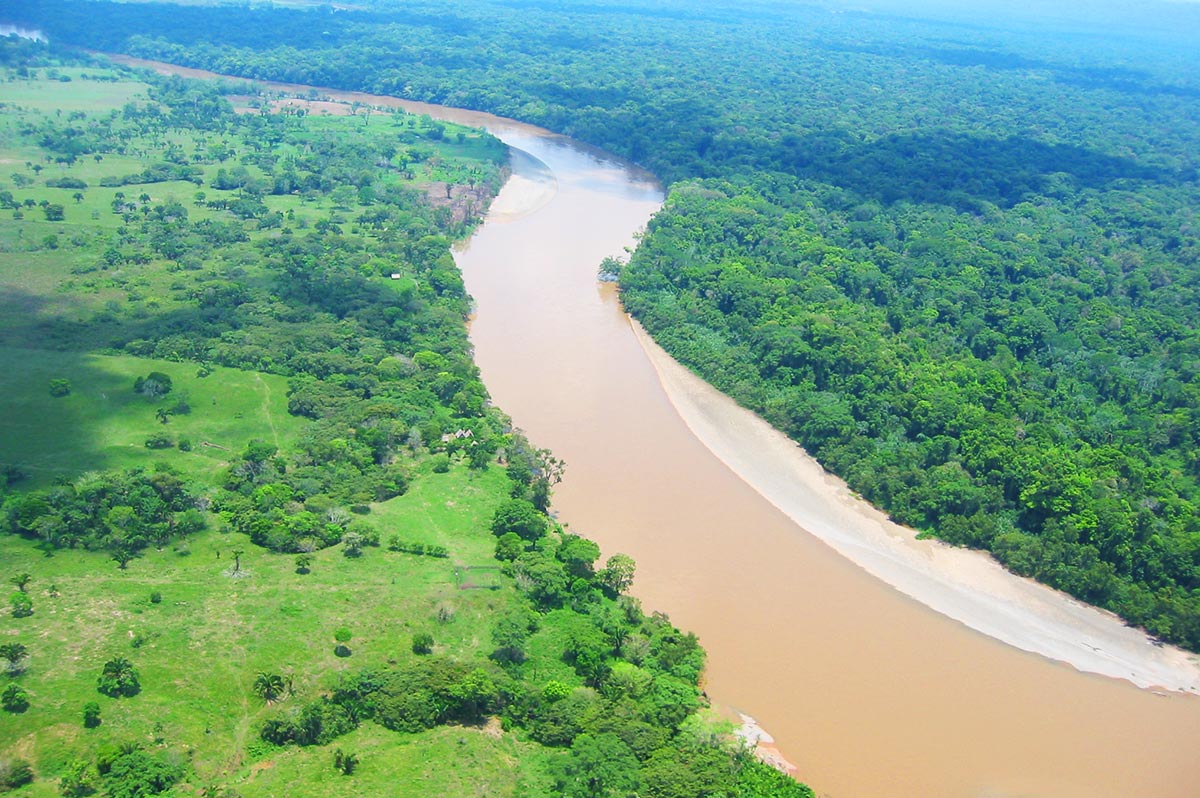
The Usumacinta River Near Piedras Negras