Battlefield Director

Tsutomo Yamazaki (Left) in Kurosawa’s High and Low (1963)

This is an unusual thing to say, but if I were to look at all the great film directors with a point of view of selecting the one that would make the best general on the battlefield, my choice would be Japan’s Akira Kurosawa (1910-1998).

Yesterday evening I did not post here because I was watching Kurosawa’s great noir film High and Low for the third time. The tale follows Toshiro Mifune as a shoe manufacturer whose son is kidnapped and held for ransom. Except it turns out that it is actually his live-in chauffeur’s son who is taken. In paying the ransom anyhow, Mifune impoverishes himself, losing his business, his house, and even his furniture.

Why do I feel that Kurosawa would make an able general? In no other film (except one, that I shall mention later) is there so much intelligently conveyed detail that enables a viewer to follow the police investigation in all its aspects during its 143 minute length without feeling lost. And the film gallops along like a 73 minuter Poverty Row quickie.

During its course, Kurosawa takes us into such a realistic picture of heroine addiction that, even today, would be too much for Hollywood to handle.

The only other film that so capably marshals s vast amount of detail is the same director’s Seven Samurai (1954). This is actually a film about a 16th century military campaign in which seven masterless samurai help farmers fight back an invasion of forty mounted bandits who are after their crops. Throughout the film’s 207 minute length, we are aware of what is happening in every part of the battlefield as the samurai and farmers battle the bandits. As with High and Low, the film zips along at a fast pace despite a vast amount of detail without losing its audience.

Compare these with the average current Hollywood production in which 120 minutes seems like a lifetime and the audience is slogging through a swamp shortly after the opening credits.

The Desert Training Center

Display at the General Patton Memorial Museum

When Germany declared war on the United States right after Japan’s Peal Harbor attack, the U.S. Army set up a Desert Training Center in the Mohave Desert, centered on the Chiriaco Summit. Only the Army called it Camp Young and even built an airstrip so that top brass could fly in.

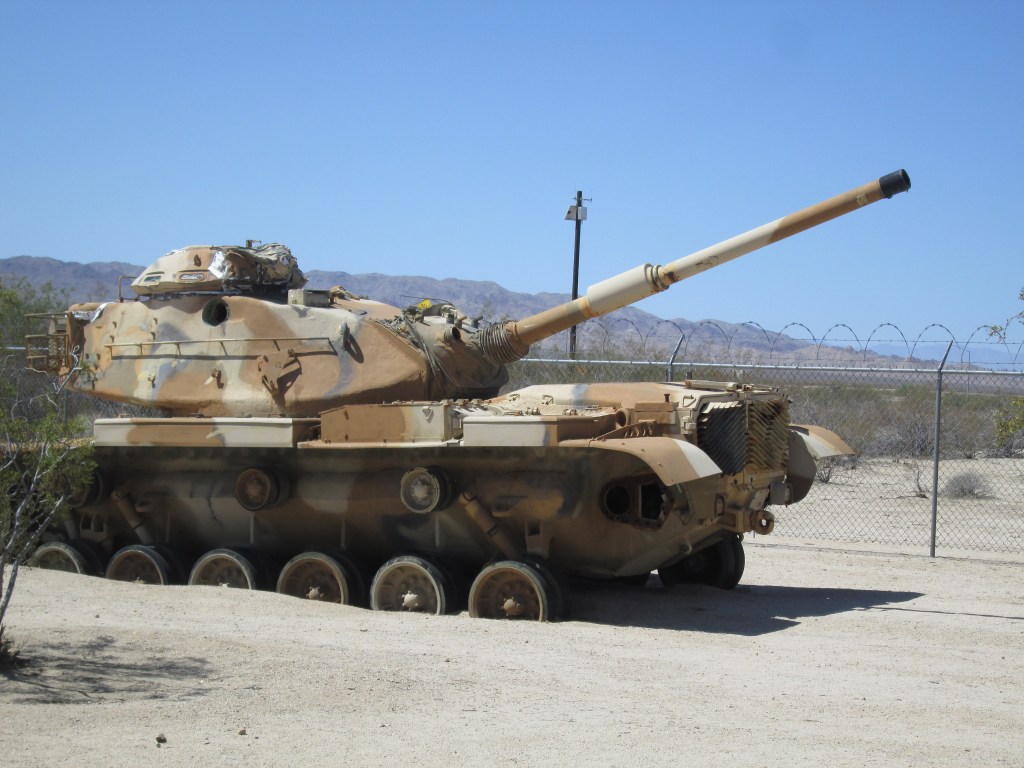
On the trip to Arizona, Martine and I spent a couple of hours at the Summit’s General Patton Memorial Museum seeing numerous exhibits on Patton’s life and the U.S.military in the Second World War, Korea, Viet Nam, and Iraq. It was nice and cool and there were a lot of things to see. We even braved the desert heat to view the tanks and other military vehicles parked outside.

Camouflaged Tank at the General Patton Memorial Museum

Martine liked the museum so much that she talked me into stopping there on the way back from Arizona. It was all right with me, because I know that my little girl is fond of military museums, having been a civilian Army employee for many years at Fort Monmouth in New Jersey, the Sacramento Army Depot, and the Twentynine Palms Marine Combat Center.

Plus we had the opportunity of eating a yummy lunch at the Chiriaco Summit Coffee Shop and a Foster’s Freeze chocolate cone at the convenience store.

Sometimes I wonder what will happen to all the military museums scattered across the country when all the veterans who fought in WW2 have passed on. These museums are most densely distributed in areas where Veterans have made their homes after they retired from the military. These museums are a useful reminder of one of the most traumatic episodes in our country’s history.

From My Piblokto Madness Bed

William Gibson on Our Military-Influenced Fashions

There are few novelists currently working whom I like as much as William Gibson. His science fiction doesn’t go that far into the future, yet he constantly introduces concepts, which he doesn’t explain, and yet which fascinate me. One such is the Piblokto Madness bed in which her character Hollis Henry from Zero History sleeps at a posh London hotel. Looking up Piblokto on Wikipedia, I found this definition: “A culture-bound syndrome observed primarily in female Inuit and other arctic populations. Individuals experience a sudden dissociative period of extreme excitement in which they often tear off clothes, run naked through the snow, scream, throw things, and perform other wild behaviors.” Huh?

On another topic, Gibson is spot on, namely the civilian fashion of adopting military styles in one’s apparel:

“Sleight had arranged for us to have a look at a garment prototype. We’d picked up interesting industry buzz about it, though when we got the photos and tracings, really, we couldn’t see why. Our best analyst thinks it’s not a tactical design. Something for mall ninjas.”

“For what?”

“The new Mitty demographic.”

“I’m lost,”

“Young men who dress to feel they they’ll be mistaken for having special capability. A species of cosplay, really. Endemic. Lots of boys are playing soldier now. The men who run the world aren’t, and neither are the boys most effectively bent on running it next. Or the ones who’re actually having to be soldiers, of course. But many of the rest have gone gear-queer, to one extent or another.”

“Gear-queer?”

Bigend’s teeth showed. “We had a team of cultural anthropologists interview American soldiers returning from Iraq. That’s where we first heard it. It’s not wholly derogatory, mind you. There are actual professionals who require these things—some of them, anyway. Though they generally seem to be far less fascinated with them. But it’s that fascination that interests us, of course.”

“It is?”

“It’s an obsession with the idea not just of the right stuff, but of the special stuff. Equipment fetishism. The costume and semiotics of achingly elite police and military units. Intense desire to possess same, of course, and in turn to be associated with that world. With its competence, its cocksure exclusivity.”

WW2-Land

The USS Arizona Memorial

It’s a strange feeling to be standing on the Arizona Memorial at Pearl Harbor. Beneath your feet is a sunken battleship in which 1,277 sailors are interred. That is roughly half the total U.S. casualties from the Japanese attack on Pearl Harbor.

The island of O’ahu has numerous military and naval bases, roughly 21% of the total land area. That includes not only Pearl Harbor itself, but Fort De Russy on Waikiki, Schofield Barracks, Hickam Air Force Base, Dillingham Field, Fort Shafter, and a whole host of others.

In fact, if there is anywhere on American soil that is a center of World War Two commemoration, it would have to be O’ahu. There have been at least four films made about the attack:

  • From Here to Eternity (1953) with Burt Lancaster and Montgomery Clift
  • Tora! Tora! Tora! (1970) with an American and Japanese Cast
  • Pearl Harbor (2001) directed by Michael Bay
  • Midway (2019), which begins with the attack on Pearl Harbor

There have also been numerous books on the subject. (And there still continue to be.) No doubt about it, America is still stuck on WW2.

When Martine and I visit Honolulu later this summer, we will spend a day going over all the exhibits and taking the shuttle over to the Arizona Memorial, as we did back in 1996. No doubt a lot has changed since then.

America: Going Down the Drain?

The Vegas Strip

Somehow, over the years, something happened to the United States and its people. In 1945—the year I was born—we were one of the few countries involved in the Second World War that were not in ruins. We were on top of the heap. The hardworking people who struggled through the Great Depression and helped restore Western Europe after the Nazi onslaught, were suddenly guilty of hubris. We thought we were really something, that our way of life was the only way to go. We were the City on the Hill, and everyplace else was a steaming sh*thole.

Nemesis struck quickly and often. Korea. The Bay of Pigs. Viet Nam. Iraq. Afghanistan. Panama. Grenada. Al Qaida. ISIS/ISIL/Daesh. And that was just the military!

We still thought we were really something. We got into deep debt, figuring that we had it coming to us. We stopped saving money for a rainy day. There was always Vegas, the Lottery, or the Horses.

We built fancy new things, never figuring that we would have to maintain and repair them somewhere along the line. The streets of Southern California are full of potholes, ringed by K-Rails, and bumpy with steel plates.

Americans drove these mean streets in leased luxury automobiles they really couldn’t afford. The more they paid, the more they assumed they could do anything they wanted: They were the privileged class with their Lexuses, Bentleys, Porsches, Mercedes-Benzes, Infinitis, and Range Rovers.

These same Americans elected a President like them, a privileged real estate developer who made the Whites into the New Aryans.

Will I live to see American feel a twinge of humility? Or will we continue to swirl around the drain until we go down it?


Living With Bad Paper

A Ticket to Homelessness?

A Ticket to Homelessness?

Joining the military could be a kind of solution for young men and women who do not have great job prospects upon leaving high school. But what if the desire for “street cred” overrides good judgment, and the GI finds himself or herself with a discharge that is considered to be Other Than Honorable, or simply OTH? Another name for such a discharge is “Bad Paper.”

For over a million former soldiers, sailors, and airmen, Bad Paper is a ticket to homelessness without the possibilities of veterans’ benefits such as education, homelessness prevention, and disability or health care. That’s not even to mention the turned-down job applications and the loss of esteem that follows.

For those who leave the military with a trail of Bad Paper, it would have been better if they were merely felons in the civilian world: The military world is unforgiving and sometimes unduly punitive. When questioned about this, General Martin Dempsey replied:

I wouldn’t suggest that we should in any way reconsider the way we characterize discharges at the time of occurrence…. It is a complex issue and we all make choices in life that then we live with for the rest of our lives and I think we have to understand that as well.

Not much help there.

Ideally, there would be some kind of civilian post-discharge review that could rectify the vagaries of military justice, which varies widely from service to service and from one unit to another.