
Favorite Films: Morocco (1930)

Gary Cooper and Marlene Dietrich in Morocco

It was Marlene Dietrich’s first film in Hollywood, and Gary Cooper’s first co-starring role in a sound film. And the director was none other than Josef von Sternberg, in my opinion one of the greatest filmmakers in the industry. The two co-stars fell in love during the filming, but the relationship between Cooper and von Sternberg was adversarial to say the least.

Nonetheless, Morocco (1930) turned out to be a gem. In its one hour and thirty-two minutes, the unbridled passion between Cooper and Dietrich has few equals in the cinema. Cooper is Private Tom Brown in the French Foreign Legion, and Dietrich is Amy Jolly, a night club singer. Within the first five minutes of the film, the two are obviously entranced with each other.
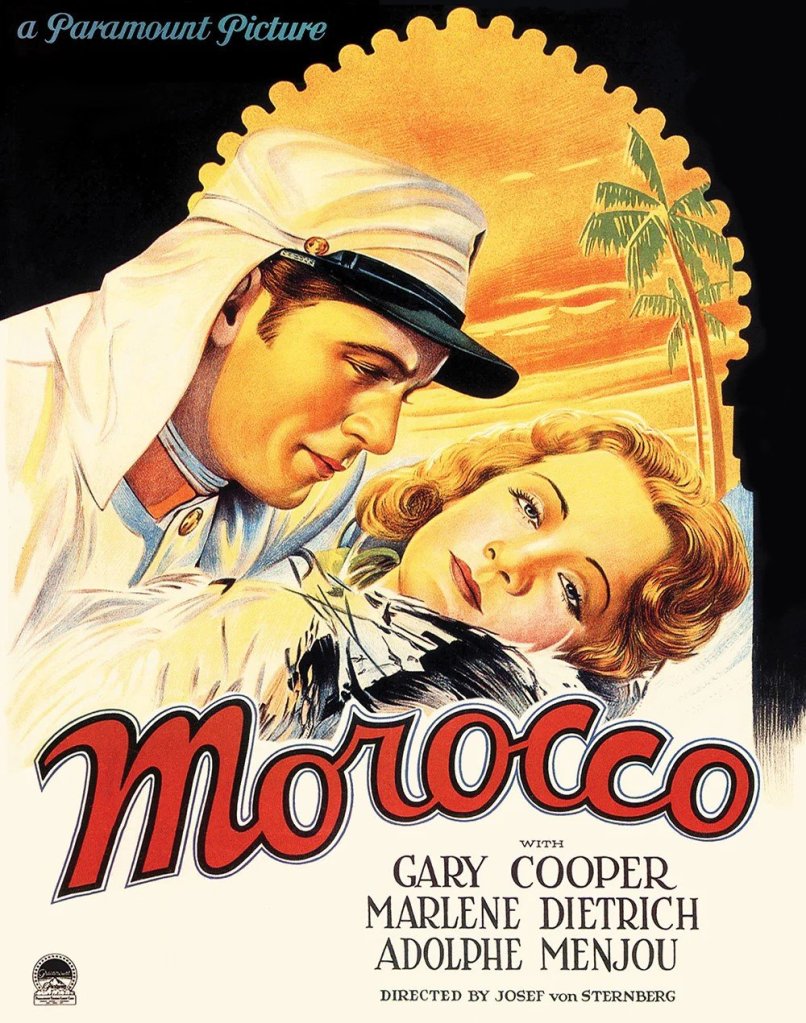
Poor rich Adolphe Menjou as M. La Bessière tries to hook up with Dietrich, but it’s no go. In the end, the nightclub singer jettisons her high heels in the sand and follows the legionnaires to their next posting along with the camp followers.

A Sack of Cobwebs

Robert Bontine Cunninghame Graham (1852-1936) was a world traveler par excellence, a splendid horseman, a controversial member of Parliament for North West Lanarkshire, and one of a handful of super-great travel writers. I am currently reading his Mogreb-el-Acksa about a trip to the forbidden city of Tarudant in Southern Morocco. He never made it to his destination, but his descriptions of his attempt are world-class literature. The following single long sentence is taken from his Preface to the book.

So I apologise for lack of analysis, neglect to dive into the supposititious motives which influence but ill-attested acts, and mostly for myself for having come before the public with the history of a failure to accomplish what I tried; and having brought together a sack of cobwebs, a pack of gossamers, a bale of thistle-down, dragon-flies’ wings, of Oriental gossip as to byegone facts, of old-world recollections, of new-world practices half understood; lore about horses’ colours, of tales of men who never bother much to think, but chiefly act, carving their lives out, where still space is left in which to carve, and acting thus so inconsiderately whilst there still remain so many stones unbroken, social problems to be solved, and the unpuncturable pneumatic tyre not yet found out.