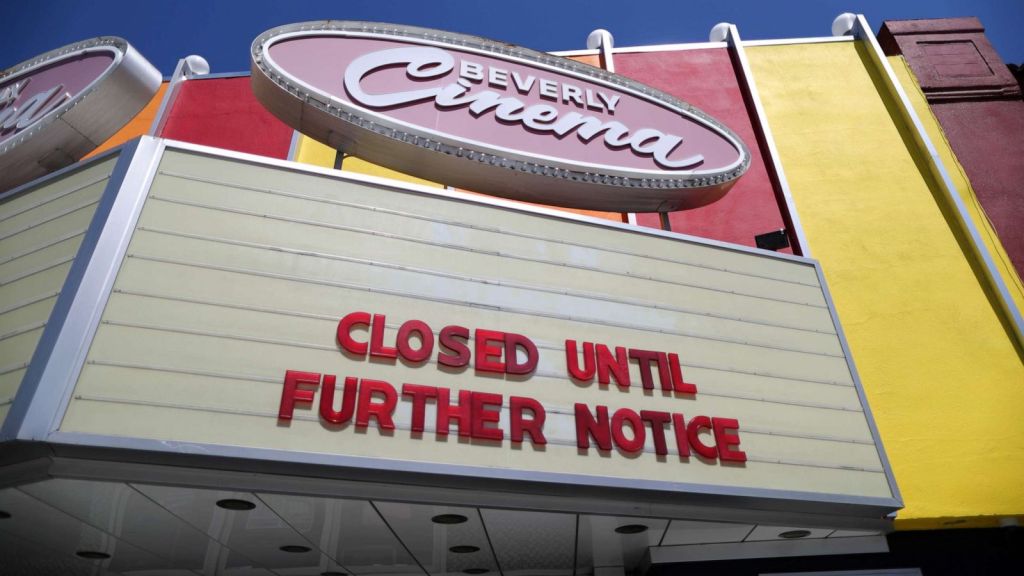
A Dying Art?

When I first came to Southern California in 1966, it was with the intention of becoming a college professor specializing in motion picture history and criticism. Now I have to admit that, in the last year, I visited a movie theater to see a current feature only once, and that was a Marvel film that I hated, namely Deadpool and Wolverine.

And yet, over the last seven years, I have seen some 960 films, mostly on television or streamed. I still love the medium, but now I recognize that it is in the act of becoming a dying art form. I don’t think it will disappear altogether. After all, one can still attend operas. There are still examples of hand-carved woodworking, lace-making, hand-written letters, and marquetry. But, as the years pass, so will many art forms.

As much as I love movies, there are fewer American movies I want to see. Part of the problem is that I am on the elderly side, and movies that appeal to the most desired demographic—young males—are, to me, “greasy kid stuff.” Superheroes that wear their colorful Underoos outdoors in public and engage in loads of computer-graphics-enhanced action. Yuck!

Who is to blame? I guess that when an art form is based on a certain technology, it is subject to the prevalence of that technology over time. But old technologies are constantly being replaced. Just in the film world, look at the various delivery systems: nitrate film, safety film, videotape (Betamax and VHS), DVD, and streaming. What’s next? Notched molecules?

I know that many of you reading this are thinking that, no, film is still a viable art form. There are numerous people intent on conserving the medium. Still, I believe it is on the road to nowhere.

All you have to do is look at what was produced in the 1950s, then in the 1960s, then in the 1970s, 1980s, 1990s, 2000s, 2010s, and now. Both statistically and artistically, the movies are dying a slow death.

Jidaigeki

Posters for The Seven Samurai (1954) and Harakiri (1962)

When I first came to Los Angeles in 1967, it didn’t take long for me to fall in love with everything Japanese. That included Japanese films, Japanese food, Japanese literature, and Japanese women. My first long RTD (Rapid Transit District) ride was on the old #83 Wilshire Boulevard route from West L.A. to La Brea Boulevard, where the Toho LaBrea theater was located a couple blocks south. I even remember the film: It was Part One of Hiroshi Inagaki’s Samurai trilogy.

Here I was, a Hungarian kid from Cleveland, finding a kind of home in the Japanese community of L.A. I even moved to Mississippi Avenue in the Sawtelle Japanese district, where there were two Japanese restaurants, the O-Sho and the Futaba Café. They were my first introduction to the cuisine. I was pretty raw at the time: When I had my first cubes of tofu in miso soup, I thought, “I’ll bet these are cut-up shark fins!”

I used to hate seafood. I thought the fish there was picked up from floating debris atop polluted Lake Erie. Now on my own in Southern California, I found myself trying (and loving) sushi after five short years.

What I loved most, however, were Japanese jidaigeki (period films), particularly those set in the samurai era. My friends Alain Silver and Jim Ursini (who collaborated on the first book on samurai films to be published in the U.S.) and I would regularly go to one of the five Japanese movie theaters then existing in Los Angeles:

  • The Toho LaBrea screened films from the Toho Studio
  • The Kokusai and Sho Tokyo theaters played Daiei films—probably my favorite
  • The Kabuki played films from Shochiku
  • The Linda Lea (my least favorite) played films from Tohei

They are all gone now. It’s all part of the growing Americanization of Japanese-Americans.

The Kokusai Theater on Crenshaw South of Adams

In fact, Alain, Jim, an I wrote a column for the UCLA Daily Bruin called “The Exotic Filmgoer.” The articles were all signed Tarnmoor (which, curiously, is the name I go under for this blog). We wrote about the Japanese and other ethnic cinemas that existed back around 1970.

I still love jidaigeki, though they’re not usually to be found around town playing in movie theaters. I have a large collection of DVDs of samurai films, and watch the Japanese films on the Turner Classic Movies (TCM) channel when they are playing.

And I still love Japanese food, though sushi is getting to be priced beyond my means.

My World 1951-1962

Where I Spent My Elementary and High School Years

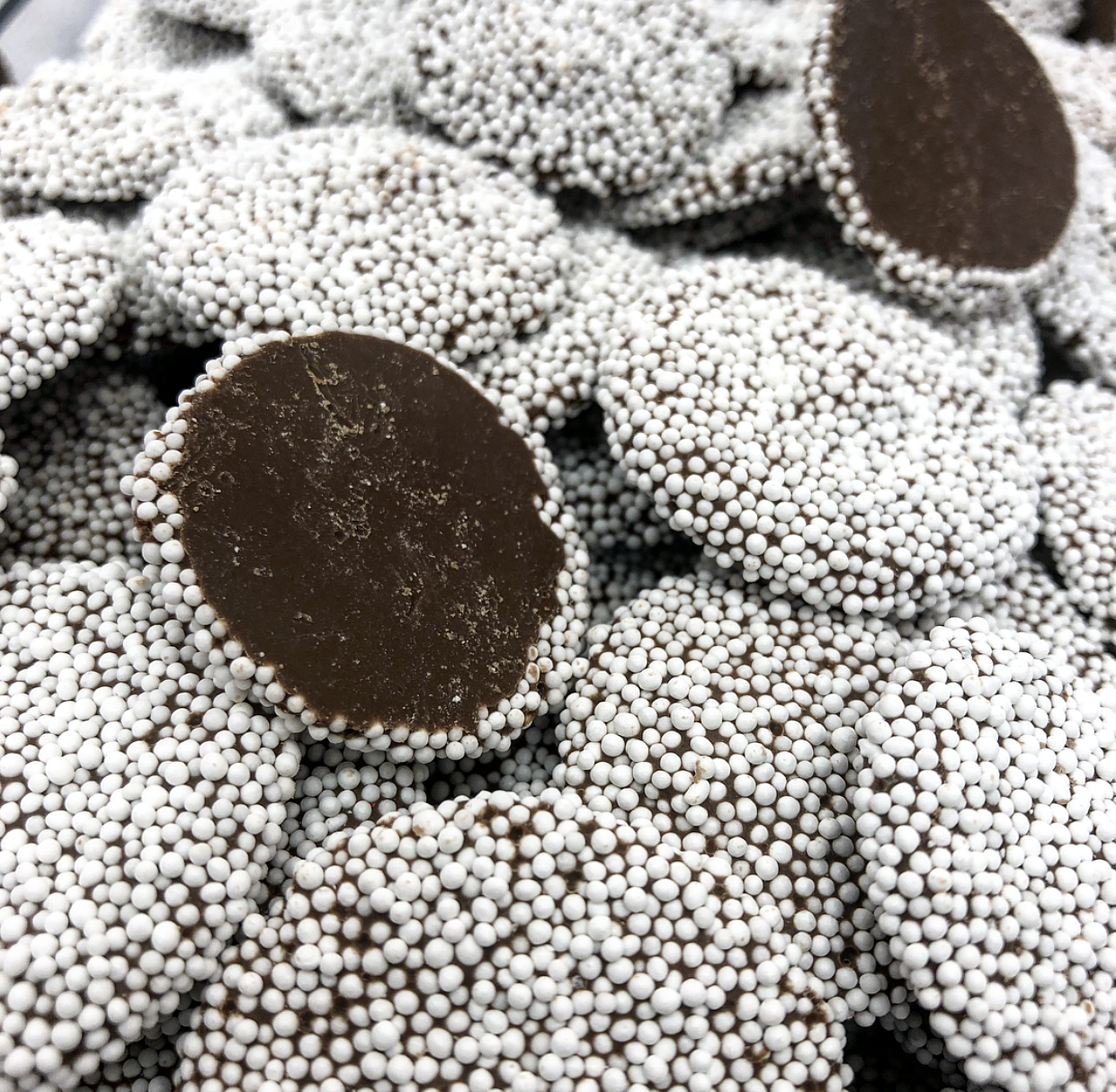
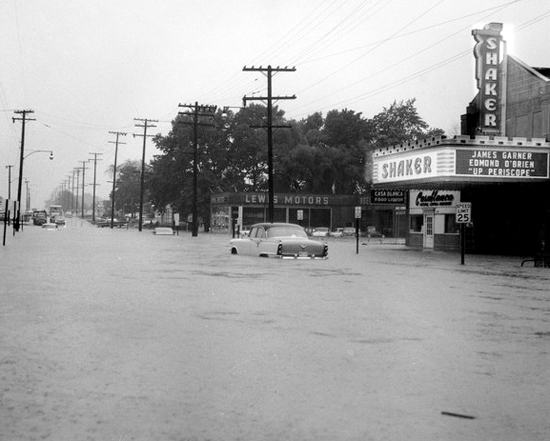
I had a Proust moment this afternoon as I bit into a chocolate nonpareil, which is a round piece of chocolate covered with little white dots of sugar candy (see picture below). It took me back to my visits to the old Shaker movie theater, which was demolished forty-odd years ago. When I lived on East 176th Street, I used to ride my bicycle down to the theater, which was located on Lee Road just south of Chagrin Blvd, which used to be called Kinsman Road back then. The pictures I saw were all Saturday matinees, complete with serials, cartoons, and the usual kiddie foofaraw. There, I would buy some popcorn and, if I had enough money, some nonpareils.

Nonpareils

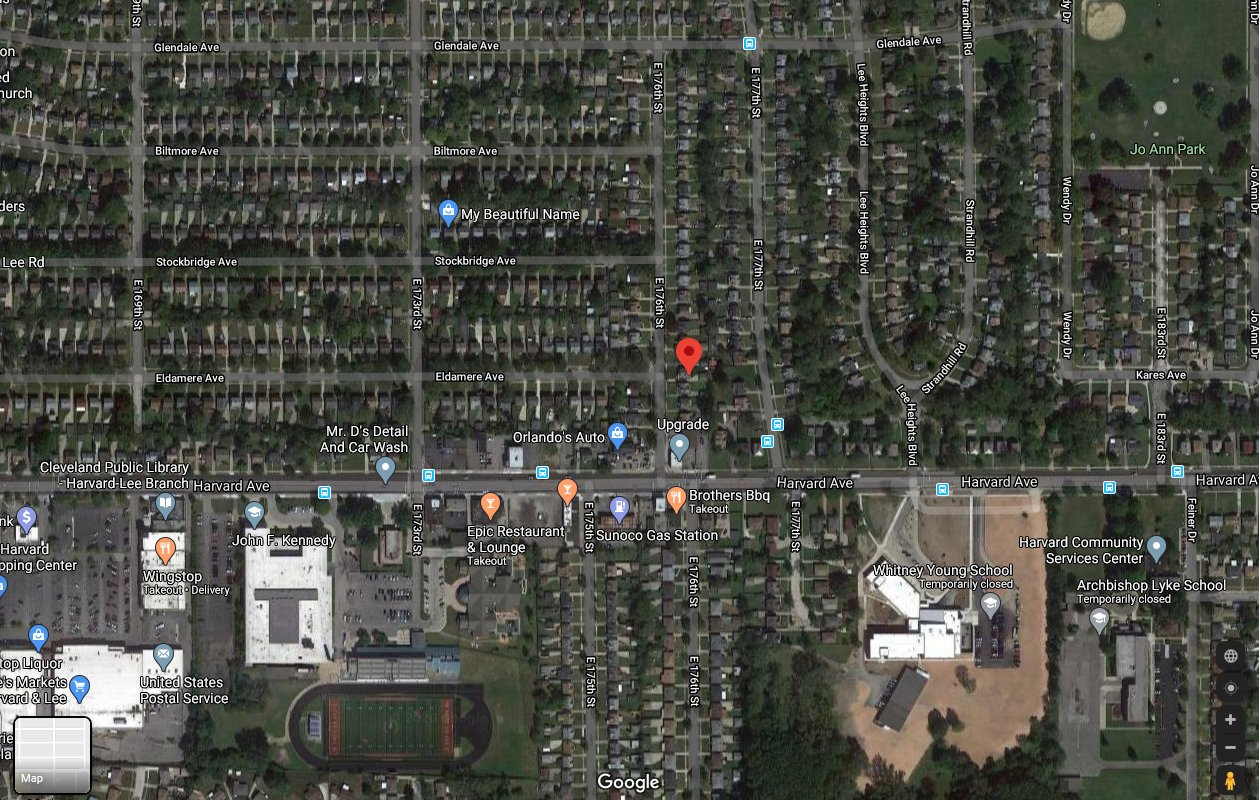
My world at that time did not stretch far from the map shown above. Occasionally, I would go downtown on the old 56A bus, boarding at at East 177th Street, a block from home. I went to elementary school at Saint Henry’s, shown on the above map as Archbishop Lyke school (now closed). My high school was a bus ride away in Bedford, Ohio at Chanel High School (now closed). I played at JoAnn Playground, trying to avoid the usual run of bullies who wanted to establish their dominance.

I had a difficult but happy childhood. The difficulty came with allergies and the start of the brain tumor that would result in surgery in the distant future year of 1966. My little brother and I were six years apart, but I did not really begin to appreciate him until after I graduated from college.

The Only Picture I Could Find of the Shaker Theater

The world in which I lived back then is completely unrecognizable today. For one thing, the tiny trees in the postwar housing that dominated are now enormous. And most of the businesses I recognized, such as the New York Bakery on Lee Road, are now a fading memory. I used to go there weekly on my bike to pick up an unseeded Jewish rye (the caraway seeds got stuck in my Dad’s teeth).

It was an interesting world in which to grow up.


99¢ Triple Features—All Night

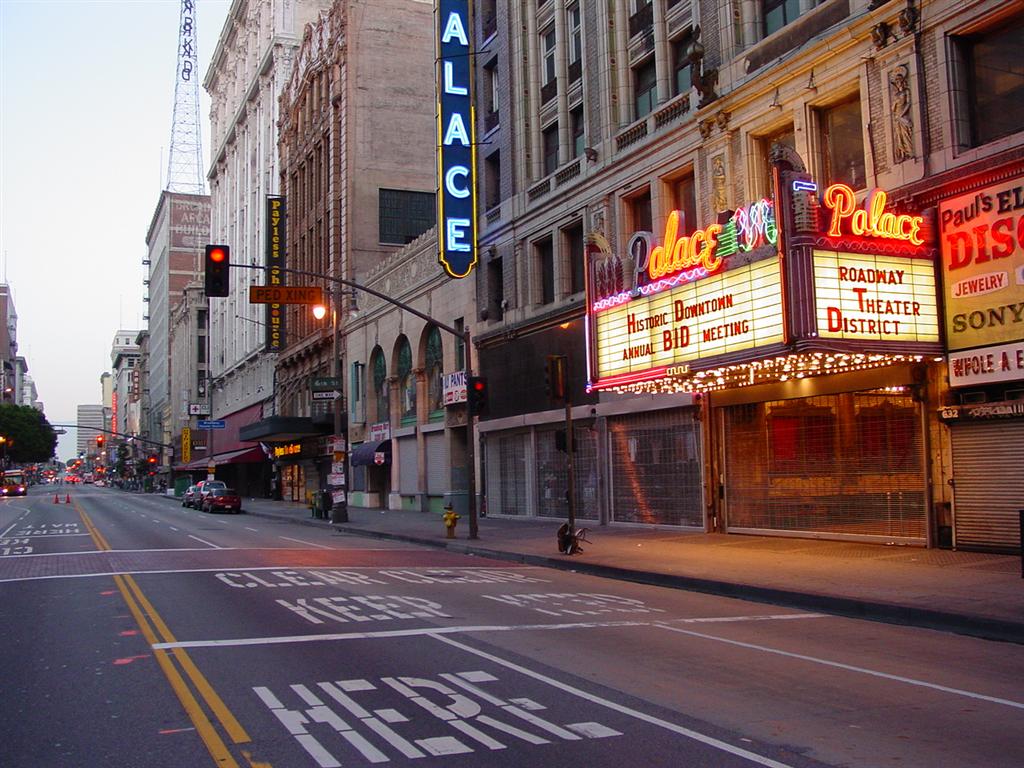
The Palace Theater on Broadway

The Palace Theater on Broadway

During the late 1960s, when I was a film student at UCLA, I felt I had to catch up fast in my knowledge of American films. After all, it was foreign films like Carl Dreyer’s Day of Wrath (1948) and Akira Kurosawa’s Seven Samurai (1957) that introduced me to what the film medium could do.

So I went with my late friend Norm Witty to see the 99¢ triple features at the remaining movie theaters on Broadway downtown. Most of these theaters are no longer showing films, though at one time it represented the highest concentration of movie theaters in the U.S.; it was called the Broadway Theater District. It included the Cameo, the Tower, the Palace, the Los Angeles, the Arcade, the Roxie, and the Olympic theaters (though the last one was located on West 8th Street). Most of them ran movies all day and all night, usually as triple features.

Even back then, most of the patrons were just intent on getting a good night’s sleep in a theater seat that wasn’t too sticky or dirty. The rest rooms were something of a horror, and the refreshments were pretty disgusting. The worst of all was the Arcade, which we went to only once.

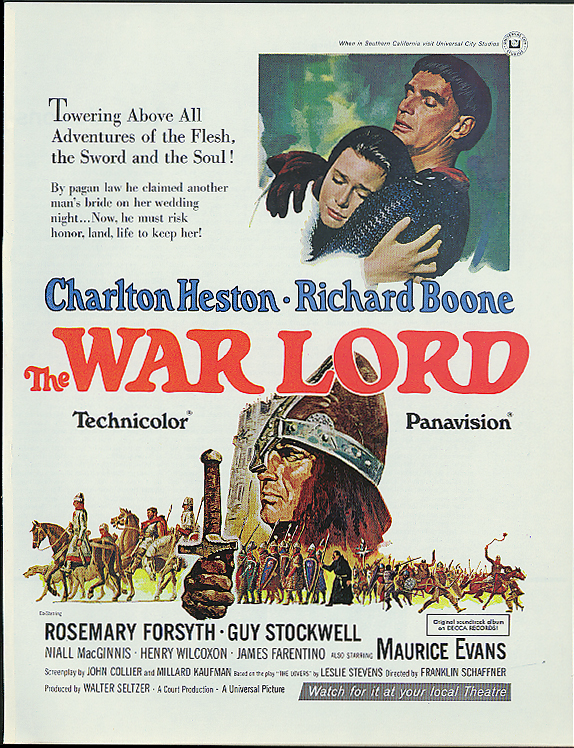
Poster for Universal’s The War Lord (1965)

Poster for Universal’s The War Lord (1965)

Probably the best film I saw on these all-night excursions was a Universal picture starring Charlton Heston, Richard Boone, and a radiant Rosemary Forsyth called The War Lord (1965). Heston and Boone are two Norman knights who take control of a Saxon village. Heston falls in love with Rosemary Forsyth, a Saxon maiden who is betrothed to another villager. When he exercises the jus primae noctis (“the right of the first night”) and demands the right to bed her before her betrothed, the Saxons begin to mutter. But then Heston decides to keep her, and war breaks out. Franklin Schaeffner directed the film, which is still worth seeing when it comes around.