Two Auto Museums Bite the Dust

Martine Sitting in a Classic Corvette

I was dismayed to find that two superb auto museums closed down in 2024. In both cases, the museums grew out of personal car collections. When the museum founders passed on to that garage in the sky, both museums started to run into hard times.

The first was the Mullin Automotive Museum in Oxnard with its Bugattis and Art Deco paintings and furniture which closed in February 2024.

Hitting closer to home was the closure in October of the Zimmerman Automobile Driving Museum in El Segundo. There was a time when we visited the museum every few weeks. Martine loved it because they concentrated on American cars and because they allowed visitors to sit behind the wheel. She was particularly fond of a classic Corvette illustrated above.

There is an excellent article in Hemmings.Com about the Zimmerman Museum’s frantic attempts to raise cash after Stanley Zimmerman died in 2020. The article contains some excellent photos of the museum’s holdings.

Museums based on private collections have a high mortality rate. They are like restaurants, which, especially after the Covid-19 lockdown, are dropping like flies.

Looking Back at Art Deco

Imaginative Reconstruction of an Art Deco Apartment

Imaginative Reconstruction of an Art Deco Apartment

Art Deco was born in France in the period immediately after the First World War and lasted roughly up to the start of the Second World War. According to British art historian Bevis Hiller, it was “an assertively modern style [that] ran to symmetry rather than asymmetry, and to the rectilinear rather than the curvilinear; it responded to the demands of the machine and of new material [and] the requirements of mass production.” Its name comes from the French Arts Décoratifs, from the 1925 Exposition Internationale des Arts Décoratifs et Industriels Modernes held in Paris.

It was not an art of the people. Rather it was associated with the wealthy, for whom optimism is a kind of religion. According to Wikipedia, it “represented luxury, glamour, exuberance and faith in social and technological progress.”

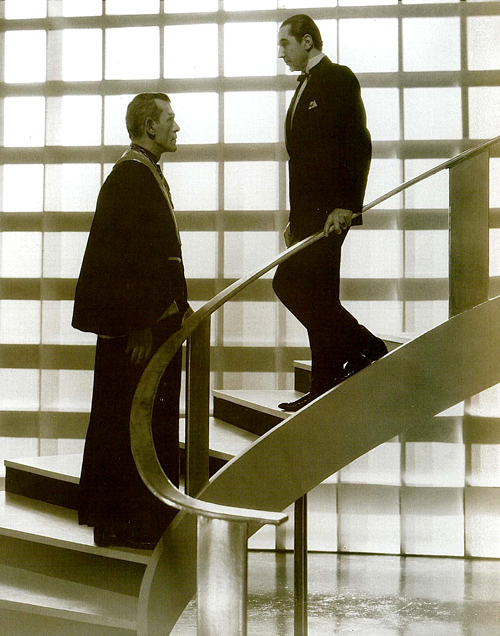
Our visit to the Mullin Automotive Museum in Oxnard last Saturday set me to thinking: To whom did Art Deco really belong? I am reminded of the strange mansion set of Edgar G. Ulmer’s The Black Cat (1934) starring Béla Lugosi and Boris Karloff as Hjalmar Poelzig, the archetypal Art Deco man.

Art Deco Domestic Architecture in The Black Cat (1934)

Art Deco Domestic Architecture in The Black Cat (1934)

There were even Art Deco print fonts, such as the following:

Art Deco Type Font

Art Deco Type Font

Think about the lavish movie sets of the Fred Astaire and Ginger Rogers movies, set in lavish Art Deco hotels in Europe and elsewhere. These were not places where people such as myself would feel highly uncomfortable. It was a world of tuxedos, butlers, fantastic dance floors, and a spic-and-span shine that almost glistened. It was “high tech” for the technology that was then extant, which manifested itself in the luxury French automobiles on display at the Mullin Museum.

Some of it filtered down to the middle class, but for the most part it represented an aspiration to empyrean social realms beyond the reach of most people.

Still, it could be incredibly beautiful, as in the paintings of Tamara de Lempicka, architecture such as the Chrysler Building in New York, industrial design, textiles, jewelry, and—of course—the cinema. I believe that we are just beginning to understand this movement.

Tamara in a Green Bugatti

Self Portrait in a Green Bugatti

Self Portrait of the Artist in a Green Bugatti (1929)

One of the discoveries I made at the Mullin Automotive Museum in Oxnard yesterday was an Art Deco painter by the name of Tamara de Lempicka. There it was, next to all those beautiful Bugatti automobiles of the 1920s and 1930s: A self portrait of the artist in a green Bugatti. (Although Wikipedia states that the painting is in a Swiss private collection, it seems that Peter W. Mullin brought it, or a passable copy of it, for his museum.

There is something about the smug look on the subject’s face behind the wheel of a luxury automobile that struck me as the epitome of Art Deco. According to the Wikipedia article on her:

Lempicka became the leading representative of the Art Deco style across two continents, a favorite artist of many Hollywood stars, referred to as ‘the baroness with a brush’. She was the most fashionable portrait painter of her generation among the haute bourgeoisie and aristocracy, painting duchesses and grand dukes and socialites. Through her network of friends, she was also able to display her paintings in the most elite salons of the era.

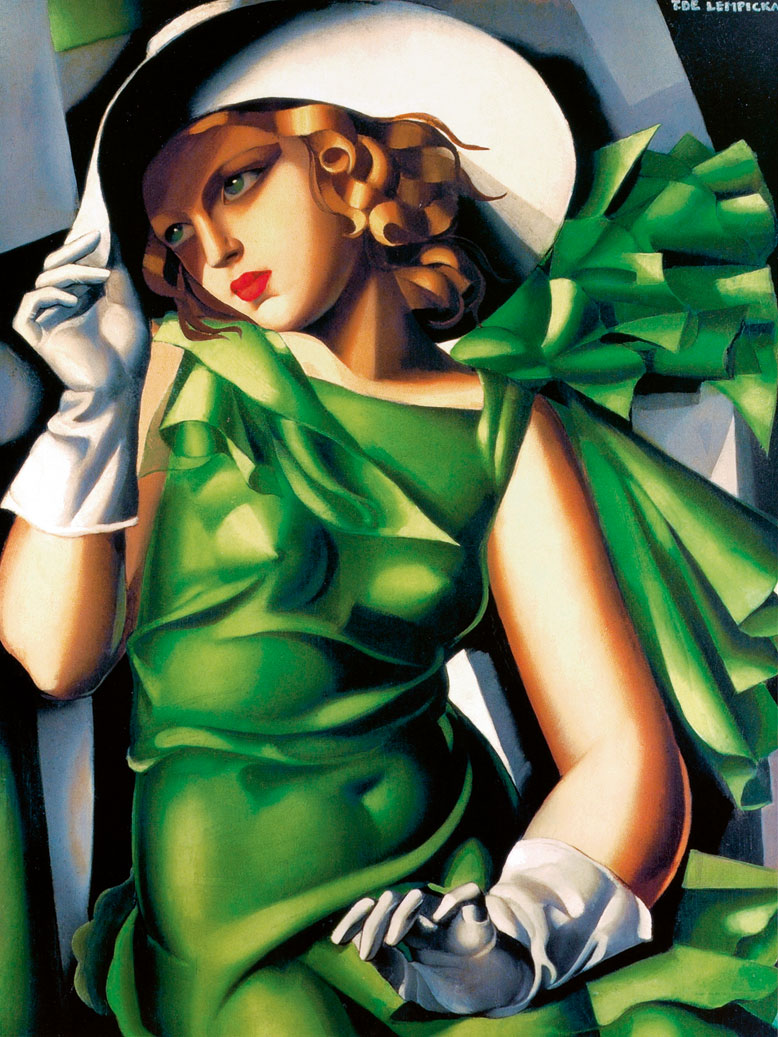
Below are two of her other paintings to give you some idea of her work:

Woman in Green

Woman in Green

There is usually a strong facial resemblance in many of her female subjects. All three of these paintings could be described as self-portraits.

Portrait of Mme Allan Bott at Saint-Moritz

Portrait of Mme Allan Bott at Saint-Moritz

“The Pinnacle of 20th Century Art and Design”

A Museum Dedicated to the Art of the French Automobile 1900-1940

A Museum Dedicated to the Art of the French Automobile 1900-1939

Oxnard, California, is blessed with two world-class automobile museums less than a mile from each other. Martine and I had visited the Murphy Auto Museum twice so far this year. It was a little more difficult to visit the Mullin Automotive Museum, mainly because it is open for tours only twice a month by reservation only.

The Mullin Automotive Museum was founded by Peter W. Mullin, an American businessman and philanthropist, who, early on, fell in love with French autos, particularly the Bugatti (which was 100% French despite the Bugatti family’s Italian origins).

Bugatti Hood Ornament

Bugatti Hood Ornament and Grill

The cars at the museum were a revelation. According to the museum’s founder:

For me the French automobiles of the 1920s and 1930s represent the pinnacle of 20th century art and design—the artistic realization in steel, leather, and glass of a modern idea created at a moment when hand craftsmanship embraced the machine, and a spirit of optimism fueled an explosion in artistic and technical development. As an avid collector, the preservation of these rolling sculptures for the enjoyment of future generations is both a responsibility and a pleasure. I relish the stewardship and preservation of their exciting histories.

Surrounding the automobiles along the outer walls is a world class exhibit of art nouveau and art deco works, including paintings, sculptures, and furniture—to to mention some of the neatest hood ornaments I’ve ever seen.

Flying Hood Ornament

Flying Hood Ornament

I was so impressed not only with the cars and the artwork that I plan on doing one or more follow-up blogs. Martine and I showed up at opening time (10 AM) and had to be ushered out at closing time (3 PM). We plan on returning in a number of months, when they have changed their exhibits.

Below is view of the exhibit floor, which is designed to resemble the original Paris automobile salons of the early 20th century, complete with signs indicating the major “exhibitors.”

The Exhibit Floor

The Exhibit Floor


To avoid getting stuck in beach traffic, we returned home via California 126, stopping at Cornejo Produce in Fillmore for some fresh locally-gown produce.