I was dismayed to find that two superb auto museums closed down in 2024. In both cases, the museums grew out of personal car collections. When the museum founders passed on to that garage in the sky, both museums started to run into hard times.
The first was the Mullin Automotive Museum in Oxnard with its Bugattis and Art Deco paintings and furniture which closed in February 2024.
Hitting closer to home was the closure in October of the Zimmerman Automobile Driving Museum in El Segundo. There was a time when we visited the museum every few weeks. Martine loved it because they concentrated on American cars and because they allowed visitors to sit behind the wheel. She was particularly fond of a classic Corvette illustrated above.
There is an excellent article in Hemmings.Com about the Zimmerman Museum’s frantic attempts to raise cash after Stanley Zimmerman died in 2020. The article contains some excellent photos of the museum’s holdings.
Museums based on private collections have a high mortality rate. They are like restaurants, which, especially after the Covid-19 lockdown, are dropping like flies.
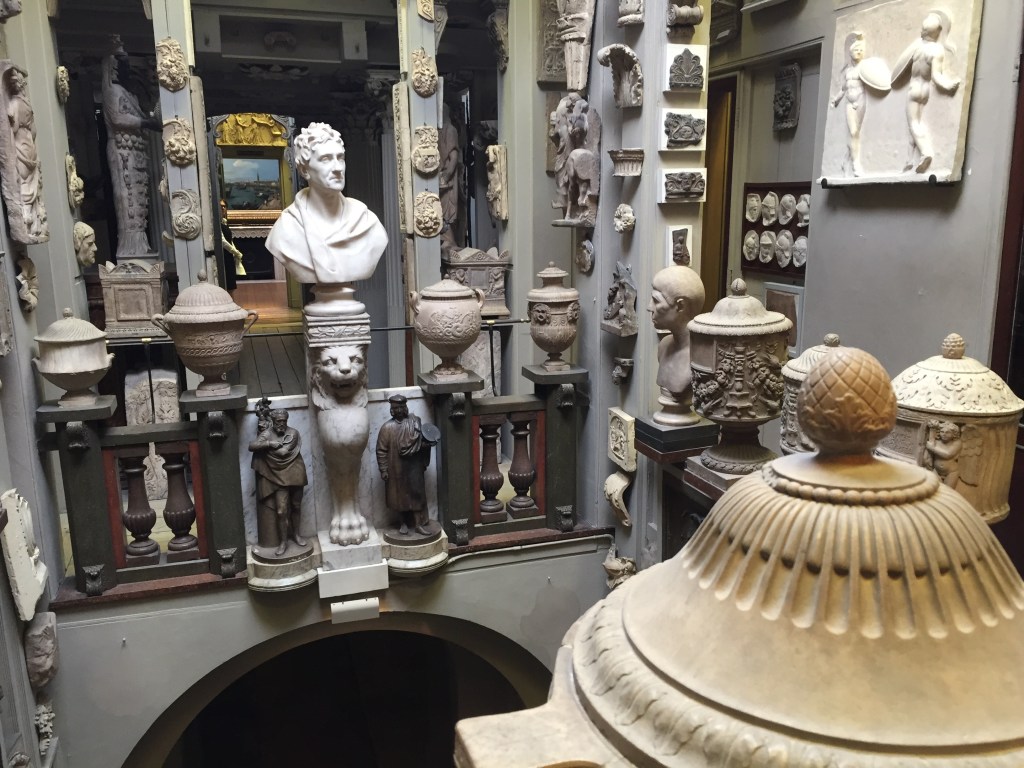
If I were asked to pick my favorite museum, I would have a hard time deciding; but I might very well end up by picking Sir John Soane’s Museum by Lincoln’s Inn Fields in London. Each time I have visited London, I have spent time marveling at the collections represented, whether of Egyptian, Greek, or Roman antiquities or 18th century paintings.
The original Sir John Soane (1753-1837) was the architect who designed the Bank of England, Not the present one, but the old one that was demolished in the 1920s. While I cannot comment on Soane’s skills as an architect, I am nothing short of amazed by Soane the art collector.
Walk through the museum, and it’s as if you were carefully edging your way through an overcrowded attic—except that Soane was no mere hoarder. He is, as it were, at the very pinnacle of a cultivated English artist circa 1800.
Paintings and Sketches Line the Walls from Floor to Ceiling
And I mean English with a vengeance. You would not find anything like this in France. The story of how the museum came to be is archetypally English (quoted from Wikipedia):
The museum was established during Soane’s own lifetime by a private Act of Parliament … in 1833, which took effect on Soane’s death in 1837. The act required that No. 13 [Lincoln’s Inn Fields] be maintained “as nearly as possible” as it was left at the time of Soane’s death, and that has largely been done. The act was necessary because Sir John had a living direct male heir, his son George, with whom he had had a “lifelong feud” due to George’s debts, refusal to engage in a trade, and his marriage, of which Sir John disapproved. He also wrote an “anonymous, defamatory piece for the Sunday papers about Sir John, calling him a cheat, a charlatan and a copyist.”
Oh, you can view the changing of the guards at Buckingham Palace, ride in giant Ferris Wheel in Greenwich, visit the British Museum, but nowhere else could you see the odd genius of a single human being—one who left us a Pisgah view of the 18th century.
Check out the museum’s website if you have a few minutes.
I have just finished reading the first volume of Konstantin Paustovsky’s Story of a Life. In Chapter 14, we are introduced to a geography teacher at the high school Kostik (short for Konstantin) attends in Kyiv named Cherpunov. Paustovsky describes his collection:
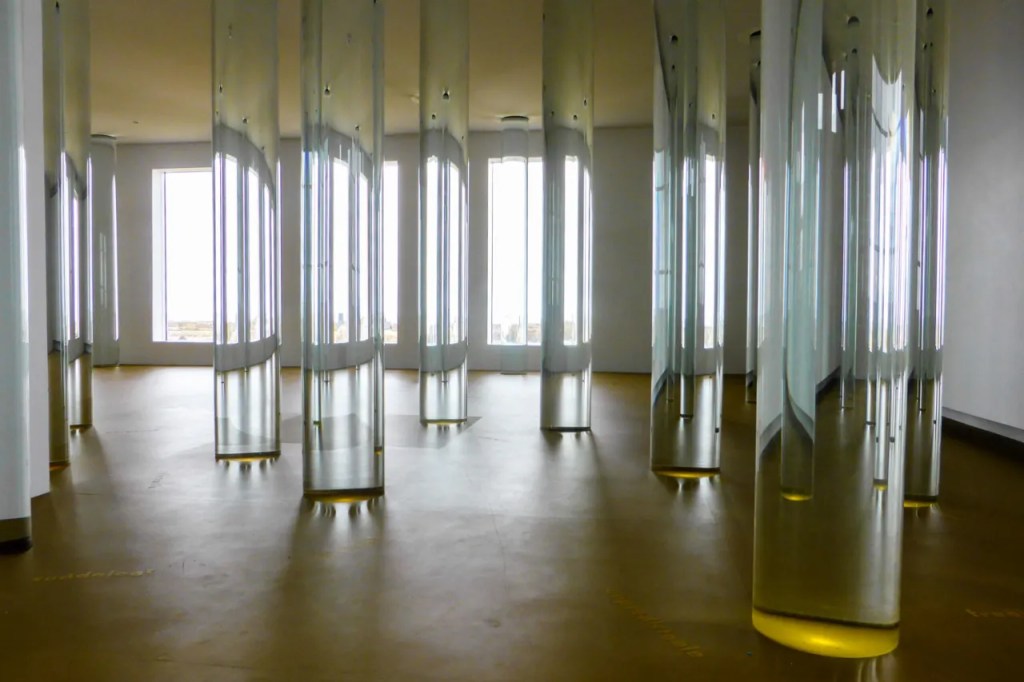
Bottles filled with yellowish water, corked and sealed with sealing wax, stood in rows on the classroom table. They had labels, inscribed in an uneven elderly hand: ‘Nile,’ ‘Limpopo,’ ‘Mediterranean.’
There were bottles of water from the Rhine, the Thames, Lake Michigan, from the Dead Sea and the Amazon, but however long we looked at them they all remained equally yellow and uninteresting.
Curiously, there is one such collection in Stykkishólmur, Iceland, on the Snæfellsness Peninsula. It is called the Library of Water. Although I have been in Stykkishólmur twice, I have never bothered to visit it. Perhaps because I suspected what Paustovsky was to find out after Cherpunov’s young wife ran off and the old teacher quit.
‘Do you remember Cherpunov?’
‘Yes, of course.’
‘Well, I can tell you now that there was never anything in his bottles except ordinary water from the tap. You’ll ask me why he lied to you. He rightly believed that he was stimulating your imagination. He attached great value to it. I remember him telling me that it was all that distinguished man from the beasts. It was imagination, he said, that had created art, it expanded the boundaries of the world and of the mind, and communicated the quality we call poetry to our lives.’
The Museum of Jurassic Technology in Culver City, California
I spent several hours this afternoon visiting a storefront in Culver City, right near the corner of Bagley Avenue and Venice Boulevard, that goes by the name the Museum of Jurassic Technology. Why Jurassic? Does it contain only exhibits relating to the earth between 201 and 145 million years ago? Was there any technology to be found during that period? Were there even any humans extant during that period?
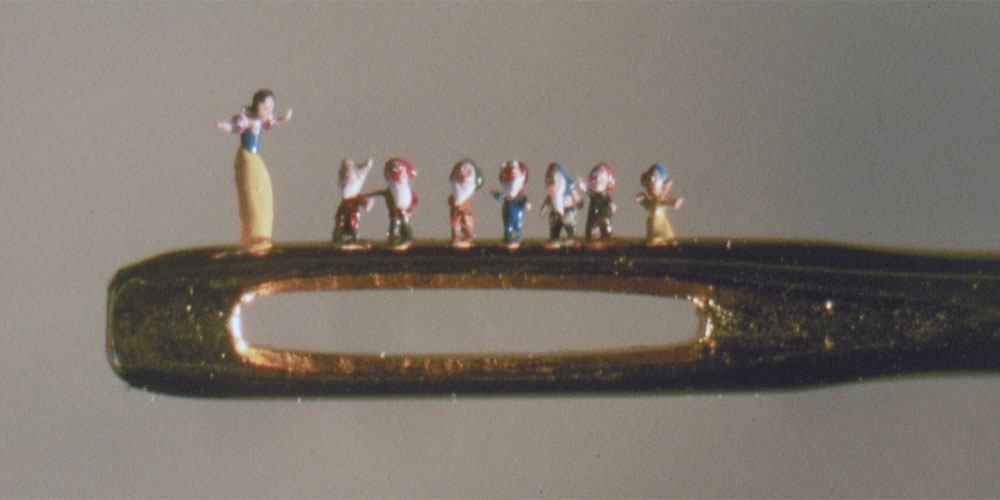
Whatever may be implied by the name, it was a real museum in that it was a collection of wonders, concentrating on smaller exhibits given the size of the property. The St. Patrick’s Day crowd consisted almost exclusively of millennials, who wandered the dark and twisting corridors of the museum peering at such exhibits as miniatures by an Armenian artist named Hagop Sandaldjian, such as this representation of Snow White and the Seven Dwarves atop the horizontal eye of a needle:
There was an unusual collection of objects gathered from various Los Angeles Mobile Home Parks, together with an attempt to account for a philosophy of trailer living as a form of reaction to the expanding universe. The museum website quotes an Estonian historian named Ants Viires on the subject:
[T]ime ravages everything, our person, our experience, our material world. In the end everything will be lost. In the end there is only the darkness. …and despite the apparent fullness and richness of our lives there is, deposited at the core of each of us, a seed of this total loss of this inevitable and ultimate darkness.
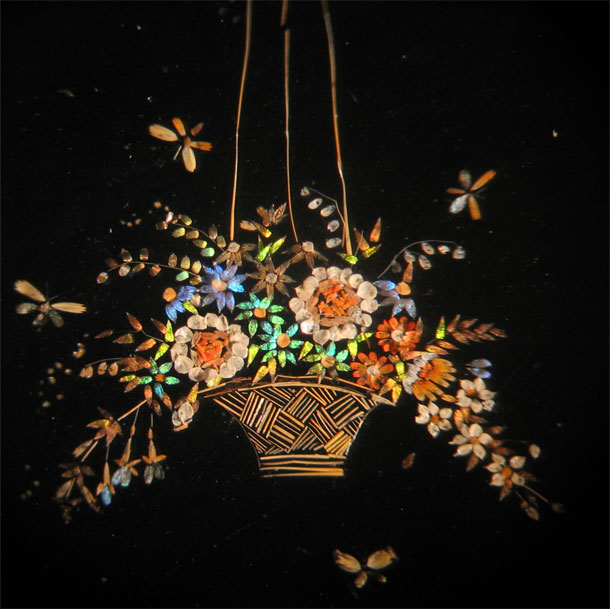
Another miniaturist on display is the work of Henry Dalton (1829-1911) consisting of images created from diatoms and the scales of butterfly wings, such as the following:
To view these works, it was necessary to view them through a microscope. There were about eight of them in a row, each pointed at a separate microminiature.
On the second floor of the museum is a little courtyard where tea and cookies are served amid the cooing of doves and the gurgling of a small fountain.
It was a fun place to visit. Not all the exhibits worked, but then that is true pretty much everywhere. I walked out of the museum with a sense of wonderment that was quickly dispelled by the rush hour traffic on Venice Boulevard.
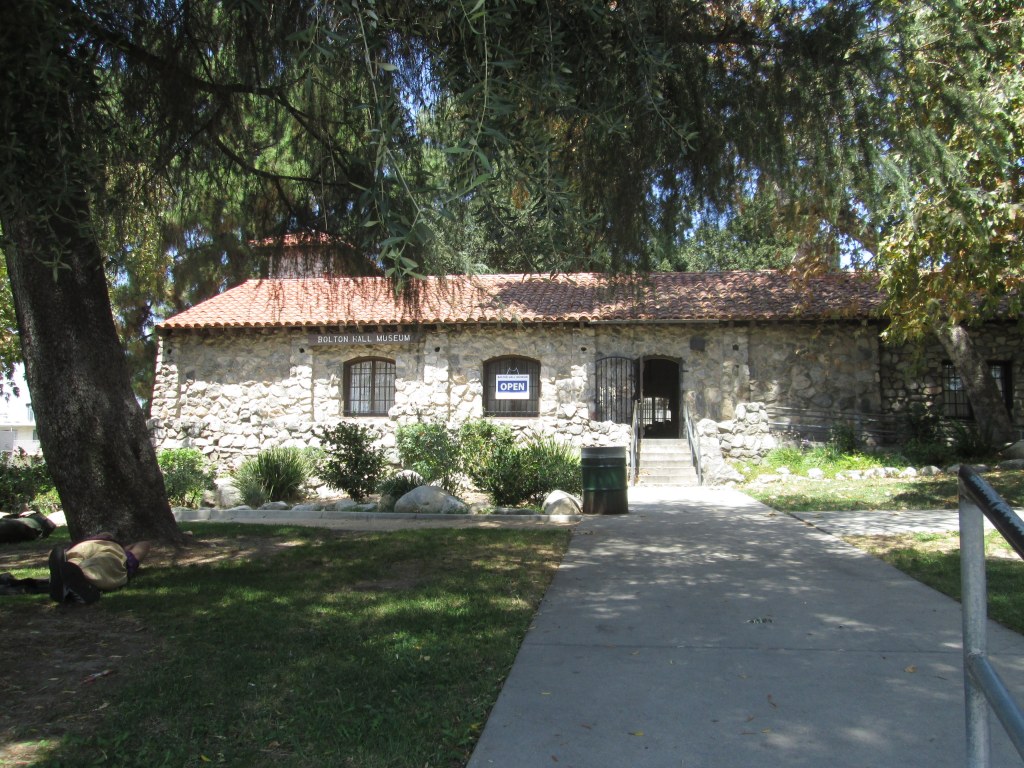
Bolton Hall, Clubhouse of Los Terrenitos (“Little Landers”)
Bolton Hall was named after a man called Bolton Hall. It was built in 1913 in Tujunga as the clubhouse of a utopian community called Los Terrenitos, or Little Landers. It was one of two communities inspired by the teachings of William E. Smythe. (The other was at San Ysidro, just across the fence from Tijuana, Mexico.)
According to a prospectus issued by Smythe in 1913:
The Little Lander is his own boss. His notion is not an acre nor half an acre, but “so much land as one individual or family can use to the highest advantage without hiring help.” No landlords or tenants, no employers or hired hands! Men work lovingly for themselves, while the best of them work but grudgingly for others. In moments of exaltation the Little Lander loves to think of himself as the Spiritual Man of the Soil—the man who works in conscious partnership with God in finishing the world. His own man on his own place, he works more in the spirit of the artist than of the farmer.
Bolton Hall Clubhouse As It Was in the Beginning
Any agricultural surplus from the small plots was donated to a cooperative: “The wagon calls to collect his vegetables, fruit, flowers, eggs, poultry—whatever he has to sell—and ship it to town, where it is received by the market manager and disposed of direct to consumers…..”
In many ways, the Little Landers were kin to the Distributists in England who followed the writings of G.K. Chesterton and the Catholics influenced by Leo XIII’s 1891 encyclical Rerum Novarum. Unfortunately, like almost all utopian communities, the Little Landers of Los Angeles lasted only for a few years. In 1917, Little Landers Incorporated was disestablished for failure to pay taxes. By 1925, almost all of the original settlers had left.
Unfortunately, the soil of the Tujunga area was not conducive to farming, so the dreams of small-plot farming did not come to pass, not here anyway.
Today all that remains is the Bolton Hall Clubhouse, which is a fascinating museum of local life. Martine and I spent an afternoon chatting with the docents inside the stone building, which was surprisingly cool considering the external temperature (90º Fahrenheit or 32º Celsius).
If you have any feeling for the area in which you live, I recommend supporting small local museums, which usually have fascinating stories to tell of the people who first settled an area and how their descendants fared.
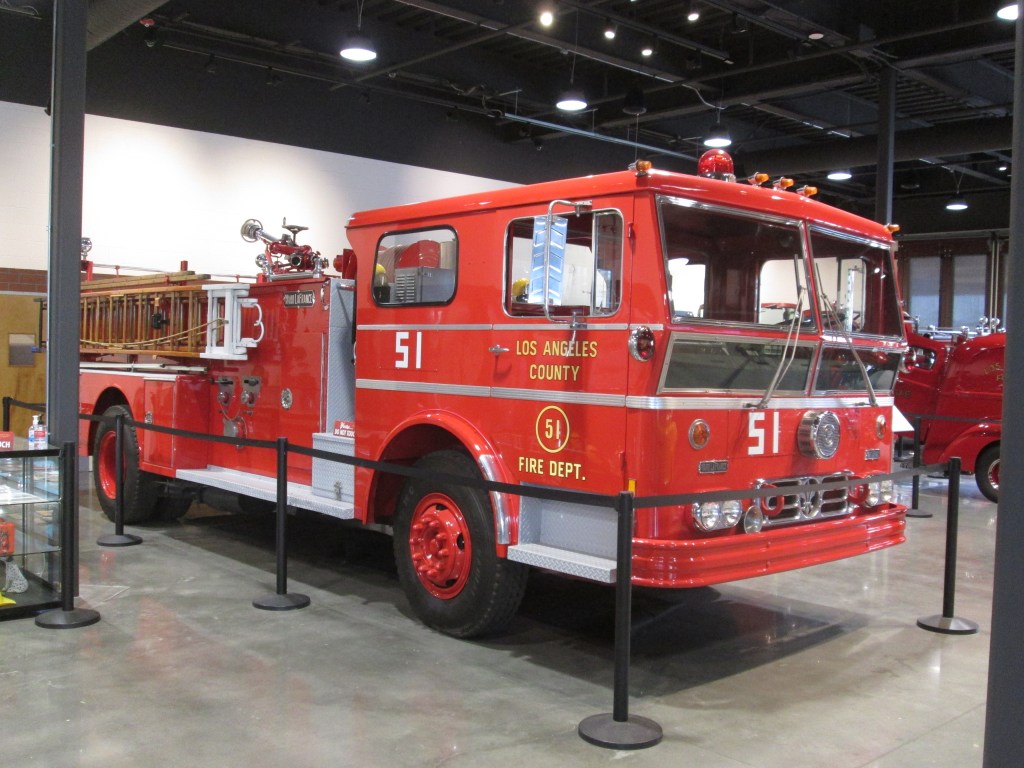
This morning, Martine and I trekked all the way to the southeastern City of Bellflower to visit the Los Angeles County Fire Museum. This is one of three firefighters’ museums in the L.A. area. (The others are the L.A. City Fire Museum on Cahuenga in Hollywood and the African-American Firefighters’ Museum on Central downtown.)
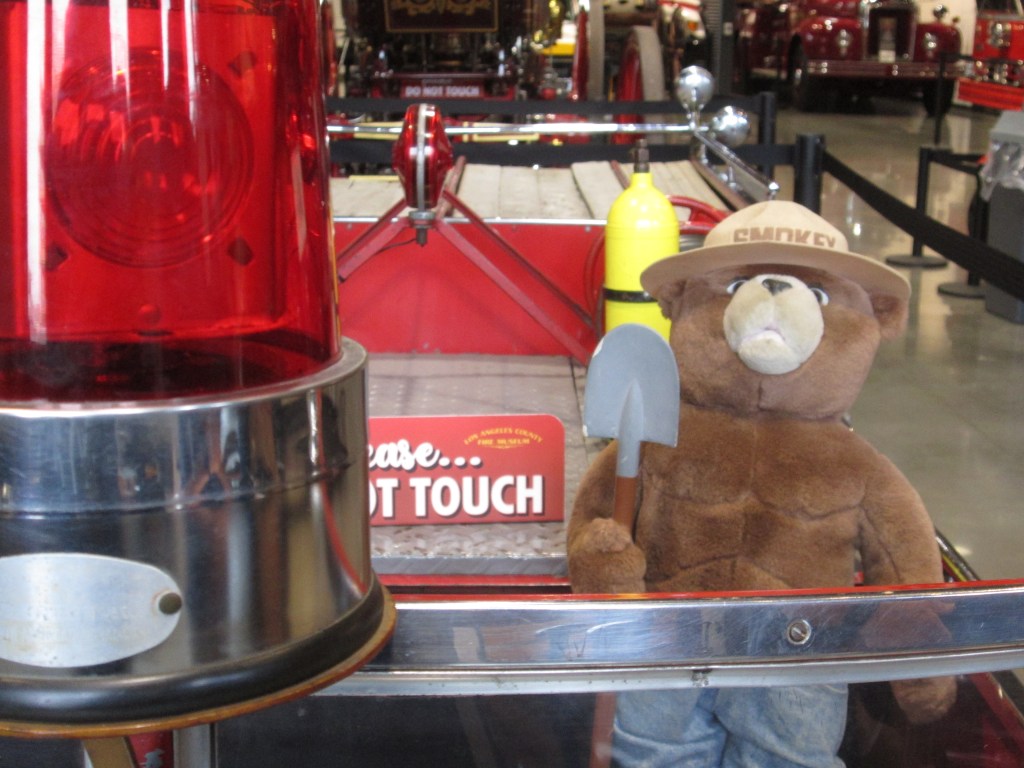
Martine brought along her 50th Anniversary Smokey Bear to show the museum staff. Smokey was a big hit to the retired firefighters who served as docents. Martine collects Smokey memorabilia, has a Smokey zipper pull on her jacket, and regularly receives a catalog from Woodland Enterprises in Moscow, Idaho of Smokey Bear goodies.
Many of the fire engines and other equipment on display were used in the television series Emergency! which aired on NBC from 1972 to 1979. That accounts for the Number 51 on many of the vehicles, as they belonged to fictional Squad 51 on the series.
The docents were all retired firefighters themselves who knew a great deal not only about the series, but how the firefighting equipment was used. Our guide was Javier Torres who patiently walked us through the exhibits.
Our Guide, Javier Torres
The Los Angeles County Fire Department covers fires outside of Los Angeles City, especially the sparsely populated areas to the north of the county where most of the wildfires happen.
I have always admired firefighters, as it is one of the few careers which create heroes. When a visitor to the museum asked me if I was a retired fireman, I quickly answered, “No, I’m not quite good enough for the job.”
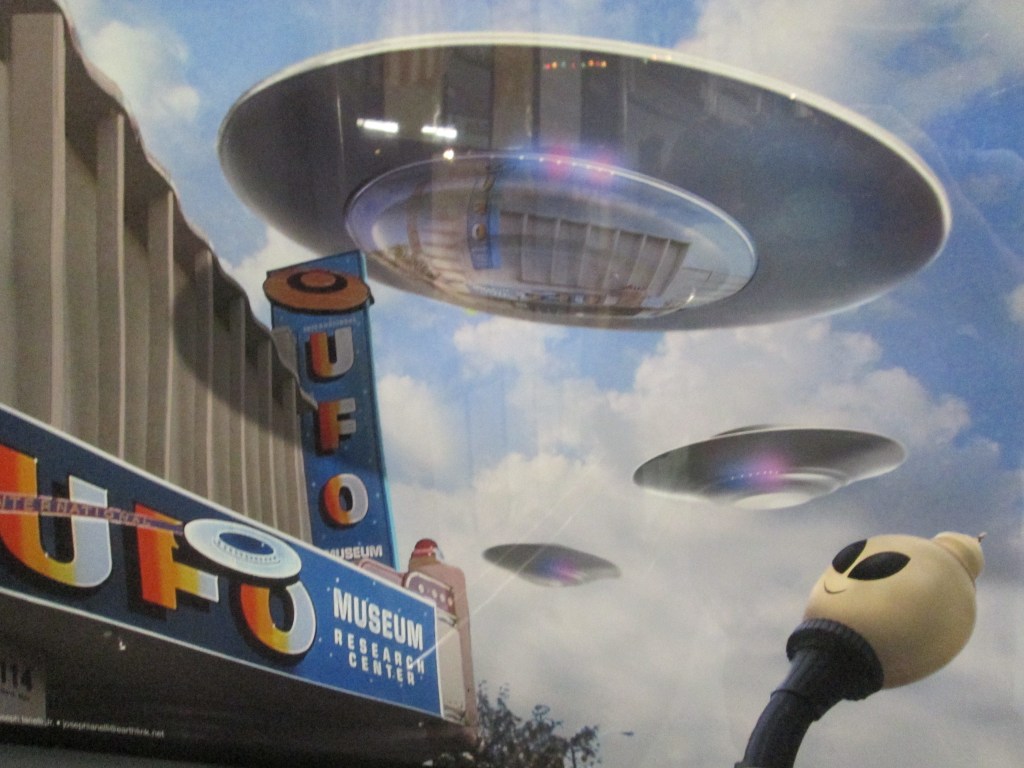
Wherever your beliefs may lie on the subject, I recommend you visit the UFO Museum in Roswell, New Mexico. First of all, it is entertaining in its depiction of widespread beliefs of space alien visits. Secondly, it’s not so earnest that it doesn’t have a bit of fun with its visitors. It’s all here, both the deadpan reportage of sightings and references to sci-fi classic films.
Oh, and thirdly, the souvenir shop is not to be missed. As I write this post, I am wearing my Roswell UFO Museum T-Shirt.
Klatu Berada Nikto
Roswell is not really on the way to anywhere, unless you count Carlsbad Canyons National Park. And from there to Interstate 40 is a long and relatively featureless drive. The only other nearby tourist attractions are the town of Lincoln (of Billy the Kid fame), Fort Stanton, and Fort Sumner (where Billy the Kid is buried).
If you’re looking for a road trip to the Southwest this fall (but please, wait for the heat of summer to die down), Roswell is a fun stop and clearly worth two or three hours of your time.
There are several things I could write about today. For instance, I could celebrate my 40th annual boycott of the Academy Awards Show. Or I could tell you what V. S. Naipaul thought about politics and politicians—well, maybe tomorrow on that one. I think instead I will talk about the Automobile Driving Museum’s Orphan Car Show held yesterday.
By “orphan” was meant all discontinued makes and models. There was a Hudson, a LA Fire Department Hummer, several American Motors and Nash products, several Austin-Healeys, even a weird Fiat that competed with golf carts. And the place was crowded with affable car collectors eager to talk about their prize possessions.
Poster for Yesterday’s “Cruise-In” Car Show
Martine always enjoys the Automobile Driving Museum because of its emphasis on classic American cars and because of its nearness to where we live. On May 1, the museum displays inside will re-open, and Martine will once again be able to sit inside a classic Corvette and dream about the old days when Detroit made some great cars.
When I got off the plane at Manuel Crescencio Rejón Airport in Mérida (aka MID) on January 14, my spirits lifted. I had had a rough flight from LAX to Guadalajara and from thence to Mérida—all after a sleepless night—but my spirits lifted as soon as I found myself once more in “The White City.” The city’s tourist axis runs from the bus station north through the Plaza de Independencia (pictured above) and Calle 60, taking a slight jog eastward and continuing northward along the Paseo Montejo several miles to the Gran Museo del Mundo Maya.
Along this axis are numerous sixteenth century churches, hotels, museums, restaurants, and shops aimed at the tourist trade. No sooner did I dump my bags at the Hotel La Piazetta at the Parque de la Mejorada than I hoofed it to the Plaza Independencia and had a world class shoeshine. In past visits, I wore a set of custom-made hiking boots of chrome leather which the shoeshining fraternity stationed at the plaza polished to a gorgeous sheen. Then, as it was hot (90º F or 33º C) and humid, I went out for a beer. My old favorite—Carta Clara from the Cervecería Yucateca—was no more, but Mexico still has good beers that make Budweiser and Coors taste like horse piss.
The Palacio Cantón Contains a Great Museum of Maya Antiquities
On my first full day in Mérida, I hiked to the Palacio Cantón on the Paseo Montejo, home to the Regional Museum of Anthropology. In it are primo examples of Maya sculpture, stelae, and glyphs—the best of the best! They are housed in a century-old mansion belonging to a former army general, who was also a millionaire.
Maya Stela
It is unlikely you will find better examples of Maya carvings anywhere else in Mexico. Even in the Gran Museo del Mundo Maya, several miles north, there is a slight drop-off in quality compared to the Palacio Cantón.
If you’ve ever seen Roman Polanski’s Chinatown (1974), you have some idea of how the City of Los Angeles annexed most of the San Fernando Valley after William Mulholland’s aqueduct brought water several hundred miles from the Owens Valley to L.A. In the period of the movie, the Valley seemed to be mostly orchards. Today, some two million people live there. Its period of greatest growth was in the immediate postwar period when aerospace was king. Today—well, today much of the gloss has vanished. During the summer, the Valley is almost as hot as the floor of the desert: Today the temp reached 91º Fahrenheit (33º Celsius) as we left in mid afternoon.
The reason we were there was to visit the Valley Relics Museum at Balboa and Stagg in Lake Balboa. The museum pays homage to the Valley’s glory days during the 1950s and 1960s, when it seems everyone was buying property there because it was cheaper than the more liveable parts of L.A. adjoining the Ocean.
Ash Trays from Bygone Restaurants and Clubs
The Valley is still an interesting destination. For one thing, there are many excellent restaurants, both ethnic and American. (Today, for instance, we discovered a great place on Ventura Boulevard at Burbank called Hummus Bar & Grill that we will no doubt be visiting again.) There are several interesting historical sights such as the Leonis Adobe and Los Encinos State Historical Park, plus museums like the Nethercutt Collection. So the Valley is still a target-rich destination, though it is no longer the fashionable locale it used to be when I first moved the Southern California in 1966.
The museum had fight posters featuring Mohammed Ali and Cassius Clay, film stuntmen memorabilia, old restaurant menus with pre-inflation prices, neon signs from clubs and restaurants like the Palomino, and even an interesting selection of working pinball machines—particularly one featuring Elvira, Mistress of the Dark, a former TV horror film hostess.
You must be logged in to post a comment.