The Folk Singer

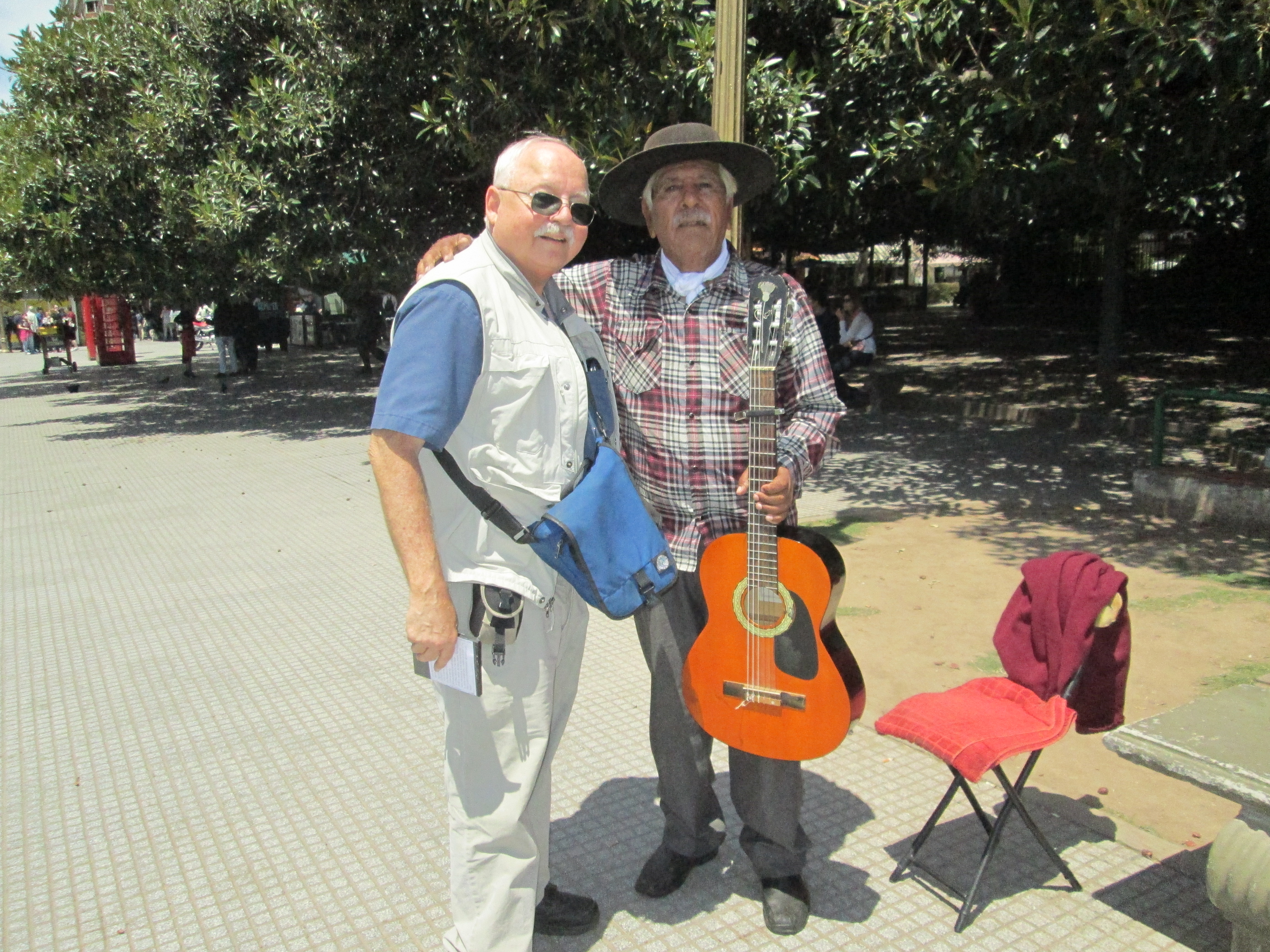
With Folk Singer Juan Carlos Balvidares, “El Caminante Argentino”

With Folk Singer Juan Carlos Balvidares, “El Caminante Argentino”

In 2011, Martine and I encountered a folk singer in front of the Café La Biela, sitting in the shade of an Ombú tree. I remember his singing vividly and so was delighted to encounter him again at the same place on the day after I landed in Buenos Aires. Señor Balvidares is the author of numerous tangos, milongas, zambas, vals, and chacareras. He has traveled around the world singing his songs.

This time, I bought a CD of his music. You can get some idea of his style by looking at this YouTube site. Click here for him performing in the barrio of San Telmo.

I have written previously about the late Carlos Gardel and his great tangos of the 1920s and 1930s. Balvanera may not have Gardel’s dulcet tones, but his music is an authentic and living link to the songs of the gauchos of the Argentine and Uruguayan pampas. Although he plays largely for tourists today, I enjoyed listening to his music—then and now.


A Martian at the Love-In

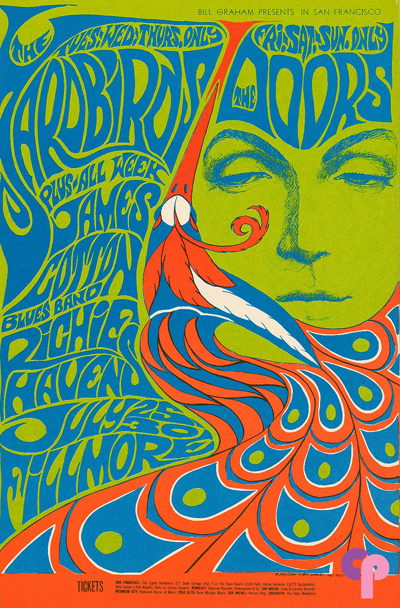
Poster for One of Bill Graham’s Presentations at the Fillmore

Poster for One of Bill Graham’s Presentations at the Fillmore

Yes, I went through the Sixties—and a wild time it was! That is, for some people. By the time I reached the (chemically-induced) age of puberty, around the age of 23, I felt badly out of place. And I would have even if I were not in swinging Los Angeles in 1967. I had just come off the operating table for a pituitary tumor in September 1966 and was still beginning to imagine life without daily severe frontal headaches pressing on my optic nerve.

Girls were pretty much out of the question. As for drugs, I was newly on hydrocortisone, thyroid, and testosterone (and still am, and will be for my whole life); and I didn’t want to see how LSD, psylocybin, and other psychedelic compounds would act on me. Also, within a few months after my arrival in L.A., I was told I had aseptic necrosis of the left hip and had to be on crutches for two years. Hence, I felt like a Martian surrounded by people who were intent on having a wildly good time.

I have never gone to a rock concert. I couldn’t even drive until 1985 because I was on a blood pressure medication (Catapres) that made me narcoleptic. On car rides, I fell asleep within minutes.

Rock Impresario Bill Graham

Rock Impresario Bill Graham

Today, Martine and I went to the Skirball Museum and saw their special exhibit on Bill Graham and the Rock & Roll Revolution. It was a revelation to me of all the things I had missed. Until this afternoon, I had no idea of the role that Graham played in sponsoring rock concerts over a quarter of a century until he died in a helicopter crash in a storm at the age of 60.

I eventually outgrew my Martian isolation. As a young woman, Martine was more familiar than I was with the big rock bands, as she listened to them all on her radio when she was growing up in New Jersey. In the 1980s, I began to catch up with the music—though in another fifteen years, I rejected all pop music in favor of classical music by dead guys in powdered wigs.

But, no matter, I was reminded of my early days in Los Angeles. I would wait until Fridays, when the L.A. Free Press was distributed. There I read about all the love-ins, the psychedelic power of oven-roasted banana skins (“bananadine”), with ads for all the head shops and local concerts. I was never much of a hippy, but it was a yeasty time. It was fun remembering it.

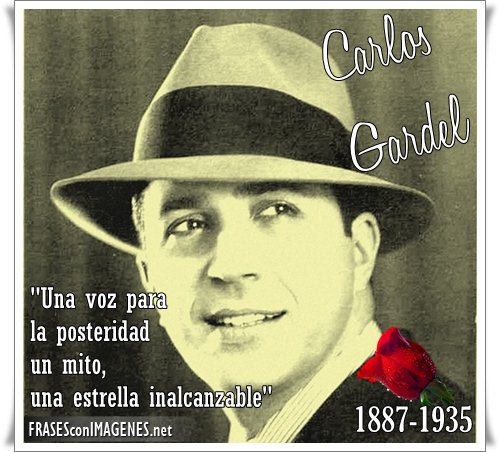
Carlos Gardel

He Died Eighty Years Ago Today in a Plane Crash

He Died Eighty Years Ago Today in a Plane Crash

Perhaps the greatest singer Argentina ever produced died eighty years ago today in a plane crash near Medellín, Colombia. The following is a re-post from Multiply.Com dated July 4, 2011:

The most enduring popular music of Argentina and Uruguay is tango. Both countries lay claim to have originated it, though from our point of view, some six thousand miles north of the Pampas, it hardly matters. Suffice it to say that there was one master of the form who from 1917 to 1935 made such a mark that he will never be forgotten.

I am referring to Carlos Gardel (1890-1935), who died in a plane crash near Medellín, Colombia, at the height of his career. According to the Argentina Independent, Gardel’s story comes replete with all the makings of a folk hero: immigrant origins, a middle class upbringing, musical genius, and a tragic death. As is typical of an artist as high profile as Gardel, controversy lingers surrounding the location of his birth: though his lawyer recently presented an original birth certificate of Charles Romuald Gardés, born in Toulouse, France, any Uruguayan will remind you that Gardel often affirmed that he was born in Tacuarembó, Uruguay: “My heart is Argentine, but my soul is Uruguayan, because that is where I was born,” he once declared.

Gardel grew up in the Abasto neighborhood of Buenos Aires, where he attained the affectionate nickname ‘Carlitos’ and learned to sing operas and Argentine folk music while working as a professional applauder in opera houses. He recorded his first tango, ‘Mi Noche Triste’ (My Sad Night) in 1917. Until then, tango had been an almost entirely instrumental form of music. Gardel’s music revolutionised the genre by bringing tango from underground dance salons to upper class and international popularity. His name continues to serve as a synonym for tango, and his songs live on as classics of the modern era.

Perhaps his most famous tango is ‘Por una Cabeza’ (By a Head), which tells the story of a horse-track gambler who is addicted to excitement and romance. Just by happenstance, Gardel recorded his most famous tango on film. You can see it by clicking here.

Whether he was born in France or Uruguay doesn’t matter any more. What matters is what he did to a musical form that took the world by the storm in the 1920s. It all started when Rudolph Valentino made his silent film The Four Horsemen of the Apocalypse in 1921. Audiences wanted to know more about the music that their screen idol was dancing to, and so from the piano score of a silent film it spread like wildfire.

In preparation for my [2011] trip to Argentina, I am loading my MP3 player with tangos by Gardel and others. You might want to see some more of the YouTube videos clips featuring his lyrics sung by him (as opposed to instrumental versions).

The lyrics of the early tangos were written in the lunfardo dialect of Argentinian Spanish (or Castellano), which essentially a form of slang which emerged from the slums of Buenos Aires.

Musical Madeleine

LAPD Emerald Society Piper

LAPD Emerald Society Piper

You’ve probably heard about Marcel Proust’s triggering of his memory by eating French cookies known as madeleines. Well, since I’m diabetic, I have to use something else to trigger my memories. In that department, I find that, for me, nothing works better than music.

The police bagpipe player (above) was practicing a song that suddenly hit me between the eyes. I walked up to her and startled her by asking the name of the song she was playing. One of her colleagues answered for her with something that sounded like “Saigon.” He mentioned that it was played in a movie called Empire something. That’s when it all came back to me: The song is called “Suo Gân,” which means lullaby in Welsh. The movie is Steven Spielberg’s Empire of the Sun (1989), based on J.G. Ballard’s autobiographical novel of the same name about spending World War Two as a child in a Japanese concentration camp near Shanghai.

I love the song. You can watch it on YouTube performed by the Kings College Choir.

My Favorite Spielberg Film

My Favorite Spielberg Film

I’ve seen Empire of the Sun several times and even read Ballard’s book. There is something incredibly beautiful about so many Welsh songs that I plan to write a posting about some of my favorites in the next week or so. If you feel starved to hear some now, watch the film How Green Was My Valley (1941), which features some beautiful examples.

What exactly did hearing a few notes from “Suo Gân” do for me when I heard them played by a police bagpiper at last Sunday’s Irish Fair in Long Beach? It sent me back to Wales, which I visited twice in the 1970s. Welsh is the most musical language I have ever heard; and I loved wandering around listening to people speak in places like Betws-y-Coed, Conwy, and Abergavenny.

Although I am a person of words and literature, music strikes me at my innermost core—even when I hear just a few notes.


“Where Words Fail…”


At Its Best, This Is What Music Does

At Its Best, This Is What Music Does

It was Hans Christian Andersen who wrote, “Where words fail, music speaks.”

Tonight, Martine and I attended the Torrance Civic Chorale’s annual Christmas concert. It was beautiful. Conductor David Burks enabled me to step outside my usual noisily conflicted self and into an ethereal place, one of joy and celebration.

I’m not going to try to talk about what music does for me, because how it acts on me is outside the world of words. I could tell you what kind of music I like the most, but I could not even begin to describe the mechanism by which my emotions are directly manipulated.

I regularly listen to KUSC-FM in Los Angeles, which plays classical music pretty much all day. When musicologist and KUSC announcer Jim Svejda—a man who for decades has influenced my taste in music—talks about music or interviews a musician, I wish he would shut up. I’ve even told the station that when phoning in my annual donation: “Please keep Jim Svejda on, but tell him not to talk so much.”

It’s not what Svejda says that influences me: It is his choices in the music he plays.

Over the years, I have been most moved by Gustave Mahler, Jean Sibelius, and Anton Bruckner. Last night, I read Vladimir Sorokin’s Day of the Oprichnik while listening to Bruckner’s Third Symphony. It was nothing short of sublime. Now that I have much of my favorite music on an MP3 player, I feel liberated. High in the Andes, I listened to Sibelius and Tchaikovsky and felt they were writing music about what I was seeing with my eyes even as I was seeing it..


It’s Not Over Until the Bearded Lady Sings

In Eurovision, the Wurst Always Wins

In Eurovision, the Wurst Always Wins

I have always been amused by the annual Eurovision song contest, if only because it means so much to all the nations participating.This year, the winner was a bearded drag queen from Austria who goes by the name of Conchita Wurst (real name: Tom Neuwirth). I heard a bit of his/her number, “Rise Like a Phoenix,” on YouTube. I have to admit that Conchita was in good voice and deserved some credit for not turning the number into a freak show.

Every year, I root for Iceland to win. For a tiny little island nation (under 400,000 population), they have tons of raw musical talent. This year, the representative was a group called Pollapönk, which looks something like a cross between the Mighty Morphin Power Rangers and the Teletubbies. Their musical number was called “No Prejudice,” which you can see here at YouTube. This year Pollapönk placed a lowly fifteenth out of twenty-six. According to the Iceland Review website, their favorable votes came mostly from San Marino (8), France (7), and Italy (6).

I doubt anything lik Eurovision would ever make it big in the United States. Although Europe has the musical talent, Eurovision is far too political (big surprise!) and far too oriented toward a lumpenproletariat audience. It differs from such performers as Barry Manilow and Tom Jones mainly in the politically liberal orientation of the musical numbers presented.


Be Cool, You Fool!

If You’re in College, and You’re Uncool, You’re Nowhere

If You’re in College, and You’re Uncool, You’re Nowhere

When I work Sundays the last five or six weeks of tax season, I always break my workday in two. The high-rise where my accounting firm is located does not run air-conditioning on Sundays, with the result that the oxygen level gets pretty well depleted. So I usually take a four-to-six mile walk around the UCLA area, eat lunch in the UCLA student union, and shop at the UCLA bookstore, returning to work around one in the afternoon.

The Ackerman Union has several chain restaurant outlets and a number of TV monitors that are kept tuned to mtvU, where the programming seems (on Sundays anyhow) to be all music videos.

If these music videos have a message, it is: If you’re not cool, you’re nothing—the Twenty Teens’ equivalent of the Beatles’ Nowhere Man. Everyone in a rock music video is always dressed in the just-right casual style, like the group shown above. Nowhere is seen anything as forbidden as a book, an older person, or a work of classical music. (is it because these are all associated with Schoolwork?)

In the world of music videos, all that matters is looking right and making all the cool moves to impress one’s peers. The peer group is everything, to the exclusion of all else. It almost verges on the tribal.

Perfect Landscapes

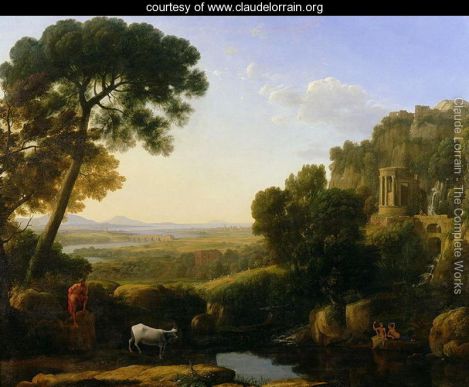
Claude Lorrain’s “A Landscape with Argus Guarding Io”

Claude Lorrain’s “A Landscape with Argus Guarding Io”

It doesn’t matter what the painting is called. It’s by Claude Lorrain (1600-1682), so it’s a landscape with classical overtones and various people picturesquely arranged across the foreground as if they were born to grace that landscape the moment they walked across it.

There is something so perfect about Lorrain’s landscapes that I was enthralled to discover a website called Claude Lorrain: The Complete Works. Granted that the pictures are all identified across the top and side, as in the example above, it is still wonderful to see so many of the master’s works all in one place. Take a look at the website and enlarge some of the landscapes: They are perhaps the best ever painted.

I don’t write about painting much, but that’s not because it isn’t important to me. It’s the same reason I don’t write much about music. Both art forms, especially music, tend to defy the world of words—and that’s where I tend to live.

This last weekend, I spent a whole day putting together an MP3 collection of some of my favorite music, including Brahms, Sibelius, Mahler, Tchaikovsky, Beethoven’s Symphonies and Late Quartets, Prokofiev, Elgar, Welsh choral music, and Argentinian tangos sung by Carlos Gardel. They will keep me company on my lonely travels across Iceland.

The Thirty Plus Years’ Quest

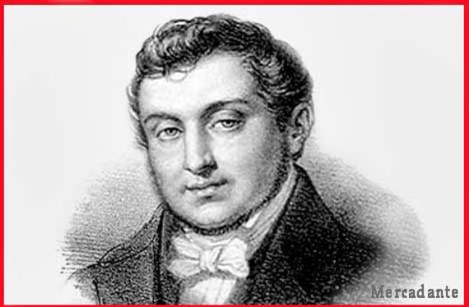
Saverio Mercadante (1795-1870)

Saverio Mercadante (1795-1870)

It was over a third of a century ago. I was preparing to go to work at Urban Decision Systems and listening to a classical music station on the radio, probably KUSC-FM. Suddenly, a piece of music came on called “Variations on a Theme on Stabat Mater by Rossini” by the Neapolitan composer Saverio Mercadante.

I have been looking for that piece of music at record stores (when there used to be such things), eBay, even iTunes—without a shred of luck. Then today I just happened to Google “Mercadante Rossini Stabat Mater” and got two hits on YouTube. Needless to say, I played both clips. One was an Italian recording entitled Sinfonia Sopri i Motivi dello Stabat Mater de Rossini, and the other was a recording conducted by Claudio Scimone with the L’Orchèstre National de l’Opéra de Monte Carlo and entitled Sinfonia sur des thèmes du Stabat Mater du célèbre Rossini (1843).

The musical phrase I loved came in at around the 7:50-minute mark on both recordings and lasted for a little over a minute.

It was nice, but it didn’t impress me as much as it did back in the 1970s or 1980s. Perhaps what I heard on the radio was a better recording. I just don’t know. Or perhaps my taste in music has changed. I am no longer like Swann and Odette de Crécy at the Verdurins oohing and aahing over that little phrase of Vinteuil’s.

What amazed me is that so many things that were impossible to find just twenty years ago can now be Googled and brought up in mere seconds. Technology is wonderful. Sometimes.


I Make An Exception

David Burks, Artistic Director and Conductor of the Torrance Civic Chorale

David Burks, Artistic Director and Conductor of the Torrance Civic Chorale

In general, I am not too fond of Christmas carols. I find them sappy and all too frequently a wheezy, whiny attempt to get shoppers to go into a buying frenzy. Mt annual exception is the Christmas concert of the Torrance Civic Chorale. Here there is no Little Drummer Boy PahRupUpUpPum, but rather an attempt to find the hidden heart of Christmas and Chanukah through music.

Under its genial and brilliant artistic director and conductor, David Burks, the Chorale has put on a series of concerts over the years that feature a combination of old standbys in new arrangements, medleys, and relatively unknown (to us) holiday music from around the world.This year featured the American premiere of “Wherever You Are,” a British carol referring to the enforced separation of families of Tommies during the Afghanistan conflict.

Martine and I started attending the concerts at the invitation of a good friend of ours who sings Second Soprano. But we wound up just loving the concerts as a heart-warming manifestation of the holiday spirit as we feel it should be—not the way it is in elevators and blaring over the speakers at shopping malls.