The Crossing of the Berezina

The low point of Napoleon’s retreat from Moscow was the crossing of the ice-choked Berezina River, after the Russians had destroyed the bridge. Curiously, that crossing was also a choke point in Charles XII of Sweden’s invasion a hundred years earlier—a fact that Napoleon was aware of as he carried with him Voltaire’s Histoire de Charles XII. Here is the scene as described in Patrick Rambaud’s The Retreat:

What Voltaire wrote of the Swedish troops could have been a description of this shadow of the Grande Armée: “The cavalry no longer had boots, the infantry were without shoes, and almost without coats. They were reduced to cobbling shoes together from animal skins, as best they could; they were often short of bread. The artillery had been compelled to dump all the cannon in the marshes and rivers, for lack of horses to pull them….” The Emperor snapped the book shut, as if touching it would put a curse on him. Slipping a hand under his waistcoat, he made sure that Dr Yvan’s pouch of poison [for possible suicide] was safely attached to its string.

And here is the beginning of Victor Hugo’s poem “Expiation,” part of his The Punishments, about the retreat from Russia (as translated by Robert Lowell):

The snow fell, and its power was multiplied.
For the first time the Eagle bowed its head—
Dark days! Slowly the Emperor returned—
Behind him Moscow! Its own domes still burned.
The snow rained down in blizzards—rained and froze.
Past each white waste a further white waste rose.
None recognized the captains or the flags.
Yesterday the Grand Army, today its dregs!
No one could tell the vanguard from the flanks.
The snow! he hurt men struggled from the ranks,
Hid in the bellies of dead horses, in stacks
Of shattered caissons. By the bivouacs
One saw the picket dying at his post,
Still standing in his saddle, white with frost
The stone lips frozen to the bugle’s mouth!
Bullets and grapeshot mingled with the snow
That hailed ... The guard, surprised at shivering, march
In a dream now, ice rimes the gray moustache
The snow falls, always snow! The driving mire
Submerges; men, trapped in that white empire
Have no more bread and march on barefoot.
They were no longer living men and troops,
But a dream drifting in a fog, a mystery,
Mourners parading under the black sky.
The solitude, vast, terrible to the eye,
Was like a mute avenger everywhere,
As snowfall, floating through the quiet air,
Buried the huge army in a huge shroud ...

That was the low point of Napoleon’s reign, unless you include Elba, Waterloo, and captivity under the English at St. Helena.

The Greatest Chart Ever Drawn

Charles Minard’s Chart of Napoleon’s Russian Campaign 1812-1813

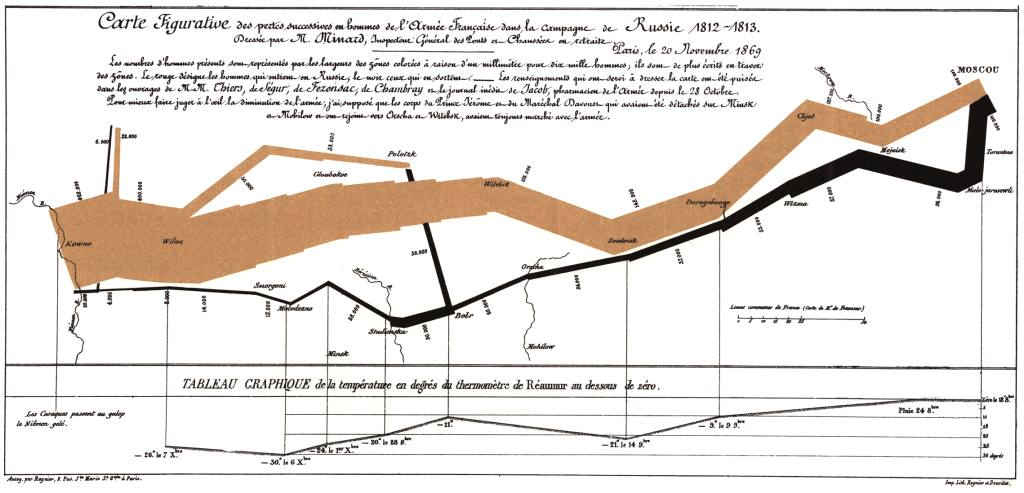
Never before has a military campaign been illustrated so completely as Charles Joseph Minard’s 1869 Carte figurative des pertes successives en hommes de l’Armée Française dans la campagne de Russie 1812–1813. It shows the strength of Napoleon’s forces at every point in the campaign.

Compare the red band at the far left of the illustration showing Napoleon’s force of half a million men as they crossed into Russia in June 1812. Notice as the red band narrows until it reaches Moscow, particularly after the casualties of the Battle of Borodino.

The black band illustrates the retreat from Moscow as winter is beginning to set in. That band gets progressively narrower until the crossing of the Berezina River at Studienka, highlighted by a black smudge I made on the above chart. After Berezina, only 25,000 combatants and 30,000 non-combatants survived. You can see the black band narrow after Berezina.

That particular battle was frequently described in Honoré de Balzac’s stories. particularly “Adieu.” It market the catastrophic end to a catastrophic campaign, which led in short order to Napoleon’s first exile, on Elba.

On the lower part of Minard’s graph, the relative temperature at several selected points during the retreat from Moscow is shown. Note that it was it its lowest around the time the Berezina was crossed.