
Doesn’t Look Like Much, Does It?
When I was attending my mindful meditation session on November 15, the cute young woman who acted as liaison with the L.A. Central Library handed me a flier that promised an interesting experience:
Live, from another world! Watch the live stream of NASA’s InSight mission when it lands on Mars. InSight is a robotic lander designed to study the interior of the Red Planet. The mission is scheduled to land on the surface of mars at Elysium Planitia, where it will deploy a seismometer and burrow a heat probe. This will be the first mission dedicated to studying the deep interior of the planet.
As the event was scheduled for today at 11 am, I took the Metro to the Central Library and attended the event. For all the years that I have lived in Southern California, I have never interested myself in the space program—except for my visit to the retired space shuttle Endeavour at the California Science Center. This was to be the first Mars landing in six years, and it was the first that was planned and executed all within the State of California. It was put together by the Jet Propulsion Laboratory (JPL) in Pasadena, staffed largely by graduates of Cal Tech, and launched early in May from Vandenberg Air Force Base near Lompoc.
Although technically, the live-streaming was a bit of a dud, with the image going into long buffering pauses in between live action snippets. At one point, I asked if they were running Windows 3.1, which was the version I used in the late 1980s. When I found that they were using Apple’s Safari browser, I noted yet another black mark laid to Apple’s account (though it probably wasn’t Apple’s fault).
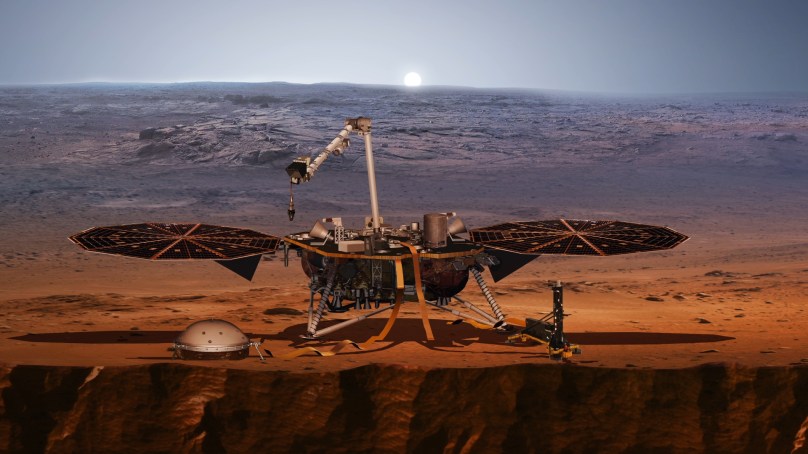
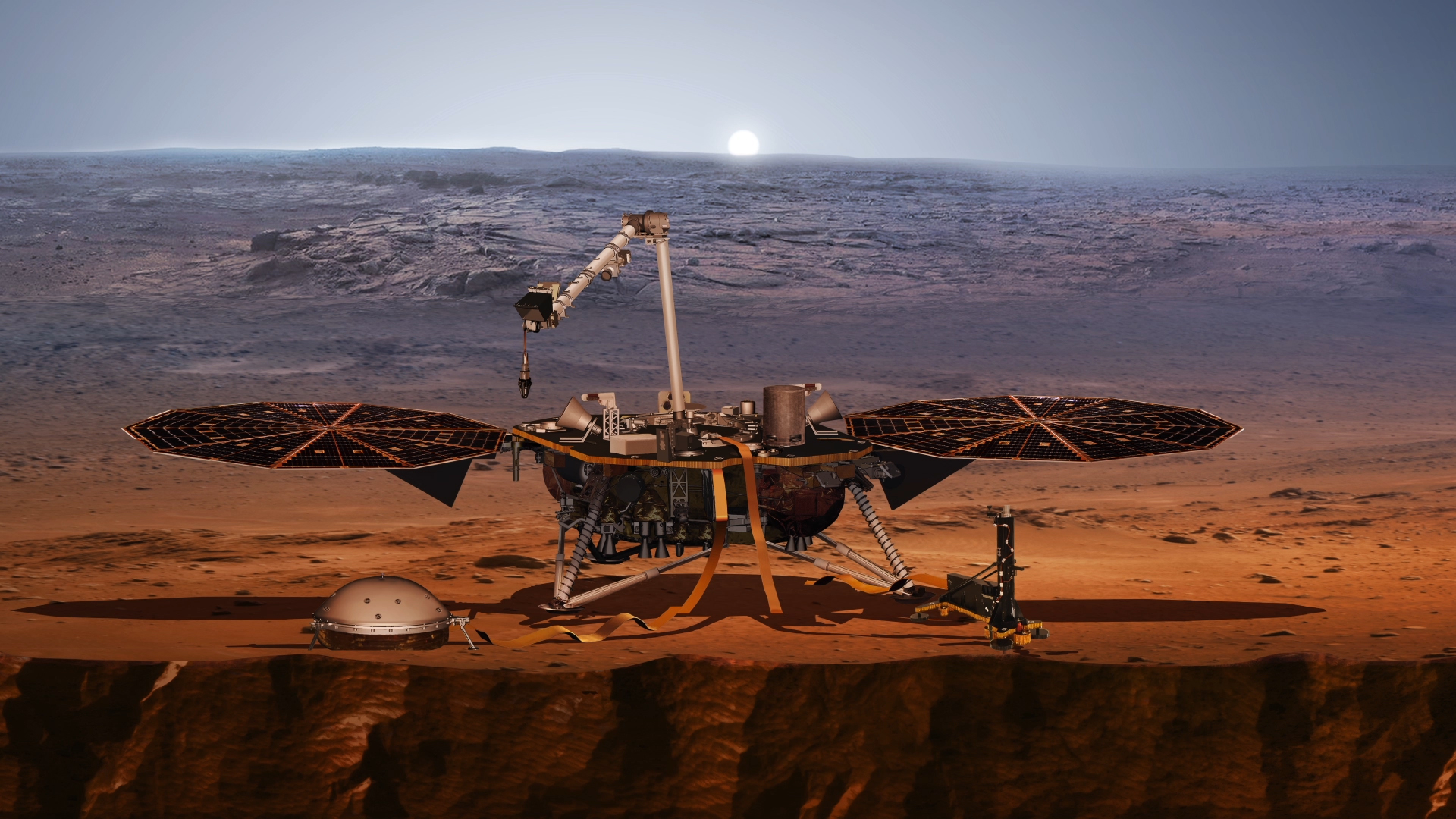
Mockup of the Mars InSight Lander
Fortunately, there were a number of JPL employees present who were able to bridge all the lacunae and present a coherent picture of the mission from the point of view of the techies who were most involved. Fortunately, it was a splendid success, with the first picture coming in within minutes of the landing. It doesn’t look like much: It’s merely an image of the surface on which the lander was situated. You can see mostly a lot of dust (this is because there is a protective transparent lens cap covering the photo lens) and a rock in the lower left foreground. At the lower right, you see one of the legs of the lander.
This mission is not meant to move around the surface of the planet: It is, rather, to use a seismograph (that’s the object above that looks like an upside-down colander) to determine whether the Red Planet has a molten core, or whether it’s as dead as our moon. There is also a probe drilled 15 feet into the surface of the planet to measure micro-variations in heat.
I understand that JPL has an open house in the spring that I am interested in attending.
34.052234
-118.243685


 Tarnmoor
You must be logged in to post a comment.