

Woman Wearing Demon Mask in Onibaba
Both films begin with the same situation. In Medieval Japan, there is civil war. Men are pressed into one of the competing armies, leaving behind a mother and wife in a hut. The situation is dangerous, what with deserters and roving bands of masterless samurai. And the same actress appears in both films, Nobuku Otawa, who also happened to be the director’s wife.
The two films are Onibaba (1964) and Kuroneko (1968), both by the same director—Kaneto Shindo— and both produced by the Toho Studio. In the former film, the hut is located in a sea of tall reeds; in Kuroneko, in a bamboo forest.
In the 1960s, I believe that the best films produced anywhere in the world were made by a handful of Japanese film studios: Toho, Daiei, Schochiku, Nikkatsu, and Tohei. Although Hollywood pioneered wide-screen films, it was the Japanese who mastered the medium, whether in black and white or in color.
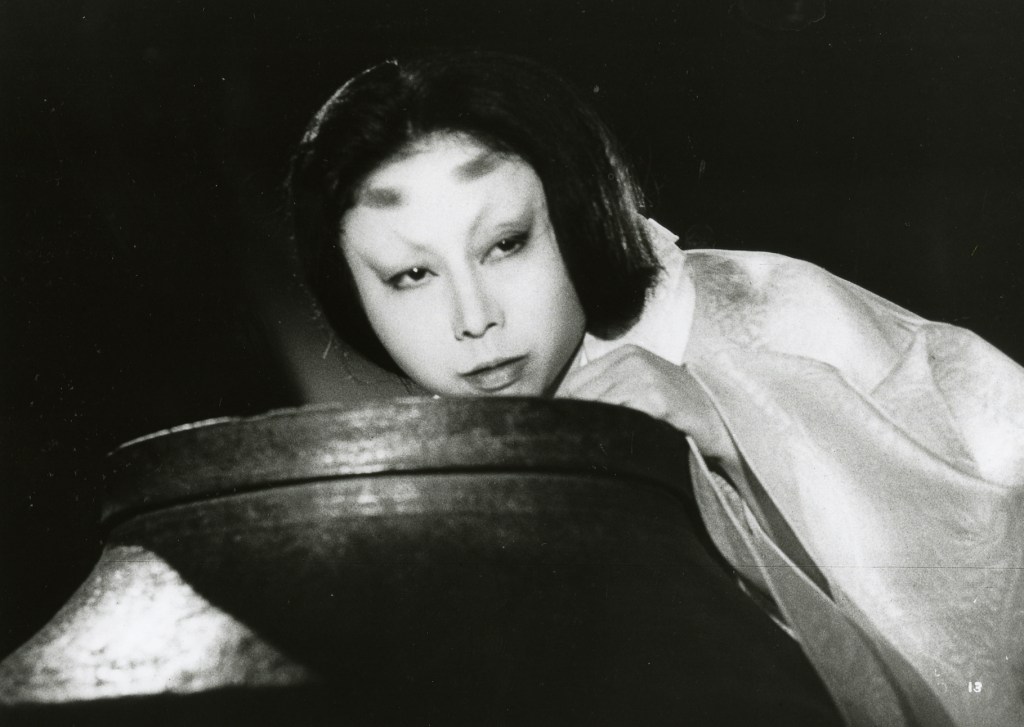
Nobuku Otawa in Shindo’s Kuroneko
Last night I stayed up late watching Onibaba and Kuroneko on the Turner Classic Movies (TCM) channel.
Onibaba is the better of the two films. The tall grass becomes a character in the film, much like the sand dunes in Hiroshi Teshigahara’s Woman in the Dunes (1964). When the daughter runs through the tall grass to tryst with her lover, the viewer feels that anything can happen. And it does: A demon appears in her path blocking the way.
Both films are available from the Criterion Collection.
 Tarnmoor
You must be logged in to post a comment.