Kahuna Lapa’au

In preparation for an upcoming trip to Hawaii in a couple of weeks, I am reading the work of a distinguished novelist and microbiologist: O. A. Bushnell’s The Gifts of Civilization: Germs and Genocide in Hawaii. Never before have I read a book about what happens to public health when a 19th century Western power takes over a primitive aboriginal society.

Bushnell claims that the native Kahuna Lapa’au healers were not inferior to American physicians of the period. When you consider that 19th century medicine was into bloodletting, blistering, and the ingestion of mineral poisons. it is not surprising that aboriginal healers were in now wise inferior.

Unfortunately, they were dealing with a whole new range of illnesses introduced by the white man, diseases such as measles, smallpox, malaria, leprosy, and the various venereal diseases. This led to widespread confusion among native healers as to which treatment to use, at a time when neither American nor native Hawaiian medical practice was effective.

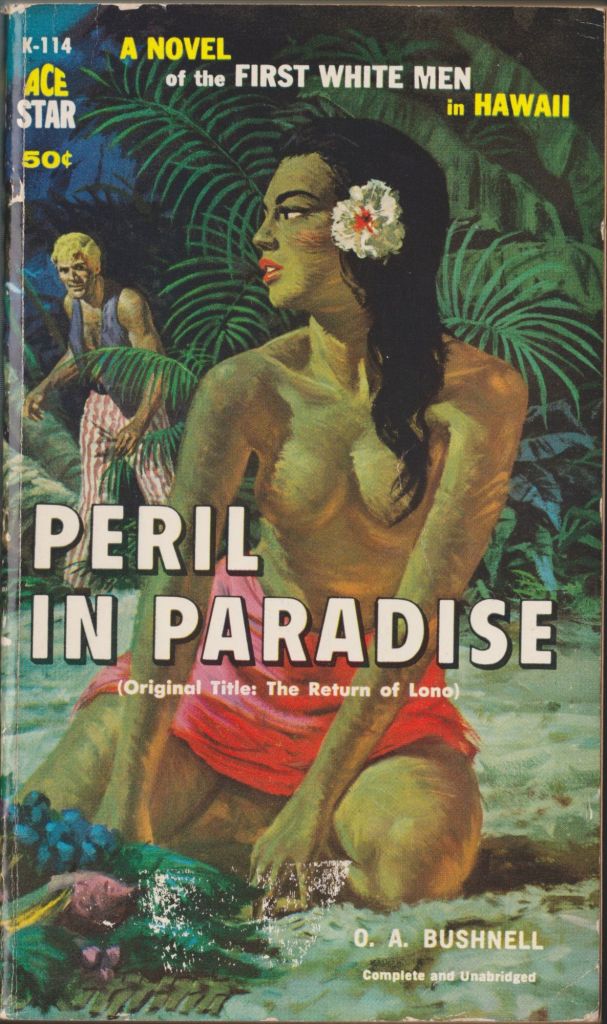
In this book and in his novels—The Return of Lono, Ka’a’awa, Molokai, The Stone of Kannon, and The Water of Kane—Bushnell created an impressive body of work on the interface of the two cultures.

Ozzie’s Islands

O. A. Bushnell’s Home in Manoa Valley

Who is the great novelist of Hawaii? (If you say James Michener, deduct a thousand points and surf off a cliff.)

When Martine and I went to Hawaii in 1996, I did some research on the subject and came up with the name O. A. (short for Oswald Andrew) Bushnell. I promptly bought all five of his novels:

  • The Return of Lono (1956), about the death of Captain Cook on the Big Island of Hawai’i
  • Ka’a’awa: A Novel About Hawaii in the 1850s (1972)
  • Moloka’i (1975) about Father Damien and the leper colony at Kalaupapa
  • The Stone of Kannon (1979) and its sequel The Water of Kane (1980) about Japanese immigration to Hawaii
O. A. Bushnell (1913-2002)

I am ashamed to say that, to date, I have read only the first two books. Between now and our trip to Hawaii this fall, I will also add Moloka’i to my to-be-read pile.

What I find interesting about Bushnell is that he was a professor of microbiology at the University of Hawai’i at Manoa. In fact, he also wrote a book on the subject: Gifts of Civilization: Germs and Genocide in Hawaii (1993). Yet he was also a natural at writing fiction. Come to think of it, much of his novel Ka’a’awa dealt with the devastating smallpox and influenza epidemics of the 1850s

How to Make Serious Literature Look Cheap

I remember visiting the Los Angeles Times Book Fair around 2000 and coming upon a booth staffed by the University of Hawai’i Press. At the time, I had not yet read any of my Bushnell titles, but I asked about how the author was doing. “Ah, poor Ozzie!” came the answer. “He’s pretty ill, and we can only hope he pulls through.” Alas, he was to die shortly after.

But his work lives on, and it is definitely worth reading.