Chicken Enchiladas in Mitla

Mixtec Ruins at Mitla, State of Oaxaca, Mexico

It was January 1980. My brother and I were traveling in an arc across southern Mexico along a route taken by Graham Greene in the 1930s, when he was doing his research for The Power and the Glory, which he described in his travel book The Lawless Roads.

Dan and I flew to Mexico City, transferring there to a flight to Villahermosa, which was the least hermosa (beautiful) city either of us had seen in all of Mexico. From there, we went to Palenque, San Cristóbal de las Casas, Oaxaca, and back to Mexico City via all-night bus.

While we were in Oaxaca, we took a side trip to see the Mixtec ruins at Mitla, which consisted of numerous geometric motifs such as are shown in the above photo. Seeing ruins in the desert makes one hungry and thirsty, so we repaired to a little restaurant within shouting distance of the ruins.

We were the only customers in the place. After a few minutes, a little girl raced out of the kitchen and stopped dead in her tracks, seeing two large and hairy gringos seated at a table. She did a quick U-turn and ran back to the kitchen shouting ¡Mamacíta! Within a couple of minutes, her mother appeared at our table with a notepad asking in Spanish what we wanted. Dan and I both ordered chicken enchiladas, rice, and beans.

There followed a long delay of several minutes which was punctuated with what Dan and I recognized as the death squawk of a chicken whose neck was being wrung. (Our great grandmother, old Hungarian farm woman that she was, liked to buy live poultry and butcher them and pluck their feathers herself.)

In time, about thirty minutes in all, our lunches were served. The chicken which had given its all for us turned out to be old and tough, with a decidedly stringy texture. It had been old, but by God it was fresh! We did our level best to eat as much as we could before thanking the proprietor and her daughter and making our way to the bus terminal.

That was a fun trip which gave us dozens of funny stories to remember for the long years to come.

A One-Man Renaissance

Francisco Toledo (1940-2019)

In his book On the Plain of Snakes: A Mexican Journey, Paul Theroux met with Francisco Toledo in Oaxaca shortly before the artist died. I was curious to see images of some of his works because his meeting with Theroux raised my interest.

A Zapotec Indian from Juchitán in the southeast corner of the State of Oaxaca (near the Isthmus of Tehuantepec), Francisco Benjamin López Toledo was a noted painter, sculptor, illustrator, and protestor. When McDonald’s wanted to plant the Golden Arches in the zócalo of Oaxaca, Toledo set up a table offering free tamalitos to passers-by explaining to them the damage that would be done to their culture.

Animal-Headed Woman

When Theroux asked him what he thought of Frida Kahlo, Toledo replied:

I started out hating her. Then later I began to see that she represented something. And outsiders were interested in her. Her life was so complex and painful. So she is something. But there are so many others.

Kahlo is well known to art critics outside of Mexico, along with a handful of other artists such as Orozco, Rivera, Tamayo, and Siqueiro; but Toledo is right that Mexico is fairly crawling with great art. This was brought home to me during my recent trip to Yucatán, when I made a point of visiting art and folk museums.

Illustration: Mythical Creature

To another American visitor, Toledo describes his work:

What I do is a mixture of things, but the pre-Hispanic world has been a source of inspiration. There are certain solutions that are decorative that come from pre-Hispanic art and at the same time there is much primitive art that is refined or simple but also very modern.

They described his work as employing innovative materials, such as sand and amate paper, which was used by pre-Columbian Indians, made with the crushed bark of the amate tree (Ficus insipida, a species of fig).

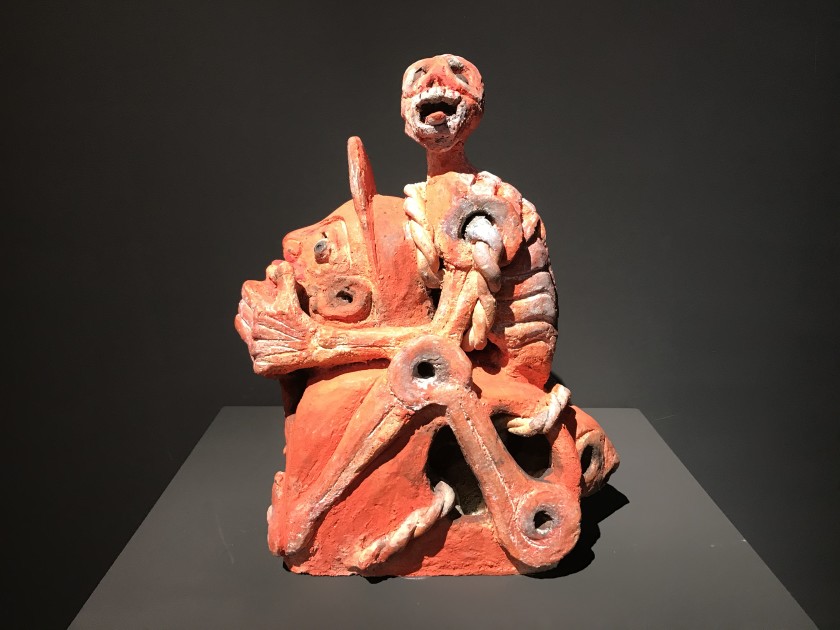
A Ceramic Sculpture Honoring the Disappeared of Mexico

I hope to present the work of other Mexican artists in posts to come.

Mexican Folk Art: Alebrijes

Magical Realism—Zapotec Style

At the Casa de Montejo in Mérida, I stumbled onto a special exhibit of Mexican folk art by Jacobo and María Ángeles and their collaborators from the Zapotec town of San Martín Tilcajete in the State of Oaxaca. In general, I think that Mexican folk art is magical, but Jacobo and María are something else. They are known for their sculpted figured known as alebrijes in a series called “Tonas and Nahuales.” According to Wikipedia, “Alebrijes are brightly colored Mexican folk art sculptures of fantastical creatures.”

These particular sculptures are carved from the wood of the copal tree, which is sacred to many Meso-American peoples because it is the source of incense for worship. They are meticulously painted, and various other objects are frequently attached.

Magical Monkey

This was the first of several visits I made to see Mexican folk art in both Mérida and Valladolid. In every case, I was enthralled.

The Ángeles art group has an excellent website which can be accessed here. Of particular interest is a four-minute video in Spanish with English subtitles explaining their method of creating these alebrijes as well as a quick survey of their other activities:

Future posts will describe other works of Mexican folk art that caught my eye.

Piedras Antiguas

The Ruins of Monte Alban Near Oaxaca

The Ruins of Monte Alban Near Oaxaca

Tonight, as Martine and I had dinner at the Monte Alban Restaurant in West L.A., I flashed back briefly to one of the best vacations I ever had, when my brother and I went to Mexico together in 1979. We started in Villahermosa (I’ll have to tell you about that particular experience in a later post), then went on to Palenque and San Cristóbal de las Casas and Oaxaca, ending up in Mexico City for the flight home.

Although the Monte Alban Restaurant serves Oaxacan specialties, particularly meats with mole sauce, I went for the non-mole dishes. Dining at one of the zócalo cafés in Oaxaca, I picked up a bug which I will forever refer to as the Oaxaca Caca. For about a day and a half, I hugged the porcelain while producing a cacophony of rectal groans from the underworld. I heard my brother laughing in the other room at my discomfort, and begged him to go to the market and pick up some bananas for me.

When I got better, we took a bus up to see the ancient Zapotec ruins on top of a hill near the city. While Dan and I were wandering around, we were accosted by a local who whispered to us, “Pssst, Señor … piedras antiguas.” With great drama, he opened up a piece of cloth that looked like dark blue velvet which contained several small carved stones meant to resemble ancient Zapotec carvings.

Well, they were piedras (stones) for sure … but antiguas (ancient)? We didn’t think so. If they were genuine, we’d be in danger of being arrested at the airport for illegally exporting a pre-Columbian artifact. And if they weren’t, we could certainly get a better price for them in the city. So we thanked the gentleman for sharing such a treasure with us, and went on to other parts of the ruin, where—surprise!—we met up with the original salesman’s brothers-in-law selling more piedras antiguas.