It’s amusing to think that Slab City exists primarily because the military lawyers who drew up the papers for deeding the land Camp Dunlap was situated on to the State of California made a slight error. According to Wikipedia:
As of October 6, 1961, a quitclaim deed conveying the land to the State of California was issued by the Department of Defense as it was determined the land was no longer required. The deed did not contain any restrictions, recapture clauses, or restoration provisions. All of the former Camp Dunlap buildings had been removed. The remaining slabs were not proposed for removal. Later, legislation required that revenue generated from this property would go to the California State Teachers’ Retirement System.
But was there ever any revenue generated from the Camp Dunlap property? Who would be so imprudent as to spend good money buying land occupied by squatters, tweakers, snowbirds, religious freaks, people hiding out from the law, and other non-solid citizens?
If the bronze plaque above looks weirdly shaped, it’s because it is shaped like Imperial County.
Bombay Beach was only an appetizer. For real off-the-grid living, there’s no place like Slab City, several miles inland from Niland, California, along a fast deteriorating paved road.
Once upon a time, this used to be the Marine Corps’ Camp Dunlap, used for artillery training during World War Two and also as a bombing range for planes flying out of Marine Corps Air Station El Centro. Around 1950, the USMC started closing up shop. They took away all the buildings and tents, leaving only the slabs. Due to an interesting legal error, which I will discuss in tomorrow’s post, the area was left open for whoever wanted to squat on the premises.
It didn’t take long before the squatters starting showing up. Billing itself as “the last free place,” Slab City started taking off in the 1980s after articles in trailer and Recreational Vehicle (RV) magazines wrote articles featuring it.
Do You See Any Power Lines? Nope
Unlike Bombay Beach, the subject of yesterday’s post, there is neither running water nor electrical power nor trash pickup in Slab City. I imagine that water has to be trucked in from elsewhere in Imperial County. As for power, there are a lot of solar panels and probably not many air conditioners. During the summer, the mean daily maximum temperature is between 102° and 107° Fahrenheit (39° and 42° Celsius). Being in the middle of the desert, the precipitation is mostly nonexistent, and the wind can be wicked, bringing with it chemicals from the polluted Salton Sea shore.
On the other hand, there is no cost to live in Slab City. In addition to about 150 year-round residents, during the winter months thousands of snowbirds from around the US. and Canada park their RVs in an empty spot along the road and prepare to enjoy a life of doing not much.
Apparently there is a nearby hot spring where people can bathe and even shower. As Slab City is situated along the San Andreas fault, one can count on a number of natural hot springs along its length. (And one can also count on earthquakes from time to time.)
For an interesting picture of what it is like to visit Slab City, check out the Wiki Voyage page. And don’t forget to drink lots and lots of water.
When I was still in college trying to decide where I would go to graduate school, I kept studying maps of California because it looked like I would attend UCLA (which I did). The one thing that arrested my attention was that Southern California had a sea entirely within the state. It was called the Salton Sea, and it did not seem to have any major population centers along its banks. Why, I wondered.
It seems that the Salton Sea was created by accident in 1905-1906 when the Colorado River was diverted to flow into a low-lying basin that had been dry since the late 16th century. For a while, particularly in the 1950s and 1960s, it was a major tourist draw—but not in the summer, when the temperature frequently exceeded 120° Fahrenheit (49° Celsius). Hollywood stars swam and boated in the waters, and there were a number of resort towns along the banks.
During the 1970s, the Sea’s increasing salinity and pollution resulted in large-scale fish and bird deaths; and, suddenly, the Salton Sea was deemed an environmental disaster. Plus, it was shrinking due to evaporation. The roads to the north ran through land that was white with salt. People started to remember that the San Andreas Fault ran right through the middle.
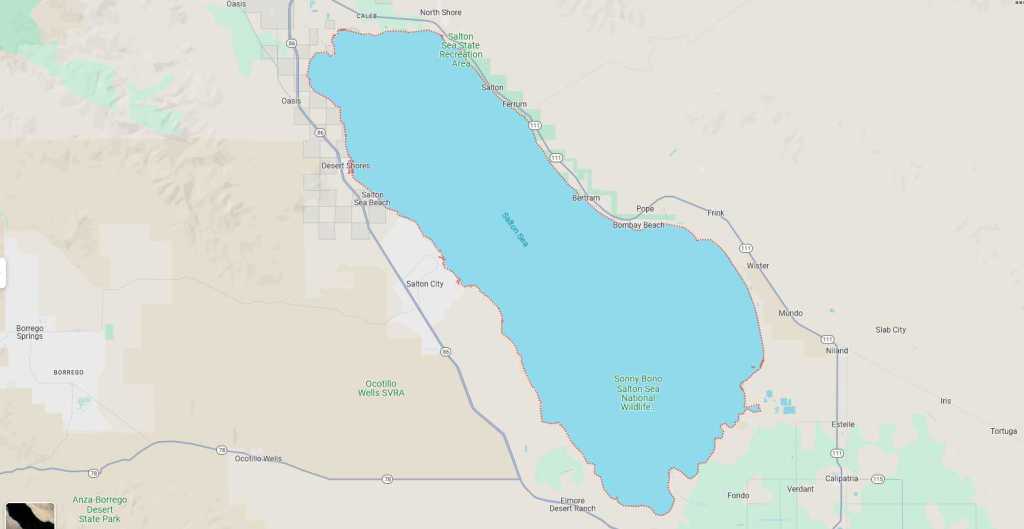
Last Saturday, my brother and I drove along the eastern shore of the Sea to view a stark landscape that was staging a weird comeback, first as a major lithium extraction site, and secondly as a magnet for people who wanted to live off the grid.
For the next several days, I will be posting blogs in a series I call “Off the Grid,” about our visit to the rogue communities of Bombay Beach, Slab City, Salvation Mountain, and East Jesus. None of them are incorporated cities, but all are alive with a kind of ferment that lends them a certain glow.




 Tarnmoor
You must be logged in to post a comment.