Steps

The Inca Ruins at Machu Picchu

I knew I was getting old when I was at the ruins of Machu Picchu ten years ago when I was 69 years old. There was a light drizzle, and there were hundreds of rough slightly wet steps without guard rails. I envisioned myself stumbling and pitching down the mountain into the Valley of the Urubamba below.

For me, getting older is not what I thought it would be. In general, my mental acuity has not suffered, but I do lurch a bit when I walk. And going down a flight of stairs requires a firm grip on the handrail and a slow, somewhat painful progress to the bottom. (Going up a flight is not as bad, so long as there’s a handrail.)

Now that the Los Angeles Central Library has resumed its mindful meditation sessions, I take the light rail to the 7th Street Metro Center and walk three blocks to the library. There is an escalator going up to the street level, but on the return trip, I must take the elevator. Downtown Los Angeles has a large homeless population, so it is rare to ride the elevator when it is free of various bodily effluvia. Today, it wasn’t. But it was still better than taking the stairs, especially when there are people sitting on the stairs that have to be gotten around without access to the handrails.

Yes, there are some problems about getting old. The good news is that, for me, they are not insurmountable. I could probably even go to Peru again, but next time I’ll take a collapsible cane.
Death By Comfy Chair

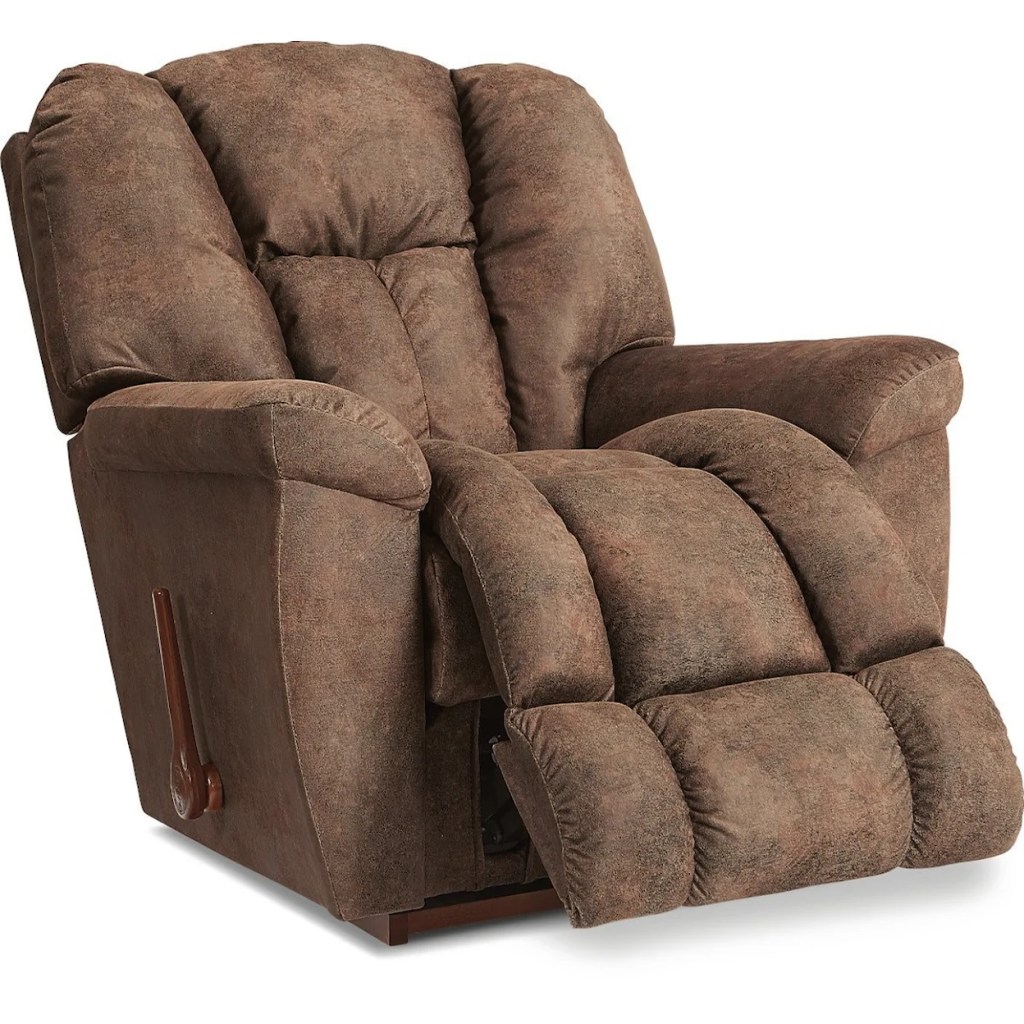
La-Z-Boy Maverick-582 Rocker Recliner

I have never understood why people buy those overstuffed recliners. Is it because they are tired of living and just want to sink into something soft while their body functions shut down? Never forget the old Monty Python episode in which the Spanish Inquisition uses comfy chairs as a form of (not unwelcome) torture.

All the seating in my apartment tends to be on the firm side. In fact, I refer to them as my uncomfy chairs. To that I attribute the back that, at my advanced age, my back doesn’t hurt; and I am more agile than most of my age cohort.

This brings to mind one of my favorite poems by Dylan Thomas entitled “Do Not Go Gentle Into That Good Night.”

Do Not Go Gentle Into That Good Night

Do not go gentle into that good night,
Old age should burn and rave at close of day;
Rage, rage against the dying of the light.

Though wise men at their end know dark is right,
Because their words had forked no lightning they
Do not go gentle into that good night.

Good men, the last wave by, crying how bright
Their frail deeds might have danced in a green bay,
Rage, rage against the dying of the light.

Wild men who caught and sang the sun in flight,
And learn, too late, they grieved it on its way,
Do not go gentle into that good night.

Grave men, near death, who see with blinding sight
Blind eyes could blaze like meteors and be gay,
Rage, rage against the dying of the light.

And you, my father, there on the sad height,
Curse, bless, me now with your fierce tears, I pray.
Do not go gentle into that good night.
Rage, rage against the dying of the light.

And so I continue to burn and rave at close of day from my uncomfy chair.

Stuck in a Bubble

As we age, we tend to find ourselves stuck in a bubble. Even with the wonders of the smart phone and social media, we seem to have found a new way of isolating ourselves. One of my friends cannot have a conversation without mentioning the politics and culture of America between 1966 and 1976. His talk is of the Kennedy assassinations (he was actually present at Robert Kennedy’s), the FBI vs. the Sioux at Pine Ridge, the Manson Family, and related topics. He goes back frequently to his college days or his Midwestern upbringing.

If one is feeling stressed, I can understand trying to find refuge in the past. It is a particular temptation as one ages, especially if life has not proved satisfactory in some way. And, when you think about it, it rarely does. We are all mortal, and the stresses do not disappear when one is up against the endgame. As we all inevitably are.

My way of fighting the bubble-ization of old age is to try to understand the present. Mind, I didn’t say to accept it. For instance, I do not own a smart phone—though I have a flip phone I use occasionally. I use FaceBook mainly as a content provider: All my WordPress posts are sent to my FaceBook page, and I usually add a couple of funny comics to boot. I do not have any Twitter, Instagram, TikTok, or other social media accounts. (And I don’t feel socially deprived as a result.)

When people try to put me down with an “Okay, Boomer!,” I merely point out that I am pre-Baby-Boom, having been born during the last days of the Second World War. In fact, I was born some six months before the Trinity A-Bomb test, so I’m also pre-Atomic-Age. That only means I am older than dirt. But I am still alive.

Birthday! Birthday!! Birthday!!!

Now Imagine This Cake with 78 Candles on It

Over the last few decades, I have become quite blasé about my date of birth. I usually saw I was born on the thirteenth day of the thirteenth month (which is true, as the months wrap around). When asked for my astrological sign, I say, “No Trespassing.”

When you’re young, you get all kinds of cake and presents. When you’re my age, you just get measurably older.

Am I any wiser? Not really, I am probably a little more tolerant maybe up two percentage points. I have definitely noticed I am getting more crabby. (Those kids had better get off my lawn, STAT, or I’ll have to reach for my flamethrower.)

After what I went through with my brain tumor more than half a century ago, I never thought I would live this long. Even as a grade school kid, I looked forward to the year 2000 and thought, “Wow, if I live to that year, I’ll be fifty-five years old!” And to an eight-year-old, that seemed really O-L-D.

My father died at the age of seventy-four; and my mother, at the age of seventy-nine. Though I am minus a few body parts (pituitary gland, left hip), I am still surprisingly healthy. The joints are getting a bit creaky, but I can still walk. As for my mind, well let us speak respectfully of the dead.

I wonder, what kind of crap will I write when I reach seventy-nine?

No Stylist He!

Poet Charles Bukowski (1920-1994)

Okay, so he’s no great stylist. You won’t quote his poems at length the way you might quote Keats or Shakespeare. But I guarantee you will get what he has to say because it is written to communicate simply and directly. You can read a book of Bukowski poems the way you read a pulp novel, from end to end, with total comprehension. In my book, that counts.

mugged

finished,
can’t find the handle,
mugged in the backalleys of nowhere,
too many dark days and nights,
too many unkind noons, plus a
steady fixation for
the ladies of death.

I am 
finished, roll me
up, package
me,
toss me 
to the birds of Normandy or the
gulls of Santa Monica, I
no longer
read
I
no longer
breed,
I
talk to old men over quiet
fences.

is this where my suicide complex
un-
complexes?: as
I am asked over the telephone:
did you ever know Kerouac?

I now allow cars to pass me on the freeway.
I haven't been in a fist fight for 15 years.
I have to get up and piss 3 times a night.

and when I see a sexpot on the street I
only see
trouble.

I am
finished, back to square one,
drinking alone and listening to classical
music.

much about dying is getting ready.
the tiger walks through my dreams.

the cigarette in my mouth just exploded.

curious things still do
occur.

no, I never knew Kerouac.

so you see:
my life wasn’t 
useless
after
all.

“The Best Is Yet To Be”

I never thought I would be alive at the age of 77. My father died at 74 years old; and my mother, at 79. When I was a student at St. Henry Elementary School, I thought, “Gosh, I’ll be 55 years old when we get to the year 2000.” I passed that milestone at a run.

In the illustration above, I am somewhere between the third and fourth figure. Thankfully, my health is good. I can get about without a cane, though I find going down a flight of stairs to be painful. Kneeling on a hard surface is out of the question.

When I think about aging, I call to mind the first stanza of Robert Browning’s poem “Rabbi Ben Ezra”:

Grow old along with me!
The best is yet to be,
The last of life, for which the first was made:
Our times are in His hand
Who saith “A whole I planned,
Youth shows but half; trust God: see all, nor be afraid!” 

I see some of my friends fall by the wayside, some dying, some suffering personality disorders as they age, and some just isolating themselves.

This is not a subject anyone likes to think about. There are, however, dangers inherent in suppressing any important subject.

The times are always bad—and always have been. Yes, what is happening in Ukraine is terrible. But so was ducking under my school desk at St. Henry to practice for a Communist H-Bomb attack. So was World War Two. So was … oh … Genghis Khan.

I always wanted to be a writer. And in a manner of speaking, I am one. I don’t care about compensation or fame. Just sitting down around 9 o’clock most evenings and writing this blog is a worthwhile effort. It makes me feel good about myself.

Old Man …

… Who Doesn’t Realize He’s Getting Old

Unless one has children of one’s own, and if one is in reasonable health, one doesn’t really know one is getting old. Yesterday, my friend Bill Korn told me his own interpretation of my posting from a couple days ago, I Don’t Feel at Home Here, Either. The young, when they acknowledge my existence at all, seem surprised to see such a spry oldster doing approved things. Several weeks ago, I was about to enter a Trader Joe’s market when a younger woman flashed a delighted look at me, as if here was a decrepit old man doing the right thing. What was my reaction? I gave her the stink-eye, at maximum volume. She looked infuriated, as if I had stomped on her Yorkie or slipped her smart phone into a sewer grating.

What my reaction was saying was: “Don’t patronize me, you stupid beeyotch! I do not require your approval.”

But then, that’s me all over. I don’t cotton to strangers. When I am traveling in a foreign country and am approached by American tourists, I answer back in Hungarian. I think I’m taking after my Great Grandmother Lidia Toth (born in 1876), who could make a longshoreman blush with her swearing. She was one of those, “Who’re you looking at, Punk?” type of people, except her language was ever so much more colorful.

As a result, I am not likely to initiate contacts with strangers—with several exceptions. When I travel, I try hard to communicate with the locals and generally get good responses. I do not … ever … make … friends …. with …. American … tourists. Does that mean that I am anti-American? Not really, I just find it’s a waste of time. I even go out of my way to help foreign tourists who are obviously stuck in Los Angeles, which is not the easiest place in the world to get around in.


De Incommodis Senectutis

Old Man

Old Man

But even then, if anyone does reach old age, his heart weakens, his head shakes, his vigor wanes, his breath reeks, his face is wrinkled and his back bent, his eyes grow dim and his joints weak, his nose runs, his hair falls out, his hand trembles and he makes silly gestures, his teeth decay, and his ears get stopped with wax. He will believe anything and question nothing. He is stingy and greedy, gloomy, querulous, quick to speak, slow to listen, though by no means slow to anger. He praises the good old days and hates the present, curses modern times, lauds the past, sighs and frets, falls into a stupor, and gets sick. Hear what the poet says: Many discomforts surround an old man. But then the old cannot glory over the young any more than the young can scorn the old. For we are what they once were; and some day we will be what they are now.—Pope Innocent III, On the Misery of the Human Condition

An Old Man

It’s the Same Everywhere

It’s the Same Everywhere

An old Man,
Is loath to bid the world goodnight, hee knowes the grave is a long sleepe, and therefore would sit up as long as hee could. His soule has long dwelt in a ruinous tenement, and yet is so unwilling to leave it that it could be content to sue the body for reparitions. He lives now to be but a burthen to his friends, as age is to him, and yet his thoughts are as farre from death as he is nigh it. Howsoever time bee a continued motion, yet the Dyall of his age stands still at 50, that’s his age for ten yeares afterward, and love’s such a friend that like a flattering glasse tels him hee seemes farre younger. His memory is full of the actions of his youth, which hee often historifies to others in tedious tales, and thinks they should please others because himselfe. His discourses are full of parenthesis, and his wordes fall from him as slowly as water from an Alimbecke; drop by drop. He loves the chimney corner and his chaire which he brags was his grandfathers, from whence he secures the cubboard from the Catts and Dogges, or the milke from running over, and is onely good to build up the architecture of a seacole fyre by applying each circumstant cynder. When his naturall powers are all impotencyes, hee marries a young wench for warmth sake, and when hee dyes, makes her an estate durante viduitate onely for widowhood. At talke hee commonly uses some proverbiall verses gathered perhaps from cheese-trenchers or Schola Salerna, which he makes as applyable, as a mountebank plasters to all purposes, all occasions. Hee cals often to the Servingman for a cup of Sacke, and to that end stiles him friend; and wonders much that new wine should not bee put in old bottles. Though the proverbe be, once a man and twice a childe, yet he hopes from his second childhood to runne backe into his teenes, and so bee twice a man too. Lastly, hee’s a candle burnt to the snuffe, the ruines onely of a man, whose soule is but the salt of his body to keepe it from stincking, and can scarcely performe that too.—Wye Saltonstall, Picturae Loquentes (1635)