
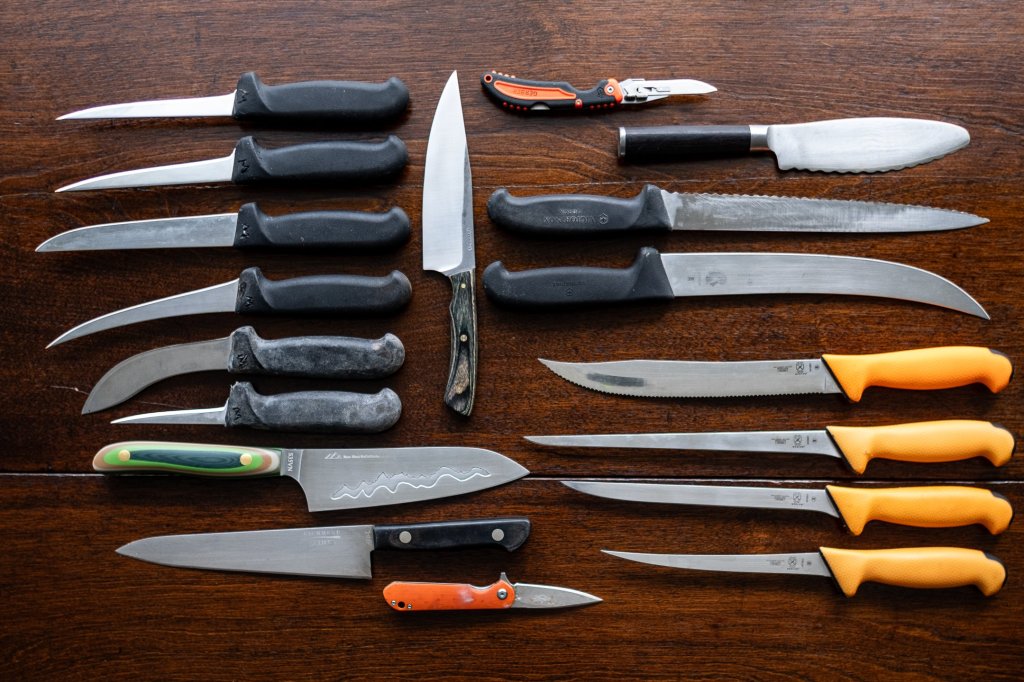
They suddenly appear on Page 207 of Olga Tokarczuk’s House of Day, House of Night (1988), a strange sect known for sharp knives:
They spent their days singing psalms and making knives. They made blades better than anyone in the whole of Silesia and fitted them with carefully polished handles made of ash wood, which every human hand fell in love with instantly. They sold them once a year in early autumn when the apples were ripening on the trees. They held a sort of fair, which attracted people from all over the district; they each bought several knives, sometimes as many as a dozen, in order to sell them on at a profit. During these fairs people forgot that the Cutlers were of a different faith and believed in a different God, and that it would have been easy to produce evidence and drive them away. For who would make such good knives then?
Whenever they bore a child they mourned instead of rejoicing. Whenever someone died, they undressed him, laid his naked corpse in a hole in the ground and danced around the open grave.
About forty pages later appears this poem, called “The Cutlers’ Psalm”:
Futility on all the earth
blessed be barren wombs
holy be all sterility
sacred is decay, desirous is decline
wondrous the fruitlessness of winter
the empty shells of nuts
logs burnt to ashes that still keep the shape of the tree
seeds that fall on to stony ground
knives gone blunt
streams run dry
the beat that devours another’s offspring
the bird that feeds on another’s eggs
war that is always the start of peace
hunger that is the beginning of repletion
Sacred old age, daybreak of death,
time trapped in the body,
death sudden, unexpected.
death downtrodden like a path in the grass
To do, but have no results
to act, but stir nothing
to age, but change nothing
to set off, but never arrive
to speak, but not give voice
Whew!

 Tarnmoor
You must be logged in to post a comment.