
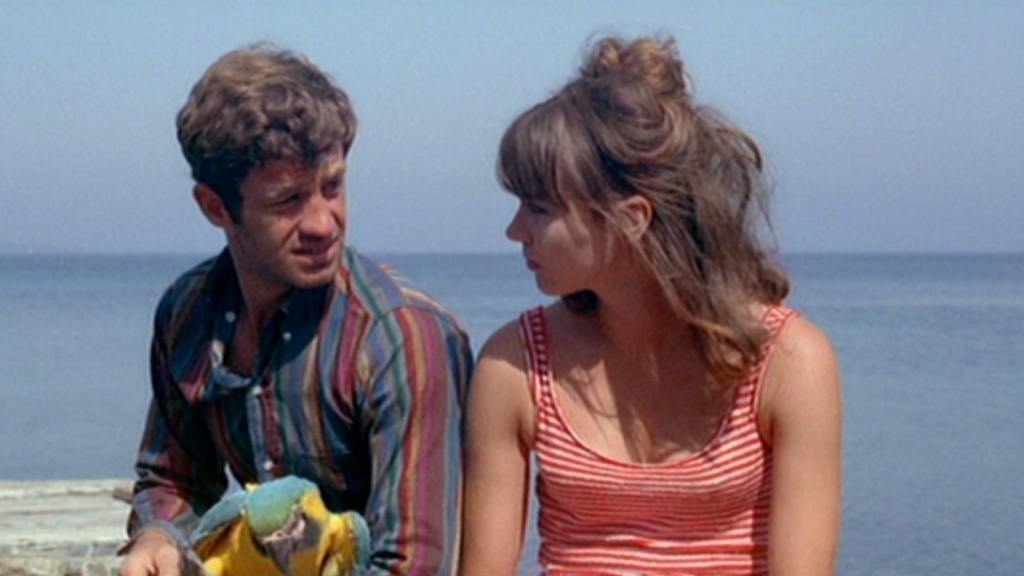
Favorite Films: Pierrot le Fou (1965)

Jean-Paul Belmondo and Anna Karina in Pierrot le Fou

In the late 1960s, as I was studying graduate film history and criticism at UCLA, I was completely enamored with the films of Jean-Luc Godard. I remember telling my late friend Norm Witty that I was glad that my favorite film director was so young and that he would be making great films for decades to come.

As it turns out, I was only half right. He did continue to make films, but something was gone once he divorced Anna Karina. That happened in 1965, shortly after he made Pierrot le Fou with his wife and Jean-Paul Belmondo.

After Pierrot, Godard came out with two or three films sans Karina, and then descended into a darker period with La Chinoise and Weekend (both 1967). After that, although he was still prolific, I have seen only two of his films. It was as if something was gone forever from his work.

What was gone was that almond-eyed beauty Anna Karina. Godard was clearly in love with her, as I would have been if I were him. Pierrot is a film about the deterioration of their relationship: Belmondo as Ferdinand is a bookworm spouting profundities at every turn, while Karina’s Marianne Renoir is instinctive, emotional, and mysterious.

I love the film because I am a bookworm, and I know full well how that puts me at a disadvantage in relationships. Another director—Orson Welles in Mr. Arkadin (1955)—has the last word about how I feel in the matter:

The Tale of the Scorpion and the Frog in Mr. Arkadin

Boardwalk

Pacific & Windward, the Center of Venice, California

If you squint hard when you look at the above picture, you can see the set of the Mexican border town in Orson Welles’s Touch of Evil (1958) in which Charlton Heston plays a Mexican drug enforcement officer—one of his weirder roles.

Now it’s just ground zero for one of Los Angeles’s main tourist attractions: The Venice Boardwalk. The boardwalk runs roughly between the Santa Monica Pier and the Venice Pier. It’s only when you cross the border from Santa Monica into Venice that the fun begins. There are scores of tattoo parlors, cafés, tourist junk shops, fortunetellers, psychics, and handcrafts. including a lot of dubious art. The Midwestern tourists who come by the busload see what they think is the “real” Los Angeles, whereas what they see has been created largely for their benefit.

I sort of enjoy the tatty atmosphere of the Boardwalk, but I mainly go because it contains one of Los Angeles’s last surviving bookshops, Small World Books. Today I picked up a copy of James M. Cain’s last novel, The Cocktail Waitress, and a book by Alan Watts about Buddhism. Then I had a slice of pepperoni pizza from Rey’s and trundled back to my car, which was parked at a confusing intersection of streets a few blocks away near Electric and Abbot Kinney.

If you go a few blocks south on Pacific, you will find the bridge over the Venice canal that was the scene of where Joseph Calleia plugs Orson Welles’s corrupt Captain Hank Quinlan.

The Scorpion and the Frog, Circa 2017

There’s a Lesson Here for Voters

The story goes back to Aesop. A frog sitting by the riverbank is approached by a scorpion, who asks him to ferry him across. The frog hesitates: “But you’ll sting me and I’ll die.” The scorpion asks, “Where is the reason in that? If I stung you, we’d both die.” Being a reasonable creature, the frog agrees and lets the scorpion hop on. In the middle of the river, the frog feels a horrible pain as he is injected with the scorpion venom. As he feels his body shutting down, he asks: “Why did you do this thing? Now we’ll both die.” I don’t know if scorpions can shrug, but let us say this one can. His last words are: “I can’t help it: It’s my nature.”

Or you can hear Orson Welles tell the same tale in his film Mister Arkadin (1955):

Now what’s the moral of this story insofar as you and I are concerned? Let’s say the scorpion has a shock of bright orange hair. He’s been around for a long time, so we have some notion of how he behaves. Knowing that, why have we allowed that scorpion on our backs?