“A Vast Field in Perpetual Turmoil”

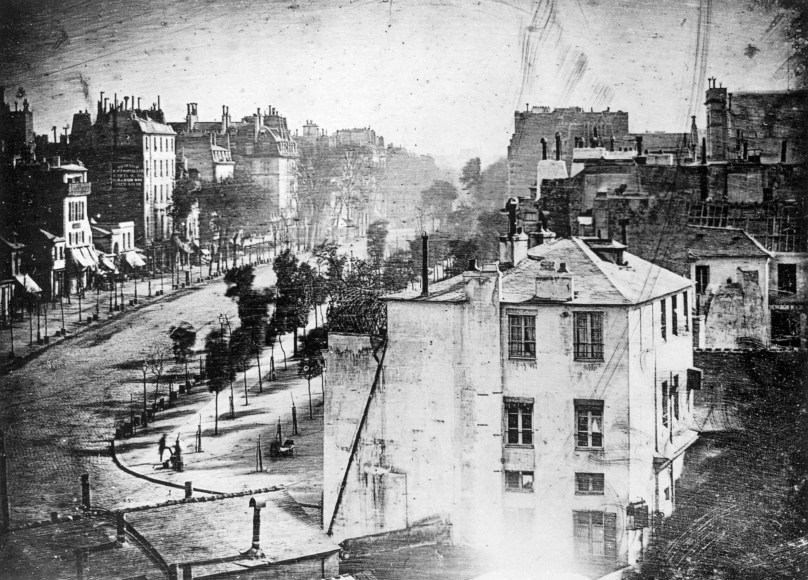
Paris’s Boulevard du Temple in 1837 or 1838

The above photograph is the first one to show a human being. There he is, in the lower left, having his shoes shined. All the pedestrians and carts and carriages have disappeared because this was an eight-hour exposure, ensuring only that static subjects could be recorded. Below is a description of Paris by Honoré de Balzac at the beginning of The Girl with the Golden Eyes (1835) that is anything but static:

One of those sights in which most horror is to be encountered is, surely, the general aspect of the Parisian populace—a people fearful to behold, gaunt, yellow, tawny. Is not Paris a vast field in perpetual turmoil from a storm of interests beneath which are whirled along a crop of human beings, who are, more often than not, reaped by death, only to be born again as pinched as ever, men whose twisted and contorted faces give out at every pore the instinct, the desire, the poisons with which their brains are pregnant; not faces so much as masks; masks of weakness, masks of strength, masks of misery, masks of joy, masks of hypocrisy; all alike worn and stamped with the indelible signs of a panting cupidity? What is it they want? Gold or pleasure? A few observations upon the soul of Paris may explain the causes of its cadaverous physiognomy, which has but two ages—youth and decay: youth, wan and colorless; decay, painted to seem young. In looking at this excavated people, foreigners, who are not prone to reflection, experience at first a movement of disgust towards the capital, that vast workshop of delights, from which, in a short time, they cannot even extricate themselves, and where they stay willingly to be corrupted. A few words will suffice to justify physiologically the almost infernal hue of Parisian faces, for it is not in mere sport that Paris has been called a hell. Take the phrase for truth. There all is smoke and fire, everything gleams, crackles, flames, evaporates, dies out, then lights up again, with shooting sparks, and is consumed. In no other country has life ever been more ardent or acute. The social nature, even in fusion, seems to say after each completed work: “Pass on to another!” just as Nature says herself. Like Nature herself, this social nature is busied with insects and flowers of a day—ephemeral trifles; and so, too, it throws up fire and flame from its eternal crater. Perhaps, before analyzing the causes which lend a special physiognomy to each tribe of this intelligent and mobile nation, the general cause should be pointed out which bleaches and discolors, tints with blue or brown individuals in more or less degree.

By dint of taking interest in everything, the Parisian ends by being interested in nothing. No emotion dominating his face, which friction has rubbed away, it turns gray like the faces of those houses upon which all kinds of dust and smoke have blown. In effect, the Parisian, with his indifference on the day for what the morrow will bring forth, lives like a child, whatever may be his age. He grumbles at everything, consoles himself for everything, jests at everything, forgets, desires, and tastes everything, seizes all with passion, quits all with indifference—his kings, his conquests, his glory, his idols of bronze or glass—as he throws away his stockings, his hats, and his fortune. In Paris no sentiment can withstand the drift of things, and their current compels a struggle in which the passions are relaxed: there love is a desire, and hatred a whim; there’s no true kinsman but the thousand-franc note, no better friend than the pawnbroker. This universal toleration bears its fruits, and in the salon, as in the street, there is no one de trop, there is no one absolutely useful, or absolutely harmful—knaves or fools, men of wit or integrity. There everything is tolerated: the government and the guillotine, religion and the cholera. You are always acceptable to this world, you will never be missed by it. What, then, is the dominating impulse in this country without morals, without faith, without any sentiment, wherein, however, every sentiment, belief, and moral has its origin and end? It is gold and pleasure. Take those two words for a lantern, and explore that great stucco cage, that hive with its black gutters, and follow the windings of that thought which agitates, sustains, and occupies it! Consider! And, in the first place, examine the world which possesses nothing.

Assemblée dans un parc

Watteau de Lille (Louis-Joseph Watteau, dit). “Assemblée dans un parc”. Huile sur toile, vers 1785. Paris, musée Cognacq-Jay.

I have always loved the paintings of Jean-Antoine Watteau (aka Watteau de Lille and Louis-Joseph Watteau). There is a kind of sad elegance in them, frequently in a beautiful natural setting. I saw the above painting at a small art museum in Paris that is little visited. The Musée Cognacq-Jay is dedicated to the art of the 18th Century and features, besides Watteau, such painters as Boucher, Fragonard, Greuze, Chardin, Tiepolo, and Robert.

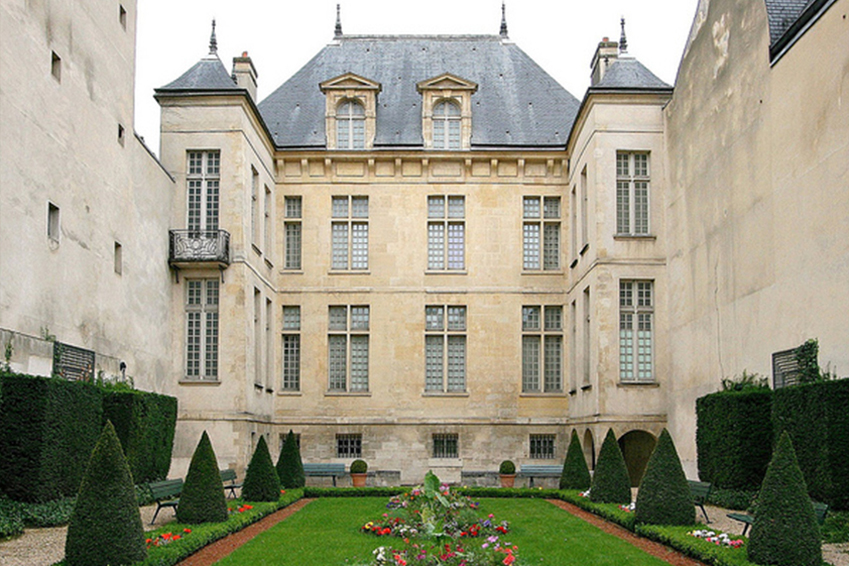
Most of the works therein were acquired between 1900 and 1927 by Ernest Cognacq, founder of the Samaritaine department store, and his wife Marie-Louise Jay. The building the collection sits in is an elegant structure redolent of the 18th century. Situated at 8 rue Elzévir, it is close to the Marais District of Paris.

Musée Cognacq-Jay

If you love art, I have no doubt you would find the Cognacq-Jay more interesting than the nearby Picasso Museum or the Pompidou Center. Unless, of course, you are a big fan of modern art, which I am not.

The Twisties

French Gymnast Melanie de Jesus Dos Santos

The term was much discussed during the last Tokyo Olympiad (2021), when U.S. gymnast Simone Biles withdrew from competition after suffering an attack of “the twisties.”

At that time, the BBC discussed the phenomenon:

So what are the “twisties”?

Gymnasts have described the twisties as a kind of mental block.

In some sports a sudden mental block – like the “yips” in golf – may cost you a missed putt, or a lost game.

In gymnastics, it can cause a person to lose their sense of space and dimension as they’re in the air, causing them to lose control of their body and do extra twists or flips that they hadn’t intended. In the worst cases, they can find themselves suddenly unable to land safely.

The twisties can happen to a gymnast even if they’ve done the same manoeuvre for years without problems.

Biles – one of the sport’s all-time greatest athletes – appeared to become disorientated while performing a vault on Tuesday and stumbled as she landed.

It was a moment that struck an instant chord with those who suspected what she might be going through.

I have been watching the U.S. women gymnasts on the balance beam earlier this evening, and the subject came up on an NBC interview with Simone Biles before her routine was televised. Now Simone is a very grounded person with clear perception and first-hand knowledge of the demons that can assail a performer in the spotlight. And, like few other participants in the Olympics, Simone is definitely in the spotlight. All. The. Time.

As it turned out, Simone’s balance beam routine in Paris 2024 was spot on. Afterwards, NBC showed another gymnast in the process of suffering a major case of the twisties. It was Melanie de Jesus Dos Santos of Martinique, who was competing for France.

A stunningly beautiful young woman, Dos Santos is shown muffing spectacularly all the major gymnastic events. In between gaffes, she was almost perfect; but she was in the throes of the twisties.

Whatever we do in life, we can suddenly lose our way. We could drive a chef’s knife into our fingers while chopping onions; or slip and fall in the bathroom while getting out of the tub; or turn the steering wheel the wrong way when backing out of a parking space; or any of a thousand other missteps.

When we are in the twisties, we should do what Simone Biles did: Drop out momentarily from any high performance activities. It’s not cowardice. It’s what we have to do to survive when we momentarily lose our way.

My Cities: Paris

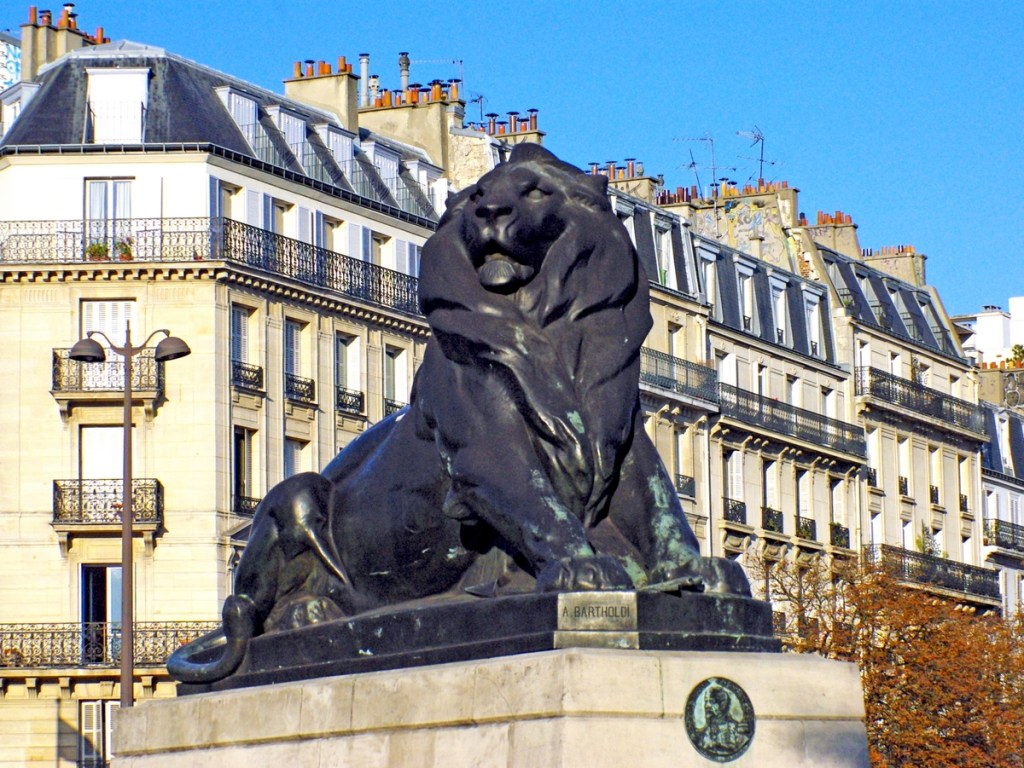
Place Denfert-Rochereau in Paris

My last name is Paris, although I have not a drop of French blood in my veins. In Hungarian, my last name is Páris, pronounced PAH-reesh. On my father’s Czechoslovakian passport when he emigrated to the United States in 1929 (bad timing), his last name was shown as Parisej. When I asked him about this, he said the dominant Czechs always messed with Slovak last names.

There was a time when I was anti-French. This reached its height in 1976, when my Laker Airlines flight to London first stopped at Paris’s Orly Airport. We were all deplaned and made to go through security by the French police. When one of the officers wanted me to open up the back up my Olympus OM-1 camera and expose the film that was loaded, I refused and remarked rather snootily, “Je ne suis pas Carlos le terroriste!” Somehow, the officer smirked and let me continue without sending me to the guillotine.

Since then, I began to admire France more and more. My girlfriend, Martine, was born in Paris. My favorite novelists (Honoré de Balzac and Marcel Proust) are French. Subsequently, I visited Paris twice with Martine, staying first near Place de Clichy and then on the Left Bank near the Eiffel Tower.

I fell in love with Arthur Rimbaud, Blaise Pascal, Paul Eluard, François Villon, Emile Zola, Albert Camus, Patrick Modiano, Jean-Pierre Manchette, Nicolas Poussin, Antoine Watteau, Claude Lorrain, Auguste Renoir and his cinéaste son Jean, Jean-Luc Godard … Oh, hell, the list goes on damn near forever! In the end, I did a 180.

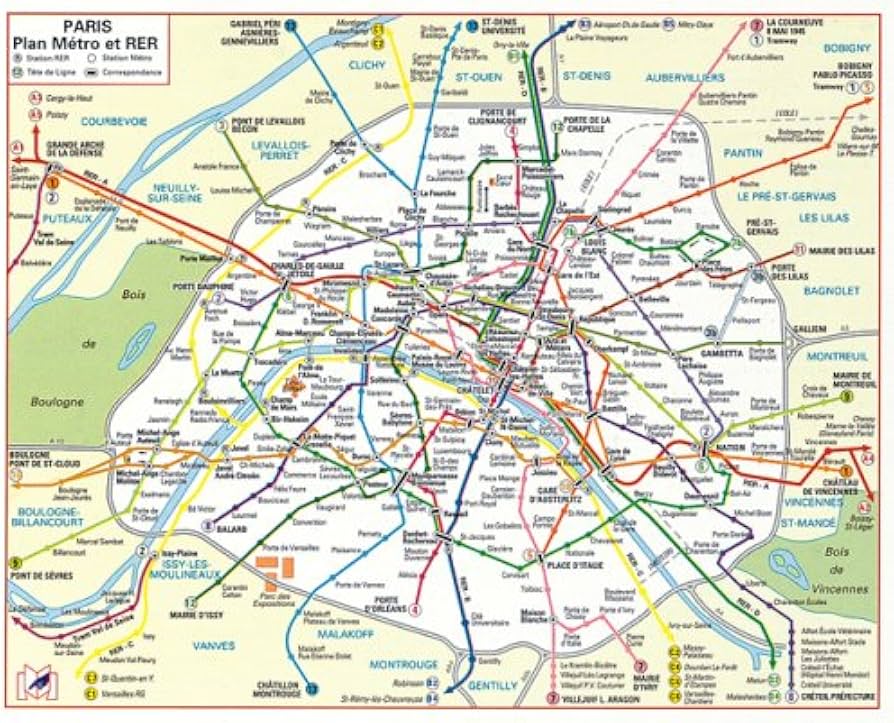
Public Transit Map of Paris

Now with the opening ceremony of the 2024 Paris Olympics, I am more impressed than ever with the French. In a handful of brilliant images, France reminded us who and what they were, and what they meant to the world.

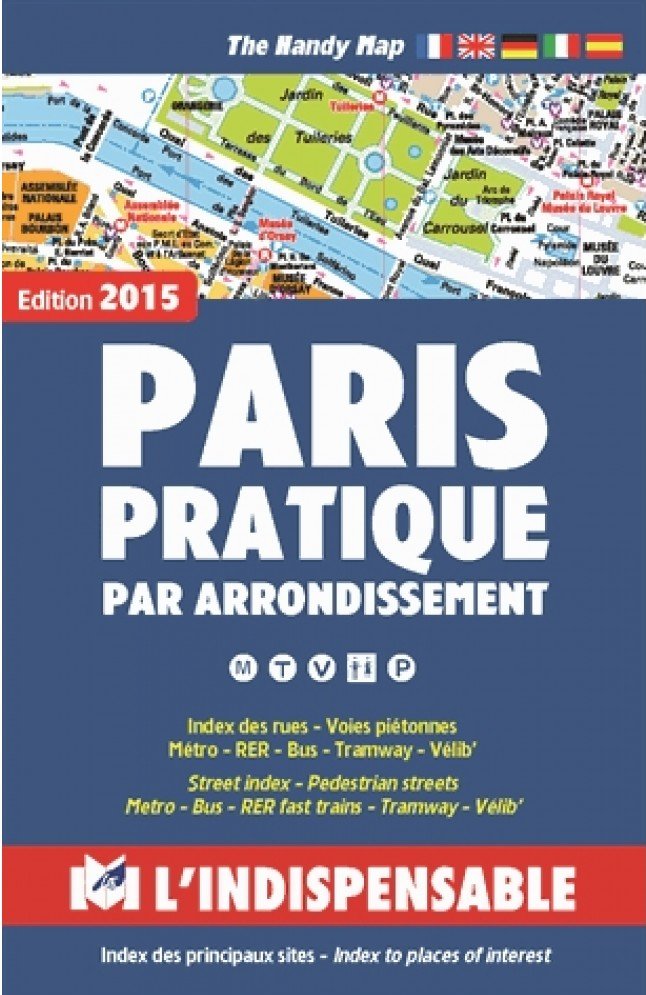
Whenever I read a French novel, I am never without a copy of Paris Pratique Par Arrondissement in my lap, so I can follow the action street by street, neighborhood by neighborhood. It’s almost as if I considered Paris as more than just another city: It is a city I revere, a world city.

Endlessly Wandering the Streets of Paris

Auteuil in Paris’s 16th Arrondissement

Of recent French authors, the one I am most addicted to is Patrick Modiano, winner of the 2014 Nobel Prize for Literature. Since I first read his Out of the Dark (1998) for an Internet French Literature group ten years ago, I have read most of his work and am still hungry for more, though there are only a few titles left to go. And, no doubt, I will probably start re-reading them.

Scene of the Crime (2021) is one of his most recent novels, which I just finished today. Jean Boesman experienced some fascinating but very dicey people back in the 1960s and is haunted by the memory. He has been sought after by several of them for knowing where some swag from past smuggling has been hidden, but he successfully avoids them. Nonetheless, he still endlessly goes over his relationship with the young women in the group. As he says at one point, “We are from our childhood as we are from a country.”

That country was the Paris of the 1960s and 1970s. I cannot read Modiano without a map book of Paris on my lap, following his characters wanderings and evasions through the most walkable city on Earth.

In Scene of the Crime, I tracked Boesman through Boulogne-Billancourt (where Modiano was born), Auteuil, Pigalle/Place Blanche, the Quays along the Seine, and Saint Lazare.

None of Modiano’s books are particularly long: Most can be completed in one or two sittings. I usually take a little longer, because I am following the action on a map of Paris.

On the Rue de l’Aude

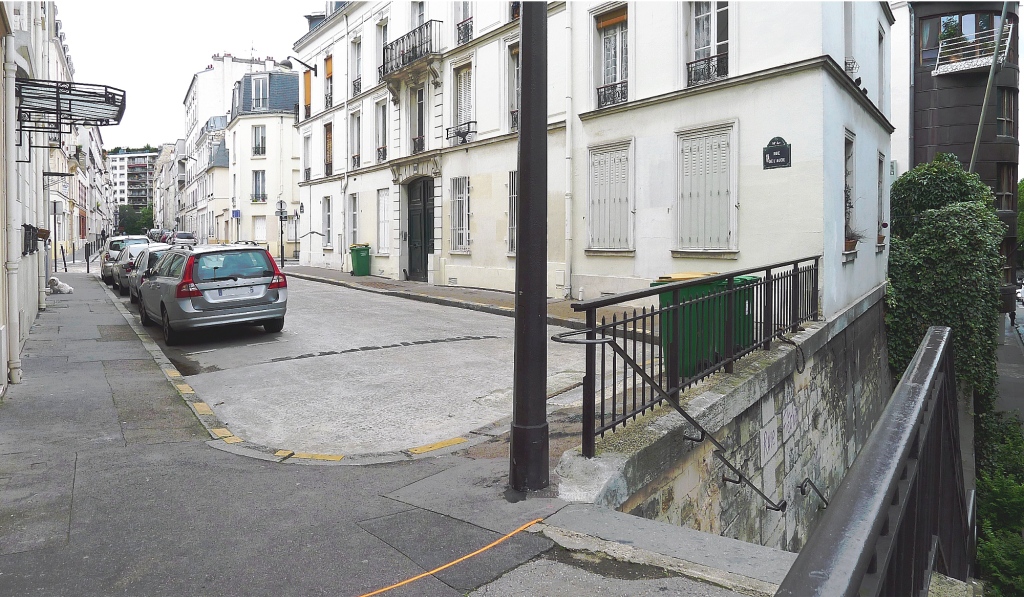
The Rue de l’Aude in the XV Arrondissement of Paris

I am fatally in love with the novels of Patrick Modiano. This evening, I re-read his The Black Notebook, published in France in 2012 as L’Herbe des nuits. His fatally lost characters end up wandering the streets of Paris, trying to recover lost memories. Meanwhile, I try following their path using an old copy of Paris Pratique par Arrondissement.

The following is from page 75 of my Houghton-Mifflin edition:

And I was afraid I would be waiting for her in vain that night. Then again, I often waited without knowing if she’d show. Or else she would come by when I wasn’t expecting her, at around four in the morning. I would have fallen into a light sleep, and the sound of the key turning in the lock would startle me awake. Evenings were long when I stayed in my neighborhood to wait for her, but it seemed only natural. I felt sorry for people who had to record appointments in their diary, sometimes months in advance. Everything was prearranged for them, and they would never wait for anyone. They would never know how time throbs, dilates, then falls slack again; how it gradually gives you that feeling of vacation and infinity that others seek in drugs, but that I found just in waiting. Deep down, I felt sure you would come sooner or later.

The Swan

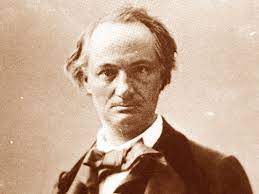
French Poet Charles Baudelaire (1821-1867)

Today, as I was re-reading Patrick Modiano’s The Black Notebook (2012) with its labyrinthine reconstructions of an imperfectly remembered past, I thought of a poem by Charles Baudelaire that gave me the same feeling, It is called “The Swan”:

The Swan

I

Andromache, I think of you! The stream,
The poor, sad mirror where in bygone days
Shone all the majesty of your widowed grief,
The lying Simoïs flooded by your tears,
Made all my fertile memory blossom forth
As I passed by the new-built Carrousel.
Old Paris is no more (a town, alas,
Changes more quickly than man’s heart may change);
Yet in my mind I still can see the booths;
The heaps of brick and rough-hewn capitals;
The grass; the stones all over-green with moss;
The _débris_, and the square-set heaps of tiles.

There a menagerie was once outspread;
And there I saw, one morning at the hour
When toil awakes beneath the cold, clear sky,
And the road roars upon the silent air,
A swan who had escaped his cage, and walked
On the dry pavement with his webby feet,
And trailed his spotless plumage on the ground.
And near a waterless stream the piteous swan
Opened his beak, and bathing in the dust
His nervous wings, he cried (his heart the while
Filled with a vision of his own fair lake):
“O water, when then wilt thou come in rain?
Lightning, when wilt thou glitter?”
Sometimes yet
I see the hapless bird — strange, fatal myth —
Like him that Ovid writes of, lifting up
Unto the cruelly blue, ironic heavens,
With stretched, convulsive neck a thirsty face,
As though he sent reproaches up to God!

II

Paris may change; my melancholy is fixed.
New palaces, and scaffoldings, and blocks,
And suburbs old, are symbols all to me
Whose memories are as heavy as a stone.
And so, before the Louvre, to vex my soul,
The image came of my majestic swan
With his mad gestures, foolish and sublime,
As of an exile whom one great desire
Gnaws with no truce. And then I thought of you,
Andromache! torn from your hero’s arms;
Beneath the hand of Pyrrhus in his pride;
Bent o’er an empty tomb in ecstasy;
Widow of Hector — wife of Helenus!
And of the negress, wan and phthisical,
Tramping the mud, and with her haggard eyes
Seeking beyond the mighty walls of fog
The absent palm-trees of proud Africa;
Of all who lose that which they never find;
Of all who drink of tears; all whom grey grief
Gives suck to as the kindly wolf gave suck;
Of meagre orphans who like blossoms fade.
And one old Memory like a crying horn
Sounds through the forest where my soul is lost….
I think of sailors on some isle forgotten;
Of captives; vanquished … and of many more.

The translation is by F. P. Sturm.

Serendipity: Dépaysement

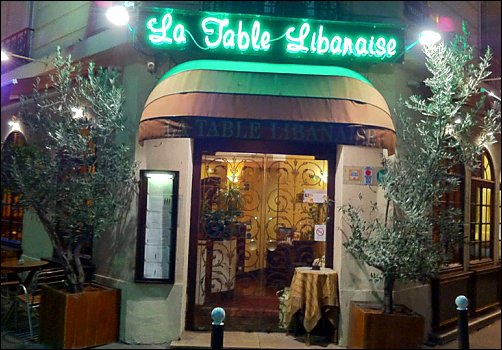
Lebanese Restaurant in Paris

The term dépaysement is a French concept which refers to that feeling of disorientation that specifically arises when you are not in your home country nor identify exclusively with it. It’s the way that I, a Hungarian-American who loves to travel in places like Latin America and Iceland, feel as the United States slides down the drain of Trumpism. Juan Goytisolo (1931-2017), a Catalan writer of Basque extraction who lived most of his life in Marrakech, felt that way about Spain, particularly after the Franco régime’s depredations. The following is from his essay “Why I Have Chosen to Live in Paris” from his essay collection Space in Motion:

Q: If I understand you rightly, French cosmopolitanism ….

A: There is no such thing as French cosmopolitanism; there is interculturalism, plurality, osmosis: a universe in miniature. If a person so desires, he can eat in a Cambodian restaurant, drink mint tea in a Moorish café, see a Hindu or Turkish movie in the afternoon—Yilmaz Güney’s The Sheepflock in my opinion is one of the best films of the year—and in the evening, with a bit of luck, attend a concert of the Noss el Ghiwán or Izanzaren. Society is linked to the idea of space, but culture—like the individual—is mobile, drifting like the wind. Culture today cannot be French or Spanish, or even European, but rather mestizo, bastard, fecundated by civilizations that have been victims of our self-castrating, aberrant ethnocentrism. For up until now we have exported the Occidental model with all its props—from its ideology to its drugs and gadgets—we are at present witnessing an inverse process that personally fascinates and delights me: the gradual dissolution of “white” culture by all the peoples who, having been forcibly subjected to it, have assimilated the tricks, the techniques necessary to contaminate it.

Q: So then, Paris for you …

A: Insofar as it abandons its pretensions of being a beacon and accepts its status as a motley, bastard, heterogeneous metropolis that belongs to no country, I will always feel better in it than in any other exclusively “national” city that is uniform, chaste, compact, rid of its angels.


The First Ever Photograph of a Human Being

Look Closely at the Lower Left of the Photo, Where the Street Curves

This is a slightly modified reprint of a blog I published on the late unlamented Multiply.Com on January 21, 2011.

If you don’t look hard, you can easily miss it. Near the bottom left corner of the above photograph is the first photographic image of a human being ever taken. The place is the Boulevard du Temple in Paris. The year is 1838. And the photographer is none other than Louis Daguerre, after whom the daguerreotype was named.

The only reason you don’t see other people in the street is that the exposure was for ten minutes, and anyone or thing in motion appeared only as a blur if at all. The reason the gentleman above was standing still for ten minutes was that he was getting his shoes shined.

No one knows the man’s name or anything about him. He just wandered into history, got his shoes shined, and went on his way.

Referenced in this article: For more info and a closer view of our mystery subject, click here.

Geographies: Real

A More Recent Edition of This Invaluable City Atlas Than Mine

This is one of two posts by an inveterate map freak. I will start with real geographies that inspired some of my more fantastic fictional ones. I have read two novels this month which inspired me to dig up my copy of Paris Pratique Par Arrondissement Édition 2005. The first was Cara Black’s Murder in Clichy; and the second, Georges Simenon’s masterful Maigret and the Bum.

Ever since I was a grade school boy, I loved maps and atlases. It became even more pronounced when, at the same time, I collected stamps from such strange corners of the world as Tannu Touva, Bechuanaland, Liechtenstein, and Nejd. Naturally, I had to know where these geographic entities were, their principal cities, and some knowledge of their economies (if any).

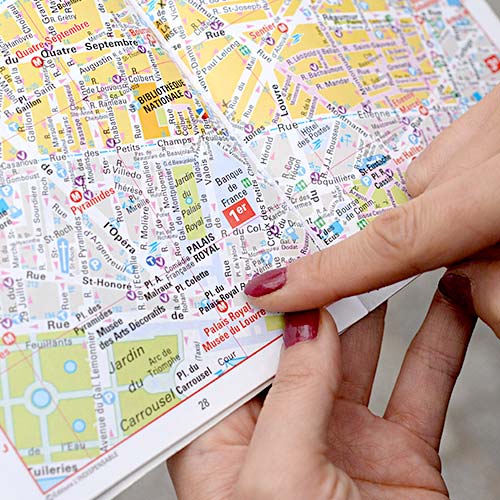
No, I Don’t Wear Nail Polish

The best city street atlas I have ever seen is the abovementioned Paris Pratique Par Arrondissement. Each of the twenty arrondissements (districts) of the city gets either two facing pages, or, if required, two sets of two facing pages. In addition, there are maps of the metro, the RER (suburban rail routes), major bus lines, the Bois de Boulogne, the Bois de Vincennes, and La Défense. Throughout, it is organized so logically that I cannot imagine using any other map to follow the action in novels set in the City of Lights.

Absent from this handy atlas are the suburban banlieus which tourists are not likely to visit unless they are in the market for recreational drugs or a bit of the old ultra-violence. Unlike American cities, which tend to be hollowed-out at their core and liveable only in the outlying suburbs, Paris reserves the center for historical buildings and the wealthy, while the areas beyond the peripheral highway are strictly for slumming.