

Dancers from the Kárpátok Folk Dance Ensemble
… of me, what you will find is a strange sort of Hungarian. Although I have read no studies to this effect, I think that the first language you learn to speak is what determines, at the deepest level, who you are. My first language was an older dialect of the Magyar language from the region just to the southwest of Budapest. Today, when I speak the language—haltingly—Hungarians laugh at my choice of words and horrible grammar. Yet, my ever-so-sophisticated American English is merely an overlay on a base that was set in concrete before I was five. I feel myself to be a kind of Brummagem Hungarian.
Last night, Martine and I attended a Hungarian folk dance program at St. Stephen’s Catholic Church just south of downtown L.A. The dance was put on by the Kárpátok Folk Dance Ensemble, which has just recently celebrated its 50th anniversary. That a city like Los Angeles, which does not have that large a Hungarian population, could support an organization like Kárpátok is an unending surprise to me.
For many of the fifteen-odd dances they performed, I was in tears. There are certain themes in Hungarian music that take me way back to my beginnings. I could not lay my finger on it, but a deep emotional chord is struck deep in my core.
The people in attendance were curious about me. My pronunciation is near perfect, but I might as well be retarded. As for Martine, she doesn’t know a word of Magyar and depended on me for many things I was unable to explain.
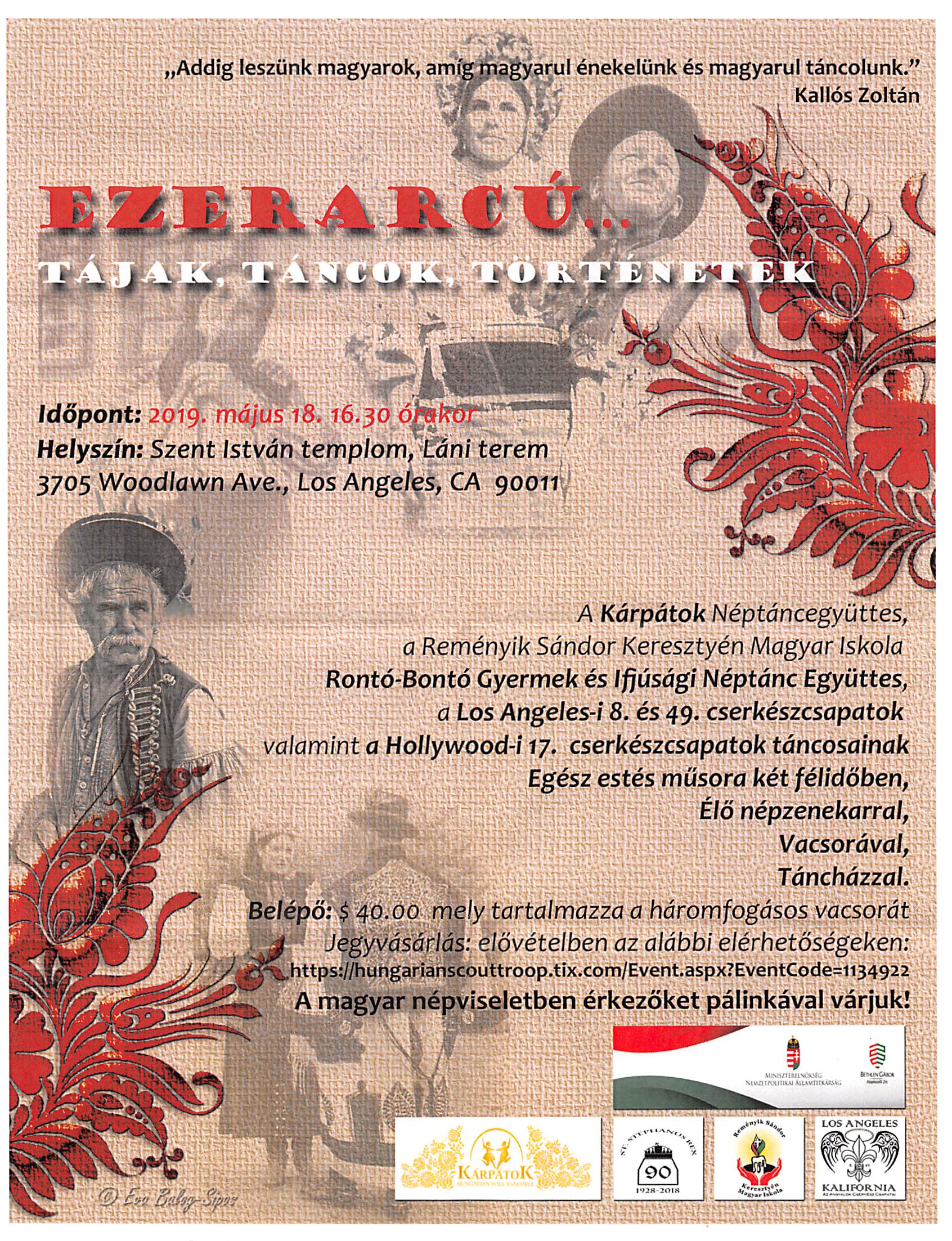
Flyer for the “Thousand Faces” Dance Concert We Attended
That didn’t keep up from enjoying the music and dances—and the Hungarian meal that was served afterwards—even though we were both suffering from nasty colds. She might be French, but Martine enjoys these Hungarian events as much as I do, though in a different way. I do believe she prefers Hungarian food to the great cuisine of France, especially where pastries are involved.

 Tarnmoor
You must be logged in to post a comment.