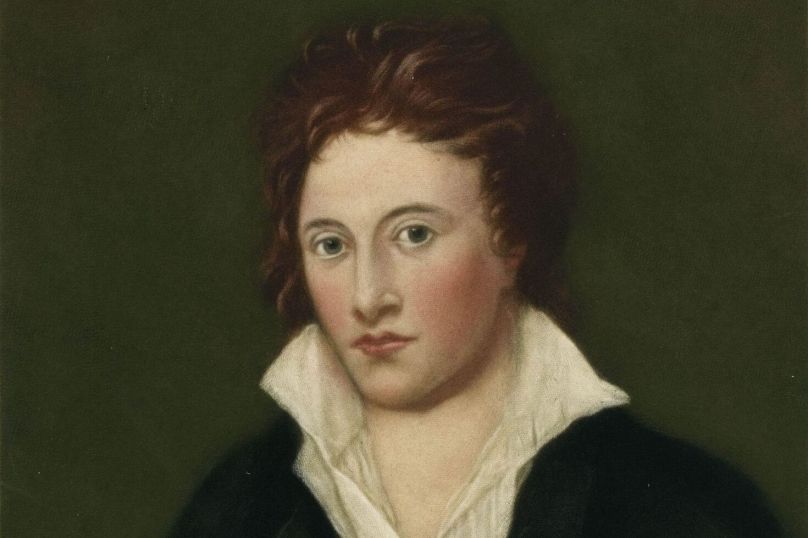
In his sonnet entitled “England in 1819,” Percy Bysshe Shelley evinced as great a disgust of what was happening in England during the last days of George III as I do when I look at Trump’s America. Sadly, Shelley did not outlive George III by much: He died in an 1822 boating accident off the coast of Italy.
England in 1819
An old, mad, blind, despised, and dying King; Princes, the dregs of their dull race, who flow Through public scorn,—mud from a muddy spring; Rulers who neither see nor feel nor know, But leechlike to their fainting country cling Till they drop, blind in blood, without a blow. A people starved and stabbed in th’ untilled field; An army, whom liberticide and prey Makes as a two-edged sword to all who wield; Golden and sanguine laws which tempt and slay; Religion Christless, Godless—a book sealed; A senate, Time’s worst statute, unrepealed— Are graves from which a glorious Phantom may Burst, to illumine our tempestuous day.
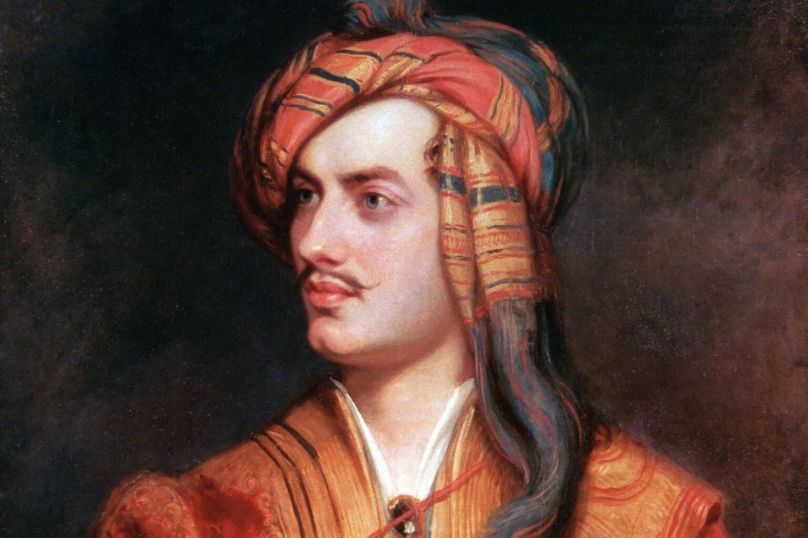
British Poet George Gordon, Lord Byron (1788-1824)
In that wonderful peak into the lives of two of England’s greatest poets we are indebted to Edward John Trelawny’s Records of Shelley, Byron, and the Author for eyewitness accounts. Although Trelawny was not altogether truthful at times, what would we give to have similar accounts of Shakespeare, Montaigne, and Erasmus, however imperfect?
I forgot that great actors when off the stage are dull dogs; and that even the mighty Prospero, without his book and magic mantle, was but an ordinary mortal. At this juncture Shelley joined us; he never laid aside his book and magic mantle; he waved his wand, and Byron, after a faint show of defiance, stood mute; his quick perception of the truth of Shelley’s comments on his poem transfixed him, and Shelley’s earnestness and just criticism held him captive.
I was, however, struck with Byron’s mental vivacity and wonderful memory; he defended himself with a variety of illustrations, precedents, and apt quotations from modern authorities, disputing Shelley’s propositions, not by denying their truth as a whole, but in parts, and the subtle questions he put would have puzzled a less acute reasoner than the one he had to contend with. During this discussion I scanned the Pilgrim [Byron] closely.
In external appearance Byron realised that ideal standard with which imagination adorns genius. He was in the prime of life, thirty-four; of middle height, five feet eight and a half inches; regular features, without a stain or furrow on his pallid skin, his shoulders broad, chest open, body and limbs finely proportioned. His small highly-finished head and curly hair had an airy and graceful appearance from the massiveness and length of his throat: you saw his genius in his eyes and lips. In short, Nature could do little more than she had done for him, both in outward form and in the inward spirit she had given to animate it. But all these rare gifts to his jaundiced imagination only served to make his one personal defeat (lameness) the more apparent, as a flaw is magnified in a diamond, when polished; and he brooded over that blemish as sensitive minds will brood until they magnify a wart into a wen.
His lameness certainly helped to make him sceptical, cynical, and savage. There was no peculiarity in his dress, it was adapted to the climate: a tartan jacket braided—he said it was the Gordon pattern, and that his mother was of that race. A blue velvet cap with a gold band, and very loose nankeen trousers, strapped down so as to cover his feet; his throat was not bare, as represented in drawings.
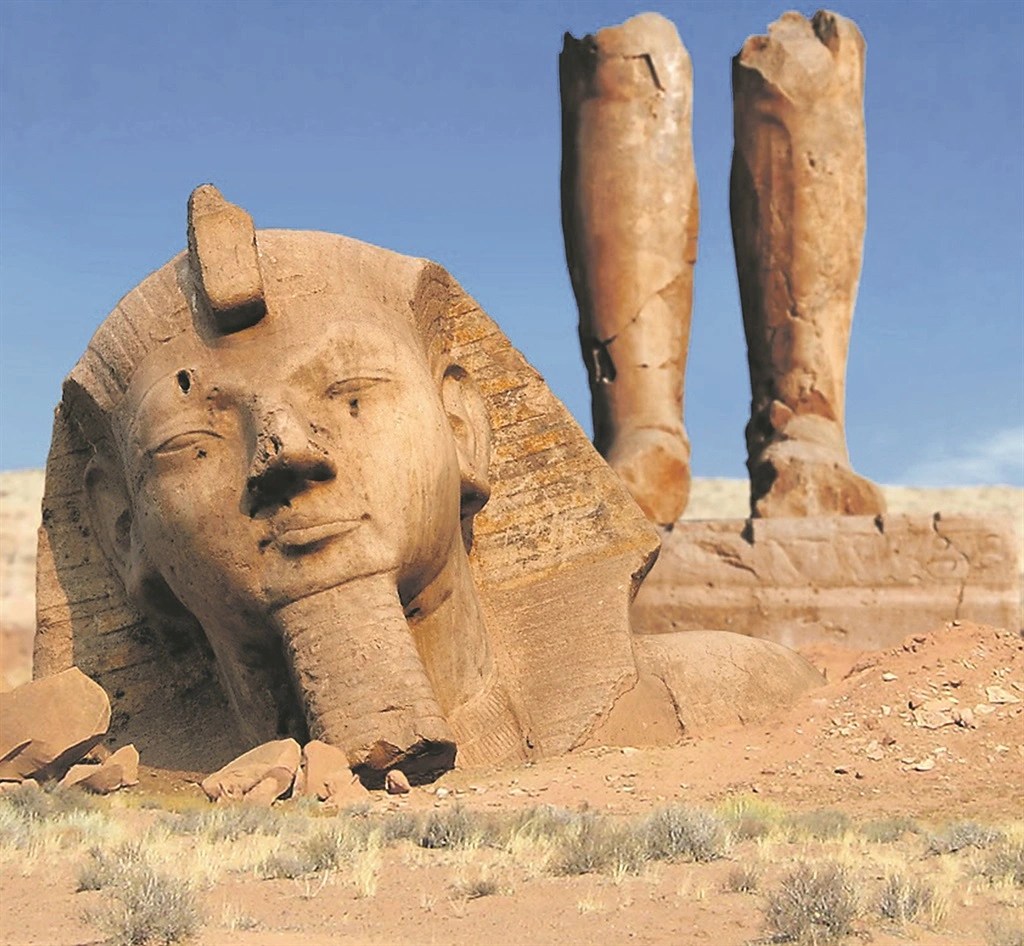
In this election season, with all those overweening ambitions in play, I like to think of Percy Bysshe Shelley (1792-1822) and his poem “Ozymandias.” Can you guess why?
Ozymandias
I met a traveller from an antique land Who said: “Two vast and trunkless legs of stone Stand in the desert . . . Near them, on the sand, Half sunk, a shattered visage lies, whose frown, And wrinkled lip, and sneer of cold command, Tell that its sculptor well those passions read Which yet survive, stamped on these lifeless things, The hand that mocked them, and the heart that fed: And on the pedestal these words appear: ‘My name is Ozymandias, king of kings: Look on my works, ye Mighty, and despair!’ Nothing beside remains. Round the decay Of that colossal wreck, boundless and bare The lone and level sands stretch far away.”
Frederick Catherwood’s Drawing of Maya Ruins at Chichén Itzá
I wanted to write about the Notre Dame de Paris fire yesterday, but I held back. All I could have said at that point is, “What a horrible shame! I am completely aghast!” It needed me to sleep on he news before I was able to put the event in any perspective.
That perspective, as it comes to me now, is that our past is always and everywhere going up in flames, collapsing under the wrecking ball, or being abandoned and overgrown. The City of Los Angeles, for example, is under the sway of greedy developers who think nothing of bulldozing our history. Much of the history of motion picture production in Hollywood is gone forever, with just a few isolated buildings such as the Chinese and Egyptian Theaters, the Lasky-DeMille Barn, and the Post 43 American Legion Theater standing out from the architectural Kleenex boxes.
Have you ever heard of the seven wonders of the ancient world? They are (or rather were) as follows:
The Lighthouse of Alexandria, Egypt
The Colossus of Rhodes
The Mausoleum of Halicarnassus
The Temple of Artemis at Ephesus
The Statue of Zeus at Olympia, Greece
The Hanging Gardens of Babylon
The Great Pyramid at Giza, Egypt
How many of these wonders still exist? Only one, the Great Pyramid. All the others were destroyed by natural disasters and other mishaps over the centuries and millennia. All the great cathedrals of Europe are vulnerable to fires, terrorism, floods, and what have you.
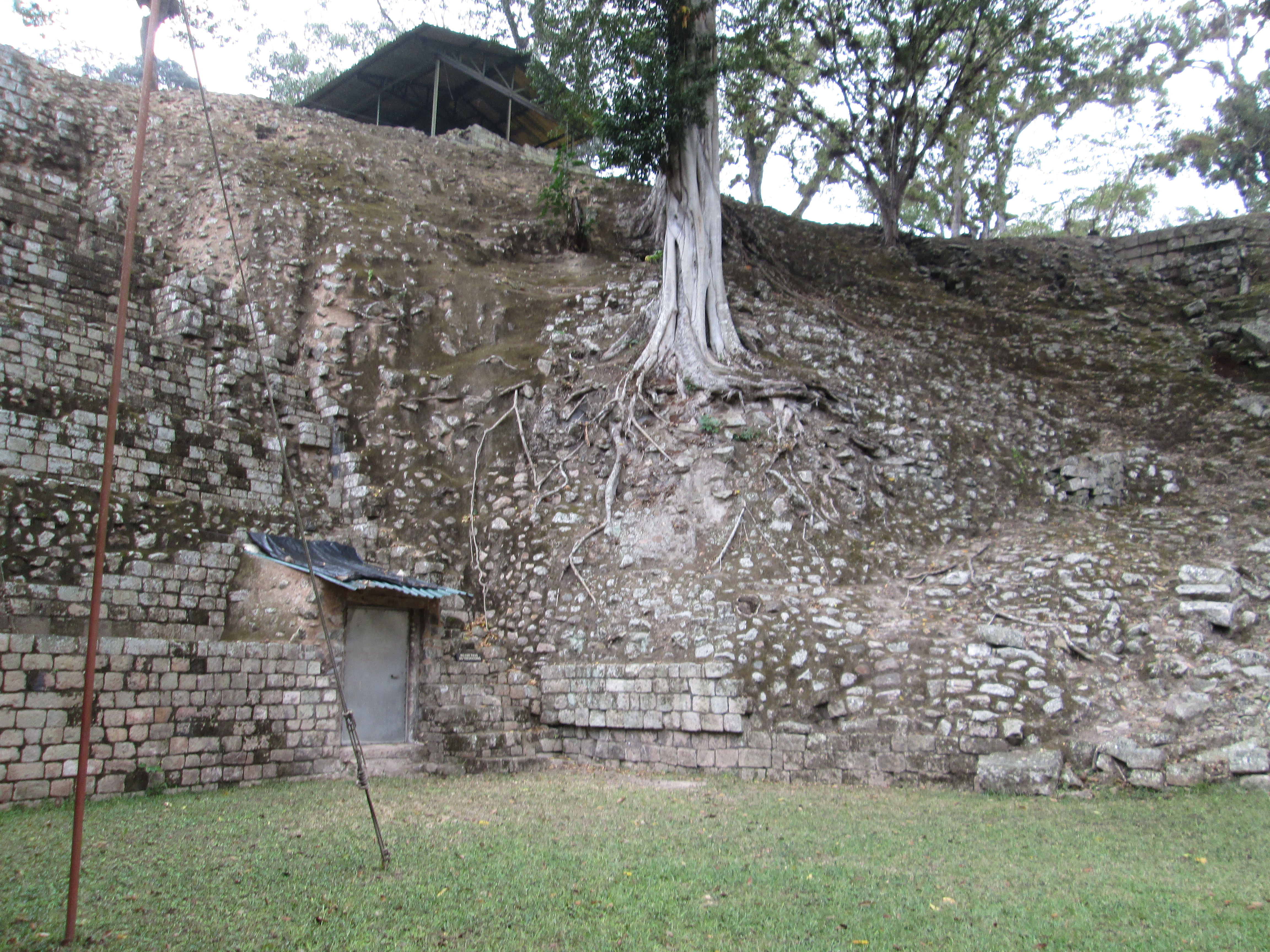
Overgrown Maya Ruins at Copán, Honduras
My visits to Maya ruins in Guatemala and Honduras in January brought home to me in the most vivid way the fragility of the past. I keep thinking of Shelley’s poem “Ozymandias”:
I met a traveller from an antique land,
Who said—“Two vast and trunkless legs of stone
Stand in the desert. . . . Near them, on the sand,
Half sunk a shattered visage lies, whose frown,
And wrinkled lip, and sneer of cold command,
Tell that its sculptor well those passions read
Which yet survive, stamped on these lifeless things,
The hand that mocked them, and the heart that fed;
And on the pedestal, these words appear:
My name is Ozymandias, King of Kings;
Look on my Works, ye Mighty, and despair!
Nothing beside remains. Round the decay
Of that colossal Wreck, boundless and bare
The lone and level sands stretch far away.”
How many other cultural landmarks will disappear during our lifetimes? I have visited Notre Dame twice and marveled at the sheer artistry and magnificence of the place. I hope that the French succeed in reconstructing the interior, the roof, and the spire that were destroyed in the conflagration.


 Tarnmoor
You must be logged in to post a comment.