All About Albertine

Marcel and Albertine from a Film Version

Marcel and Albertine from a Film Version

The following is both a long prose poem and a work of literary criticism by Canadian poet Anne Carson. It tells everything you ever wanted to know about Albertine, who appears in 5 of the 7 volumes of In Search of Lost Time. It’s called “The Albertine Workout.” The poem is taken from The London Review of Books.

1. Albertine, the name, is not a common name for a girl in France, although Albert is widespread for a boy.

2. Albertine’s name occurs 2363 times in Proust’s novel, more than any other character.

3. Albertine herself is present or mentioned on 807 pages of Proust’s novel.

4. On a good 19 per cent of these pages she is asleep.

5. Albertine is believed by some critics, including André Gide, to be a disguised version of Proust’s chauffeur, Alfred Agostinelli. This is called the transposition theory.

6. Albertine constitutes a romantic, psychosexual and moral obsession for the narrator of the novel mainly throughout Volume Five of Proust’s seven-volume (in the Pléiade edition) work.

7. Volume Five is called La Prisonnière in French and The Captive in English. It was declared by Roger Shattuck, a world expert on Proust, in his award-winning 1974 study, to be the one volume of the novel that a time-pressed reader may safely and entirely skip.

8. The problems of Albertine are
(from the narrator’s point of view)
a) lying
b) lesbianism,
and (from Albertine’s point of view)
a) being imprisoned in the narrator’s house.

9. Her bad taste in music, although several times remarked on, is not a problem.

10. Albertine does not call the narrator by his name anywhere in the novel. Nor does anyone else. The narrator hints that his first name might be the same first name as that of the author of the novel, i.e. Marcel. Let’s go with that.

11. Albertine denies she is a lesbian when Marcel questions her.

12. Her friends are all lesbians.

13. Her denials fascinate him.

14. Her friends fascinate him too, especially by their contrast with his friends, who are gay but very closeted. Her friends ‘parade themselves’ at the beach and kiss in restaurants.

15. Despite intense and assiduous questioning, Marcel cannot discover what exactly it is that women do together (‘this palpitating specificity of female pleasure’).

16. Albertine says she does not know.

17. Once Albertine has been imprisoned by Marcel in his house, his feelings change. It was her freedom that first attracted him, the way the wind billowed in her garments. This attraction is now replaced by a feeling of ennui (boredom). She becomes, as he says, a ‘heavy slave’.

18. This is predictable, given Marcel’s theory of desire, which equates possession of another person with erasure of the otherness of her mind, while at the same time positing otherness as what makes another person desirable.

19. And in point of fact, how can he possess her mind if she is a lesbian?

20. His fascination continues.

21. Albertine is a girl in a flat sports cap pushing her bicycle across the beach when Marcel first sees her. He keeps going back to this image.

22. Albertine has no family, profession or prospects. She is soon installed in Marcel’s house. There she has a separate bedroom. He emphasises that she is nonetheless an ‘obedient’ person. (See above on Albertine as a ‘heavy slave’.)

23. Albertine’s face is sweet and beautiful from the front but from the side has a hook-nosed aspect that fills Marcel with horror. He would take her face in his hands and reposition it.

24. The state of Albertine that most pleases Marcel is Albertine asleep.

25. By falling asleep she becomes a plant, he says.

26. Plants do not actually sleep. Nor do they lie or even bluff. They do, however, expose their genitalia.

27. a) Sometimes in her sleep Albertine throws off her kimono and lies naked.
27. b) Sometimes then Marcel possesses her.
27. c) Albertine appears not to wake up.

28. Marcel appears to think he is the master of such moments.

29. Perhaps he is. At this point, parenthetically, if we had time, which we don’t, several observations could be made about the similarity between Albertine and Ophelia – Hamlet’s Ophelia – starting from the sexual life of plants, which Proust and Shakespeare equally enjoy using as a language of female desire. Albertine, like Ophelia, embodies for her lover blooming girlhood, castration, casualty, threat and pure obstacle. Albertine, like Ophelia, is condemned for a voracious sexual appetite whose expression is denied her. Ophelia takes sexual appetite into the river and drowns it amid water plants. Albertine distorts hers into the false consciousness of a sleep plant. In both scenarios the man appears to be in control of the script yet he gets himself tangled up in the wiles of the woman. On the other hand, who is bluffing whom is hard to say.

30. Albertine’s laugh has the colour and smell of a geranium.

31. Marcel gives Albertine the idea that he intends to marry her but he does not. She bores him.

32. Albertine’s eyes are blue and saucy. Her hair is like crinkly black violets.

33. Albertine’s behaviour in Marcel’s household is that of a domestic animal which enters any door it finds open or comes to lie beside its master on his bed, making a place for itself. Marcel has to train Albertine not to come into his room until he rings for her.

34. Marcel gradually manages to separate Albertine from all her friends, whom he regards as evil influences.

35. Marcel never says the word ‘lesbian’ to Albertine. He says ‘the kind of woman I object to’.

36. Albertine denies she knows any such women. Marcel assumes she is lying.

37. At first Albertine has no individuality, indeed Marcel cannot distinguish her from her girlfriends or remember their names or decide which to pursue. They form a frieze in his mind, pushing their bicycles across the beach with the blue waves breaking behind them.

38. This pictorial multiplicity of Albertine evolves gradually into a plastic and moral multiplicity. Albertine is not a solid object. She is unknowable. When he brings his face close to hers to kiss she is ten different Albertines in succession.

39. One night Albertine goes dancing with a girlfriend at the casino.

40. When questioned about this she lies.

41. Albertine is a quick and creative liar; she may even be a natural liar. But she is a bad liar.

42. Albertine lies so much and so badly that Marcel is drawn into the game. He lies too.

43. Marcel’s jealousy, fury, envy, impotence, curiosity, pride, boredom, suffering and desire are all exasperated to their highest pitch by the game.

44. Who is bluffing whom is hard to say. (See above on Hamlet).

45. Near the end of Volume Five, Albertine finally runs away, vanishing into the night and leaving the window open. Marcel fusses and fumes and writes her a letter in which he claims he had just decided to buy her a yacht and a Rolls Royce when she disappeared, now he will have to cancel these orders. The yacht had a price tag of 27,000 francs, about $75,000, and was to be engraved at the prow with her favourite stanza of a poem by Mallarmé.

46. Albertine’s death in a riding accident on p.642 of Volume Five does not emancipate Marcel from jealousy, it removes only one of the innumerable Albertines he would have to forget. The jealous lover cannot rest until he is able to touch all the points in space and time ever occupied by the beloved.

47. There is no right or wrong in Proust, says Samuel Beckett, and I believe it. The bluffing, however, remains a grey area.

48. Let’s return to the transposition theory.

49. On 30 May 1914, French newspapers reported that Alfred Agostinelli, a student aviator, fell from his machine into the Mediterranean sea near Antibes and was drowned. Agostinelli, you recall, was the chauffeur whom Proust in letters to friends admitted that he not only loved but adored. Proust had bought Alfred the aeroplane, which cost 27,000 francs, about $75,000, and had had it engraved on the fuselage with a stanza of Mallarmé. Proust also paid for Alfred’s flying lessons and registered him at the flying school under the name Marcel Swann. The flying school was in Monaco. In order to spy on Alfred while he was there, Proust sent another favourite manservant, whose name was Albert.

50. Compare and contrast Albertine’s sudden fictional death by runaway horse with Alfred Agostinelli’s sudden real-life death by runaway plane. Poignantly, both unfortunate beloveds managed to speak to his/her lover from the wild blue yonder. Agostinelli, before setting out for his final flight, had written a long letter, which Proust was heartbroken to receive the day after the plane crash. Transposed to the novel, this exit scene becomes one of the weirdest in fiction.

51. Several weeks after accepting the news that Albertine has been thrown from her horse and killed, Marcel gets a telegram:

You think me dead but I’m alive and long to see you! affectionately Albertine.

Marcel agonises for days about this news and debates with himself whether to resume relations with her, only to realise that the signature on the telegram has been misread by the telegraph operator. It is not from Albertine at all but from another long-lost girlfriend whose name (Gilberte) shares its central letters with Albertine’s name.

52. ‘One only loves that which one does not entirely possess,’ says Marcel.

53. There are four ways Albertine is able to avoid becoming possessable in Volume Five: by sleeping, by lying, by being a lesbian or by being dead.

54. Only the first three of these can she bluff.

55. Proust was still correcting a typescript of La Prisonnière on his deathbed, November 1922. He was fine-tuning the character of Albertine and working into her speech certain phrases from Alfred Agostinelli’s final letter.

56. It is always tricky, the question whether to read an author’s work in light of his life or not.

57. Granted the transposition theory is a graceless, intrusive and saddening hermeneutic mechanism; in the case of Proust it is also irresistible. Here is one final spark to be struck from rubbing Alfred against Albertine, as it were. Let’s consider the stanza of poetry that Proust had inscribed on the fuselage of Alfred’s plane – the same verse that Marcel promises to engrave on the prow of Albertine’s yacht, from her favourite poem, he says. It is four verses of Mallarmé about a swan that finds itself frozen into the ice of a lake in winter. Swans are of course migratory birds. This one for some reason failed to fly off with its fellow swans when the time came. What a weird and lonely shadow to cast on these two love affairs, the fictional and the real; what a desperate analogy to offer of the lover’s final wintry paranoia of possession. As Hamlet says to Ophelia, accurately but ruthlessly, ‘you should not have believed me.’

58.

Un cygne d’autrefois se souvient que c’est lui
Magnifique mais qui sans espoir se délivre
Pour n’avoir pas chanté la région où vivre
Quand du stérile hiver a resplendi l’ennui

(Mallarmé, ‘Le vierge, le vivace et le bel aujourd’hui’)

a swan of olden times remembers
that it is he:
the one
magnificent but
without hope setting himself free
for he failed to sing
of a region for living
when barren winter
burned all around him with ennui

59. ‘Everything, indeed, is at least double.’

La Prisonnière p.362
 

Meeting Marcel

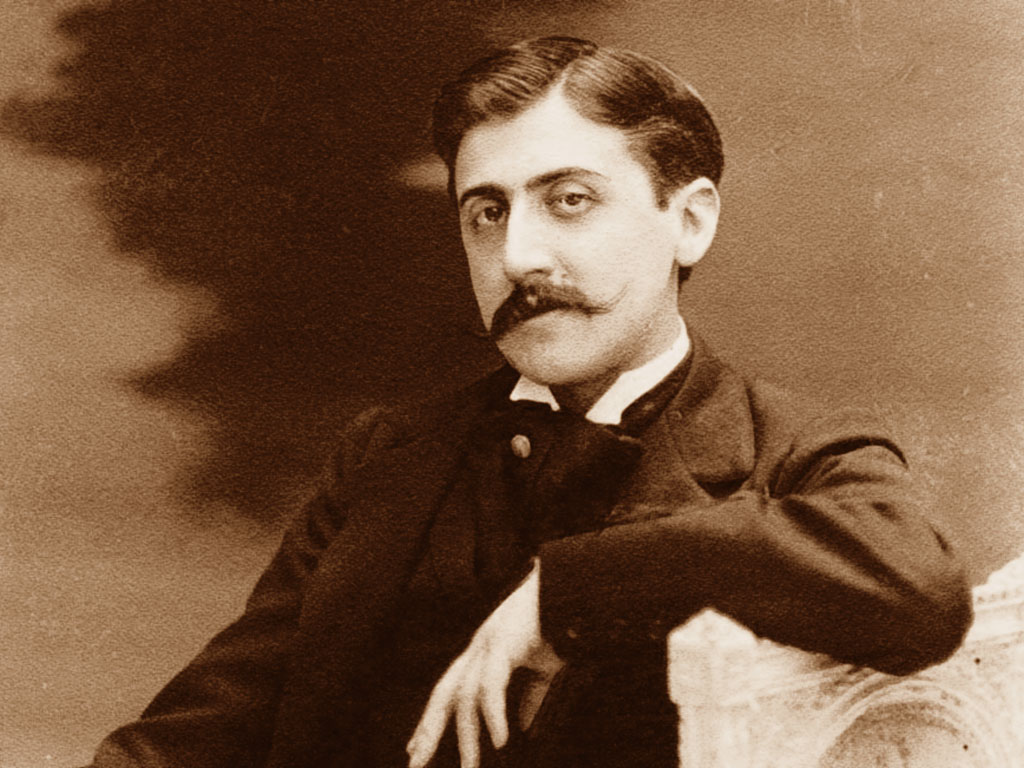
Marcel Proust

Marcel Proust

It is always interesting to read one great writer’s judgment on another. Such was François Mauriac about his meeting in February 1918 with Marcel Proust:

He seemed rather small to me, stoopshouldered in his tight-fitting jacket, his thick black hair shadowing his pupils, dilated, it appears, by drugs. Stuffed into a very high collar, his starched shirtfront bulging like a breastbone, he cast on me a nocturnal eye whose intensity intimidated me.

At the end of the great first chapter in his book Proust’s Way, Mauriac pays homage to the brilliance of his colleague:

The integral history of a young life, of its loves, its friendships, its weaknesses, its intellectual or religious crises, offers the vast proportions of the history of the ideas and customs at a certain epoch as they are reflected in a single spirit. And a long old age would not be enough to complete the account or to exhaust its drama.

As I slowly wend my way through A la recherche du temps perdu—for the third time—I can vouch for that. I will never be finished with his intense vision of the life of one particular individual and his milieu some century and a quarter ago in a distant European country.


Serendipity: “Nothing Perishes”

C. K. Scott Moncrieff, Translator

C. K. Scott Moncrieff, Translator (Painting by Edward Stanley Mercer)

This is a translation of a passage by the Roman poet Ovid from The Metamorphoses. The remarkable thing is that is was made by a thirteen-year-old boy who later grew up to translate Marcel Proust’s multi-volume masterwork, In Search of Lost Time:

Everything is changed but nothing perishes. The spirit wanders, going hence, thither, coming thence, hither and takes possession of any limbs it pleases. With equal ease it goes from beasts into human bodies and from us into beasts, nor in any length of time does it fail. And as wax is easily moulded in new shapes, nor remains as it had been before, nor keeps the same form, but is yet itself the same; so do I teach that the soul is ever the same, but migrates into different shapes.

Although many think that Scott Moncrieff’s translations are growing a little long in the tooth, there is no doubt of their excellence. As Walter Kaiser wrote in The New York Review of Books (June 4, 2015):  “Not surprisingly, Scott Moncrieff’s translations from Latin and Greek in the examination that year [1903] were awarded higher scores than anyone else’s, for it turns out that the astutely ingenious, poetic use of language for which he is celebrated in his great translation of Proust was his from an early age.”


Summer in Balbec

The Viking Penguin Edition of Proust Edited by Christopher Prendergast

The Viking Penguin Edition of Proust Edited by Christopher Prendergast

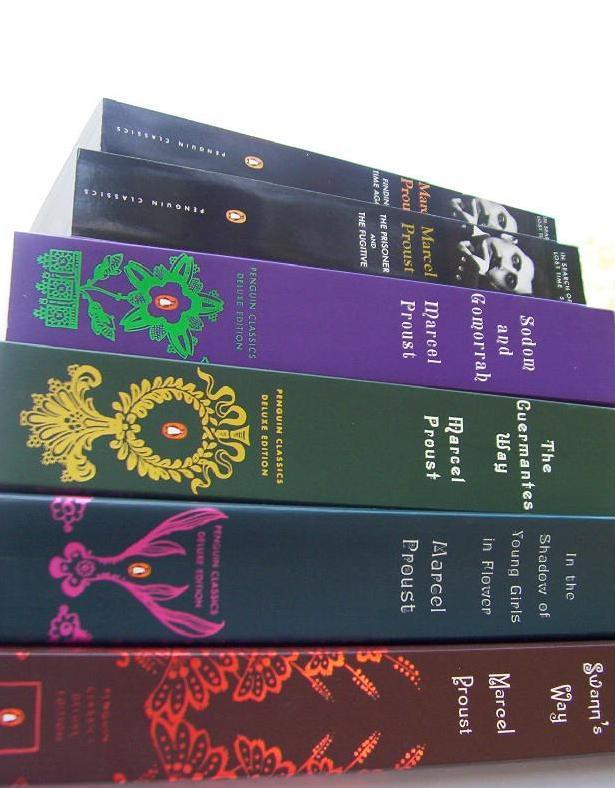
It has been beastly hot in Southern California, but I have been diverted from mere animal sweating by reading Marcel Proust’s In the Shadow of Young Girls in Flower as translated by James Grieve. Although his translation is considered the bastard orphan of the series as pictured above, I still loved it—after reading the authoritative C. K. Scott-Moncrieff translation twice.

Generally, it takes me a whole decade to go through the entire In Search of Lost Time, but it’s time well spent. I hope to tackle The Guermantes Way (again, for the third time) after my vacation; and I hope to live long enough for at least one or two more complete re-readings.

Many who have tackled Swann’s Way have been put off by its opening, in which young Marcel schemes for about fifty pages to have his mother come in to his bedroom and kiss him goodnight despite his father’s general disapproval of the practice. Then there are those long sentences that seem to go on forever—but which carry a significant amount of meaning in the process. Once you get over those two hurdles, the rewards come fast and furious.

Chief among those rewards is being in the mind of Marcel, the narrator. (He never gives his last name.) His hopes and desires are sketched with such intensity that few have experienced in this life. These relate to his family, his acquaintances, his heroes, his reading, his knowledge of art (just tracking the paintings he mentions is a full-time job), and his loves.

In the Shadow of Young Girls in Flower is mostly about his two main loves, Gilberte Swann and Albertine Simonet. In the first volume of the book, he reluctantly gives up on Gilberte, who has on occasion treated him contemptuously. Still, he hangs out with her parents hoping to demonstrate to the daughter that he is worthy of her attention.

In the second volume, Marcel is with his grandmother at the seaside resort of Balbec. There, he meets Robert de Saint-Loup, who becomes his friend, and the “little gang” of girls that become his obsession. Of the latter, Marcel toys with Andree, Rosemonde, and Gisele, but his real obsession is for Albertine. The book just stops short of the relationship with her actually commencing. (That, and Marcel’s anxieties about Albertine, are for the later volumes.)

Reading Proust takes a long time: I devoted two weeks to this book, but I loved every minute of it.

Dreaming of Proust

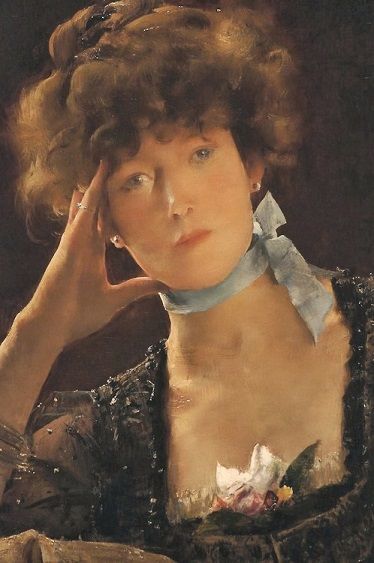
Alfred George Stevens’s “Portrait of Sarah Bernhardt” (1885)

Alfred George Stevens’s “Portrait of Sarah Bernhardt” (1885)

When you’re a hopeless intellectual like me, you, too, will have dreams that smack of literary criticism. This one is from last Saturday night. Despite the hot, humid weather we’re having in Los Angeles, I had just begun re-reading the second volume of Proust’s In Search of Lost Time, in the David Grieve translation called In the Shadow of Young Girls in Flower. (That title alone gives rise to dreams of a sort.)

Marcel has finally won the right to go to the theater to see the great actress La Berma (thought to be Sarah Bernhardt) as Racine’s Phèdre, albeit chaperoned by his grandmother. Feeling he is about to be exposed at long last to the holy grail, Marcel awaits the magical moment. It comes, but, alas, the lad is disappointed. Although he claps and cheers madly with the audience, Marcel feels that the actress did not live up to her hype.

That’s where my dream begins. I am thinking: Well, now, the entire heptology is full of disappointments: In the first volume Swann is cruelly deceived by his love, Odette de Crécy … but marries her anyhow. Marcel idealizes the ancient nobility of the Oriane, Duchesse de Guermantes, but gives us ample opportunities throughout the series to see how trivial her decorous life has become. As for Palamède, Baron de Charlus, he is given to affairs with lower class young men and, in the final volume, ends up being flagellated by one of them in a male bawdy house. Albertine does wind up in a relationship with Marcel, but he agonizes constantly that she is bi-sexual. Besides, she dies young.

Again and again, it almost seems as if Proust’s grand theme is either “You can’t always get what you want” or “Nothing is as good as it seems at first.”

And that’s where my dream left off. In the end, though, I rejected my dream interpretation. Marcel’s inner life is so vivid and intense that all the disappointments still make it all worthwhile. If that negativity were the only thing I got from reading Proust, why would I be reading the seven volumes for a third time? (Er, aside from THAT, I mean).

Incidentally, the original Stevens portrait of Sarah Bernhardt (above) is at the Hammer Museum in Westwood, near my place of work.


Tarnmoor’s ABCs: Marcel Proust

He Went As Far As One Could Go with a Cookie

           He Went About As Far As One Could Go with a Cookie

I was so very impressed by Czeslaw Milosz’s book Milosz’s ABC’s. There, in the form of a brief and alphabetically-ordered personal encyclopedia, was the story of the life of a Nobel Prize winning poet, of the people, places, and things that meant the most to him. Because his origins were so far away (Lithuania and Poland) and so long ago (1920s and 1930s), there were relatively few entries that resonated personally with me. Except it was sad to see so many fascinating people who, unknown today, died during the war under unknown circumstances.

My own ABCs consist of places I have loved (Iceland), things I feared (Earthquakes), writers I have admired (Chesterton, Balzac, and Borges); things associated with my past life (Cleveland and Dartmouth College), people who have influenced me (John F. Kennedy), and things I love to do (Automobiles and Books). This blog entry is my own humble attempt to imitate a writer whom I have read on and off for thirty years without having sated my curiosity. Consequently, over the months to come, you will see a number of postings under the heading “Tarnmoor’s ABCs” that will attempt to do for my life what Milosz accomplished for his. To see my other entries under this category, hit the tag below marked “ABCs”. I don’t guarantee that I will use up all 26 letters of the alphabet, but I’ll do my best. Today, we’re at the letter “M,” for Marcel Proust, whose In Search of Lost Time I am now reading for the third time.

There are many literary giants of the Twentieth Century—writers such as James Joyce, Fernando Pessoa, William Faulkner, Jorge Luis Borges, Gabriel García Marquez, Graham Greene, G. K. Chesterton, Ryonosuke Akutagawa, Eugene O’Neill, Bertolt Brecht, Thomas Mann, Italo Svevo, Mikhail Bulgakov … the list stretches on and on. One who has had a particular role to play in my life is Marcel Proust. It seems I cannot let a year pass by without re-reading another installment of his massive In Search of Lost Time, which consists of seven full-sized novels:

  • Swann’s Way
  • In the Shadow of Young Girls in Flower (originally translated as Within a Budding Grove)
  • The Guermantes Way
  • Sodom and Gomorrah (originally translated as Cities of the Plain)
  • The Prisoner
  • The Fugitive (originally translated as The Sweet Cheat Gone)
  • Finding Time Again (originally translated as The Past Recaptured)

The first four volumes were completely edited by Proust during his lifetime. The last three received their final proofing from others (but are still great).

Quite frankly, it is not easy to read Proust. Some sentences seem to go on for pages. It requires intense concentration not to go astray, even within an individual paragraph. One old friend, who is a high school English teacher, abandoned Swann’s Way in the first section.

Why do I so highly regard a not-particularly-successful gay social climber whose world has so little in common with mine? For one thing, Proust writes about not so much memory as of the shimmering obsessions that monopolize so much of our attention yet, in the long run (the series spans decades), fall by the wayside as life goes on.

I have already had my fourth reading of Swann’s Way. When I return from Peru, I plan to re-read In the Shadow of Young Girls in Flower for the third time. If God is good to me, there will be a fourth and—who knows—maybe even a fifth reading of the series in the time that remains to me.

Odette

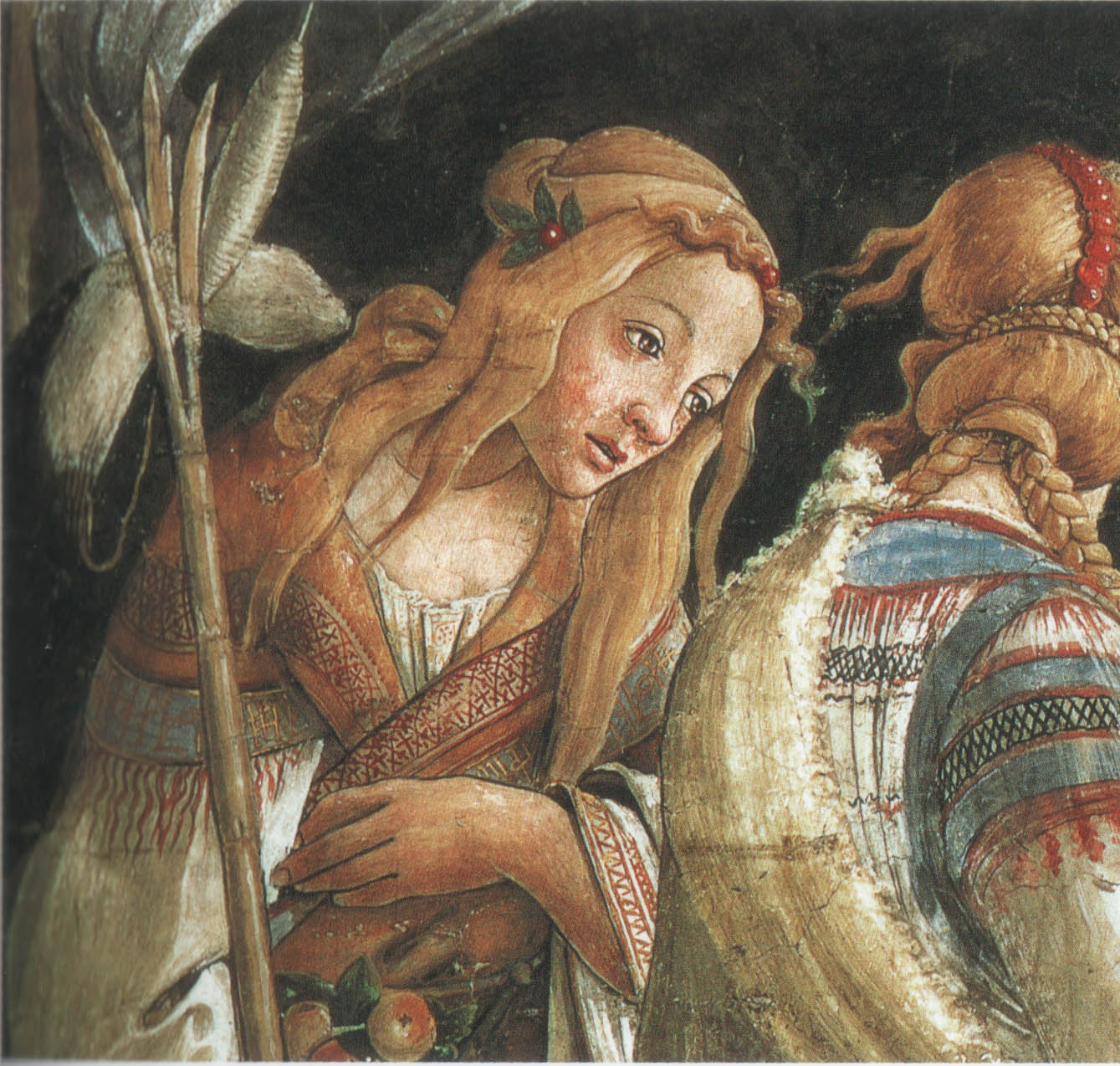
Detail of Zipporah from Botticelli’s The Trials of Moses

Detail of Zipporah from Botticelli’s The Trials of Moses

Shown above is a detail from Sandro Botticelli’s painting “The Trials of Moses” depicting Jethro’s daughter Zipporah. It is this image which Marcel Proust used to describe the love of Charles Swann’s life, Odette de Crécy. It was a mammoth undertaking, especially as Proust was gay: He constantly had to translate heterosexual behavior through a homosexual template, which was more familiar to him. (In later volumes, Marcel’s lover Albertine was thus “translated” from his Italian chauffeur, Alfred Agostinelli.) As difficult as it seems to do this, Proust succeeded so well that Swann’s Way is perhaps the greatest work in literature about disappointment in love.

Swann was not immediately taken with Odette:

[S]he had seemed to Swann not without beauty, certainly, but of a type of beauty that that left him indifferent, that aroused no desire in him, even caused him a sort of physical repulsion, one of those women such as everyone has his own, different for each, who are the opposite of the kind our senses crave. Her profile was too pronounced for his taste, her skin too delicate, her cheekbones too prominent, her figures too pinched. Her eyes were lovely, but so large they bent under their own mass, exhausted the rest of her face, and always gave her a look of being in ill health or ill humor.

A few pages later, we see what Swann (and by extension Proust) was doing in crystallizing his feelings toward this young woman::

He placed on his worktable, as if it were a photograph of Odette, a reproduction of Jethro’s daughter. He admired the large eyes, the delicate face, which allowed one to imagine the imperfect skin, the marvelous curls of the hair along the tired cheeks, and adapting what he had found aesthetically beautiful up to then to the idea of a living woman, he translated it into physical attractions which he rejoiced to find united in a creature whom he could possess. The vague feeling of sympathy that draws us toward a masterpiece as we look at it became, now that he knew the fleshly original of Jethro’s daughter, a desire that henceforth compensated for the desire that Odette’s body had not at first inspired in him. When he looked at that Botticelli for a long time, he would think of his own Botticelli, whom he found even more beautiful, and bringing the photograph of Zipporah close to him, he would believe he was clasping Odette against his heart.

Alas, Odette is openly unfaithful to Swann and drives him crazy with envy as the Comte de Forcheville moves in on his woman, while their friends at the Verdurins’ salon conspire against him. In the process, Swann’s life becomes bitter; and he no longer derives any joy from the things that hitherto had sustained him, his friends, his art, and high society. In the end, Swann admits to himself: “To think that I wasted years of my life, that I wanted to die, that I felt my deepest love, for a woman who did not appeal to me, who was not my type!”

Of course, that didn’t keep him from marrying her. But that is another story.

“A Half-Open Door”

Pieter de Hooch’s The Mother

Pieter de Hooch’s The Mother

In Marcel Proust’s Swann’s Way, Charles Swann uses his knowledge of art and music to convince himself that the love of his life is Odette de Crécy. First, he discovers a musical phrase by the composer Vinteuil which Odette also loves. Then there is the matter of the paintings. Listening to Vinteuil, his mind wanders to the work of a Dutch painter:

He would begin with the sustained violin tremolos that are heard alone for a few measures, occupying the entire foreground, then all of a sudden they seemed to move away and, as in those paintings by Pieter de Hooch, which assume greater depth because of the narrow frame of a half-open door, away in the distance, in a different color, in the velvet of an interposed light, the little phrase would appear, dancing, pastoral, interpolated, episodic, belonging to another world. It rippled past, simple and immortal, distributing here and there the gifts of its grace, with the same ineffable smile….

From my own past, I know well that one makes use of bogus comparisons to crystallize one’s growing love for a young woman. I remember one whose facial expression kept bringing the Latin word claritas to mind. It turned out that, like Swann, I was deceiving myself with someone whose motivations were anything but clear. But, such is life.

I am fascinated by Proust’s references to art and would like to recommend Eric Karpeles’s excellent book, Paintings in Proust, to anyone venturing into In Search of Lost Time.

Half Life

How Do I Survive the Rigors of Tax Season?

How Do I Survive the Rigors of Tax Season?

This is not my favorite time of the year. I have to work longer hours in a more stressful atmosphere, and I no longer have the weekends during which to unwind. My life becomes what I refer to as a “half life”—not to be confused with a radioactive isotope.

I still have dinner with Martine every evening, though the dishes I prepare (yes, I am the cook, even at this time of year) are usually simpler. After we eat, however, I disappear into my library and read until it’s time for bed, usually around 10:30 pm. At this time, however, I am more careful about the books I read: I insist on works that absorb and enthrall me. Right now, I am reading Lydia Davis’s masterful translation of Marcel Proust’s Swann’s Way, here called The Way by Swann’s. At my side is a useful volume showing all the many paintings mentioned by Proust: Paintings in Proust by Eric Karpeles.

The above painting, Vermeer’s “A View of Delft,” plays a major part in The Captive, the fifth volume in Proust’s In Search of Lost Time. I present it here in its entirety:

The circumstances of his [the writer Bergotte’s] death were as follows. A fairly mild attack of uraemia had led to his being ordered to rest. But, an art critic having written somewhere that in Vermeer’s View of Delft (lent by the Gallery at The Hague for an exhibition of Dutch painting), a picture which he adored and imagined that he knew by heart, a little patch of yellow wall (which he could not remember) was so well painted that it was, if one looked at it by itself, like some priceless specimen of Chinese art, of a beauty that was sufficient in itself, Bergotte ate a few potatoes, left the house, and went to the exhibition. At the first few steps he had to climb, he was overcome by an attack of dizziness. He walked past several pictures and was struck by the aridity and pointlessness of such an artificial kind of art, which was greatly inferior to the sunshine of a windswept Venetian palazzo, or of an ordinary house by the sea. At last he came to the Vermeer which he remembered as more striking, more different from anything else he knew, but in which, thanks to the critic’s article, he noticed for the first time some small figures in blue, that the sand was pink, and, finally, the precious substance of the tiny patch of yellow wall. His dizziness increased; he fixed his gaze, like a child upon a yellow butterfly that it wants to catch, on the precious patch of wall. “That’s how I ought to have written,” he said. “My last books are too dry, I ought to have gone over them with a few layers of colour, made my language precious in itself, like this little patch of yellow wall.” Meanwhile he was not unconscious of the gravity of his condition. In a celestial pair of scales there appeared to him, weighing down one of the pans, his own life, while the other contained the little patch of wall so beautifully painted in yellow. He felt that he had rashly sacrificed the former for the latter. “All the same,” he said to himself, “I shouldn’t like to be the headline news of this exhibition for the evening papers.”

He repeated to himself: “Little patch of yellow wall, with a sloping roof, little patch of yellow wall.” Meanwhile he sank down on to a circular settee whereupon he suddenly ceased to think that his life was in jeopardy and, reverting to his natural optimism, told himself: “It’s nothing, merely a touch of indigestion from those potatoes, which were undercooked.” A fresh attack struck him down; he rolled from the settee to the floor, as visitors and attendants came hurrying to his assistance. He was dead. Dead for ever? Who can say? Certainly, experiments in spiritualism offer us no more proof than the dogmas of religion that the soul survives death. All that we can say is that everything is arranged in this life as though we entered it carrying a burden of obligations contracted in a former life; there is no reason inherent in the conditions of life on this earth that can make us consider ourselves obliged to do good, to be kind and thoughtful, even to be polite, nor for an atheist artist to consider himself obliged to begin over again a score of times a piece of work the admiration aroused by which will matter little to his worm-eaten body, like the patch of yellow wall painted with so much skill and refinement by the artist destined to be for ever unknown and barely identified under the name Vermeer. All these obligations, which have no sanction in our present life, seem to belong to a different world, a world based on kindness, scrupulousness, self-sacrifice, a world entirely different from this one and which we leave in order to be born on this earth, before perhaps returning there to live once again beneath the sway of those unknown laws which we obeyed because we bore their precepts in our hearts, not knowing whose hand had traced them there—those laws to which every profound work of the intellect brings us nearer and which are invisible only—if then!—to fools. So that the idea that Bergotte was not dead for ever is by no means improbable.

They buried him, but all through that night of mourning, in the lighted shop-windows, his books, arranged three by three, kept vigil like angels with outspread wings and seemed, for him who was no more, the symbol of his resurrection.

There have been many scholarly analyses of the little patch of yellow wall mentioned in The Captive, such as the one to be found by clicking here and scrolling down halfway.

The past translations by C. K. Scott-Moncrieff are still widely available, but they suffer from a stiffness and even prissiness that does not encourage new readers. I have many literate friends who have been so put off by the beginning of Swann’s Way that they laid the book aside and deprived themselves of the payoff to be found by sticking it out.

How I intend to survive the rest of this tax season—the most difficult part—is by holding fast to what moves me the most in literature. And Proust is very near the top.

The World of Marcel

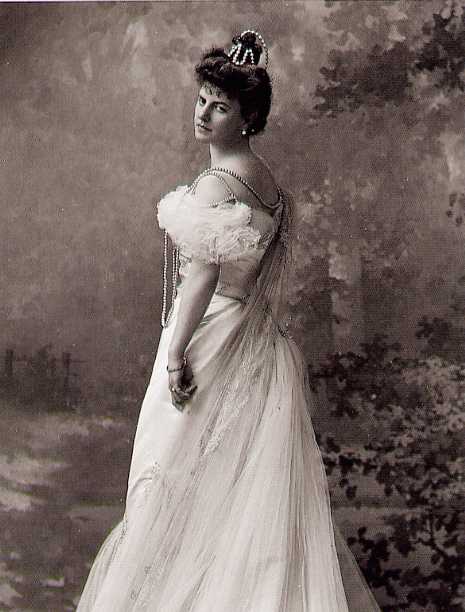
The Comtesse Elisabeth de Greffulhe (1886)

The Countess Elisabeth de Greffulhe (1886)

Marcel Proust’s In Search of Lost Time is one of the most incredible worlds to be found in all of literature. Stretched over seven volumes, it consists of some 3,000 pages published over a period of fourteen years, during the last several of which its author was no more. It tells of the life and loves of one Marcel (last name never supplied), who falls in unrequited love with a young girl named Gilberte Swann. At the same time, he adores—though not in a sexual way—the Duchess Oriane de Guermantes, who, in her person, represents the French aristocracy dating all the way back to the Middle Ages to the days of Gilbert the Bad. Above (and below) are illustrations of the Countess Elisabeth de Greffulhe, who is thought to be one of the models for the Duchess. Later he falls for bad girl Albertine Simonet, based on his male Italian chauffeur Alfred Agostinelli, the most successful transgender operation in fiction.

Over the last several days, I have read the last volume of the series—Finding Time Again—for the second time. I found myself so deeply involved in Proust’s world that I resolved to do a third reading of the entire series, beginning with Swann’s Way, during tax season. I can’t have enough of Proust’s world, such that I feel that I inhabit it in some way.

I see the Duchess de Guermantes in her elegant draperies and with her piercing azure eyes in my sleep. And sometimes in my waking hours. Here is another view of her, taken by the photographer Felix Nadar in 1900:

Countess Elisabeth de Greffulhe (1900)

The Countess Elisabeth de Greffulhe (1900)

The fin-de-siècle world of Marcel is a fragile one, with the horrendous Dreyfus affair on one side (fully as divisive as our own cultural divisions between religious conservatives and sane people) and the First World War on the other. Proust takes us through all, from his childhood to his doubts expressed in the last volume whether he can live long enough to do justice to his memories. Fortunately, he did. Although he never finished editing the last three volumes of the series, enough remains intact to warrant equating their quality to the first four.

Many of my friends cannot stand Proust. One, a very literate high school teacher of English, found Swann’s Way to be unreadable. In fact, we have not seen each other much after that because he thought I was reading too many works he regarded as being doubtful. What, Proust, doubtful? Far from doubtful, he is the Twentieth Century’s Gold Standard for other writers to aspire to, but never reach, not by a country mile.

This spring, I will return to the world Marcel made and dream of the piercing gaze of Oriane de Guermantes. It is as if I could see it already….