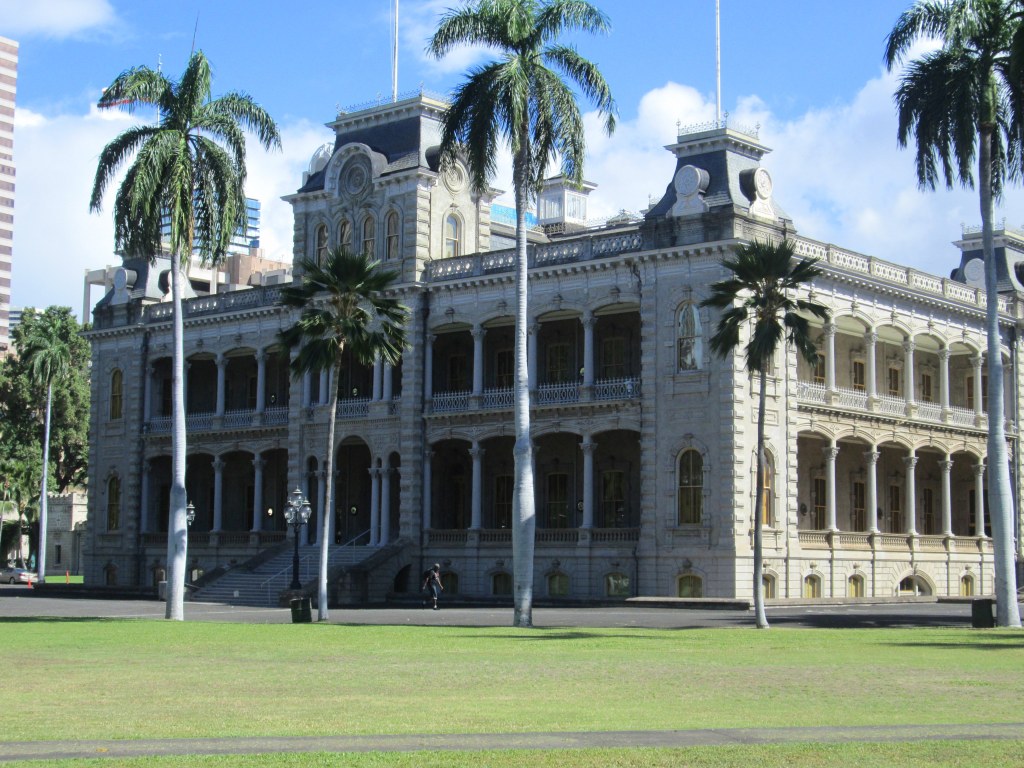
A Royal Palace on American Soil

Honolulu’s Iolani Palace (Built 1879)

Not far from the Hawaii State Capitol sits the Iolani Palace, home of the monarchs of the Kingdom of Hawai’i from Kamehameha III in 1879 until the overthrow of the monarchy under Queen Lili’uokalani by a group of American merchants in 1893.

As I prepare to go to Hawaii in a week or so, I am conscious once again that the United States ruthlessly stepped on the rights of the Hawaiian people just so that a cabal of American merchants could have their way. On this trip, I plan to read Queen Lili’uokalani’s autobiography. For eight months, the Queen was imprisoned in one of the second floor bedrooms until she was tried by a military tribunal on some trumped-up charge.

It was like the U.S. and the American Indians all over again. Fortunately, there were no massacres by the cavalry in this instance, though the takeover was no less final—and unjust.

Lili’uokalani

Queen Lili’uokalani, the Last Sovereign Monarch of Hawai’i

Liliʻu Loloku Walania Kamakaʻeha was born in 1838 to a family of ali’i, or chieftains, in Honolulu. She was informally adopted by an even more noble couple and raised with their daughter, Bernice Pauahi Bishop, after whom the Bishop Museum is named. Her brother David Kalakaua was crowned King of Hawaii in 1874. When he died in 1891, Lili’uokalani, as she was now called, became Hawaii’s only regnant queen, at the age of 52.

Unfortunately, her reign was to last less than two years. Under Kalakaua, the American and European businessmen forced on the monarchy in 1887 what became referred to as the Bayonet Constitution, which, among other things, deprived native Hawaiians of the right to vote. In attempting to replace the Bayonet Constitution with one that recognized the rights of Native Hawaiians, Lili’uokalani ran afoul of the same bunch of avaricious businessmen who were responsible for the bayoneting of Hawaiian civil and voting rights.

The rest is history: Lili’uokalani was forced to abdicate. Then she was imprisoned in a room on the second floor of the Iolani Palace for treason committed against the “Provisional Government,” or PG, sometimes spelled PiG by Hawaiians. It took several years for the United States to annex Hawaii, which Grover Cleveland refused to do. But once the USS Maine was sunk in Havana Harbor, the land grab was on under President McKinley.

Although she reigned for only a short time, Lili’uokalani was a capable ruler, though not always able to decipher the deviousness of the Occidental mind. She was a talented musician who composed numerous songs still sung today, including “Aloha ’Oe.”

The Vacant Throne

The Throne Room at Iolani Palace, with King Kalakaua’s Ceremonial Uniform

On our first full day in Honolulu, Martine and I visited the Iolani Palace, which was the seat of the Hawaiian monarchy that was dethroned in 1893 by a cabal of crooked American businessmen, diplomats, and naval officers. Even after they succeeded, it was only the sinking of the Maine in Havana harbor in 1898 that led to Hawaii becoming a U.S. territory.

The story of the annexation of Hawaii is told in Stephen Dando-Collins’s Taking Hawaii: How Thirteen Honolulu Businessmen Overthrew the Queen of Hawaii in 1893, With a Bluff. The “founding fathers” of the annexation make Donald Trump look like a Boy Scout, what with their lies, braggadocio, and even cowardice. When the moment came to move, several of the members of the so-called Committee of Public Safety conveniently came down sick.

The Hawaiians of today revere their monarchy, especially Queen Lili’uokalani, who was an able ruler who failed only because she could not appease a cabal of American and European businessmen who did not even feel that Hawaiian natives should have the right to vote.

The Iolani Palace

The Palace was built by the penultimate ruler of the monarchy, King Kalakaua, in 1882. It is tastefully designed, with verandas on all sides permitting the cool ocean breezes to circulate through the building. Nowadays, all the windows are closed so that the paintings on the wall don’t fade prematurely.