
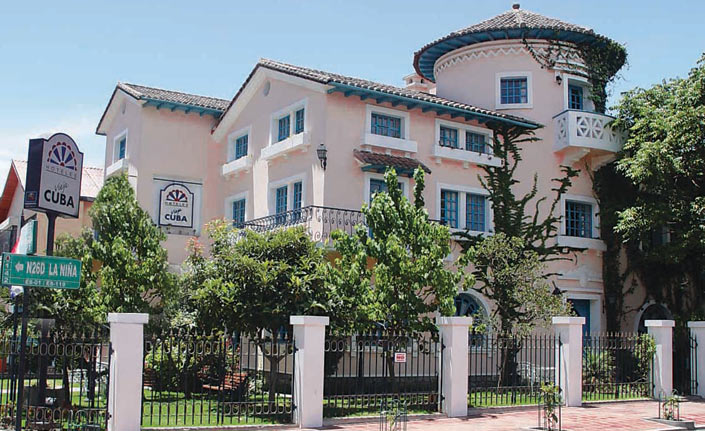
Viejo Cuba

Our Boutique Hotel in Quito

Our Boutique Hotel in Quito: El Viejo Cuba

For almost forever, I have been in charge of planning the vacations for Martine and myself. My brother Dan knew that, so I thought I’d let him have the upper hand. As we tend to think alike on most issues, that will be no problem.

We will be in Ecuador together for two weeks, then he will return to L.A. by himself because of business obligations. I will have an additional week in Southern Ecuador all alone. For those last seven days, I will do all my own planning as before. I think that’s a good compromise.

One thing that will be different is that Dan wants to rent a car and drive. That gives us a much broader choice of places to stay and allows us a lot of flexibility. I keep thinking of the three all-night bus rides I took in Argentina and Chile. Although I rather enjoyed them, I don’t think that Dan would quite so much.

That puts me in the role of navigator, which is a role I enjoy. Whenever, as a child, I went anywhere with our family, I was the one hunched over a map and dictating directions.

Our first stop in Ecuador will be the Hotel Viejo Cuba (illustrated above).  It’s a few blocks north of the popular Mariscal Sucré neighborhood, named after Bolivar’s favorite general.

This trip will be different, but I like the way it’s shaping up.

Un Hueco en el Cielo


It Means “An Opening Into Heaven”

It Means “An Opening Into Heaven”

I have been reading Tom Miller’s The Panama Hat Trail, about the author’s search for where Panama hats are made. (Hint: It’s not Panama.)

In the first chapter, he quotes the residents of Quito, Ecuador, as saying that their city is un hueco en el cielo, an opening into heaven:

“What does un hueco en el cielo mean to you?” an Indian from Ambato asked me. Well, I replied, that here you are so close to God, physically and spiritually, you can virtually peak into heaven. She smiled. “That’s what most North Americans and Europeans say. To the Indians it means that God could look down upon us.”

That is an interesting point of view in this most Catholic of countries. It enables God to look down and see His creation more clearly.

Miller continues:

At ninety-three hundred feet, Quito’s air is so rarefied that the sun’s rays beat down with deceptive strength. A brisk midday walk in the equatorial Andes leaves you sweating profusely. Near dusk, garúa—intesne fog—rolls through the city, limiting vision to an arm’s length. “The man who doesn’t like clouds has no business coming to Ecuador,” wrote the Belgian Henri Michaux in 1928. “They’re the faithful dogs of the mountains.” Clouds go through gymnastics at this altitude, first low hugging the ground, then high embracing Mount Cayambe or Pichincha, then settling briefly in the Chillos or Tumbaco valleys before finally returning again to ground level.

Compared to Argentina, Chile, or Peru relatively little has been written about Ecuador. Between now and our departure date this fall, I plan to read everything I can find. Since tax season is over, I’ll have no trouble finding the time.