To Prince or Not To Prince

Statue of Niccolò Machiavelli in Florence’s Uffizi Gallery

Will the real Niccolò Machiavelli please stand up. For over five hundred years, his name has been synonymous with cruelty and immorality in governance. But is that the real Machiavelli, or was his work The Prince not meant to be taken seriously?

Even Jean-Jacques Rousseau in The Social Contract had his doubts:

Machiavelli was a proper man and a good citizen; but, being attached to the court of the Medici, he could not help veiling his love of liberty in the midst of his country’s oppression. The choice of his detestable hero, Cesare Borgia, clearly enough shows his hidden aim; and the contradiction between the teaching of The Prince and that of the Discourses on Livy and the History of Florence shows that this profound political thinker has so far been studied only by superficial or corrupt readers. The Court of Rome sternly prohibited his book. I can well believe it; for it is that Court it most clearly portrays.

I am currently reading Machiavelli’s The Discourses and find it entirely different from The Prince, Instead of advice to princes to be evil, he comes across as altogether more reasonable. For instance:

All writers on politics have pointed out, and throughout history there are plenty of examples which indicate, that in constituting and legislating for a commonwealth it must needs be taken for granted that all men are wicked and that they will always give vent to the malignity that is in their minds when opportunity offers.

And: “Men never do good unless necessity drives them to it; but when they are too free to choose and can do just as they please, confusion and disorder become everywhere rampant.” It certainly does not look as if the writer were urging confusion and disorder on the people of Florence. In fact, everything he wrote other than The Prince shows him to be a loyal and responsible citizen of Florence.

Could it be that The Prince was written as a warning to his readers of what happens when their leaders are cruel and uncaring?

The Story of Joseph

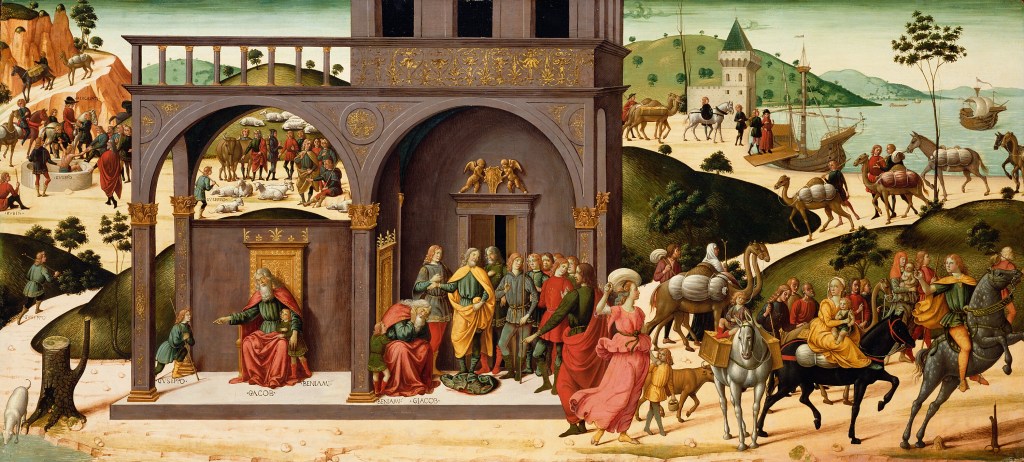
In One Image, Several Scenes of the Story of Joseph

Yesterday at the Getty Center, I spent most of my time in the Medieval and Renaissance galleries, reacquainting myself with old friends. One painting that fascinated me was “The Story of Joseph” (circa 1485), attributed to the Florentine Biagio d’Antonio, which in foreground and background gives several early episodes of the tale of Joseph from the Old Testament. By focusing on different parts of the image, one saw different scenes from the story.

The following is the description of the painting from the Getty Center website:

Drawn from the Old Testament, a series of continuous narratives depicts episodes from the life of Joseph, the favorite son of the Hebrew patriarch Jacob. To make the story easier to follow, Biagio d’Antonio included inscriptions identifying the principal characters.

In the left-hand loggia, Jacob, seated on a throne, sends Joseph to his half-brothers tending sheep in the field. In the far left corner, the brothers, jealous of their father’s love for Joseph, strip him of his jacket and throw him into a pit. Passing merchants purchase the young boy from his brothers for twenty pieces of silver. In the background to the right, the merchants board the ship that will take them and their cargo to Egypt. In the right-hand loggia, the brothers show a blood-smeared coat to their father as evidence that Joseph is dead. With his head in his hand, Jacob mourns his son, whom he believes to be dead.

It’s almost as if this were a precursor to the cinema by telling a detailed story in a single still image. One of the things I love most about Medieval and Renaissance painting are the picturesque landscape backgrounds, which lend an aura of fantasy.

Many people (Martine among them) don’t care for the repetitive Biblical themes of the art of the period. What interests me is the almost endless variety within a familiar, given subject matter.