
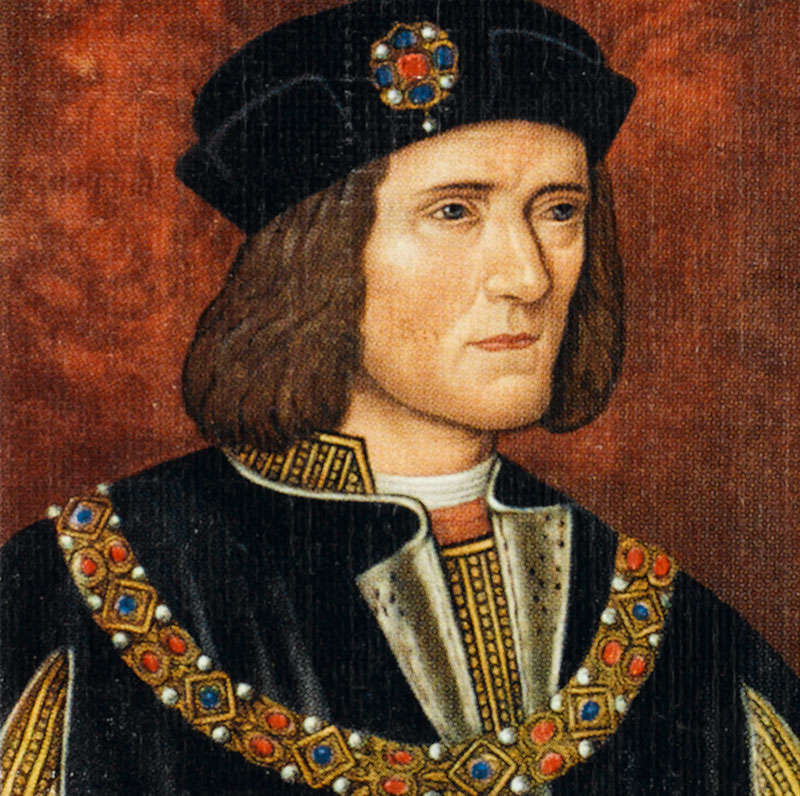
Portrait of Richard III Hanging in he National Portrait Gallery
In Josephine Tey’s The Daughter of Time, Inspector Alan Grant of Scotland Yard is laid up in the hospital for a stretch, during which time he decides to investigate whether Richard III was really the villain painted by Shakespeare in his play of the same name. After examining the evidence, Grant decides in favor of the monarch killed at Bosworth Field on August 22, 1485. His successor, Henry VII, had Sir Thomas More write a biography blackening his name.
The portrait above also figured in Grant’s reasoning. Although it was painted over a century after Richard’s death, the subject’s face is not that of a vile murderer as described by Queen Margaret (widow of Henry VI) in the play:
From forth the kennel of thy womb hath crept
A hellhound that doth hunt us all to death:
That dog, that had his teeth before his eyes,
To worry lambs and lap their gentle blood,
That foul defacer of God’s handiwork,
That excellent grand tyrant of the earth
That reigns in gallèd eyes of weeping souls,
Thy womb let loose to chase us to our graves.
These lines are addressed to the old Duchess of York, Richard’s mother.
I was interested to hear that the body of Richard has finally been located, under the asphalt of a parking lot in Leicester. If you missed the story, you can find it, with photos, by clicking here.
 Tarnmoor
You must be logged in to post a comment.