A Perfect 10

Romanian Gymnast Nadia Comăneci in 1976

The first Olympics I watched to any extent were the 1976 games of the Montreal Summer Olympics. The heroine of those games was the 14-year-old Nadia Comăneci of Romania. She made Olympics history by being the first gymnast to score a perfect 10—and not once, but seven times. That netted her three gold metals, a silver, and a bronze, which she is seen wearing in the above photo.

Nadia started the whole gymnastics mania that has grown up around the Summer Olympics, and that continued with Svetlana Boginskaya, nicknamed “The White Swan of Belarus” in 1988 and 1992, and with Simone Biles today.

What ever happened to Nadia? Actually, she was in the opening day ceremonies of the 2024 Paris Olympiad. Today, she is an American citizen, having hightailed it out of Romania before the fall of the Ceauşescus in 1989.

Today she is 62 years old, being some 48 years removed from the svelte little girl who enchanted all of us way back when.

Trianon

The Crown of St. Stephen of Hungary

Looking back at the treaties that ended the First World War, it appears that the Hungarian half of the Kingdom of Austria-Hungary was made to pay the heavier price for what was essentially the Emperor Franz Joseph’s decision to go to war against the Serbs for assassinating the heir to the throne in Sarajevo. According to Wikipedia:

The treaty regulated the status of the Kingdom of Hungary and defined its borders generally within the ceasefire lines established in November-December 1918 and left Hungary as a landlocked state that included 93,073 square kilometres (35,936 sq mi), 28% of the 325,411 square kilometres (125,642 sq mi) that had constituted the pre-war Kingdom of Hungary (the Hungarian half of the Austro-Hungarian monarchy). The truncated kingdom had a population of 7.6 million, 36% compared to the pre-war kingdom’s population of 20.9 million.Though the areas that were allocated to neighbouring countries had a majority of non-Hungarians, in them lived 3.3 million Hungarians – 31% of the Hungarians – who then became minorities.

How Trianon Chopped Hungary to Bits

Pieces of Hungary went to Yugoslavia, Romania (the largest chunk, all of Transylvania), Russia, Czechoslovakia, and even Austria. What did Austria lose for its participation in the war? Essentially, Bohemia (to Czechoslovakia) and the much of the Tirol (to Italy). The new borders of Hungary became to larger of the two green areas in the above map.

I can understand separating out the Slovenians, Croatians, Russians, and Slovaks; but a great injustice was done to the Hungarians of Transylvania, who are treated as second-class citizens of Romania.

The Saddest City

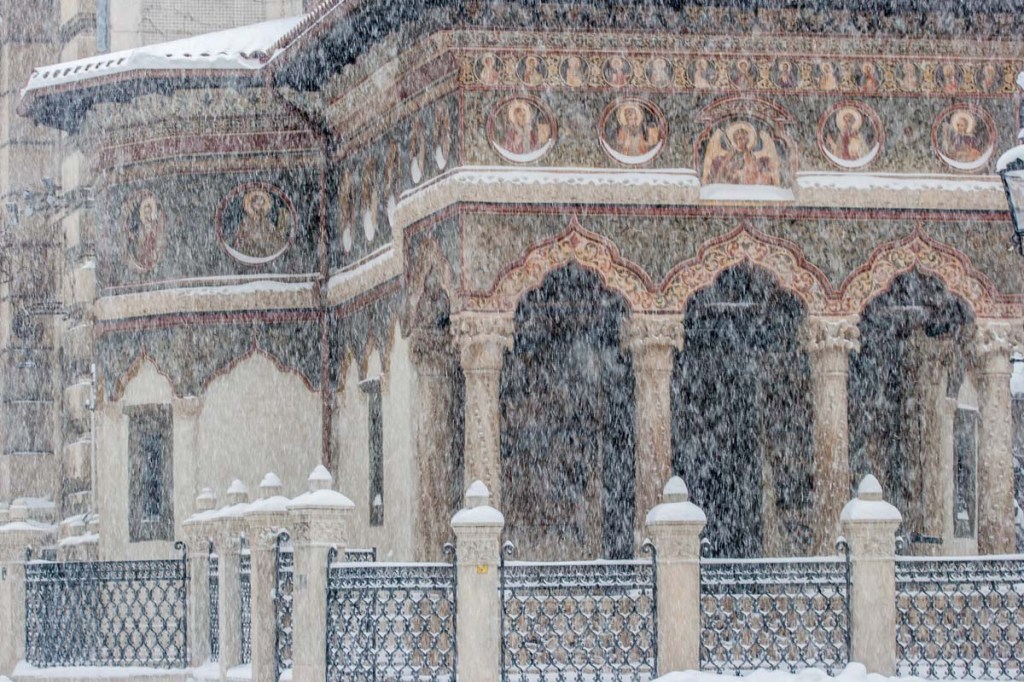
Bucharest in Winter

I am reading a great Romanian novel by Mircea Cărtărescu entitled Solenoid. In it, I found the following description of Bucharest, the country’s capital:

More probably, like all of Bucharest, the saddest city on the face of the earth, the factory had been designed as a ruin from the start, as a saturnine witness to time devouring its children, as an illustration of of the unforgiving second law of thermodynamics, as a silent, submissive, masochistic bowing of the head in the face of the destruction of all things and the pointlessness of all activity, from the effort of carbon to form crystals to the effort of our minds to understand the tragedy in which we live. Like Brasilia, but more deeply and more truly, Bucharest was born on a drawing board from a philosophical impulse to imagine a city that would most poignantly illustrate human destiny: a city of ruin, decline, illness, debris, and rust. That is, the most appropriate construction for the faces and appearances of its inhabitants. The old factory’s production lines, driven by long-immobile motors had produced—and perhaps, in a quiet isolation beyond humanity, continued to produce—the fear and grief, the unhappiness and agony, the melancholy and suffering of our life on Earth, in sufficient quantities for the surrounding neighborhood.

Tim Conway and Me

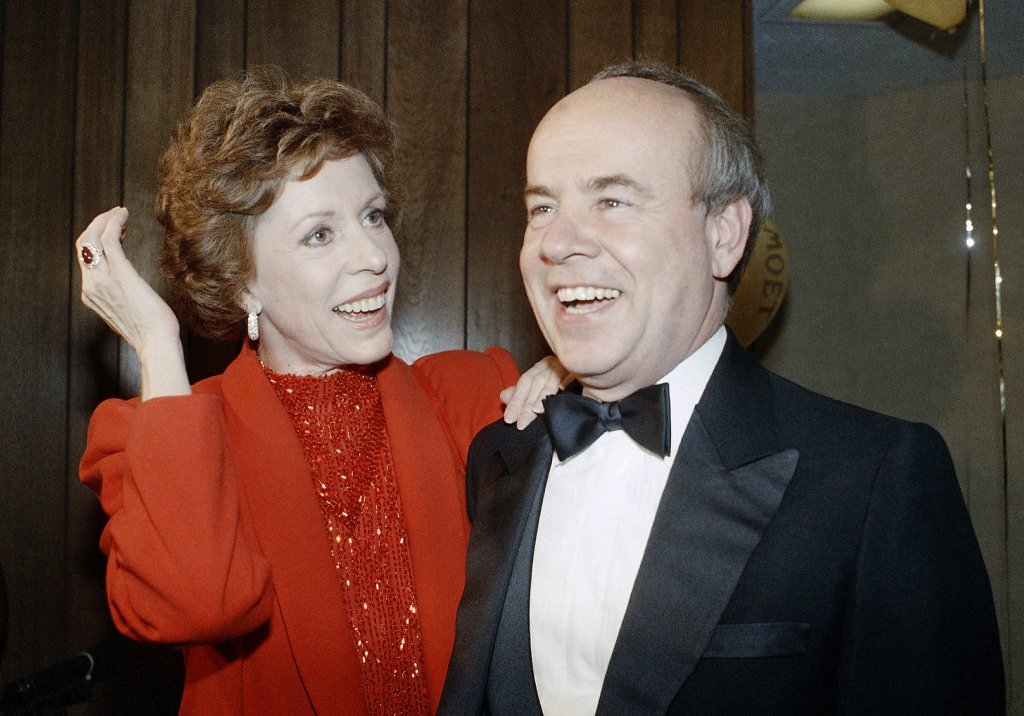
Carol Burnett with Tim Conway

Although I hail from Cleveland, Ohio, I am not a big fan of what I and many of my friends call “The Mistake on the Lake.” There I one Clevelander I have always admired. No, not Halle Berry, though I find her incredibly beautiful. And not Paul Newman, who I admit was a talented film actor.

My choice is Tim Conway, who, although born eleven years earlier than me, had a childhood that curiously paralleled my own. Just as I was born to a family that spoke only Hungarian in the home, Tim spoke only Romanian. (Funny, he doesn’t look Romanian—but he was born Toma Conway to an Irish father and a Romanian mother, Sophia, who bore the Romanian equivalent to my mother’s Hungarian name, Zsófi.)

Like my mother, Sophia was born in the United States but taken to be raised in Europe. Like my Slovak father Elek, Daniel Conway adopted his wife’s language in the family circle. Thus, when Tim first attended school, he spoke mostly Romanian, just as I spoke only Magyar.

The parallels stop there. Toma had his name changed to Tim when he started in show business, as there was already a well-known British actor named Tom Conway. Whether playing in McHale’s Navy or The Carol Burnett Show, Tim Conway was one of the funniest men on television. I still watch The Carol Burnett Show on MeTV up to six times a week. Great stuff!

The Strange Case of Ion Aliman

He Won a Landslide Vote Despite the Fact That He Was Dead

It happened in the small town of Deveselu, Romania, of some three thousand inhabitants. The ballots had already been printed up with his name on them; but then Aliman died in Bucharest of Covid-19 on September 19. I could see this happening in the U.S., but not in quite the same way.

You see, Aliman was up for re-election, and the voters of Deveselu really loved him. “He was a real mayor to us,” one woman voter said. “He took the side of the village, respected all the laws. I don’t think we will see a mayor like him again.”

After the funeral, dozens of villagers visited his grave. “It is your victory,” one of them said. “Know that you will be proud of us. Rest in peace.”

A Small Town in Southern Romania

Obviously, there’s going to have to be a new mayor; but it’s not going to be any of the candidates who opposed the late incumbent. They’ll have a new election and vote in a replacement. I get a nice feeling, though, about the voters of Deveselu. If that happened here, no doubt a number of Americans would be gunned down and there would be a general feeling of hatred and paranoia. Maybe we can learn something about democracy from these Romanian villagers.