East Is East

Budapest Parliament

Whenever things go blooey here in Sunny California, as they are wont to do from time to time, I remind myself that I am at the center of my being an Eastern European. I may have been born in Cleveland, Ohio, but the language that spoke most intimately to my emotions was Magyar (Hungarian).

My life has been a series of shifts from east to west and back again. That has prevented me from being depressed at setbacks that have occurred. We Eastern Europeans are used to suffering. But we have our own insane pride that prevents us from falling apart.

Consequently, I love reading literature that has been translated from Hungarian, Czech, Polish, Serbian, Romanian, Ukrainian, and Russian. And whatever my politics are—and they are certainly not on the side of Vladimir Putin—I see the stories, novels, dramas, and poems the product of a people, not a political system. The people are all right, however the politics might suck.

I have always dreamed of riding from Moscow to Vladivostok on the Trans-Siberian Railroad. To see a vast country unrolling before my eyes on the long trip to the Sea of Japan. I also see myself as reading long Russian novels during that trip. Alas, I think I am now too old for such an adventurous journey.

Currently, I am reading Eugene Vodolazkin’s The Aviator, which makes me feel these things more intensely.

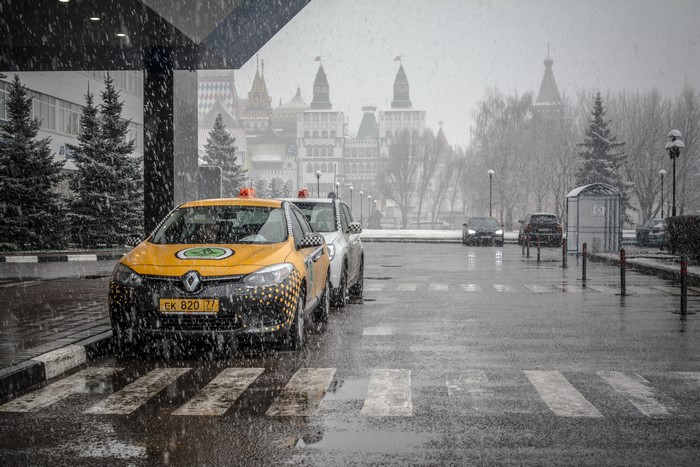
Bad Weather Ahead

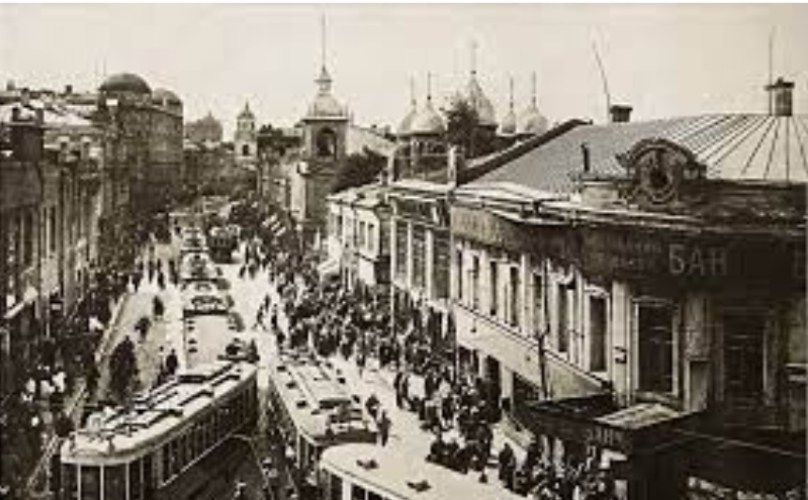
Moscow in the 1920s

Sigizmund Krzhizhanovsky (1887-1950) was a Soviet writer who, in his own words, was “known for being unknown.” Hopefully, that will no longer be true as New York Review Books releases more of his stories. I have just finished reading his Autobiography of a Corpse, which contains a prescient 1939 story titled “Yellow Coal.” Tell me if the first paragraph of the story, quoted below, reminds you of our present situation:

The economic barometer at Harvard University had continually pointed to bad weather. But even its exact readings could not have predicted such a swift deepening of the crisis. Wars and the elements had turned the earth into a waster of its energies. Oil wells were running dry. The energy-producing effect of black, white and brown coal was diminishing yearly. An unprecedented drought had swaddled the sere earth in what felt like a dozen equators. Crops burned to their roots. Forests caught fire in the infernal heat. The selvas of South America and the jungles of India blazed with smoky flames. Agrarian countries were ravaged first. True, forests reduced to ashes had given place to ashy boles of factory smoke. But their days too were numbered. Fuellessness was threatening machines with motionlessness. Even glacier snow-caps, melted by the perennial summer, could not provide an adequate supply of waterpower; the beds of shrinking rivers lay exposed, and soon the turbine-generators would stop.

Arkady and Boris Strugatsky

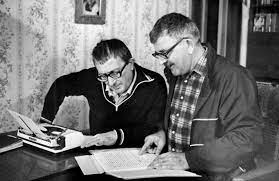
Soviet Writers Arkady (1925-1991) and Boris (1933-2012) Strugatsky

They were by far the greatest science fiction authors who ever lived. The two brothers produced a string of masterpieces (the greatest being Roadside Picnic, or Пикник на обочине) that are unlikely to be surpassed, ever!

I am currently reading two of their novels whose chapters are artfully interleaved. They wrote Ugly Swans (Гадкие лебеди) in 1972; in 1986, they wrote Lame Fate (Хромая судьба) and shuffled the chapters together. Reading it is an amazing experience. I’ve finished about 40% of the nested novels at this point. I haven’t even encountered the science fiction yet, though I feel it is lurking and waiting to pounce.

Among the brothers’ works I have read are:

  • Space Apprentice (1962)
  • Far Rainbow (1963)
  • Hard to Be a God (1964)
  • The Final Circle of Paradise (1965)
  • The Second Invasion from Mars (1967)
  • Prisoners of Power (1969)
  • The Dead Mountaineers’ Hotel (1970)
  • Roadside Picnic (1972)
  • Definitely Maybe (1977)
  • Beetle in the Anthill (1980)
  • The Time Wanderers (1986)

Many of the Strugatskys’ titles have never been translated into English. I think that, ultimately, they will all be. I can think of few Soviet writers working in any genre that have such a large and consistently excellent body of work.

There are only a handful of science fiction writers I admire. After the Strugatsky brothers, there are Stanislaw Lem from Poland and, in the United States, Philip K. Dick and Clifford D. Simak.

Jean Gabin and the Kuleshov Effect

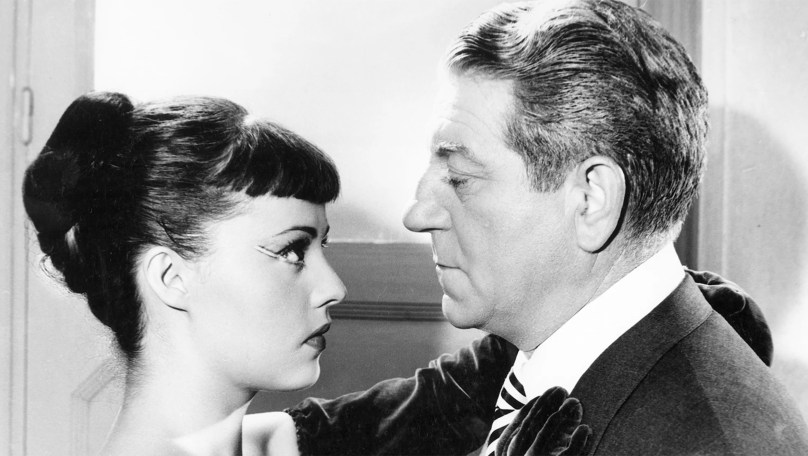
Jeanne Moreau and Jean Gabin in Touchez pas au grisbi

Last week I saw a great film on Turner Classic Movies’ “Noir Alley.” It was Jacques Becker’s 1954 film Touchez pas au grisbi starring Jean Gabin, one of the all-time great actors of the French Cinema. What made him great was the opposite of what makes most American film actors today look cheesy and fake.

It all relates to what is known in cinema as the Kuleshov Effect, an experiment made by Lev Kuleshov and other Soviet filmmakers. Here is how Wikipedia describes it:

Kuleshov edited a short film in which a shot of the expressionless face of Tsarist matinee idol Ivan Mosjoukine was alternated with various other shots (a bowl of soup, a girl in a coffin, a woman on a divan). The film was shown to an audience who believed that the expression on Mosjoukine’s face was different each time he appeared, depending on whether he was “looking at” the bowl of soup, the girl in the coffin, or the woman on the divan, showing an expression of hunger, grief, or desire, respectively. The footage of Mosjoukine was actually the same shot each time. Vsevolod Pudovkin (who later claimed to have been the co-creator of the experiment) described in 1929 how the audience “raved about the acting … the heavy pensiveness of his mood over the forgotten soup, were touched and moved by the deep sorrow with which he looked on the dead child, and noted the lust with which he observed the woman. But we knew that in all three cases the face was exactly the same.”

Kuleshov’s Experiment

In today’s Hollywood, on the other hand, actors tend to overdo the mobility of their facial expressions. Add to that the fact that, when they act the part of a tough guy, they are bearded, scraggly, and tattooed.

Compare that to the acting of Jean Gabin in Touchez pas au grisbi. He always looks the same, dapper and somewhat atone-faced. This is equally true when he is romancing dance hall girls or pumping lead into a rival gangster who wants the gold bars (the grisbi, or loot) he stole in an earlier robbery. One of the reasons, I think, for the popularity of Clint Eastwood is that he acts tough without hamming it up.

Vodka and Zakuski

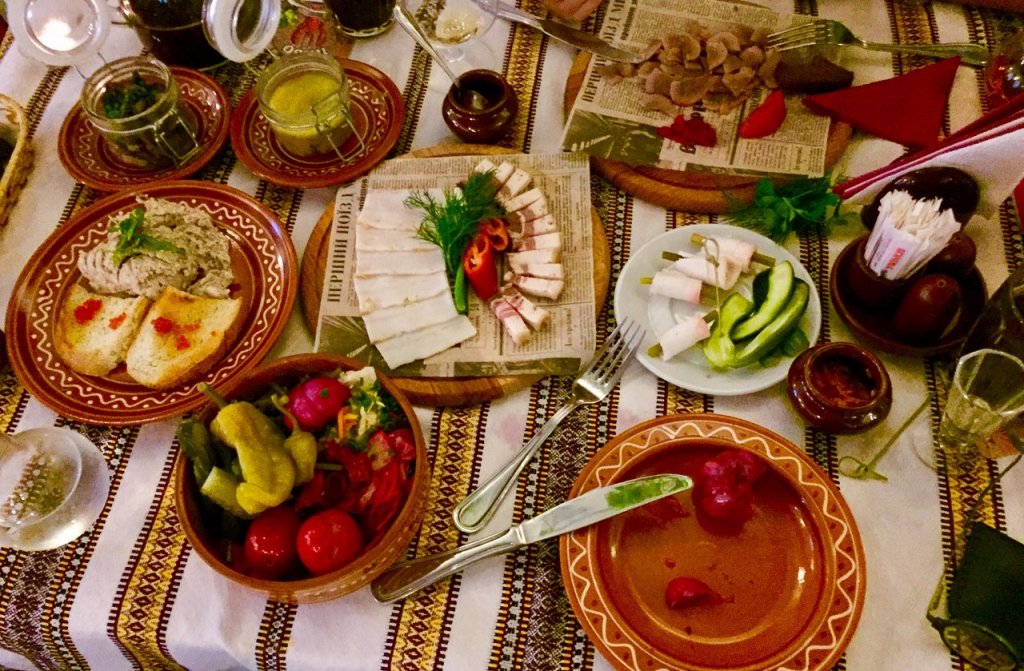
Zakuski: Hors d’Oeuvres to Go with Vodka

It’s a culinary tradition in Slavic countries such as Russia and Ukraine: When you drink vodka, you eat zakuski, which literally means “something to bite after.” It sounds like a delicious culinary tradition. Except for one thing: I’ve never had vodka.

After reading Ukrainian writer Andrey Kurkov’s Jimi Hendrix Live in Lviv (2012), I just might get myself a bottle. Throughout the novel, the characters are dealing with a strange anomaly. The inland city of Lviv has strange incidents of seagulls, starfish, a stench of seaweed, and salt water crabs appearing in various places throughout the city.

Several residents band together to try to identify the problem, which they do after the consumption of a whole lot of vodka and zakuski. Their Lviv is a magical city in which the hand of the late Jimi Hendrix is buried in a local cemetery, having been supplied by the KGB with the help of Lithuanian operatives. Why? Apparently to study the speed of the spreading of rumors in Soviet society.

This is the fifth work of fiction by Ukrainian author Andrey Kurkov that I have read. They are all of them sweet and gentle—especially as they come from a land that is now mired in a brutal invasion by Russian forces. I cannot help but think that Kurkov’s whimsy can be as deadly to Putin’s aims as any weapons in his arsenal. Anyhow, let’s hope so. I have a lot more of Kurkov that I want to read; and I hope he continues to live a long and productive life.

Maxim Gorky on Anti-Semitism

Anti-Semitic Cartoon from 1892

I have been reading Maxim Gorky’s Fragments from My Diary (Заметки из дневника) published in 1924. Here are two excerpts.

SUBSTITUTES FOR MONKEYS

Professor Z., the bacteriologist, once told me the following story.

‘One day, talking to General B., I happened to mention that I was anxious to obtain some monkeys for my experiments. The General immediately said, quite seriously:

‘“What about Jews—wouldn’t they do? I’ve got some Jews here, spies that are going to be hanged anyway—you’re quite welcome to them if they are of any use to you.”

‘And without waiting for an answer he sent his orderly to find out how many spieas were awaiting execution.

‘I tried to explain to His Excellency that men would not be suitable for my experiments, but he was quite unable to understand me, and opening his eyes very wide he said:

‘“Yes, but men are cleverer than monkeys, aren’t they? If you inoculate a man with poison he will be able to tell you what he feels, whereas a money won’t.”

‘Just then the orderly came in and reported that there was not a single Jew among the men arrested for spying—only Rumanians and gypsies.

‘“What a pity!” said the General. “I suppose gypsies won’t do either? … What a pity …!”’

The second is a paragraph excerpted from a fragment labelled:

ANTI-SEMITISM

I have read, thoroughly and attentively, a number of books which try to justify anti-Semitism. It is a hard and even repugnant duty to read books written with a definitely ugly and immoral design: to brand a nation, a whole nation. A remarkable task indeed! And I never found anything in those books but a moral ignorance, an angry squeal, a wild beast’s bellowing, and a grudging, envious grinding of teeth. Thus armed, there is nothing to prevent one from proving that Slavs, and all the other nations as well are also incurably depraved. And is not this the reason for the violent hatred of the Jews, that they, of all races of mixed blood, are the ones who have preserved comparatively the greatest purity of outward life as well as of the spirit? Is there not more perhaps of the ‘Man’ in the Jew than there is in the anti-Semite?

The Great Patriotic War

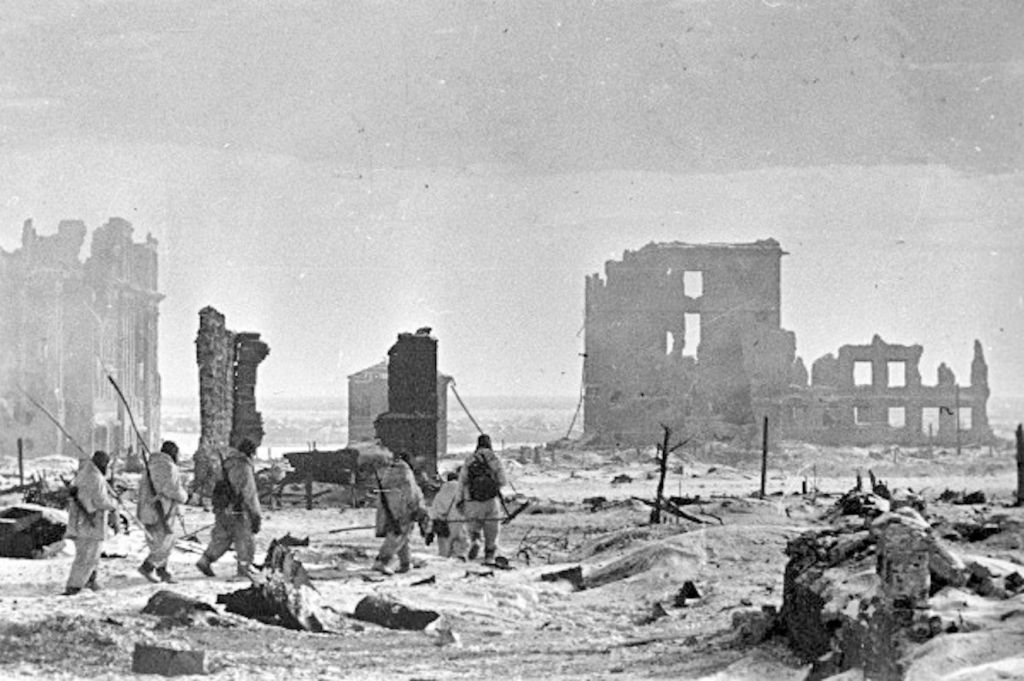
The Battle for Stalingrad (1942-1943)

Strange things happen when, through laziness or ignorance, one too readily accepts a slanted view of history. That’s one of the reasons I don’t like talking about the Second World War, mainly because the West’s participation was not what brought down Hitler and the German military machine.

In fact, until D-Day, the United States and England were not even confronting the Nazis where they lived, except in the form of bombing raids. On the ground, we started somewhat late in North Africa and then moved to Sicily and the Italian mainland, where we slogged our way up the boot of Italy.

We might not want to admit it, but it was predominately the Soviet Union that put the kibosh on Hitler. For Stalin, the war was an existential horror. If his forces didn’t hold, Russia was in danger of being wiped off the map.

According to the Percy Schramm Kriegstagebuch des Oberkommandos der Wehrmacht: 1940—1945: 8 Bde. 1961, 68% of Wehrmacht deaths were on the Eastern Front, more than double of all other Army deaths in Europe, North Africa, Italy, France, Holland, Belgium, Norway, and the Balkans combined. The figures for wounded German soldiers was even more spectacular: 82% of all wounded were on the Eastern Front.

I do not denigrate the bravery and lost lives among the Americans and British; it’s just that the Soviet Union was the main theater of the war. Recognizing this, the Russians refer to the conflict as the Great Patriotic War. It was at places like Stalingrad and the Kursk-Orel Salient where the Nazis paid the ultimate price.

Brave New World

555827 19.07.1980 Вынос олимпийского флага на торжественной церемонии открытия Игр XXII Олимпиады. Центральный стадион имени В.И. Ленина 19 июля 1980 года. Сергей Гунеев/РИА Новости

Remember the 1980 Moscow Olympics? We weren’t represented because Jimmy Carter pulled us out after the Soviets invaded Afghanistan in 1979. In 1984, the Russians got back at us by not sending anyone to the Los Angeles games.

It was a different world back then. It seems the Olympic contests were always being interpreted as Free World vs. Communists. Maybe that was mostly the news media’s doing, but not entirely. For instance, I remember the euphoria in the air when the U.S. hockey team defeated the Russians at the Lake Placid Olympics in February 1980 (that was when both Olympics were held the same year) by a score of 4-3. That despite the fact that the frantic Russians outshot the Americans 39-16.

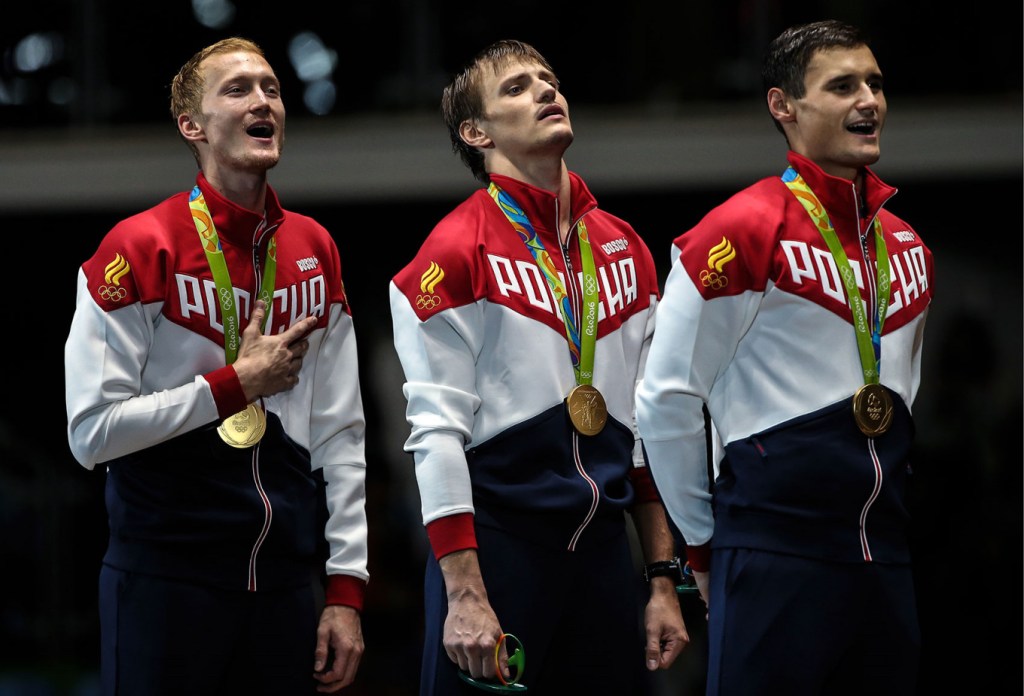
Soviet Russian Athletes on the Award Stand

But after the fall of Communism things changed. It’s no longer just the Free World vs. the Communists. The rest of the world got better, across the board it seems. Early this afternoon, I watched three Caribbean island democracies medal: St. Lucia, Dominica, and Grenada.

Of course, Russia and Belarus are not represented because Vladimir Putin decided to invade Ukraine, with his assistance of his willing stooge Alexander Lukashenko of Belarus.

Gone are the lovely Russian women gymnasts. No more “White Swan of Belarus.” A few Russian and Belarussian athletes are participating under the Olympic equivalent of the Skull and Crossbones—and probably facing the ire of Putin and Lukashenko. It’s a pity, because they have some splendid athletes there, but the Olympics is nothing if not political.

I used to always root for the Free World. Then, I just rooted for the U.S. Now I’m just happy to see the rest of the world catch up.

Of course, China is developing an impressive sports machine, but at least they haven’t invaded anybody since they got their wings clipped in 1979 in Viet Nam by Vo Nguyen Giap.

Life and Mushrooms

Count Leo Tolstoy (1828-1910)

In the last year of his life, Count Leo Tolstoy was subjected to unusual stresses. He was frequently ill with fevers, stomach ailments, constipation, and colds. His long-time marriage to Sofia Andreyevna was characterized by hysteria and mutual recriminations. Finally, his estate at Yasnaya Polyanka was constantly besieged with friends, relatives, petitioners, crackpots, and celebrity hounds. Yet, in his Diaries, he managed to keep his eyes on the main topics, as this entry on May 1, 1910, the last year of his life attests::

One of the main causes of suicides in the European world is the false teaching of the Christian Church about heaven and hell. People don’t believe in heaven and hell, but all the same the idea that life should be either heaven or hell is so firmly fixed in their heads that it doesn’t permit of a rational understanding of life as it is—namely neither heaven nor hell, but struggle, unceasing struggle, unceasing because life consists only of struggle; only not a Darwinian struggle of creatures and individuals, but a struggle of spiritual forces against their bodily restrictions. Life is a struggle of the soul against the body. If life is understood in this way, suicide is impossible, unnecessary and senseless. The good is only to be found in life. I seek the good; how then could I leave this life in order to attain the good? I seek mushrooms. Mushrooms are only to be found in the forest. How then can I leave the forest in order to find mushrooms?

The Crossing of the Berezina

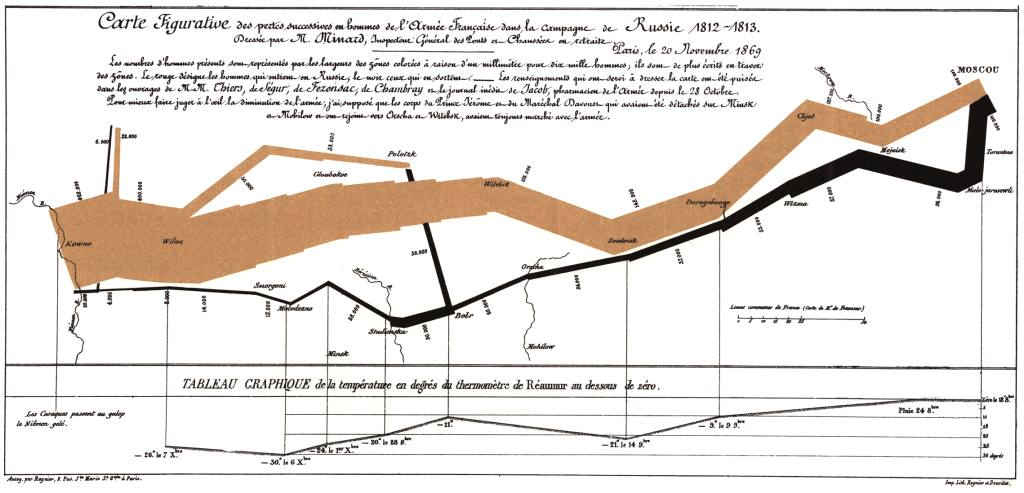
The low point of Napoleon’s retreat from Moscow was the crossing of the ice-choked Berezina River, after the Russians had destroyed the bridge. Curiously, that crossing was also a choke point in Charles XII of Sweden’s invasion a hundred years earlier—a fact that Napoleon was aware of as he carried with him Voltaire’s Histoire de Charles XII. Here is the scene as described in Patrick Rambaud’s The Retreat:

What Voltaire wrote of the Swedish troops could have been a description of this shadow of the Grande Armée: “The cavalry no longer had boots, the infantry were without shoes, and almost without coats. They were reduced to cobbling shoes together from animal skins, as best they could; they were often short of bread. The artillery had been compelled to dump all the cannon in the marshes and rivers, for lack of horses to pull them….” The Emperor snapped the book shut, as if touching it would put a curse on him. Slipping a hand under his waistcoat, he made sure that Dr Yvan’s pouch of poison [for possible suicide] was safely attached to its string.

And here is the beginning of Victor Hugo’s poem “Expiation,” part of his The Punishments, about the retreat from Russia (as translated by Robert Lowell):

The snow fell, and its power was multiplied.
For the first time the Eagle bowed its head—
Dark days! Slowly the Emperor returned—
Behind him Moscow! Its own domes still burned.
The snow rained down in blizzards—rained and froze.
Past each white waste a further white waste rose.
None recognized the captains or the flags.
Yesterday the Grand Army, today its dregs!
No one could tell the vanguard from the flanks.
The snow! he hurt men struggled from the ranks,
Hid in the bellies of dead horses, in stacks
Of shattered caissons. By the bivouacs
One saw the picket dying at his post,
Still standing in his saddle, white with frost
The stone lips frozen to the bugle’s mouth!
Bullets and grapeshot mingled with the snow
That hailed ... The guard, surprised at shivering, march
In a dream now, ice rimes the gray moustache
The snow falls, always snow! The driving mire
Submerges; men, trapped in that white empire
Have no more bread and march on barefoot.
They were no longer living men and troops,
But a dream drifting in a fog, a mystery,
Mourners parading under the black sky.
The solitude, vast, terrible to the eye,
Was like a mute avenger everywhere,
As snowfall, floating through the quiet air,
Buried the huge army in a huge shroud ...

That was the low point of Napoleon’s reign, unless you include Elba, Waterloo, and captivity under the English at St. Helena.