Well, now, it’s pushing it a bit to call it a civilization. The people who live on the eastern shore of the polluted Salton Sea live under difficult conditions. The temperature during the summer drives most of them away to cooler climes. Drinking water, especially for the communities of Slab City, Salvation Mountain, and East Jesus is problematic. To put it simply, there isn’t any.
The modern lake was formed from an inflow of water from the Colorado River in 1905. Beginning in 1900, an irrigation canal was dug from the Colorado River to provide water to the Imperial Valley for farming. Water from spring floods broke through a canal head-gate, diverting a portion of the river flow into the Salton Basin for two years before repairs were completed. The water in the formerly dry lake bed created the modern lake.
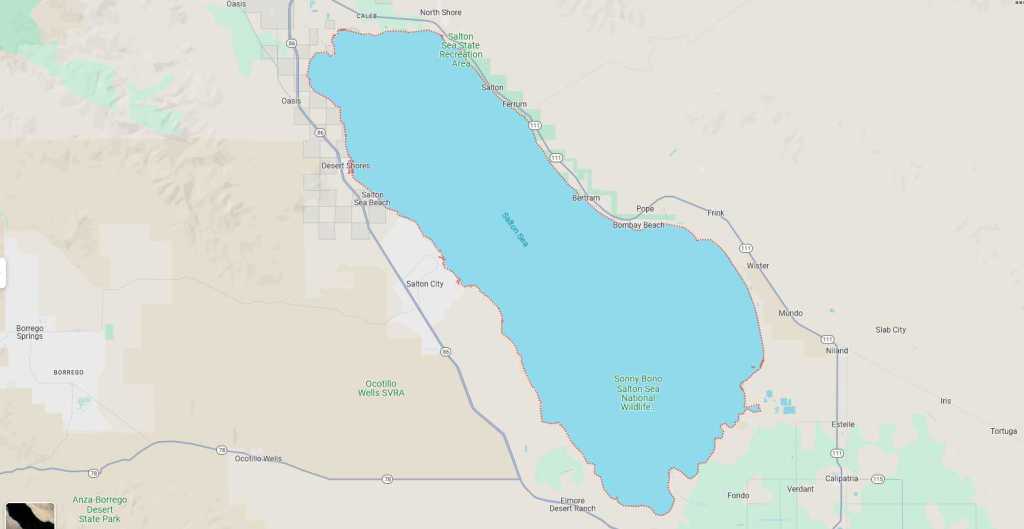
Currently, the Salton Sea is approximately 15 by 35 miles (24 by 56 km) in dimension, containing some 318 square miles (823.6 square km). For a short time, it was a popular tourist destination, until the combination of runoff of pesticides from Imperial Valley farmland to the south and blowing contaminated dust from the evaporating lake is turning it into California’s equivalent of the Dead Sea.
The Receding Salton Sea from Its Eastern Shore
The Salton Sea’s eastern shore has attracted an interesting breed of snowbird during the cooler months (if there are any there). Bombay Beach has been taken over by artsy types, along with Salvation Mountain. In Slab City and East Jesus, one is likely to run across people who are just trying to escape the pressures of modern life, even if thy have to sacrifice easy access to drinking water and the power grid.
It was a strange experience for me to relive the few hours my brother and I spent Visiting Bombay Beach and Slab City, those strange communities along the eastern edge of the Salton Sea. I keep wondering to myself what it would be like to live there, and I’ve come to the conclusion that I couldn’t survive there.
What if there were an emergency? And, with my lack of a pituitary gland as the result of a long-ago tumor, I do occasionally have emergencies. Would I be able to get my hands on Hydrocortisone HCL or Prednisone in time for me to avoid sinking slowly and lethargically into the boundary between our world and what, if anything, lies after?
And that’s only one thing. What about making the daily trip to Niland to get the necessary 5 gallons (or 19 liters) of water required for drinking, cooking, and washing? What about starting from scratch because some mentally unbalanced or drugged neighbor decides to set my encampment on fire?
I imagine that life in a place like Slab City has its moments, but it also has its anxieties and moments of outright fear. Check out this video about the Slabs from a visitor from abroad:
Ruhi Cenet’s Negative Take on Slab City
Sometimes there is a high price to pay for the type of freedom that Slab City represents. Whether it is “the last free place in America,” as it calls itself, or just one of the circles of hell in Dante’s Inferno remains to be seen.
I thought I would have negative feelings about the residents we met in Bombay Beach and Slab City, but I don’t. What I felt was compassion.
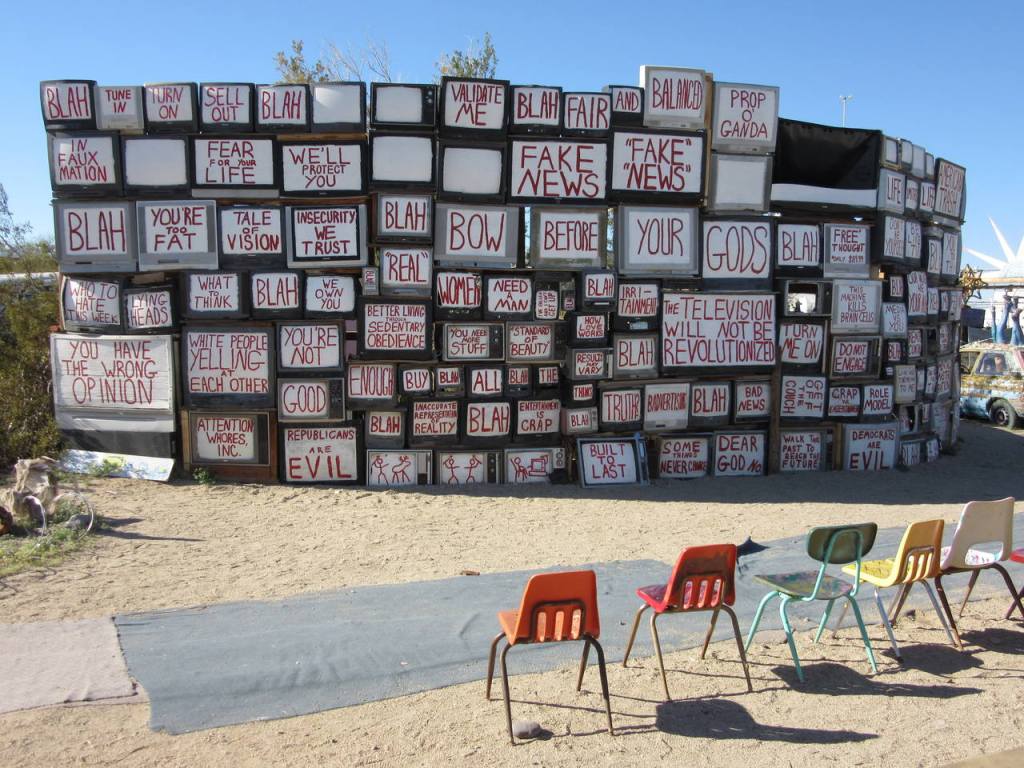
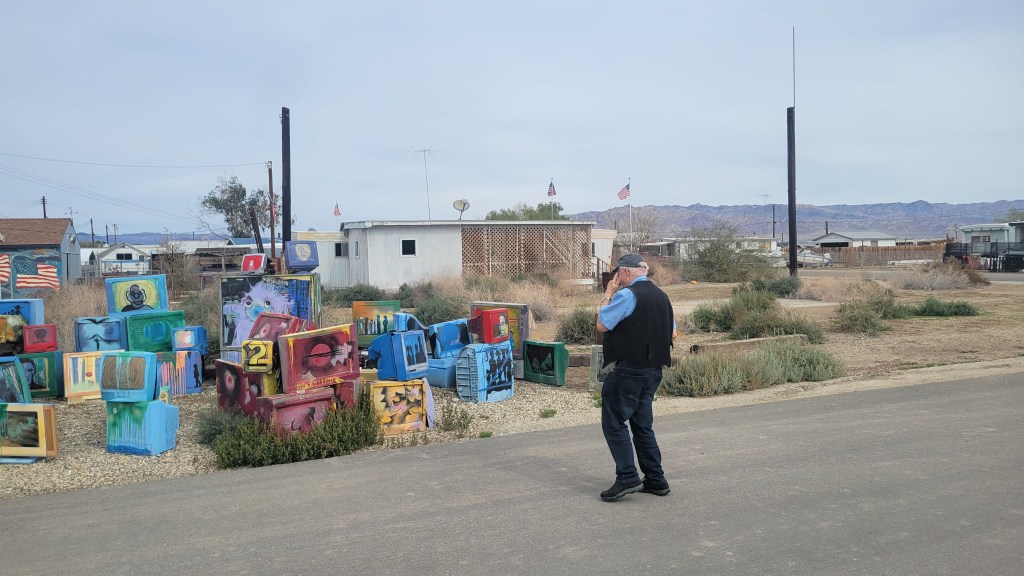
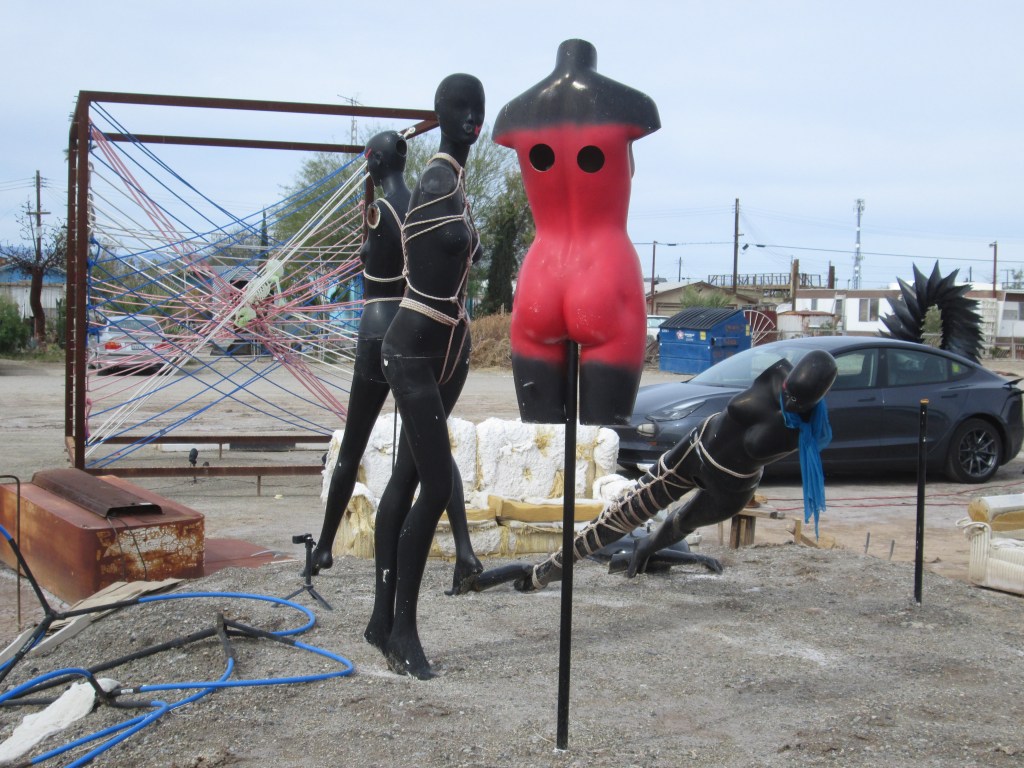
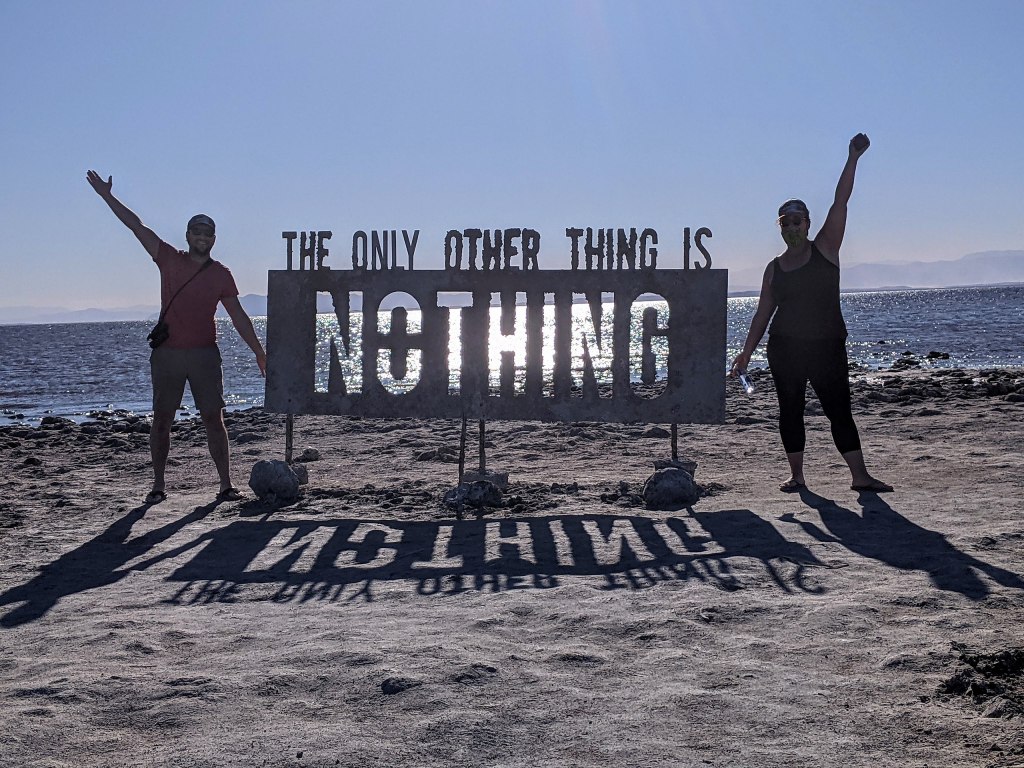
Somewhere in Slab City there is a 30-acre (12-hectare) area dedicated to large scale art installations and going under the name of East Jesus. There is no knowing where East Jesus begins and Slab City ends: Boundaries are not a big thing here. There seems to be more of a structure to EJ as it is run by a 501c3 Nonprofit Organization called the Chasterus Foundation.
East Jesus is an experimental, sustainable, habitable art installation started by Charlie Russel in 2006. East Jesus is a sprawling 30 acre museum dedicated to large-scale art. We charge no admission and rely solely upon small donations that fund our mission to preserve, protect, and continue the work of Charlie Russell. Our artist residency program gives up to a dozen low-income artists at time the space, tools, and supplies to create permanent large scale works using reclaimed materials. A member of the California Association of Museums and the only registered art museum in Imperial County, we welcome thousands of guests per week to see the possibilities of a world without waste where every action has the potential for self expression.
In 2014, we formed the Chasterus Foundation, a 501c3 nonprofit; in 2016 we purchased our land from the state of California with the intent to keep Charlie’s dream alive and to inspire others to see a life for their waste beyond the landfill.
Together, the inhabitants of East Jesus and offsite members provide a refuge for artists, musicians, survivalists, writers, scientists, laymen and other wandering geniuses.
We are dedicated to providing a working model of an improbable improvised community at the edge of the world. We are most interested in low-tech solutions, unresolved theories, non-linear advancement, and creative reuse.
We strive to document the results of these endeavors, sometimes simply by their existence. Our documents are sometimes nails, concrete, and sweat. We are partially an exhibition space for those problematic projects taking up your warehouse space, partially a build space for those problematic projects taking up the desert.
One of our guiding philosophies is “do as thou wilt”; another is “do no harm”.
What intrigued me about the organization’s website was a page called “East Jesus Survival Guide” in which we find the following tidbits:
By visiting East Jesus, you do so AT YOUR OWN RISK and assume all liability for any property damage, injury, illness, or death that occurs. By setting foot here, you and your heirs release all claims into perpetuity.
-0.5) WITH AN EVER-INCREASING NUMBER OF VISITORS, the expense of keeping shop is growing. If you ask to come camp out for a night or two, we ask that you please give us a CASH donation (or paypal, or venmo.) This helps pay for the peat moss, water, food, and helps defray the cost of all the little things you probably take for granted, like wireless internet, One Jillion Megawatts of power in the middle of fucking nowhere, and that spoon of mine you forgot to return that one time. Buying a t-shirt is so last year, but there are still a few I need to unload. $20 each. But don’t forget to stick some cash in the donation box or help out while you’re here. We are watching. Bringing a warm beer or some piece of rusty iron covered with dog shit you found in the desert and thought was “cool” does not exempt you from this.
0) RULE ZERO IS: DO NOT PISS US OFF. Any questions? Refer to Rule Zero.
0.5) PACK IT IN, PACK IT OUT / LEAVE NO TRACE. Be prepared to take everything you brought back out with you. The surrounding area, where you may be camping, is pretty trashy, but this does not magically give you permission to leave more trash. In fact, I expect you to leave your campground a tad neater and cleaner than you found it. Don’t leave plastic bottles and tampons in the fire pits, kids. Hell, do you live in a county with comprehensive recycling? Consider taking some souvenir trash home with you!
I don’t think I would survive long in East Jesus. If it isn’t the desert heat, it is having to rub shoulders with people who are at the frayed edge of acceptability.
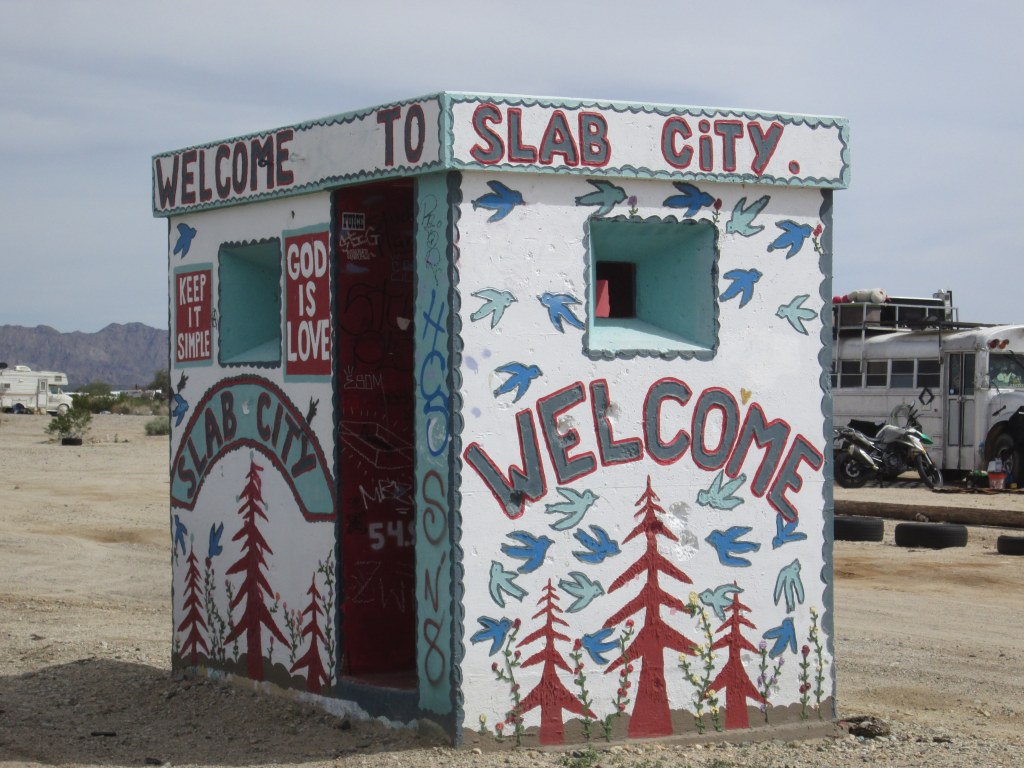
Bombay Beach was only an appetizer. For real off-the-grid living, there’s no place like Slab City, several miles inland from Niland, California, along a fast deteriorating paved road.
Once upon a time, this used to be the Marine Corps’ Camp Dunlap, used for artillery training during World War Two and also as a bombing range for planes flying out of Marine Corps Air Station El Centro. Around 1950, the USMC started closing up shop. They took away all the buildings and tents, leaving only the slabs. Due to an interesting legal error, which I will discuss in tomorrow’s post, the area was left open for whoever wanted to squat on the premises.
It didn’t take long before the squatters starting showing up. Billing itself as “the last free place,” Slab City started taking off in the 1980s after articles in trailer and Recreational Vehicle (RV) magazines wrote articles featuring it.
Do You See Any Power Lines? Nope
Unlike Bombay Beach, the subject of yesterday’s post, there is neither running water nor electrical power nor trash pickup in Slab City. I imagine that water has to be trucked in from elsewhere in Imperial County. As for power, there are a lot of solar panels and probably not many air conditioners. During the summer, the mean daily maximum temperature is between 102° and 107° Fahrenheit (39° and 42° Celsius). Being in the middle of the desert, the precipitation is mostly nonexistent, and the wind can be wicked, bringing with it chemicals from the polluted Salton Sea shore.
On the other hand, there is no cost to live in Slab City. In addition to about 150 year-round residents, during the winter months thousands of snowbirds from around the US. and Canada park their RVs in an empty spot along the road and prepare to enjoy a life of doing not much.
Apparently there is a nearby hot spring where people can bathe and even shower. As Slab City is situated along the San Andreas fault, one can count on a number of natural hot springs along its length. (And one can also count on earthquakes from time to time.)
For an interesting picture of what it is like to visit Slab City, check out the Wiki Voyage page. And don’t forget to drink lots and lots of water.
You cannot find a more low-down community in the United States. Literally. That’s because the unincorporated town of Bombay Beach is 223 feet (68 meters) below sea level. It used to be larger, but each successive census has shown a drop in population, in 2020 down to 231. And that number is a little dicey because of the large number of snowbirds who winter there.
In 1999, Huell Howser did an episode of his show “Visiting” in a Bombay Beach which is hardly recognizable today. Back then most of the residents appeared to be senior citizens. At some point since then, the hipsters moved in, and the whole place became something of an art installation.
As such, it’s a fun place to visit. My bother and I spent a couple hours there last Saturday.
Art Installation in Bombay Beach
The beach itself is no beauty. At times, the town of Bombay Beach floods when the sea, which has no outlet, rises in an unusually wet year. Part of the town is now isolated from the beach by a protective berm. In any case, the sea frequently smells bad because of all the fish die-offs. In fact, the Huell Howser video shows him walking noisily on the bones of dead fish that line the shore.
Art Along the Beach
Many of the current residents of the town are living off the grid, using solar panels to provide electricity. There is water service provided by the Coachella Valley Water District. I rather doubt that sewage is piped out of town, as the next populated place is Niland, California, some 18 miles (29 kilometers) south. There is no gas station in town, and only one bar/restaurant and possibly one convenience store.
Beginning tomorrow, we will visit a place that is really off the grid.
When I was still in college trying to decide where I would go to graduate school, I kept studying maps of California because it looked like I would attend UCLA (which I did). The one thing that arrested my attention was that Southern California had a sea entirely within the state. It was called the Salton Sea, and it did not seem to have any major population centers along its banks. Why, I wondered.
It seems that the Salton Sea was created by accident in 1905-1906 when the Colorado River was diverted to flow into a low-lying basin that had been dry since the late 16th century. For a while, particularly in the 1950s and 1960s, it was a major tourist draw—but not in the summer, when the temperature frequently exceeded 120° Fahrenheit (49° Celsius). Hollywood stars swam and boated in the waters, and there were a number of resort towns along the banks.
During the 1970s, the Sea’s increasing salinity and pollution resulted in large-scale fish and bird deaths; and, suddenly, the Salton Sea was deemed an environmental disaster. Plus, it was shrinking due to evaporation. The roads to the north ran through land that was white with salt. People started to remember that the San Andreas Fault ran right through the middle.
Last Saturday, my brother and I drove along the eastern shore of the Sea to view a stark landscape that was staging a weird comeback, first as a major lithium extraction site, and secondly as a magnet for people who wanted to live off the grid.
For the next several days, I will be posting blogs in a series I call “Off the Grid,” about our visit to the rogue communities of Bombay Beach, Slab City, Salvation Mountain, and East Jesus. None of them are incorporated cities, but all are alive with a kind of ferment that lends them a certain glow.







 Tarnmoor
You must be logged in to post a comment.