The Dalai Lama and I

Tenzin Gyatso, the 14th Dalai Lama

I first posted this on January 22, 2021.

The circumstances behind my seeing the Dalai Lama in April 1991 are indelibly etched in my memory. I arranged to first meet my friend George Hoole at his girlfriend’s apartment in Santa Maria, and then we would both go to the University of California at Santa Barbara to see the Dalai Lama give a speech.

I had only been driving for six years at the time, and I did something that killed the engine on my 1985 Mitsubishi Montero. Instead of staying on U.S. 101, I decided to take San Marcos Pass to Solvang, where I would have lunch before making my way back to the 101. Unfortunately, I drove up the pass in second gear. By the time I got to the top of the pass, my engine was a smoking ruin. I arranged to have the car towed back to Santa Monica Mitsubishi for repair, which was no easy thing as ’85 Monteros with automatic transmissions were a rarity.

George came to pick me up in Solvang and I was his passenger for the weekend. We heard the Dalai Lama give a great talk in his broken English … and this turned out to be the beginning of a difficult period for me. I teamed up with George to start a new company called Desktop Marketing Corporation, along with several of my co-workers from Urban Decision Systems, where I had been working since 1971.

It never took off, and I had to live on my savings for over a year, Ultimately, I left Desktop Marketing and managed to get a job in a Westwood accountancy firm called Lewis, Joffe & Company. Plus I had to shell out several thousand dollars for a new Montero engine.

Things don’t always tend to go your way. The early 1990s were a time of career change and retrenchment for me. But I never regret seeing the Dalai Lama in person. There is perhaps no religious figure I respected more, not even Pope John Paul II. There was something about the twinkle in his eyes which helped see me through a difficult period in my life.

I’d see him again if I could, but I would definitely avoid San Marcos Pass.
Road Trip

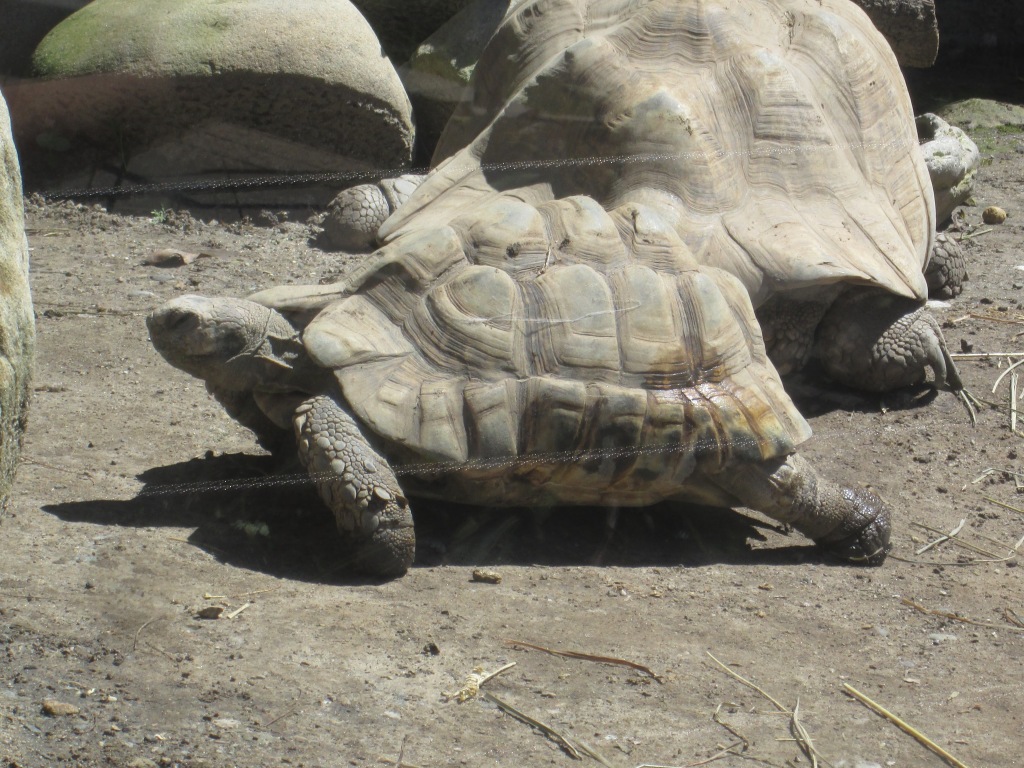
Tortoise at the Santa Barbara Zoo

Because of all the rain we’ve been having, Martine and I haven’t gone on any road trips lately. Today, we drove to Santa Barbara, had a great seafood lunch, and went to the Santa Barbara Zoo. Unlike the Los Angeles Zoo, there are usually fewer than 10,000 visitors present; and consequently there is about 76% less chance of having an infant stroller destroy your ankles.

Mind you, there were many small children in attendance. But that is to be expected at any zoo. It’s one of the few places one can take one’s small progeny and allow them to act like kids without inflicting too much damage to the animals and other visitors.

We’ve been visiting the Santa Barbara Zoo for upwards of twenty years, so we were saddened to hear that the two Asian elephants, Sujatha and Little Mac, died in 2019; and the zoo is not planning to replace them. Instead, their large compound is now an Australian “walkabout.”

On the way back, we took the pleasant and very rural California 126 to avoid the usual traffic jam around Oxnard and Ventura. We stopped at Francisco’s Fruit Stand in Fillmore to buy some honey, strawberries, and mandarins. I was shocked to find that taking 126 and I-405 in Santa Clarita takes no more time and eats up no more miles than taking either the Pacific Coast Highway to U.S. 101 or taking U.S. 101 all the way.

Unfortunately, Martine was in considerable pain from a pinched nerve in the back that has been bothering her for several years and getting progressively worse. Unless she finds a way of ameliorating her condition, we may not be able to go on many more trips together.

Hit the Road, Jack!

After our recent trip to Vegas, I am thinking of provoking the Covid-19 demons with another road trip. It’s fun to travel, and my predilection for wanderlust has been seriously subdued by the pandemic.

I don’t think I can get Martine interested in another desert destination—even though she liked the Vegas trip—but there are other less arid possibilities like Catalina, San Diego, Santa Barbara, or the Santa Ynez Valley and Solvang. I’ll just have to put my thinking cap on.

Actually, there is one desert trip that Martine likes, which we have taken twice: Up U.S. 395 along the Eastern Sierras and the Owens Valley. To see what a rich target this is, check out this California Through My Lens website.

Mission Creep

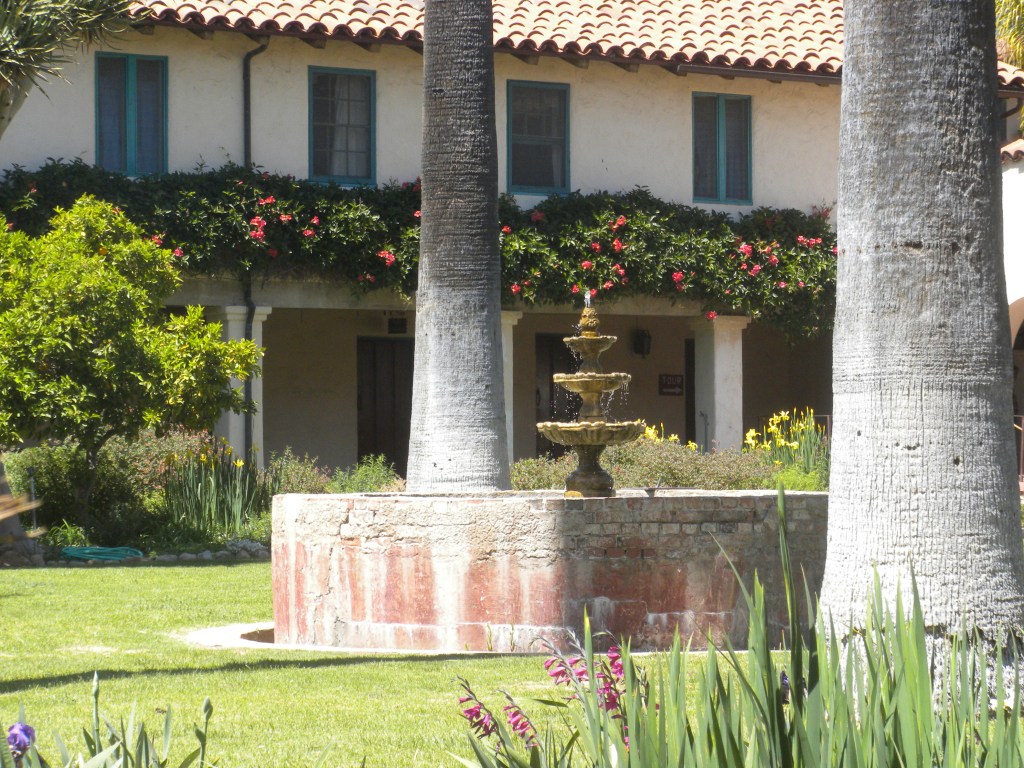
Mission Santa Barbara

California has given birth to many beautiful myths. Unfortunately, they frequently have little bearing on the actual history of the Golden State. For instance, the twenty-one Franciscan missions founded by Father Junipero Serra—who has been canonized a saint by Pope Francis in 2015—are among the most peaceful places I have ever visited. Yet they were little more than rural concentration camps in which thousands of Californian Indians found their way to early graves.

If you look at a map of the mission location, you will find that they are all strung out like so many pearls along the Camino Réal closely following the coastline. Indians who dwelt close to the coast were rounded up and assigned as peons to the various missions, where they were worked to death. During the heyday of the missions from 1769 to 1834, some 53,600 adult Indians were baptized, and 37,000 were buried.

The Graveyard of the Santa Barbara Mission

Visiting the Santa Barbara and Santa Ynez missions, I was stunned to find that the postage-stamp-sized cemeteries adjoining the missions held 3,936 and 1,227 bodies respectively. Why is this? The Indians attached to the missions (they were not allowed to leave) were essentially overworked and underfed. When they lived in the missions, the Indians lived in permanent adobe structures that were infested with fleas. Young Indian maidens were treated as nuns and confined to barracks in which the rooms were 50 feet long by 21 feet wide with bunks ranged around the walls. A single high window provided the only ventilation, while the center of the room was an improvised sewer or latrine.

According to Carey McWilliams in Southern California Country: An Island on the Land:

To understand what conversion meant to the Indian, it should be remembered that the process of Missionization necessitated a sudden transition from the settled, customary existence of the Indian in a small rancheria or village to the almost urban conditions that prevailed in the larger Mission establishments. The change … must have come as a deep mental shock to the Indian.

As much as I respect much of Catholic teaching from my long education in religious elementary and high schools, I cannot condone many practices of the past, such as the Inquisition and the treatment of native peoples in the missions.

RIP Sujatha and Little Mac

Sujatha and Little Mac Together (Which Is Which?) in 2013

In yesterday’s post, I wondered what happened to the elephants at the Santa Barbara Zoo. When we got home yesterday, I looked them up on Google and found that both had died, Sujatha in 2018 and Little Mac in 2019. Although I have no pets, I have felt a sense of loss for these two Indian elephants who had been together at the zoo since 1972. You can read more about them in this article from Radio Station KSBY’s website.

Apparently, despite their size, Indian elephants do not normally live as long as humans. In fact, after 40 years they are considered to be due for geriatric care. Little Mac had to be euthanized at the age of 48.

My relationship with the animals at the Santa Barbara Zoo surprises even me. It is a small zoo, walkable in a couple of scant hours, but I feel more strongly about the birds and animals there. Why?

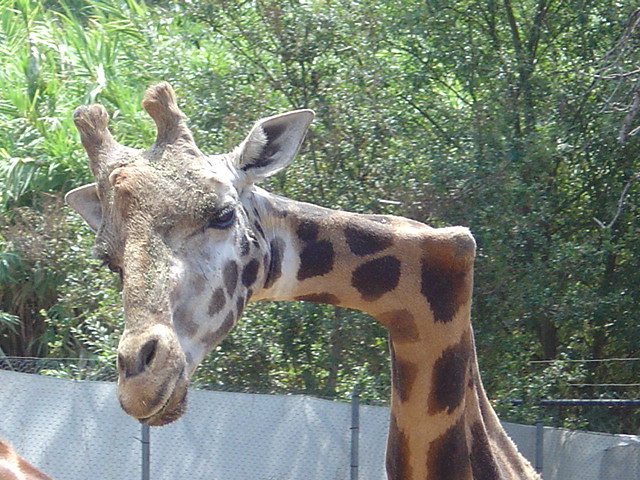
Gemina, the Giraffe with the Deformed Neck

I had become enamored of a giraffe named Gemina who died of natural causes in 2008 despite a neck that went off at a ninety degree angle. Despite her neck, Gemina lived a greater than normal lifespan (by six years) and had normal offspring. When I heard that Gemina had passed on, I was disturbed, hoping that she did not die in inordinate pain occasioned by her disability. Apparently she didn’t. She received excellent care at the zoo and was widely mourned.

So now that the elephants are gone, their home will be turned into the “Australian Walkabout” some time this summer. I will continue to return to the zoo whenever I can so that I can see my other friends there.

In Cloudy Santa Barbara

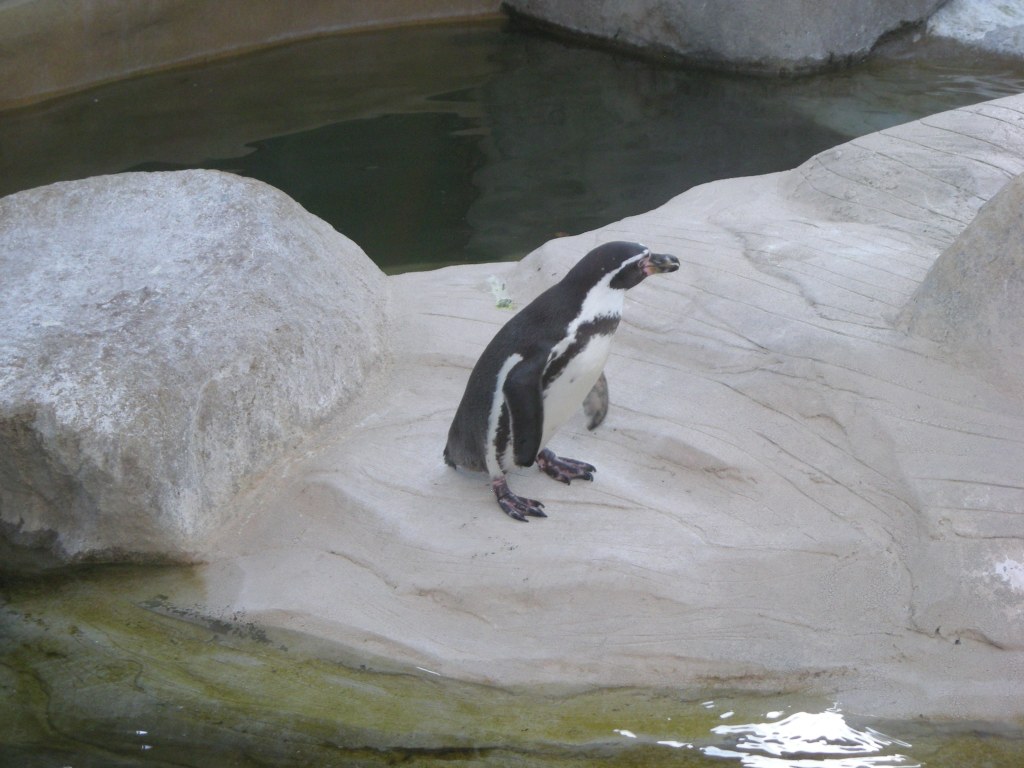
Humboldt Penguin at the Santa Barbara Zoo

Today Martine and I set out for the Santa Barbara Zoo, which is open for prepaid admissions. The Spring marine layer was in force, with heavy clouds and some drizzle between Ventura and Santa Barbara. It had stopped by the time we got to the zoo, so we were hopeful. We had a nice time despite the absence of the elephants (which were being replaced by an “Australian Walkabout” of some sort.) Also, the aviaries and some of the indoor exhibits were closed down “because of the virus.” Also, many other animals were either missing or hiding from view.

I suppose I could understand this. If I were in a cage at the zoo, I would not be too terribly interested in gaping at the teams of children and their harried parents. So I would probably present them with my hindquarters, like the above Humboldt Penguin. (Curiously enough, these Penguins come from near the Equator off the coast of Peru—not Antarctica.)

One animal which had no problem facing down the staring zoo visitors was the African lion:

We were done in about an hour, but satisfied by our walk in the cool, cloudy weather. Zoos are never perfect, but the small Santa Barbara Zoo is better than most. The LA Zoo is characterized by massive traffic jams and stroller collisions with adult ankles.

After the zoo, we drove down to the harbor and had lunch at Brophy Brothers, one of our favorite seafood restaurants in Southern California. Their New England clam chowder is to die for, and I also enjoyed the grilled mahi mahi sandwich.

By the time we were headed back home, the sun came out around Ventura and stuck around for the rest of the afternoon. In celebration, we drove home on the relatively uncrowded California 126 and stopped for strawberries the size of clenched fists at Francisco’s Fruit Stand in Fillmore. Also I picked up some yummy dried mangos and Banderita Mexican cocoanut candy.

It was a fun day, probably the most fun we had together since the onset of the plague in March 2020.

Tropical Penguins

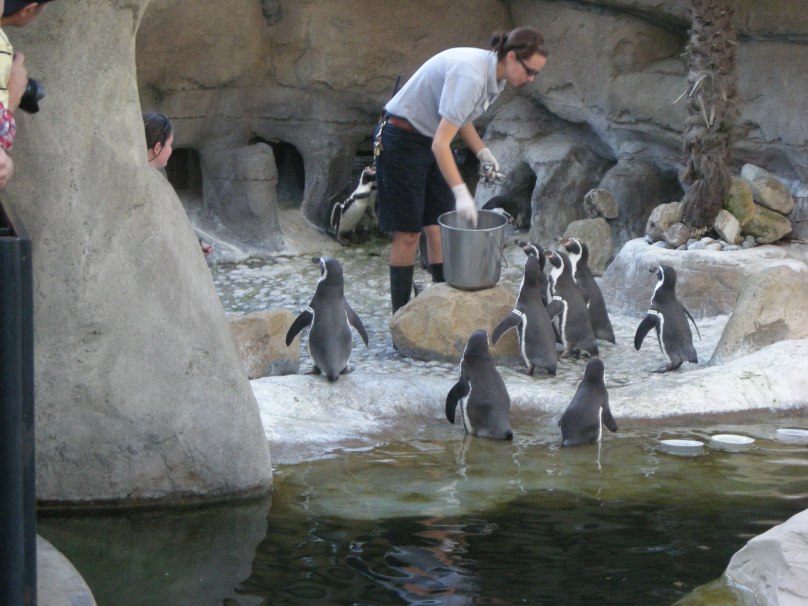
Feeding Time for the Humboldt Penguins at the Santa Barbara Zoo

I am looking back to a visit Martine and I made to the Santa Barbara Zoo some ten years ago this month. At the time, penguins interested me more and more. In 2006, I had seen some Magellanic penguins at Isla Pájaros on the Beagle Channel in Argentina’s State of Tierra Del Fuego.

In 2010, I had hopes of talking Martine into coming with me to Argentina in 2011 (which she did) and seeing the penguins at Pájaros and Punta del Tombo in the State of Chubut.

The penguins at the Santa Barbara Zoo are similar to the Magellanic penguins of Argentina, but they inhabit warmer country, namely the coastal regions of Northern Chile (site of the Atacama Desert) and Peru.

Lone Humboldt Penguin

I have always regarded the penguins at the Santa Barbara Zoo as my favorite exhibit. Clumsy on land, the Humboldts swim with speed, fury, and precision. (For that reason, they are much harder to photograph when they’re in the water.)

Flamingo Road

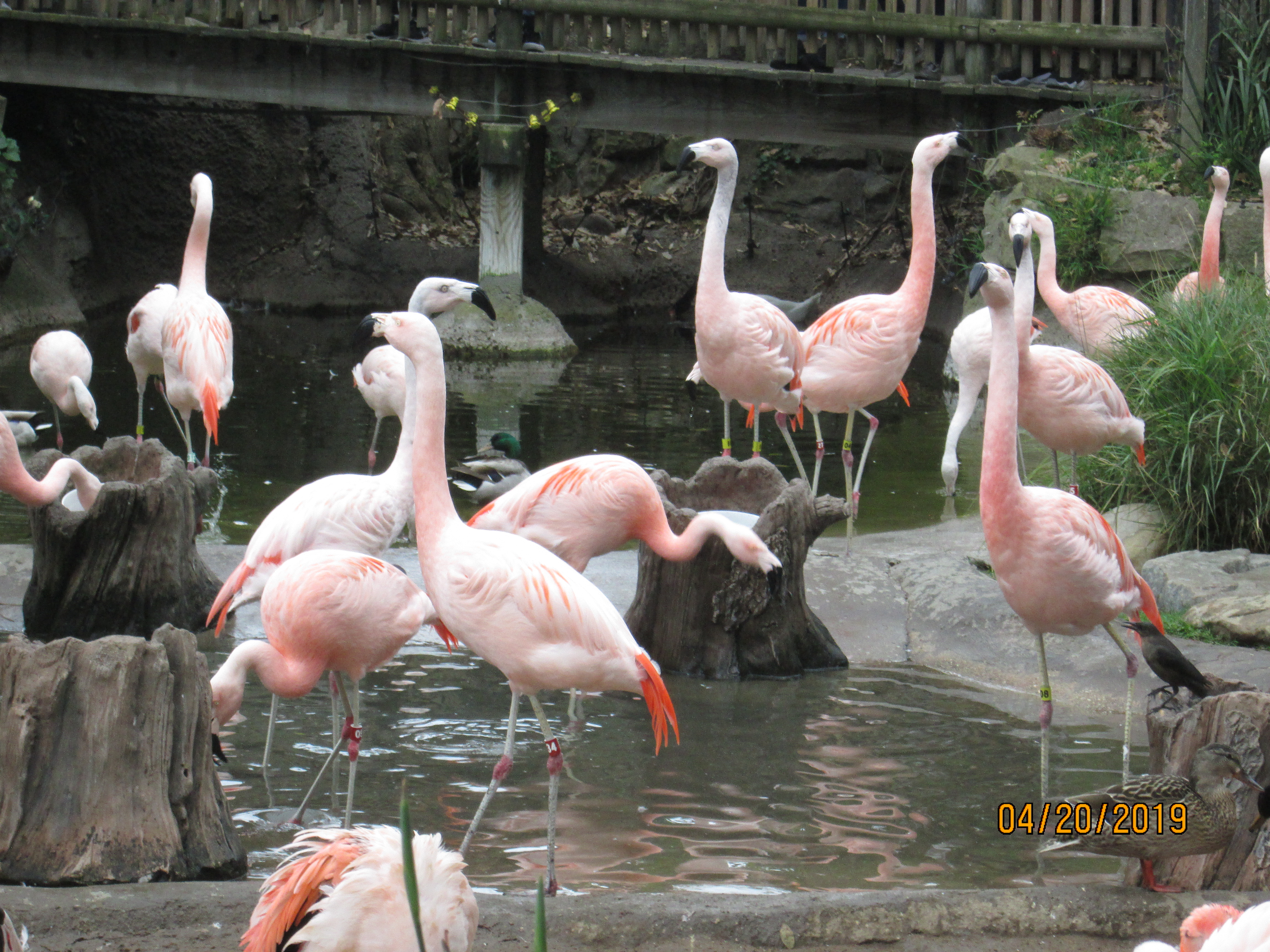
Chilean Flamingos at the Santa Barbara Zoo

On Saturday, Martine and I drove to Santa Barbara for a fish and chips lunch at the Harbor and a visit to the local zoo. Los Angeles has a bigger zoo, but it’s too big, too crowded—and it’s difficult to get buy without multiple stroller collision injuries. They’re always doing construction and forcing large numbers of visitors down narrow pathways, ending up with massive foot traffic jams.

As I mentioned in yesterday’s post, there are two smaller museums that I love: The Living Desert in the Coachella Valley and the Santa Barbara Zoo.

Like all zoos, it is impossible to see all the animals because:

  • Some of them have been withdrawn for various reasons
  • Others prefer to be in hiding, escaping the prying eyes of the gawkers

No matter, I got an eyeful of what I wanted to see, especially Chadwick the African lion, who is usually in the latter category, except that he is visible from the little train ride that circles the 32 acres of the zoo. Plus we saw the elephants, the gibbons, the Humboldt penguins, the giraffes (who have a much harder time of it if they wanted to hide). Oh yes, we also saw (and smelled) the Chilean Flamingos.

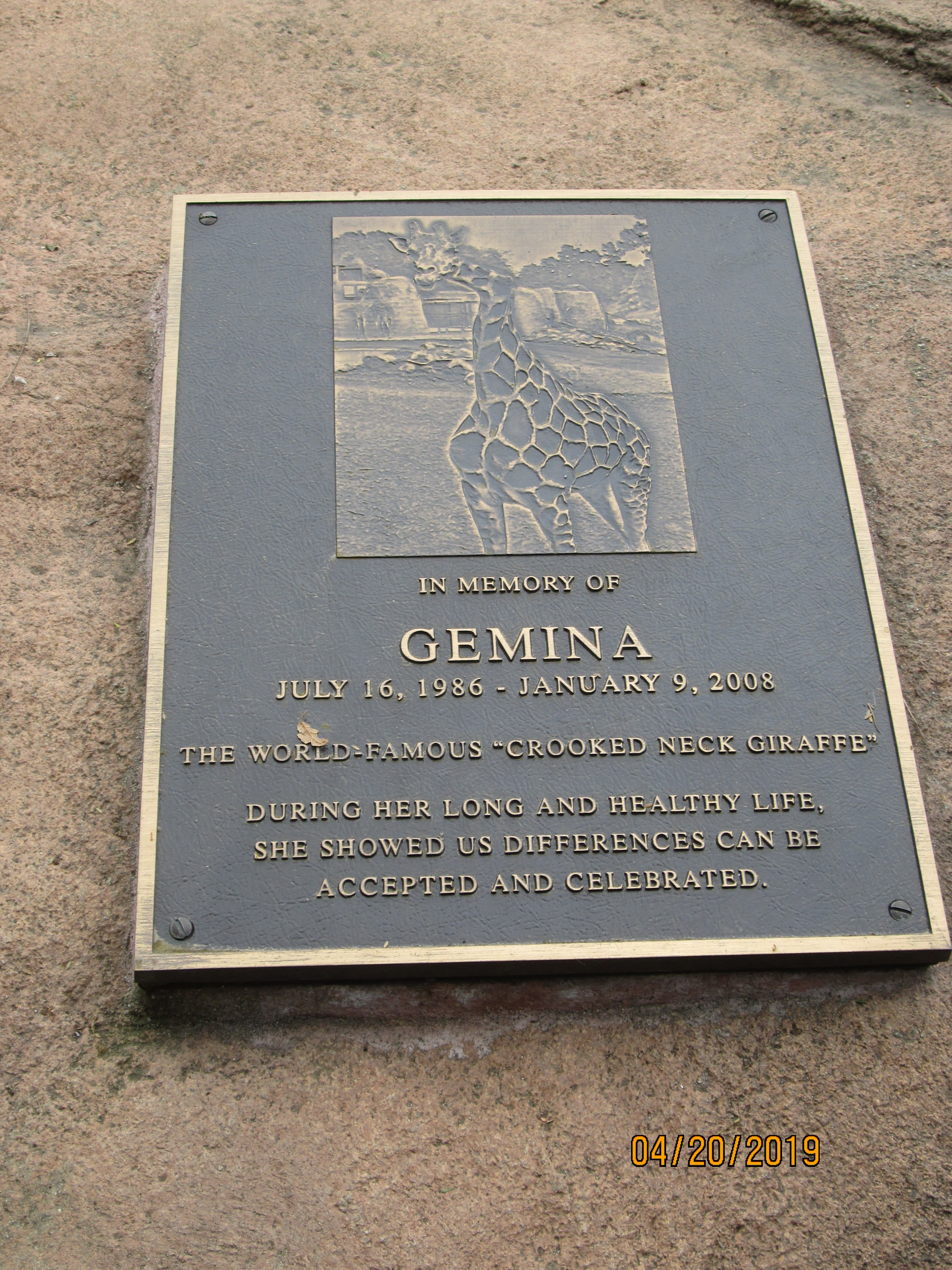
Bronze Plaque Honoring Gemina the Crooked Neck Giraffe

There is even a nice bronze plaque commemorating Gemina, the zoo’s late “crooked neck giraffe,” who died in 2008. I remember seeing her, with her neck that took off at a 90 degree angle midway up. It looked incredibly painful; but Gemina had a longer than normal life and was attractive enough to at least one male giraffe who made her a successful mother with healthy issue. One of these days, I’ll try to find one of my pictures of Gemina. I know I took several on former trips to the zoo.


At the Santa Barbara Zoo and Mission

Meerkat on Guard at the Santa Barbara Zoo

Today I rented a car to take Martine and me to Santa Barbara. My 1994 Nissan Pathfinder has a brake warning light and ABS warning light, requiring me to take it into the shop on Monday. (Even without the warning lights, I would have rented a car. It would be far cheaper than towing the Nissan great distances.)

It doesn’t take long to “do” the SB Zoo, which at 30 acres merits about two hours, more if you want to sit down and take in the atmosphere. It is only a few hundred yards from Cabrillo Beach, which makes it all the better. And today was a relatively cool day.

After the zoo, we had some extra time, so we revisited the Santa Barbara Mission—founded in 1789 by Padre Fermín Lasuén, who took over the entire chain of twenty-one missions for Padre Junípero Serra after the latter’s death. I know that the Spanish missions were involved in the suppression of the local Indian tribes, yet remain as so many islands of peace dotting the California landscape.

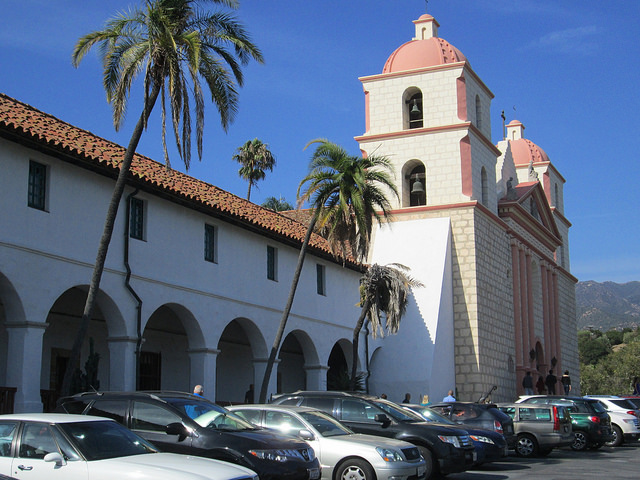
The Santa Barbara Franciscan Mission

As we were touring the mission’s museum, one of the old Franciscan padres introduced himself to us. He looked frail, probably in his eighties, but was friendly. We toured the old church and the adjoining small cemetery as well. According to a sign in the cemetery, there are some 800 Chumash Indians buried there, not to mention the Spanish conquistadors and subsequent American settlers and their families.

On the way home, we decided to skip the coastal route (there was serious construction on Route 1 in Santa Monica) and the even more crowded U.S. 101 in favor of Route 126 through Santa Paula and Fillmore. It added perhaps ten miles to our trip, but it was more restful driving through all that farm country. Plus, we stopped at Cornejo’s fruit stand near Fillmore to buy some white peaches and plums.

Gemina

Gemina, the Giraffe With the Crooked Neck

Tomorrow, I will take Martine to one of our favorite places, the Santa Barbara Zoo. Martine will probably leave me at some point in the next two or three weeks, so I want to spend some of that time revisiting places we love.

Although Los Angeles has a bigger zoo, it is so crowded and so constricted by constant construction that visitors have a hard time negotiating the paths without getting run over by harassed parents pushing strollers. As their website says, the SB Zoo has 500 animals and only 30 acres. That’s just about our speed, and tomorrow promises to be a nice day.

The most remarkable animal we have seen at the Zoo is the late Gemina, the giraffe with the crooked neck. The following long quote is a release from the zoo that I thought I’d like to pass on to you:

If you visited the Zoo between 1990 and 2008, you probably saw an unusual giraffe. Her name was Gemina and she had a crook in her neck.

Born at the San Diego Wild Animal Park (now San Diego Safari Park) in 1986, Gemina was a Baringo (or Rothschild’s) giraffe, and joined the Santa Barbara Zoo’s giraffe herd when she was just about a year old.

Her neck seemed normal until a bump appeared when she was around three years old. Slowly, over time, it sharpened into a distinctive “V”, which interrupted the graceful curve of her neck.

Though she was examined by veterinarians, a cause for the crook could not be determined. The good news? In spite of her appearance, she didn’t exhibit any signs of being in pain.

In fact, the crook didn’t hamper Gemina’s life at the Zoo. She received normal treatment by zookeepers, ate normally, gave birth to a calf, and was an accepted member of the Zoo’s giraffe herd. She was beloved by our guests, locals and visitors alike.

Long before I came to work here as the Zoo’s publicist, management had decided not to sensationalize Gemina. We could have emblazoned her image on t-shirts and made banners with her silhouette, but that’s not our style. She was a member of the giraffe herd, and not to be exploited. We responded to media requests, but didn’t push out the story.

But Gemina became an icon in spite of our low-key approach. In its second season (2004), “The Bachelor” filmed a sunset dinner at the giraffe exhibit, and the couple met Gemina. In the 2005 television show “Miracle Workers,” she was the source of inspiration for a young boy with severe scoliosis. In 2007, she was voted Number One of the “Seven Wonders of Santa Barbara” in a local radio station poll.

Martine at the Santa Barbara Zoo in 2007 … in Happier Times

By then, she was 20 years old, which is elderly for a giraffe in captivity. We threw a party for her 21st birthday, knowing that her time was nearing an end. Many of us had tears in our eyes when Zoo Campers, wearing self-made giraffe hats, sang “Happy Birthday.”

She lived another five months, before she stopped eating and her health declined. Gemina was humanely euthanized on January 9, 2008. It was a sad day at the Zoo.

But her memory lives on. Gemina is still the most asked-about animal at the Zoo, even eight years later. A children’s book, “Gemina the Crooked-Neck Giraffe,” written and illustrated by Karen B. Winnick, was released in 2013, and is still for sale in the Zoo Gift Store (all proceeds benefit the Zoo).

Now, her fans can again visit Gemina. Her distinctive top six vertebrae, skull, and jawbone have been preserved and rearticulated, and are now on view in a display case as part of the Zoo’s “Animals…Inside Out” art exhibit in the Discovery Pavilion’s Volentine Gallery.

It’s free, with admission, to view Gemina and the exhibit of cool animal x-rays. Gemina’s skeleton is on view 10 a.m. to 3 p.m. weekdays, and 9:30 a.m. to 4:30 p.m. on weekends.

Thanks goes to Skulls Unlimited for her skeletal work, and to TruPart, a Ventura company, for building the display case free of charge.

Gemina reminds us all that being different is just fine. She’s a reminder to me not to blithely feed the media’s appetite for the odd and outrageous. That we can tell a quieter story, about being accepted in a herd of your peers and loved by a generation of visitors. That one giraffe can still stand tall, even with a crooked neck.