Islands of Peace

The Church at Mission Santa Barbara

The Church at Mission Santa Barbara with Martine in the Foreground

The California Missions are probably the state’s best claim to a rich history going back to the eighteenth and nineteenth centuries. I find it nothing less than amazing that most if not all of Franciscan Father Junipero Serra’s missions are still in existence, after all the earthquakes, fires, and other disasters to which California is prone.

Mission Santa Barbara is one of four missions dedicated to converting and regimenting the Chumash Indians of the area (the others are La Purisima in Lompoc, Santa Ynez in Solvang, and San Buenaventura in Ventura). Although Father Serra was declared beatified by Pope John Paul II in 1988, there are still unresolved issues regarding mistreatment of the Indians. Each of the missions also contained Spanish military barracks for troops enforcing the political dictates of the Spanish Viceroys. So it is not uncommon to find stories where the Indians were both helped and repressed by the Missions and their dual religious and political functions.

Chumash Painting of St. Francis

Chumash Painting of St. Francis

Whatever really happened at these missions, today they are, collectively, a cultural treasure—islands of peace dotted along the California coast from San Diego to San Francisco Solano in Sonoma. I have visited perhaps ten of them so far and hope to see the rest of them eventually.

Martine and I visited Mission Santa Barbara (for the third or fourth time) on Saturday during our recent trip to the area.


Native Greenery

A Trail Through the Santa Barbara Botanic Garden

A Trail Through the Santa Barbara Botanic Garden

It’s remarkable how many of the plants we regard as being typical of California are actually imports. For instance, there is the jacaranda tree, which originally hails from Bolivia and Argentina, and the eucalyptus, an import from Australia.And it’s not only the trees, but also wildflowers, “weeds,” grasses, and other plants which came from elsewhere and spread like wildfire. Did you know, for instance, that the Tumblin’ Tumbleweed of song is actually called the Russian Thistle and comes from, you guessed it, the steppes of Eurasia.

On a hot Saturday last weekend, Martine and I took a circular trail through the Santa Barbara Botanic Garden, which is dedicated to preserving and promoting native California plants. We went through some forty ounces of cold Dasani water as we took every opportunity to sit down on shady benches and look around us.

We had tried to visit the Botanic Garden once before, but that was at the time of the Jesusita Fire of May 2009, which actually consumed part of the gardens. In fact, part of the gardens that were affected are shown in the photo above. In four years, the grasses and shrubbery bounced back quickly, though many of the tree trunks are scarred with burn marks.

The wilder parts of Southern California, such as the Botanic Gardens, which are in the foothills of the mountains around Santa Barbara, have a distinctive look and feel. They are not as “friendly” as Eastern forests. Mainly, that is because so many of the plants are somewhat prickly. In the spring at least, there is ample greenery everywhere; but once the fall months approach, much of it dries out and turns light brown until the next rainy season starts the whole cycle over again.

The road to the Botanic Gardens is tricky. You head uphill past the Santa Barbara Mission and take three or four roads to get to your destination. Fortunately, there are helpful directional signs along the way. Although the Gardens don’t get that many visitors, it is a worthwhile place to visit and good for soothing the soul of someone who has just survived a brutal tax season.


Penguin Feeding Time

Friday Afternoon Penguin Feeding

Friday Afternoon Penguin Feeding

I have always loved penguins. They are at one and the same time naive and well able to defend themselves with their razor-sharp beaks. The penguins on display at the Santa Barbara Zoo, which Martine and I visited last Friday, are Humboldt Penguins from around Peru, close to the Equator.

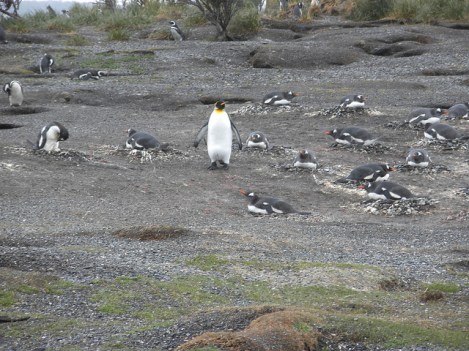
Never have I seen any emperor penguins, though I did see one disconsolate king penguin in Tierra Del Fuego in 2011 who got lost from his group and wound up with a colony of Magellanic and Gentoo Penguins on Isla Martillo in the Beagle Channel. (See picture below.)

Lost King Penguin in Argentina

Lost King Penguin in Argentina

That King Penguin was making a nuisance of himself by trying to mate with the smaller local penguins, who were having none of that particular type of miscegenation.

Why do Martine and I like the Santa Barbara Zoo instead of the much larger one at Griffith Park in Los Angeles? It seems that every time we go to the L.A. Zoo, they are undergoing major construction, forcing large crowds of people into narrow walkways past some upcoming future attraction. Until that future attraction arrives in the sweet by-and-by, we would be assailed by countless strollers wielded by desperate parents pushing their progeny through a surly mob. The future is nice, but I usually make my judgments based on the present.

There is some construction going on at the Santa Barbara Zoo, but it is small-scale compared to the pharaonic scale of L.A.

I’ve always loved zoos. We had a good time in November 2011 at the Buenos Aires Zoo, and I am toying with the idea of visiting the small Reykjavik Zoo in Iceland this June.

It was pretty hot the two days we were in Santa Barbara, but there are always a lot of shady benches for us to rest and re-hydrate ourselves.

I Get Scammed

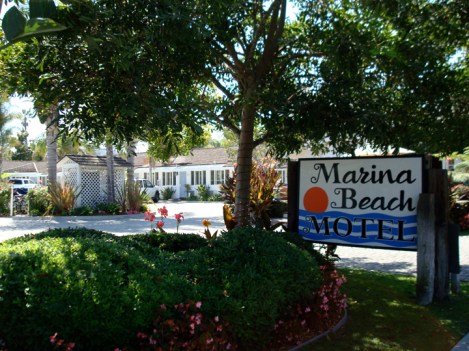
Doesn’t Look Like a Crime Scene, Does It?

Doesn’t Look Like a Crime Scene, Does It?

If I haven’t posted the last couple of days, it’s because Martine and I took the weekend off and drove to Santa Barbara. We were staying at the idyllic-looking Marina Beach Motel on Bath Street right near the coast in Santa Barbara. It was an ideal location, midway between the marina and Stearns Wharf with their seafood eateries.

Unfortunately, Martine is still not feeling up to par with the traveling pains around her back and shoulder blades (fibromyalgia?). She got tired quickly, and she wasn’t able to sleep comfortably on the king-sized bed in the motel because the mattress was too mushy for her. Also, she was still too exhausted to do much walking at the tourist attractions we visited, about which you will be hearing over the next few days.

More seriously, last night as I was dozing off in the motel room, I received a phone call purportedly from the front desk. It was one “Stacy Anderson” to tell me that the registration records for eighteen rooms in the motel had been lost because of a computer glitch, and would I dictate the relevant info to her over the phone? Because I was groggy and my critical faculties were not operating at par, I complied—including giving “Stacy” my credit card info.

As Bugs Bunny, would say, “Whatta maroon!” Just after I gave this info, I was given an 8-digit “confirmation number” (94184437) and told that I would get 40% off my bill for helping them out. It was at that point that I said the big “Uh oh!” and threw my clothes on.

Naturally, the night crew, who were sitting around sharing a pizza, had no idea of who “Stacy Anderson” was, nor had they called, nor was there anything wrong with their computer. I ran back to my room, picked up my cell phone, and called U.S. Bank to report a credit card fraud. Sure enough, they had already run up a $320 charge with Access Secure Deposits, which I denied having initiated. My credit card was promptly canceled, and I scissored it and distributed the pieces across a wide swath of Southern California.

If you are staying at a hotel or motel, you would do well to distrust any communications over the land line telephone in your room. If it is from the “front desk,” tello them you’ll be right there—and hang up! Don’t be a fool like me.